



I've seen teams where no one was a leader. Everyone thought they owned the same approval step. It led to missed deadlines and compliance trouble. The issue came down to unclear ownership.
With a clear hierarchy, tasks are defined, accountability improves, and compliance becomes stronger.
So, here, I'll explain the legal department organizational structure and how to visualize it.
In This Article
Common Legal Department Org Structure
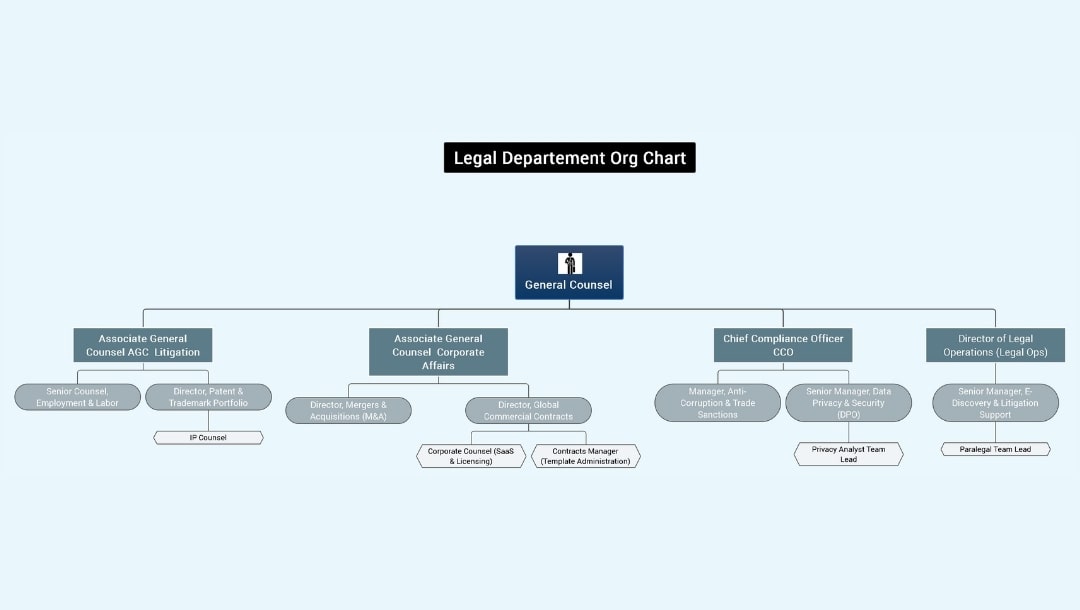


Most legal departments follow a pyramid-style structure. The head of the department supervises managers, and those managers lead teams of lawyers, paralegals, and support staff.
The number of layers changes with company size, but everyone reports upward to the department head.
Top-Level Roles
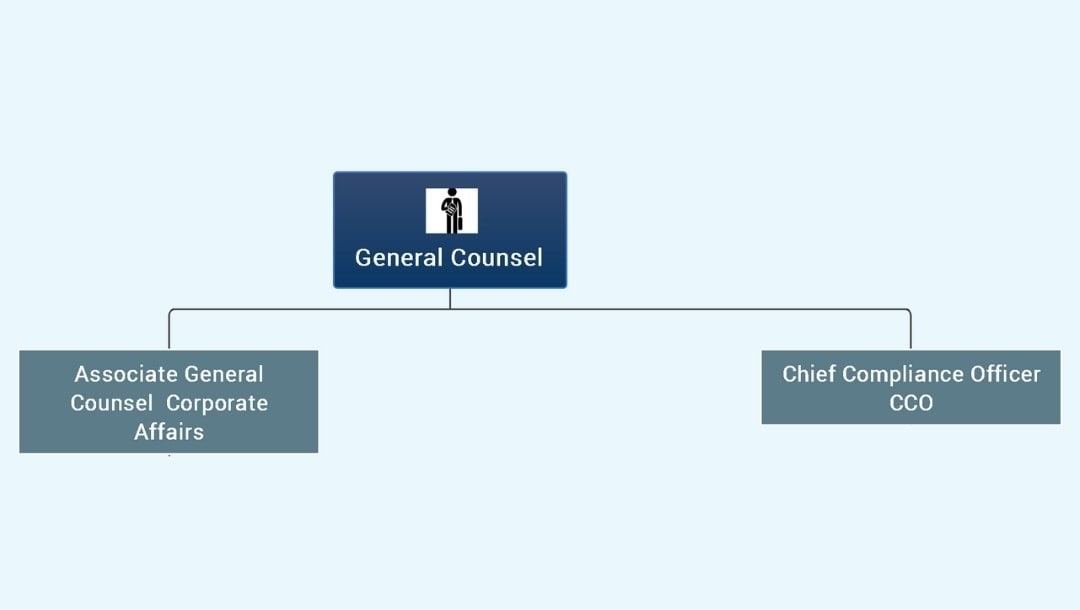
The General Counsel leads the legal team. They advise the CEO and the board on significant legal risks and liabilities. They develop the legal strategy and manage the department's budget. They also represent the company in high-stakes matters.
A Deputy General Counsel fills in when the GC is absent. Deputies often manage practice areas like litigation or compliance. Large firms may have several deputies, each owning a distinct legal function.
Some companies refer to the top legal officer as the Chief Legal Officer. The CLO role overlaps with GC. A CLO often handles broader duties such as corporate governance and regulatory affairs.
Mid-Level Management
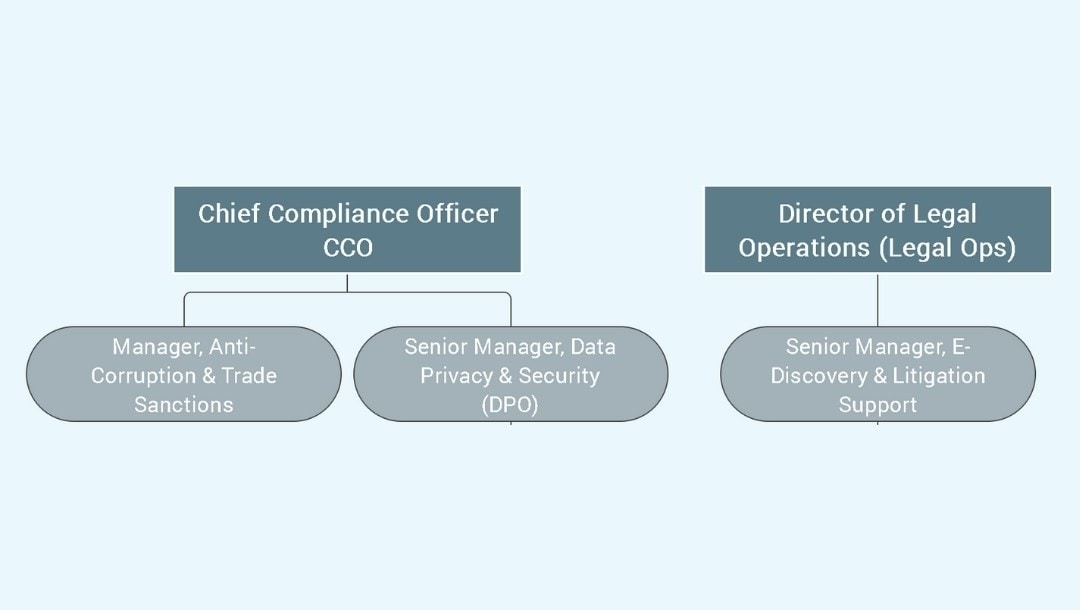
Senior Counsel handles core legal work in areas like IP, M&A, or employment law and often mentors junior counsel.
Legal Managers coordinate legal teams working in related fields. Their role includes case assignment, quality control, and deadline tracking. They report key updates to the Deputy GC or General Counsel.
The Compliance Manager helps keep operations within legal limits. They work closely with departments that handle regulatory matters, particularly in the energy, finance, and healthcare sectors.
Operational Level

Associate Counsel drafts contracts, does research, and supports litigation. They carry out much of the department's daily work under the supervision of Senior Counsel or managers.
Paralegals prepare documents, organize files, coordinate with outside counsel, and manage deadlines.
Legal Assistants handle meetings, renewal tracking, databases, and correspondence.
Contract Administrators manage the full lifecycle of contracts.
Legal Operations Specialists focus on process, vendor management, tech, and budgets.
Core Legal Functions
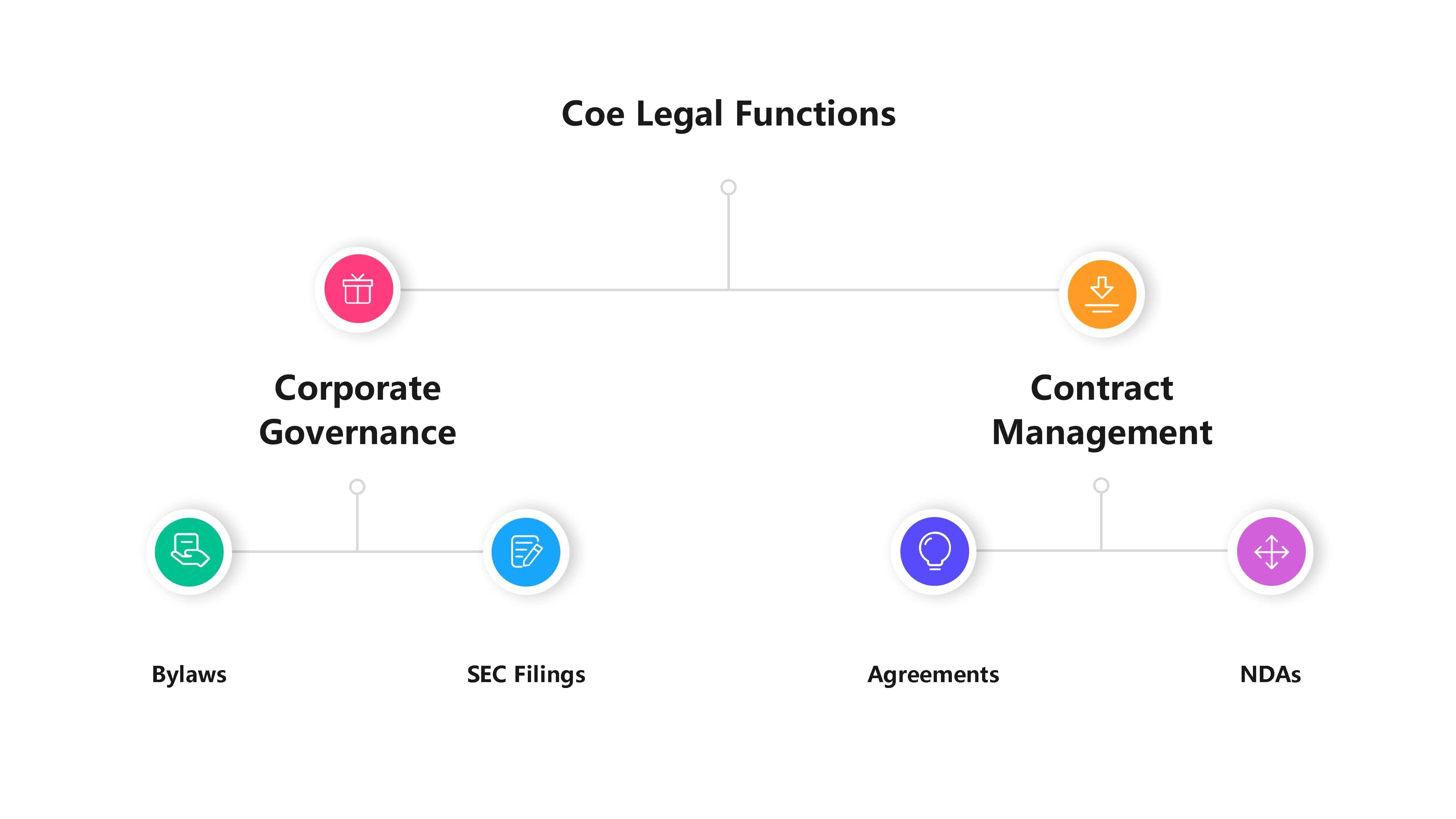
Legal teams divide work by specialty to avoid overlap and build expertise.
- Board meetings and shareholder votes belong to Corporate Governance. This group maintains by laws, manages stock records, and ensures the company follows its own rules. They also handle required SEC filings for public companies.
- Contract Management teams live in customer agreements, vendor deals, and NDAs. They review terms, push back on risky clauses, and track what renews when. I've seen these teams save companies millions by catching auto-renewal traps.
- The Litigation and Dispute Resolution department handles lawsuits and settlements. These attorneys handle pre-trial work, manage arbitration, and aim for settlement while staying ready for court.
- Compliance and Regulatory keeps the company legal. They file reports, communicate with agencies, and monitor legislative changes. In regulated industries like healthcare or finance, this team is large and always busy.
- Employment and Labor Law partners with HR on hiring, policies, and workplace disputes. This team intervenes when claims arise, including those related to discrimination, wrongful termination, and wage disputes. They also review handbooks and severance agreements.
- When the company buys or sells, Mergers and Acquisitions runs due diligence, structures the deal, and prepares documents. They work closely with finance teams and external advisors to facilitate successful transactions.
- Intellectual Property protects the company's creations. Patents, trademarks, copyrights, and trade secrets all need registration and defense. This team monitors infringement and negotiates licensing agreements.
How Legal Departments Differ Across Organizations
Structure adapts to company size, industry, and mission. What works for a Fortune 500 manufacturer won't fit a 50-person SaaS startup.
In Large Companies
Company structure grows with complexity. Each legal area has its own expert. Business units rely on dedicated counsel. A legal ops team manages budgets, tools, and vendor relations.
Contracts run on platforms that track clauses and obligations. Global operations require governance schedules and regulatory coordination, so reports and calendars are closely monitored.
In Startups and SMEs
In small teams, generalists handle most legal work, using templates and simple trackers to save time and manage renewals.
Budgets rely on fixed-fee arrangements and a small pool of firms. Counsel works closely with founders and department heads to quickly remove blocks.
In Government or Nonprofits
Legal work follows policy. Government lawyers focus on procurement, transparency, and compliance with ethics requirements. Nonprofits watch by laws, conflicts, grant terms, and restricted funding.
With small teams, they rely on policy guides, forms, and training to prevent case-by-case chaos. Outside lawyers handle hearings or niche subjects, while in-house staff maintain consistent processes and procedures.
Why a Clear Legal Structure Matters
A legal department chart isn't just a list of boxes and names. It builds clarity that supports every part of the business.
Streamlines Communication and Reporting
When roles are defined, questions reach the right person fast. Contract approvals stop bouncing between desks. Compliance issues go straight to the right expert.
Improves Efficiency and Accountability
Defined roles prevent overlap. One person drafts, another reviews, and one approves. Everyone knows their task, so nothing stalls.
Reduces Risk Through Defined Roles
Unclear roles cause gaps. When two people assume the other has filed a report, neither does. Clear ownership prevents those misses.
Helps Teams Adapt to Growth
Startups without structure struggle as they grow. A defined hierarchy makes it easier to scale, assign work, and maintain quality.
How to Create a Legal Department Organizational Chart
Building a legal department org chart doesn't require design skills or complex software.
If you are looking for a tool to quickly create an org chart, EdrawMind, with over 20,000 diagram templates, has what you need.
Here's how to do it yourself:
 Try the app & get 500 free AI tokens


Step1 Start with a Template
- Search for an organization chart template from the template gallery of an org chart maker.
- Select a layout that suits your legal team, model, functional, regional, or hybrid needs, and open it.
Step2 Define the Command Chain
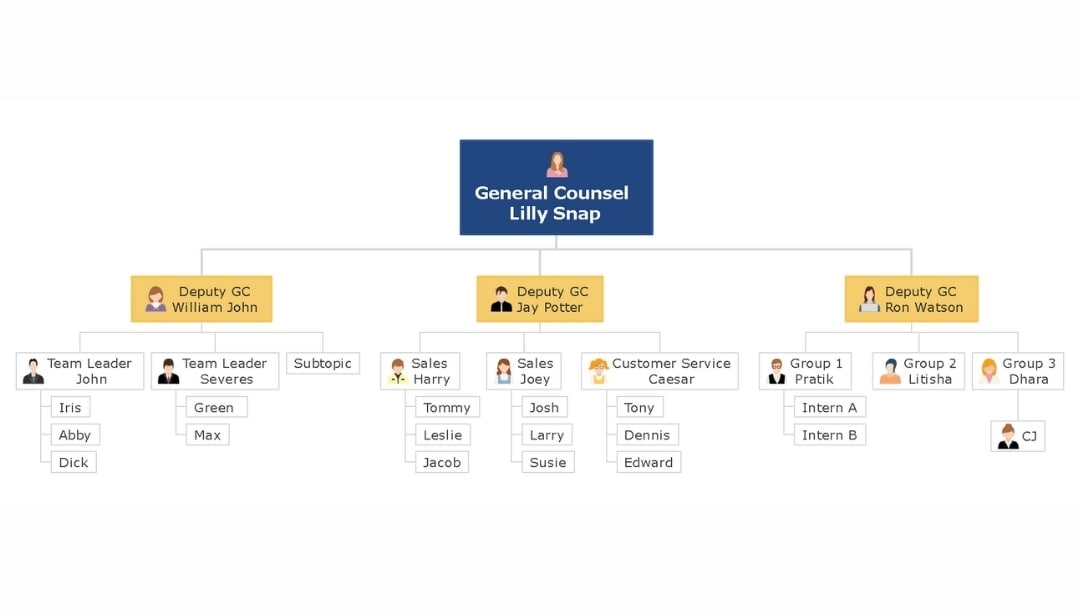
Replace the sample titles with your actual leadership roles:
- Top node: General Counsel or Chief Legal Officer
- Next level: Deputy GCs or Legal Directors
- Below: Practice leads, such as Litigation, Compliance, or Corporate Governance.
- And so on…
Check reporting lines and spans of control.
Add new branches for additional teams or units if needed.
Step3 Add Legal Units and Support Roles
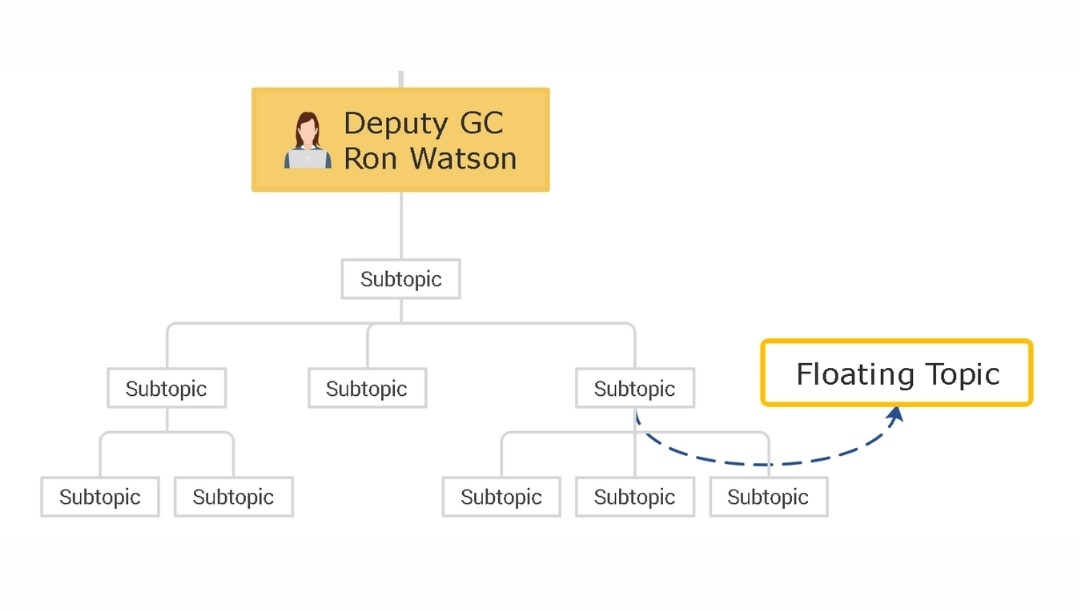
Insert Subtopics for each functional area, Contract Management, IP, HR Support, etc.
Add Floating Topics for cross-department roles like Legal Operations or External Counsel.
Keep the hierarchy clear: each unit should be connected to its direct leader.
Step4 Finalize and Share
Review everything, including connections and labels.
Once finalized, download your chart as a PDF, PNG, or PowerPoint file, depending on the tool's export options.
Tip: Save your chart template for reuse when the team changes or expands.
Final Thoughts
A strong legal department needs structure. It reduces confusion, speeds up choices, and lowers risk. Every role is defined, every line of reporting is clear.
No matter your team size, three people or hundreds, an org chart makes that structure visible and real.
EdrawMind provides you with ready-made templates and simple tools to map it all out quickly. Drag, connect, and export your chart in minutes.
It’s an easy way to make your legal team's organization practical and clear.
-
Where can I find organizational charts for major businesses?
Public companies rarely share internal org charts because they contain sensitive details. Third-party sites that compile such data often miss accuracy and context.
The best approach is to build a custom version yourself with EdrawMind templates.
-
How many lawyers does a company need in-house before creating a formal structure?
A single General Counsel can handle things early on.
Once the team grows to three or four attorneys, defined areas and reporting lines help.
At five or more, structure becomes essential. Hierarchy and management roles usually appear around 10 lawyers.
-
Can a legal department function without a General Counsel title?
Yes. Some smaller companies use Legal Director or VP Legal instead. Startups may rely on a senior lawyer before introducing a GC role.
What matters most is having someone responsible for legal strategy and executive communication.
-
How do you structure legal when the company operates globally?
Global companies often use either a centralized or a regional model. Many appoint Deputy GCs for regions such as EMEA and APAC. Hybrid and matrix setups are also common.
They centralize some legal work while keeping regional expertise for local matters.
 EdrawMind
AppsEdrawMind Online
EdrawMind
AppsEdrawMind Online