

A legal system is an organized framework and foundation that serves as a mechanism for implementing and enforcing laws. It is composed of written laws, persons in authority, justice officers, lower and higher courts, and enforcement agencies – all of which make up the system. Laws are a series of codified rules and regulations that govern society. Laws, per se, on their own, cannot significantly function. Simply put, laws, without legal systems, are toothless, spineless, and pointless. Hence, legal systems are important as they serve as a vehicle to enforce laws.
On a global scale, civil law systems and common law systems are the two major and primary legal systems regulating societies. The common law emerged in England, whose framework originates from court rulings, while the civil law system stems from Roman law, which stems from legislation. This article will discuss and compare the history, structure, and real-world applications of the two main legal systems.
In this article
What Is Civil Law?
Civil law is a legal system whose defining feature is its focus on doctrine and jurisprudence, with core principles codified into a body of law.
Key Characteristics of Civil Law
First, the doctrine or style of a civil law system focuses on codification, logical structure, and formal systematization of legal principles, as well as the trace of its history. Primary emphasis is given to written status over jurisprudential precedents, identification of its functions, determination of its domain of application, and investigation of its effects in terms of rights and obligations. The body of laws centers on a comprehensive rule that is inquisitorial in procedure.
Second, as to the function, the civil law system serves as a stable guide that draws heavily from a disorganized mass of texts, codes, books, cases, and legal dictionaries. Arising from these would be the rules and principles that clarify and purge the subject of impure elements. Thus, it then provides both the practice and the courts with a guide for the solution of particular cases in the future.
Third, as to the jurisprudence and interpretation of laws, civil law applies general principles, which are only a secondary source of law for explanation. In civil law jurisdictions, interpretation begins by identifying the relevant legal principles and verifying whether the facts support their application. Judgments and resolutions rendered in such a type of legal system are written in a more formalistic style. Civil law decisions are shorter and are separated into two parts: the motifs (reasons) and the dispositif (order).
Fourth, as to the jury's opinion, there is no hard-and-fast rule requiring strict unanimity. This is without saying that the jury's opinions are of lesser weight, but the civil law system acknowledges variety and evolution. Laws vary by state and country, and there is also an essential threshold of consideration for equity and substantial justice. Nonetheless, the jury's decision and judgment assure the prevalence of law over passion.
Lastly, as to the consequences or evolution of law, the civil law system often has a rigid structure and doctrine imposed on the courts. This means that it is subject to fewer changes over time and does not follow the doctrine of stare decisis, or the principle that subsequent rulings follow precedent if similarly situated. This type of system, although it recognizes the realities of modern life, sticks to stability and tradition.
Historical Origin of Civil Law
The civil law tradition stems from a well-organized, systematic Roman legal framework, as established in the Corpus Juris Civilis by Justinian and later evolved in Continental Europe and worldwide. It is deeply rooted in the Roman Empire and was thoroughly documented and disseminated beginning in the 19th century, especially with France’s Napoleonic Code (1804) and Germany’s Bürgerliches Gesetzbuch (1900).
Additionally, in Roman law, the key feature is the extensive codification of the adopted Roman law, incorporated into the civil codes. This system of codification originated in the Code of Hammurabi, composed in ancient Babylon in the 18th century BC. Subsequently, the idea evolved during the 17th and 18th centuries AD as a reflection of both Natural law. During that time, the political ideal was articulated through the ideas of democracy, safeguarding property, and the rule of law



Countries Using Civil Law
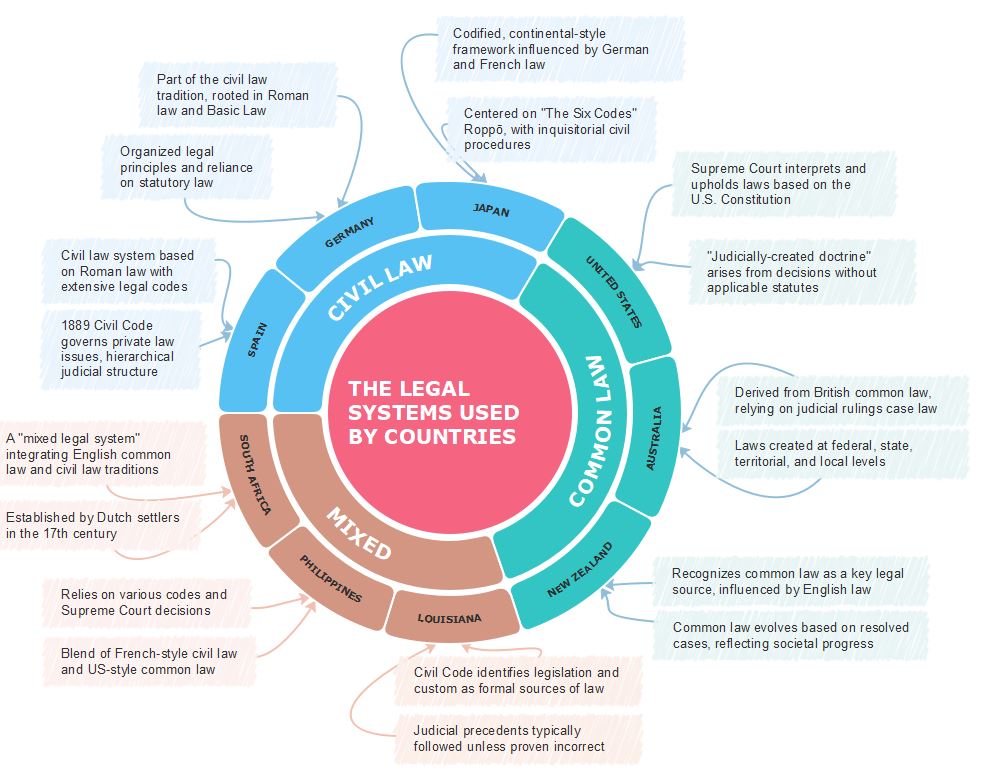
The following are examples of countries that adopt the civil law legal system: Spain, Germany, and Japan.
Spain
The Spanish legal framework is a civil law system based on Roman law, distinguished by extensive legal codes and the precedence of written legislation. The 1889 Civil Code (Código Civil) governs private law issues, covering contracts, property, and family law, and employs a hierarchical framework with the Supreme Court as the top judicial authority. The Spanish Civil Code (Código Civil) is the primary legislation governing private law in Spain and addresses matters such as contracts, property, family law, and inheritance.
The characteristics of a civil law legal system in Spain are evident in the distinction between the public and private sectors, which are generally divided into areas covering constitutional, criminal, administrative, tax, civil, commercial, social, and procedural issues. It also appears through the dominance of written law, as outlined in the sources within the Civil Code, specifically law, custom, and general principles of law, along with the hierarchical structure of the judiciary that includes a system of judicial appeals.
Germany
The German legal framework is part of the civil law tradition, with roots in Roman law and grounded in the principles established by the Basic Law of the Federal Republic of Germany. In fact, Germany was pivotal in the codification of civil law in the 19th century, and its legal codes have shaped the evolution of law in numerous other jurisdictions.
The German civil law framework clearly differentiates between public and private law, significantly impacting international legal systems through its emphasis on organized legal principles, good faith, and legal certainty. Such a system also relies on statutory law rather than court rulings, with legal frameworks systematically structured into five separate codes—civil, procedural, commercial, criminal, and criminal procedural.
Japan
Japan's civil law system is a codified, continental-style framework, mainly influenced by German and French law and significantly shaped by the Meiji Restoration of the 19th century. The foundation is the Civil Code (1896), which emphasizes private rights, duties, and family matters, whereas the Commercial Code and other specific laws address business-related issues.
The system is centered on "The Six Codes" (Roppō), mainly the Civil Code, which regulates private interactions and dealings. It includes civil procedures of an inquisitorial nature and a significant dependence on documentary evidence. Moreover, the Japanese legal framework is modeled after European legal systems, particularly those of Germany and France. Japan established its legal system during the Meiji Restoration, which reestablished imperial authority in 1868.
What Is Common Law?
Common law is a legal system characterized by case law, developed primarily by judges through court decisions and similar tribunals.
Key Characteristics of Common Law
First, as to the doctrine or style, the common law system is defined by its full and absolute reliance on precedent, or prior judicial rulings and judgments. It focuses on fact patterns and follows a "judge-made" law system, characterized by adaptability rather than reliance on statutes alone. The analysis focuses more on cases presenting similar, but not identical, facts. It heavily cites specific rules and uses analytical deduction to propose a new rule.
Second, the primary function of a common law legal system is to provide a reliable, adaptable, and structured framework for settling disputes through judicial precedent. It serves as a stable tool that can stand on its own, and its enactment must be read as a whole. It also serves as a gap-filler in judicial lawmaking: when laws are unclear, vague, or face novel legal issues, judges develop law by relying on legal doctrines and past decisions.
Third, as to jurisprudence and the interpretation of laws, it sets out a new specific rule for a new specific set of facts and serves as the principal source of law. Judges have the freedom to apply the law to an event that has been proven true according to the judge's own beliefs. It also thoroughly reveals written judgments and jurisprudence through details, contrasts them with earlier cases' facts, and establishes the legal principle applicable to the current facts.
Fourth, regarding the jury's opinion, they serve as the fact-finder, tasked with deciding guilt or liability based on the evidence presented at trial, offering a "voice of reason" or a reflection of community norms. Their "opinion" is presented officially as a verdict, establishing facts while the judge enforces the law. Juries are comprised only of laypersons — never judges and, in practice, only rarely lawyers — and are rarely employed to decide non-criminal matters. Their function is to weigh evidence presented to them.
Lastly, the consequences or evolution of law in this type of legal system indicate that there is room for change in the rule-making process. Most common law rules can be changed over time, subject to the doctrine of stare decisis. In other words, it is less timid about reform but remains open to major legal changes. This means that the realities of modern life can be addressed more promptly through the common law, intertwined with jurisprudential opinions.
Historical Origin of Common Law
The Common Law legal framework began in England in the twelfth century, at a time when governance and law were transitioning from regional customs to a centralized national power. Before this time, English law was inconsistent. Rather, legal regulations were primarily influenced by local customs, community tribunals, and the power of feudal lords. Every region had its own traditions, and there was no single nationwide legal framework. This started to shift during the rule of Henry II. His reign represented a pivotal moment in English legal history as he restructured royal justice and established lasting government institutions.
The common law, so called because it was uniform across all the king's courts in England, emerged from the customs of the English kings' courts in the years after the Norman Conquest of 1066. It created a cohesive legal framework that slowly replaced the regional folk courts and manorial courts.
Countries Using Common Law
The following countries adopt the common law legal system: the United States, Australia, and New Zealand.
United States
The United States uses a common law system, unlike civil law systems grounded in written legal codes. The United States Supreme Court is a crucial component of this system, interpreting and upholding laws as outlined in the U.S. Constitution. Since the American Revolution, the Supreme Court has been instrumental in shaping the common law tradition in the U.S. Pivotal cases that have influenced the interpretation of federal common law and the power of the judiciary.
In general, the common law system is essential to the federal judicial branch's operation and its persistent impact on the U.S. American Courts resolve cases based on previous court rulings (precedent) and/or policy, along with a sense of natural justice. In cases of purely decisional law, there is no applicable statute or constitutional clause. This kind of law made through decisions is known as "judicially-created doctrine."
Australia
Australia's common law system is a legal structure derived from British common law, mainly depending on judicial rulings (case law) and precedents established by superior courts. It operates alongside statutory law, with the High Court of Australia as the ultimate appellate court, ensuring a consistent national legal framework.
In Australia, laws are created at various levels: federal, state, territorial, and local councils, resulting in a complex legal structure. The common law tradition adds depth to this system, as judicial decisions act as precedents that influence future rulings, highlighting the importance of judges in interpreting the law.
New Zealand
In New Zealand, common law is a significant legal source and also recognizes the role of equity in jurisprudential decisions. The roots of the common law lie in the English legal system, which New Zealand adopted as its former colony. The common law system arose as a strong centralized justice system under the English kings during the twelfth century and beyond, when royal justices established and enforced general rules applicable throughout the courts in England.
An example of how the common law applies is in the law of contracts regarding posting rules. Accordingly, there is an issue regarding its acceptance or completion, as communicated to the offeror's side. Since no actual statute governs it, judges can consider existing Bills or other related decisions on email as a valid acceptance. This shows that the body of common law evolves based on the outcomes of resolved cases, mirroring the social and technological progress of that society.

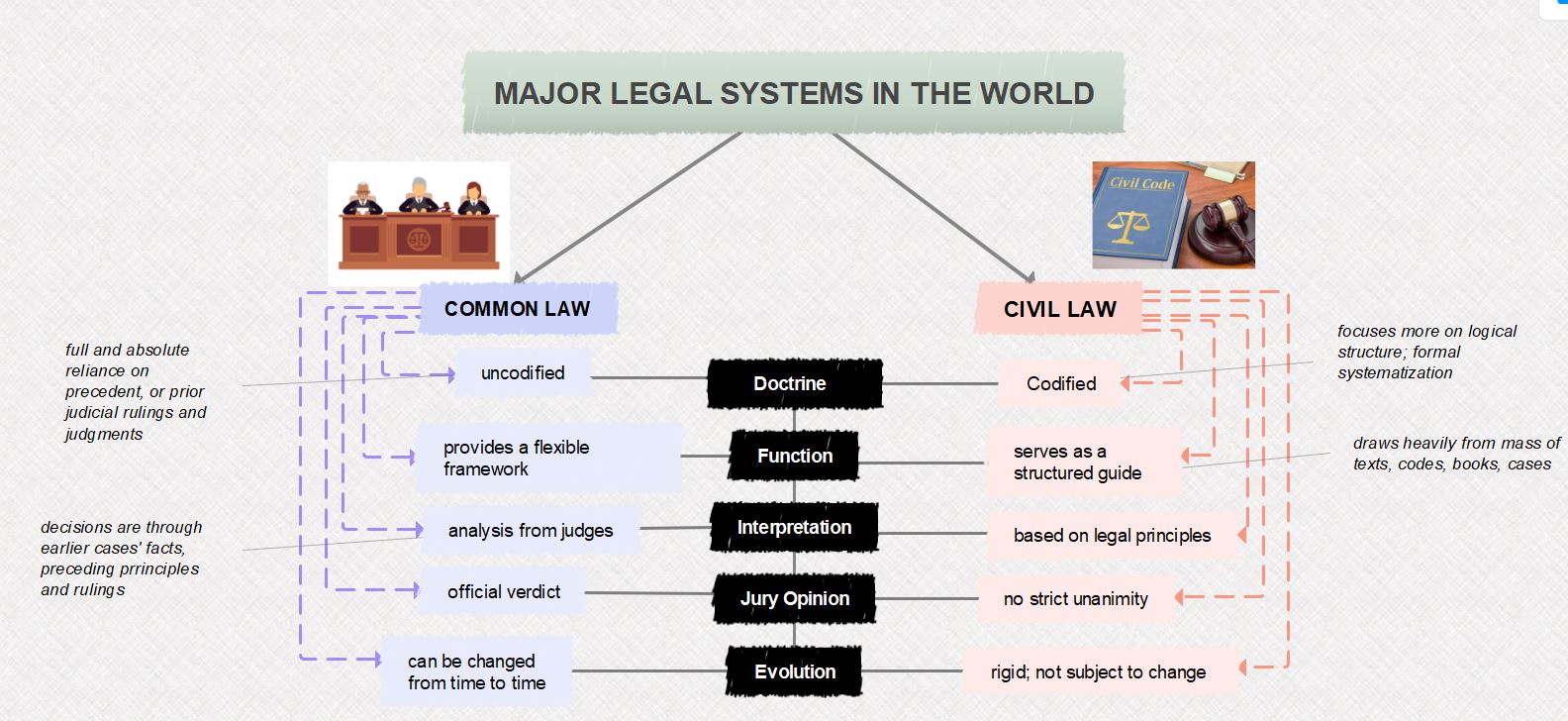
Key Differences Between Civil Law and Common Law
| Aspect | Civil | Common |
| Doctrine or Style | focuses on codification, logical structure, and formal systematization of legal principles | defined by its full and absolute reliance on precedent, or prior judicial rulings and judgments |
| Function | serves as a structured, stable guide that draws heavily from a disorganized mass of texts, codes, books, cases, and legal dictionaries. | to provide a reliable, adaptable, and structured framework for settling disputes through judicial precedent |
| Jurisprudence and Interpretation of Laws | applies general principles and interprets by identifying the relevant legal principles and verifying whether the facts support their application | written judgments are thoroughly revealed in detail by the judges, and contrast them with earlier cases' facts, and establish the legal principle |
| Opinion of the Jury | no hard-and-fast rule requiring strict unanimity | Serves as an official verdict, establishing facts while the judge enforces the law |
| Consequences or Evolution of Law | has a rigid structure and doctrine, and is subject to fewer changes over time and does not follow the doctrine of stare decisis | can be changed from time to time, subject to the doctrine of stare decisis and open to effecting major legal changes |
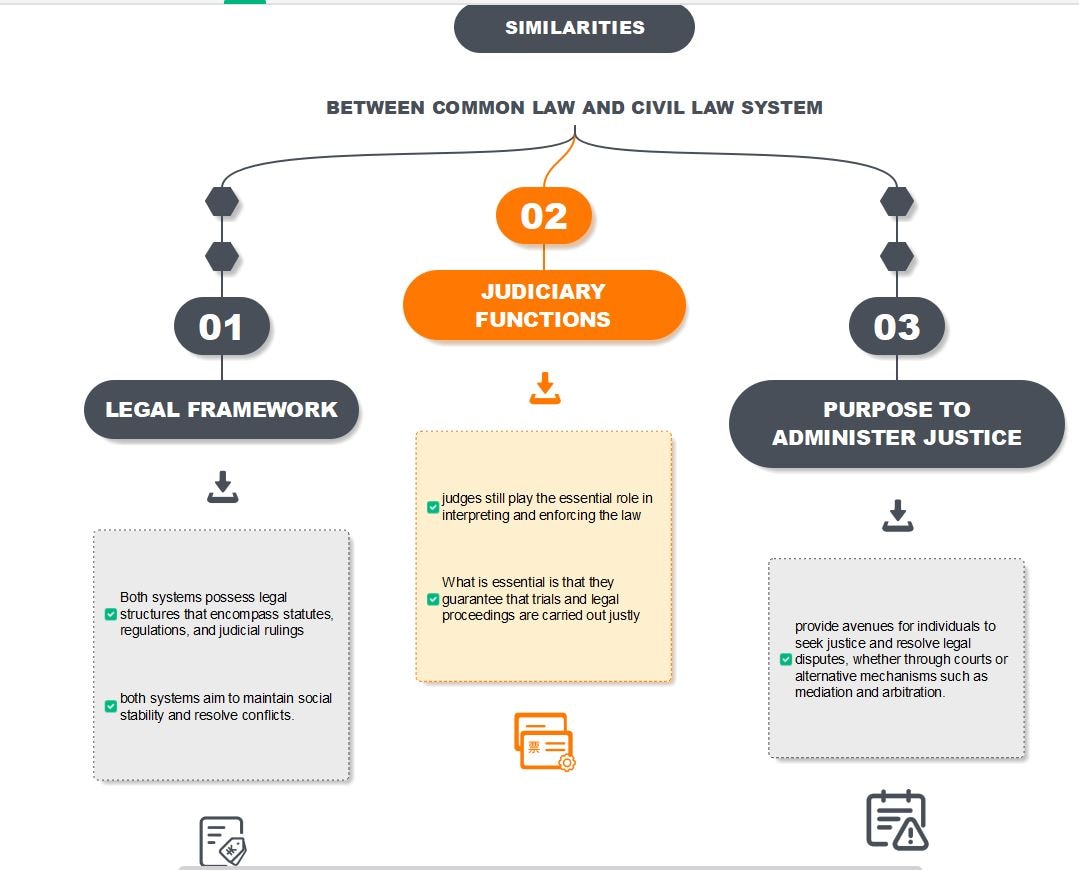
Similarities Between the Two Systems
Though both major legal systems have differences in origin, definition, and application, we can still find similarities:
- Legal Framework
The components of each system may differ, but the legal framework as a whole does not. Both systems possess legal structures that encompass statutes, regulations, and judicial rulings. This is the general standard for what comprises a legal system – it covers provisions, codes, implementing rules, and court resolutions. Moreover, both systems aim to maintain social stability and resolve conflicts. - Judiciary Functions
In both systems, judges still play the essential role in interpreting and enforcing the law. Their basis and guidelines may differ depending on the system, but the person in authority remains the same. What is essential is that they guarantee that trials and legal proceedings are carried out justly. - Purpose to Administer Justice
The ultimate common end goal, most importantly, does not vary. Legal systems, after all, exist to provide avenues for individuals to seek justice and resolve legal disputes, whether through courts or alternative mechanisms such as mediation and arbitration.
Mixed Legal Systems
Some countries combine elements of both systems: South Africa, the Philippines, and Louisiana.
- South Africa
South African law, characterized as a "mixed legal system," draws on the common law of England and the civil law systems of Europe, integrating multiple legal traditions. Roman-Dutch law, derived from Roman law and later developed and implemented in Holland and other Dutch territories during the 17th and 18th centuries, underpins common law, now more accurately referred to as South African common law. Tradition also played a part. Following the arrival of Dutch settlers at the Cape in 1652, this legal framework—common in Holland—was introduced and established in South Africa - Philippines
The legal system of the Philippines is defined by a blend of Civil law (French-style) and Common law (US-style). It relies on various codes (Penal Code, Civil Code, Corporation Code of the Philippines) as legal basis, as well as on Supreme Court judicial decisions (landmark and En Banc cases). Civil law frameworks often feature statutes that are significantly shaped by common law principles. Regarding the evolution of its legal framework, Spain has adopted the Civil law system, exemplified by the Code Napoléon. Following that, the United States assumed control and enforced the common law framework on public law. - Louisiana
Louisiana incorporates certain common law principles, but it also employs a civil law system for a significant portion of its state laws and procedures due to its history as a French territory. Additionally, on acknowledged tribal lands, the tribe's customary laws may be utilized instead of state or federal laws. Specifically, the Louisiana Civil Code identifies two formal sources of positive law: legislation and custom. If there is no legislation in the absence of law or custom relevant to a case, the judge shall make a decision based on “equity,” which is described in the Civil Code as an appeal to natural law. The acknowledged traditions are limited. Judicial precedents do not possess legally sanctioned power, yet in reality, they are typically adhered to unless shown to be incorrect or unsuitable.
Advantages and Disadvantages
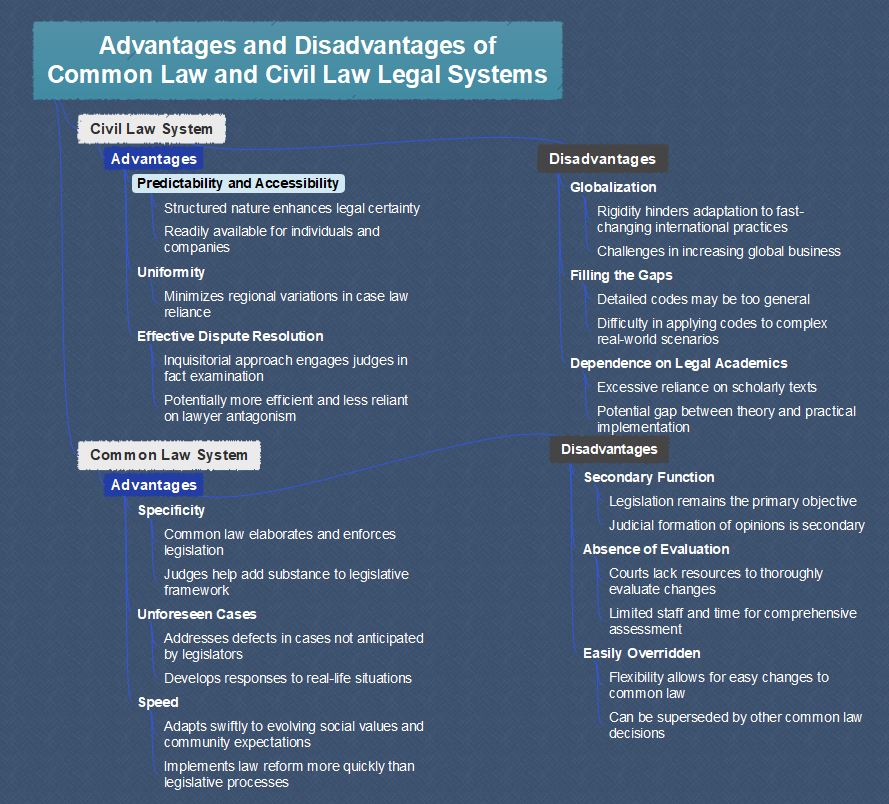
Civil Law System
A. Advantages
- Predictability and Accessibility – Being so structured, it becomes readily available, thereby enhancing legal certainty for individuals and companies.
- Uniformity – This minimizes regional variations in systems that predominantly rely on case law.
- Effective Dispute Resolution – The inquisitorial approach, in which judges play an engaged role in examining facts, may be more efficient and less reliant on lawyer antagonism.
B. Disadvantages
- Globalization – the rigidity can hinder rapid adaptation to fast-changing international commercial practices and increasing global business
- Filling the Gaps – Detailed codes can sometimes be too general, making it difficult to use them in specific, complex real-world scenarios without relying on interpretation.
- Dependence on Legal Academics – sometimes the understanding of the law leans excessively on scholarly texts instead of on actual legal practice, potentially resulting in a gap from practical implementation.
Common Law System
A. Advantages
- Specificity – Common law elaborates on, specifies, and enforces legislation. With the help of the judges, common law adds substance to the framework of legislation.
- Unforeseen cases – It can cure defects in cases and facts that legislators did not anticipate. Essentially, it can examine and develop responses to real-life situations.
- Speed – It adapts swiftly to evolving social values and community expectations. It implements law reform more quickly because the political and procedural limitations of the legislative process do not constrain it.
B. Disadvantages
- Secondary Function – legislation or making laws remains the primary objective, and the judicial formation of opinions and resolutions is secondary.
- Absence of evaluation – Courts lack the staff, time, resources, and opportunity to evaluate the alterations they implement in common law thoroughly.
- Easily Overridden – Because of its flexibility, it can also be changed easily and superseded easily by another common law.
Study laws with Mind Maps and Notes
 Try the app & get 500 free AI tokens


For law students who face and juggle endless, voluminous readings, case law, and complex procedural rules, studying immediately becomes daunting. That's where EdrawMind becomes more than just a productivity tool—it's an efficient study companion that simplifies understanding the law.
The study of law is more than just the memorization or recall of long provisions—it's about seeing connections and practical application: how regulations relate, how principles develop, and how cases rely on one another. EdrawMind enables you to achieve this by converting lengthy, text-dense documents into organized, visually engaging maps.
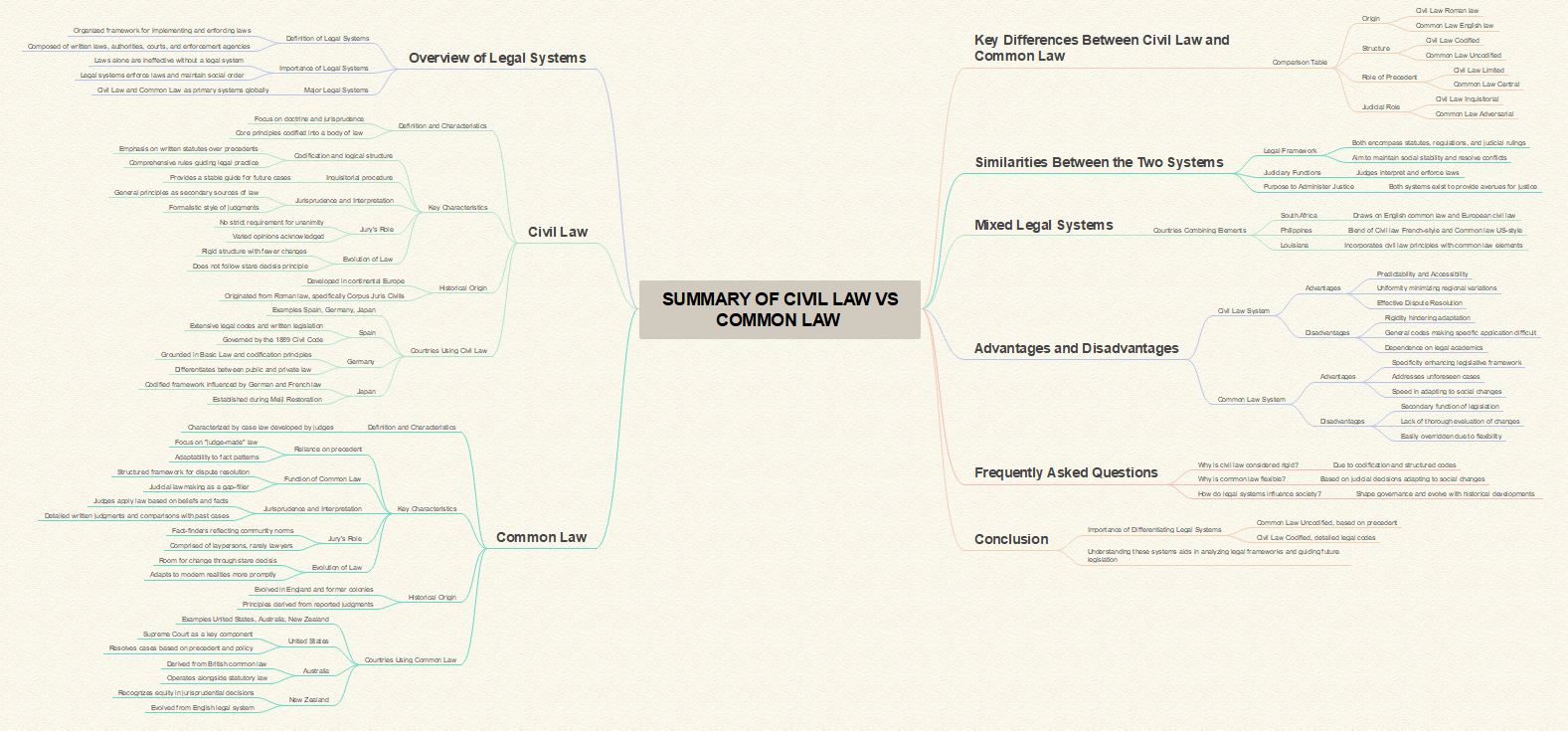
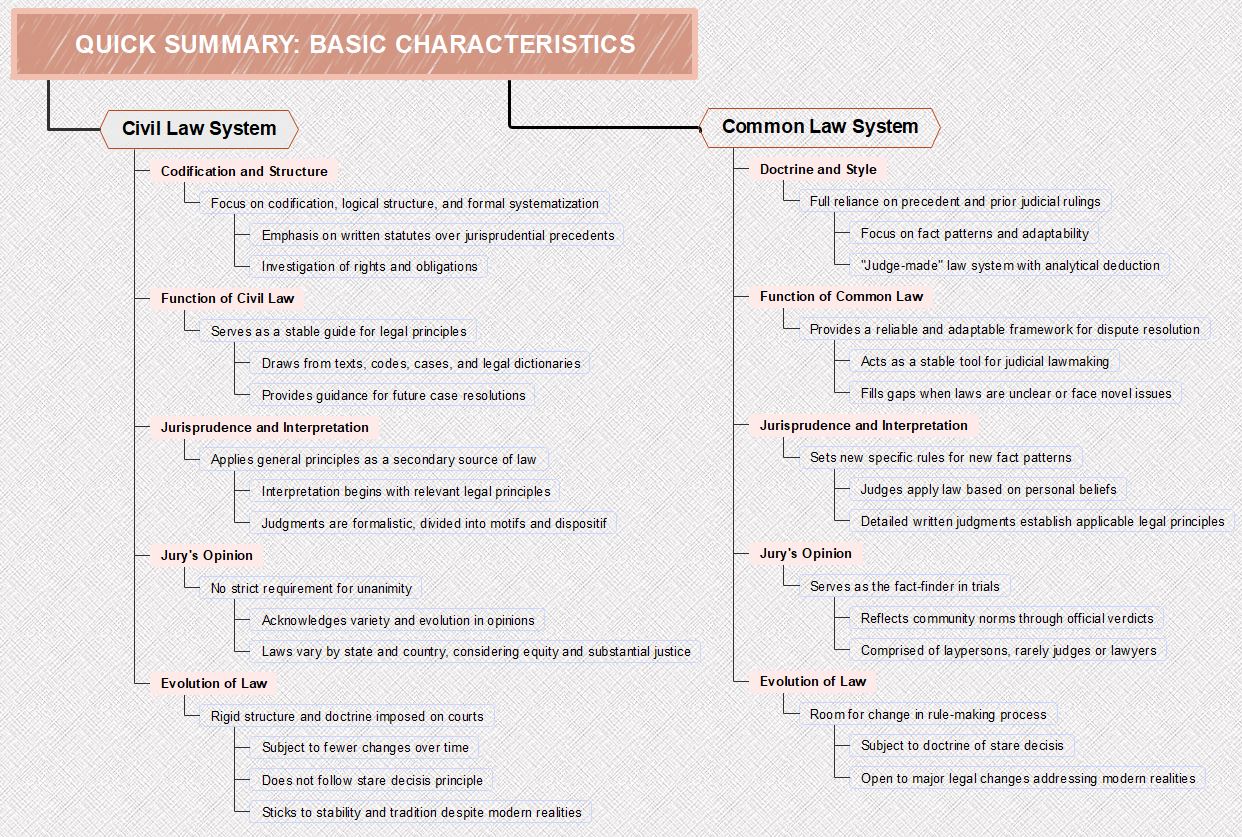
AI Mindmap – From Complex to Clarity in Seconds
Pasting a long topic on Civil vs Common Law Systems into the app takes a lot of work. Instead of manually assigning topics and subtopics, EdrawMind's AI Mindmap instantly generates an intelligent, well-organized, comprehensive mind map. This assures the user that no heading or important topic is left out, even if it is omitted by manual work.
The AI Mindmap:
- Automatically identifies key concepts, subtopics, and relationships by simply basing it on the main topic given by the user.
- Breaks down the umbrella terms into detailed concepts through logical hierarchies; and
- Saves hours of manual outlining of notes and research of related sub-headings or topics.

AI File Analysis – Turn Lengthy PDFs to Instant Legal Insights

The love of law students for summarized books, articles, and PDFs is no brainer. They basically seek a "Compendious Reviewer" of almost everything —and this is what EdrawMind's AI File Analysis does. For instance, if you only seek to focus on the specific countries that adopt a common law system but only found articles about the long history and development of this legal system, this EdrawMind feature can be of great help. One just has to upload the files, and the application quickly extracts key points, summaries, and essential parts of a chapter.
Why AI File Analysis Matters:
- Instantly identifies facts, issues, and rulings of the court in a specific case;
- Focuses on understanding rather than passive reading and long hours of dissecting concepts; and
- Uses the output as a base for mind maps or reviewers
Collaboration – Real-Time and Anytime
Another essential feature that anybody would need is collaboration. The collaboration feature in EdrawMind is one click away via the Share button in the top-right corner, where users can instantly invite others, generate links, and enable real-time editing. Exchange of ideas and assignment of responsibilities is made easy.
Overall, what truly makes EdrawMind interesting is its user-friendly design—it's remarkably easy to navigate and offers virtually everything you need from the outset. Featuring pre-made templates, integrated guides, and intelligent recommendations, it effectively "serves up" the process, enabling you to effortlessly select a design and personalize it to fit your particular objectives or study strategy.

Conclusion
It is a fundamental objective to differentiate between the two primary legal systems in the world. Common law is typically uncodified, meaning there is no comprehensive collection of legal regulations and statutes, and it is primarily founded on precedent. In contrast, Civil Law is codified, with thorough, regularly revised legal codes that detail all issues that may be presented in court, the relevant processes, and the appropriate penalties for every offense.
Being able to contrast the essential distinctions and similarities would help one analyze the intricacies and dynamics of legal frameworks that govern nations and individual citizens. Ultimately, it helps us understand history and guides legislators and judicial bodies in shaping the legal system over time.
Frequently Asked Questions:
-
Why can civil law be considered rigid?
It is rigid because its inherent composition of codification and structured codes may not easily adapt to rapidly changing global and commercial developments. -
Why is common law flexible?
It is flexible because it is primarily based on judicial decisions, which can quickly adapt to social changes through new proposed ones without waiting for legislation. -
How do legal systems influence society?
Legal systems shape governance, guide behavior, and evolve alongside historical and social developments.
 EdrawMind
AppsEdrawMind Online
EdrawMind
AppsEdrawMind Online