

What is mind planning about, and how might it help you with plotting your novel?
Mind planning is an extraordinary procedure that bolsters getting sorted out and organizes everyday exercises, just as the thoughts that consistently enter our minds on how to mind map a novel plot.
A mind map is a realistic portrayal of thoughts and ideas. It is a visual tool that causes you to orchestrate all your insights and helps you comprehend, blend, store, and grow groundbreaking studies.
Considering that 90% of the data sent to the cerebrum is visual, it can be said that anyone can hear that the estimation of mind planning lies in its ordinary sense.
Writing a novel is an innovative cycle that includes finding that good thought and permitting your creative mind to wander.
Whenever you've planned your plot and made your characters, it gets hard to control the novel's object. If applicable to the plot, nobody needs to fail to remember whatever could later become imperative to their story.
In this article
The Five Tips on How To Mind Map a Novel Plot
Start with the concept and branch it out.
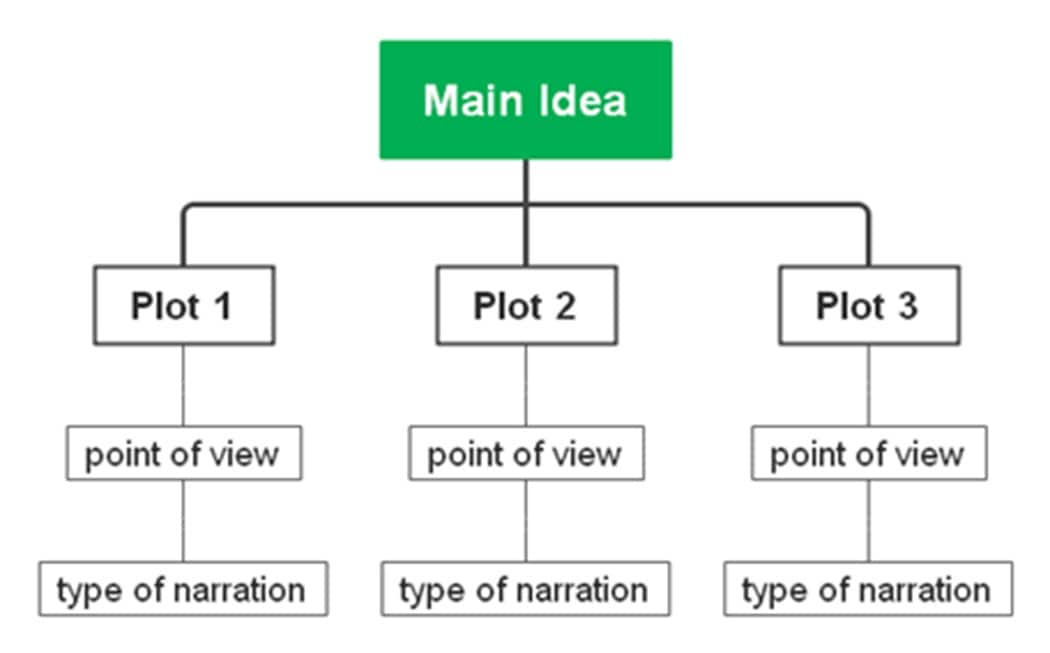
Customarily, every mind map begins with a focal topic, which is the novel's primary thought. Please write it down in the center of the guide.
At that point, let loose your mind and let your contemplations spread.
Think about the mind map like a fresh start, standing by to be painted by your thoughts. Note any idea that rings a bell. No one can tell when you will utilize it.
From the focal topic, start to add sub-topics and branch out your considerations. You may have a sub-topic for your plot with different variations – add and name them all.
Additional Notes? Indeed, Please
Numerous individuals propose writing only a couple words for each topic, while others may write real descriptions.
Nonetheless, a standard issue in a mind guide should contain a base measure of terms, including thoughts that you might want to develop later on.
On the off chance that you need to detail a particular zone, utilize the notes choice, where you can list any remaining perspectives that may ring a bell.
Customize
Keep your mind map intriguing and invigorating, and utilize various highlights to customize it.
Use tones for specific topics to feature a thought, change the mind map's subject, adjust the states of the issues, or synchronize colors with activities or characters.
For instance, utilize more obscure shades for negative feelings and lighter tones for the positive ones.
Apply whatever supports your creative mind and helps your progression of musings.
Interface the Topics
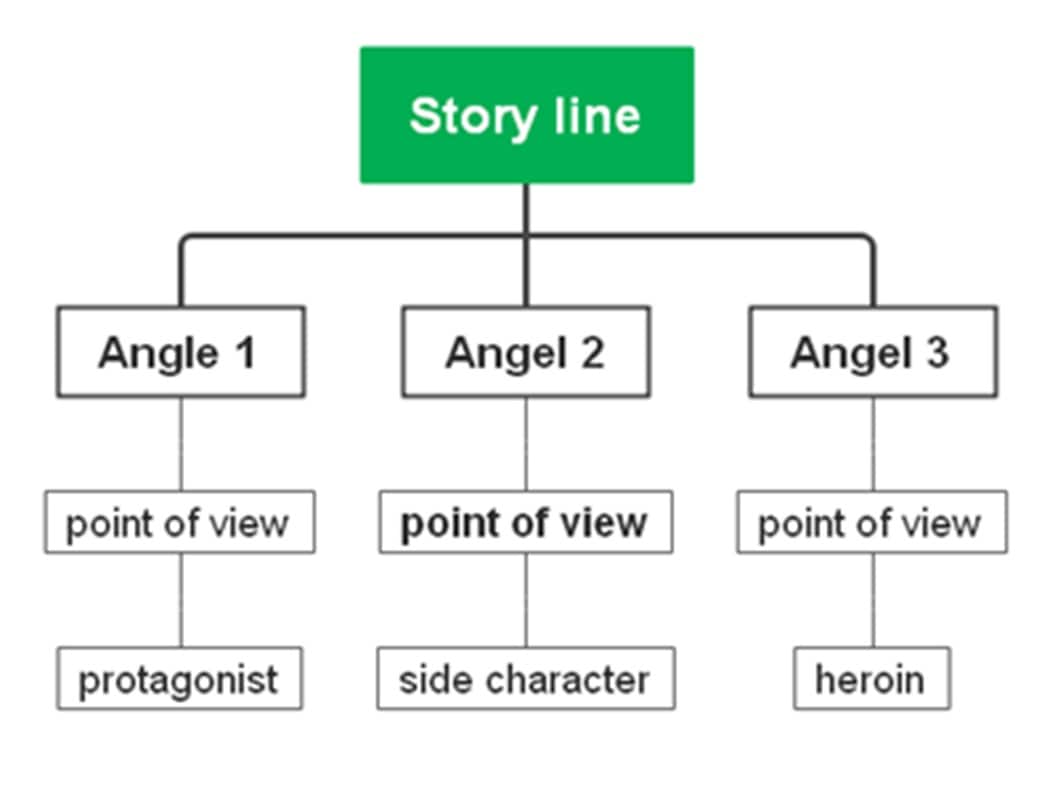
Everything is associated with all the other things. Indeed, so are the topics in a mind map.
On the off chance that you need to connect an idea to another, you can embed connections between issues and name them in the same manner.
For instance, two distinct characters in the novel may have comparative attributes – go along with them with a relationship bolt, so you recall later and build up their tendency by learning how to mind map a novel plot.
Change Viewpoint
As expressed above, mind maps are a visual perspective on your progression of thoughts.
In any case, on the off chance that you'd prefer to go for the direct portrayal and separate your guide into a bulleted list, you can generally switch between perspectives and transform your mind map into a blueprint.
All connections you added beforehand will be kept, and the change is reversible, so you can decide to return to the mind map and see it whenever you wish.
The force of mind planning can't be disparaged, as it is a powerful tool and a magnificent method to sort your considerations and thoughts.
Mind planning gives you the freedom to brainstorm and communicate your thoughts, with no imperatives. It empowers you to be inventive and urges your innovativeness to wander so you can make a thought unmistakable.
It carries lucidity to your musings so you can assemble your ideas, request them, and construct an incredible story on how to mind map a novel plot.
Mind Map Examples for Novel Plot Writing
These mind map examples for novel plot writing come from Wondershare EdrawMind’s Gallery. They help writers organize characters, settings, and storylines, making it easier to structure plots, track progress, and build cohesive narratives visually.
Novel Outline Framework
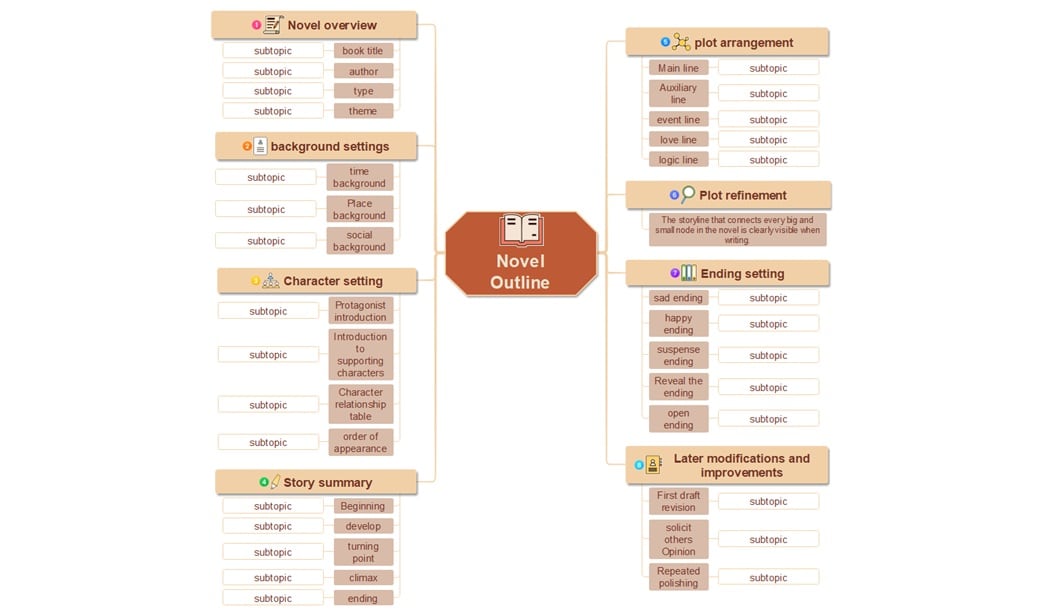


This mind map outlines the structure of a novel. It starts with plot arrangement, including main, auxiliary, event, love, and logic lines. Each connects key story elements and maintains a smooth narrative flow.
The next part refines the plot by linking major and minor story nodes. Writers can plan various endings like happy, sad, open, suspenseful, or revealed. These options guide the emotional tone and message of the story.
The final sections cover editing, feedback, and polishing. It also includes character details, background settings, and story summaries to help writers organize ideas and create a complete, engaging novel.
Five Links of Novel Writing
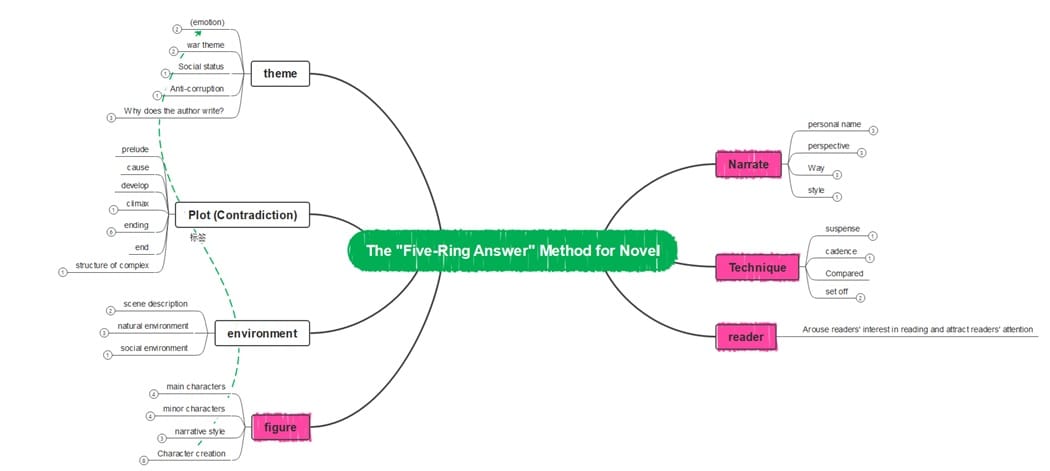
This mind map introduces the Five-Ring Answer Method for writing novels. It explores how theme, plot, environment, characters, and readers connect to form a complete, engaging story that reflects emotion, conflict, and purpose.
The map explains theme selection, plot development, and structural elements like foreshadowing, clues, and sudden turns. These parts help create balance and rhythm while guiding how events unfold and resolve with impact.
It also covers setting, character creation, and narrative techniques. Writers can build strong emotional depth, clear viewpoints, and captivating tension that attract readers and make every story more vivid and memorable.
Novel Idea for Fairy Tale
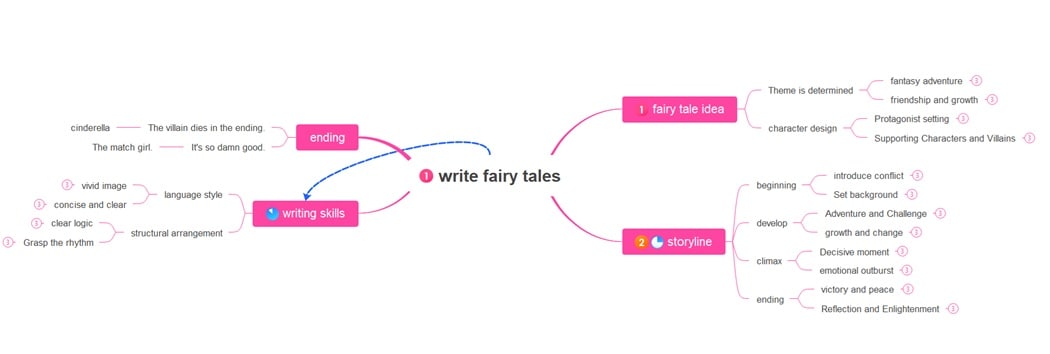
This mind map explains how to create a complete fairy tale, from building a fantasy world to designing characters and writing a meaningful story. It highlights how imagination shapes adventure, friendship, and personal growth.
The map begins with ideas, themes, and character settings. It guides writers in shaping heroes, mentors, and villains while balancing conflict, courage, and emotional change throughout the story’s beginning, development, climax, and ending.
It also introduces writing skills like vivid language, rhythm, and logical structure. These techniques help create immersive worlds, emotional depth, and clear storytelling that leave readers inspired and deeply moved by each tale.
Character Development in Novel Writing
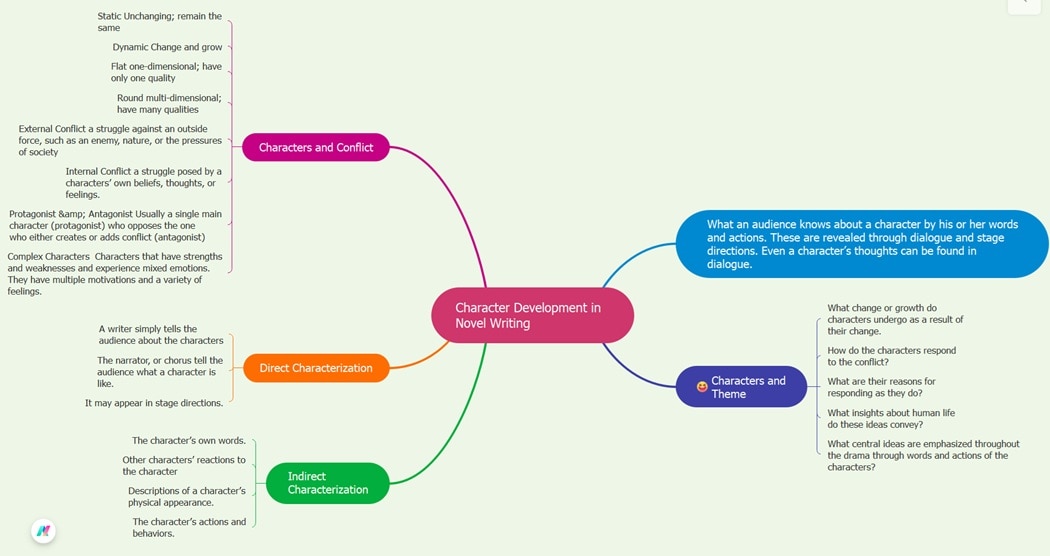
This mind map explores character development in novel writing through actions, words, and thoughts. It shows how dialogue, narration, and stage directions reveal inner emotions, motivations, and relationships that make characters feel alive and believable.
It also explains how conflicts drive growth. Characters face external and internal struggles that shape their decisions, reveal values, and transform their personalities. These changes highlight the story’s deeper themes about life and human nature.
The map includes direct and indirect characterization techniques to show or tell traits. It also defines static, dynamic, flat, and round characters to help writers design balanced and complex story figures.
How To Write an Excellent Novel
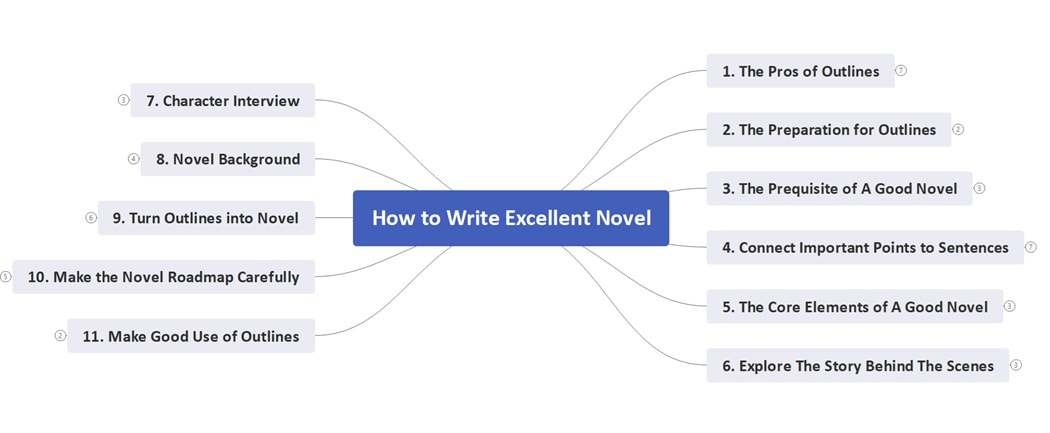
This mind map explains how to build a strong novel from planning to completion. It starts with the pros of outlines, including balance, continuity, rhythm, and character coherence, helping writers stay organized while keeping creativity alive.
It also highlights brainstorming, “what if” questions, and connecting scenes through emotional resonance. These steps help you turn loose ideas into structured plots with strong motivations, desires, and goals that keep the story engaging and believable.
The map ends with behind-the-scenes development, character interviews, and background building. It teaches how to turn outlines into complete novels, control pacing, add conflict, and refine story structure through thoughtful planning and editing.
Explore More Mind Maps or Make One for Free Now
EdrawMind makes novel writing mind maps simple and fun to create. You can outline characters, plots, or scenes with ease.
Explore templates from EdrawMind’s Gallery to start shaping your next story. In the Gallery, you’ll find templates for themes like story structure, character development, and world-building.
Choose a layout that fits your writing goal. Each template offers a ready-made framework you can adjust to match your own creative ideas:
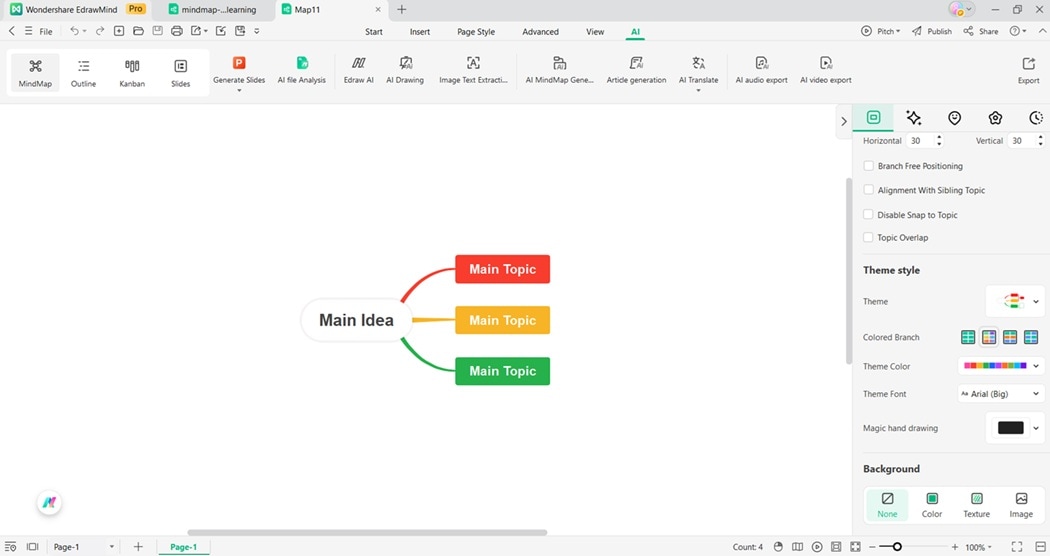
Step 1: Add Your Core Topic
Begin a new mind map and set your main topic, such as “Novel Outline,” “Fantasy Story,” or “Romance Plot.” This center topic anchors your plan and keeps every creative thought connected.
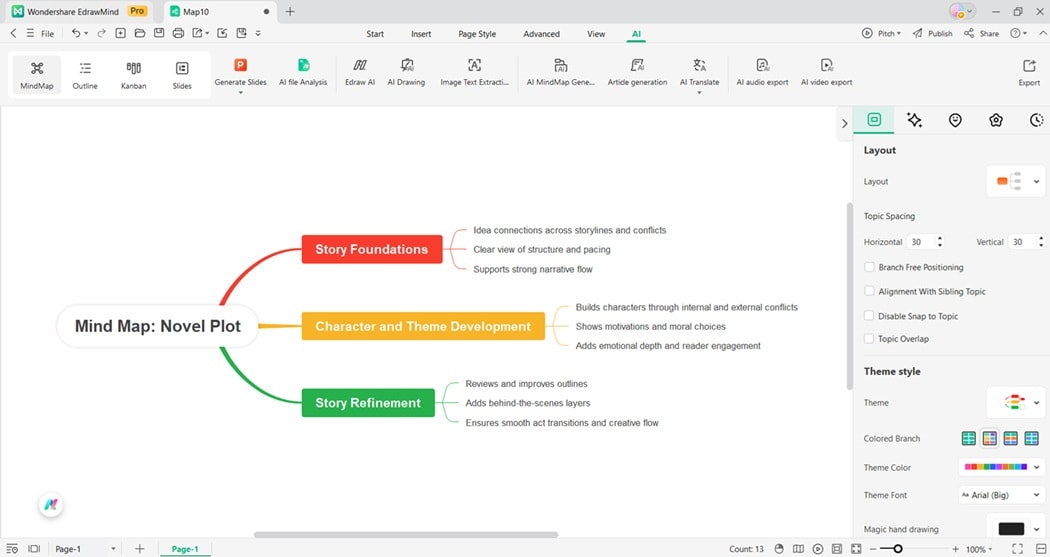
Step 2: Build Key Branches
Add branches for parts like Characters, Plot Points, Setting, and Theme. These help you organize major scenes, conflicts, and turning points that shape the flow of your novel.
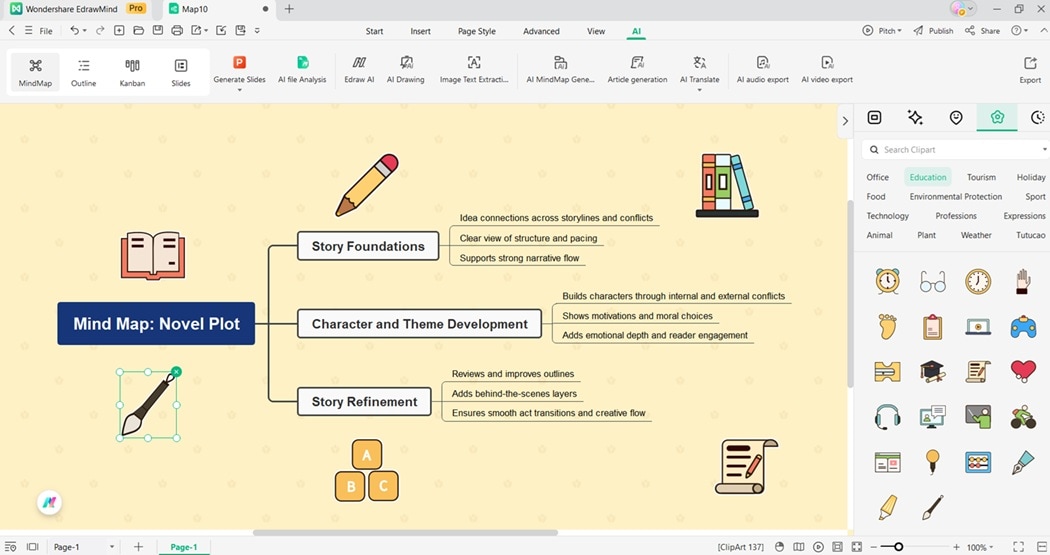
Step 3: Customize With Visuals
Use icons, colors, and connectors to show relationships between characters and events. Visual cues make your story’s flow easier to follow and spark more creative ideas.
Step 4: Improve With AI Assistance
EdrawMind AI can expand plot points, improve character arcs, or generate theme suggestions. It helps writers find balance, fix gaps, and strengthen the story outline efficiently.
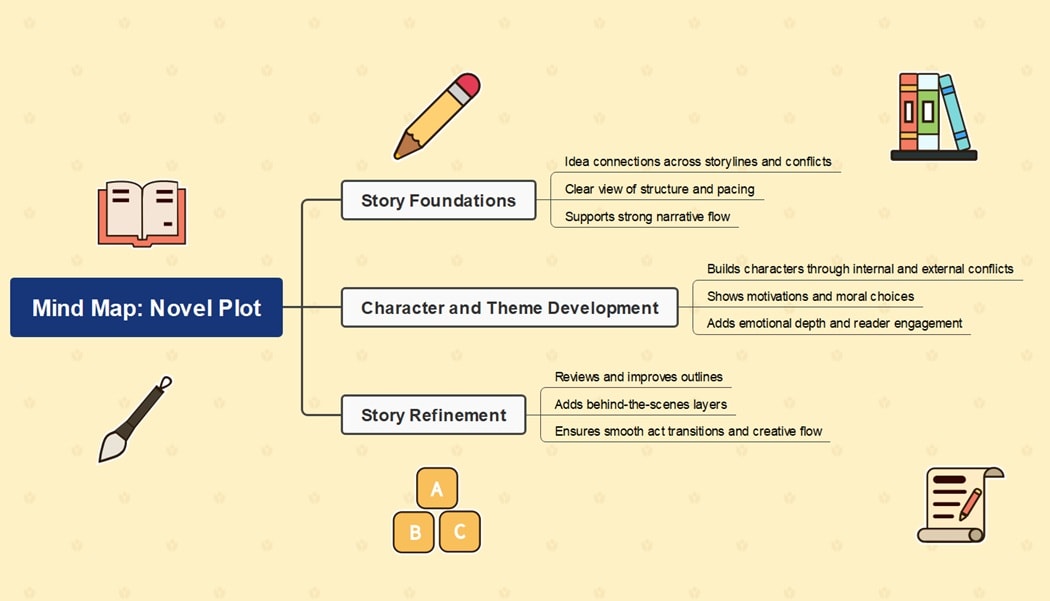
The Novel Plot Mind Map begins with story foundations. It shows how ideas connect across storylines, characters, and conflicts, helping writers see structure clearly. This supports better pacing and narrative flow throughout the book.
The next part highlights character building and theme development. It explores internal and external conflicts, motivations, and moral choices that define each story arc. These elements create emotional depth and reader connection.
The final part focuses on refining the story. It includes reviewing outlines, adding behind-the-scenes layers, and ensuring smooth transitions between acts. The map encourages creative thinking and confident writing with visual clarity.
 EdrawMind
AppsEdrawMind Online
EdrawMind
AppsEdrawMind Online