

The United States government is one of the largest and most complex organizations in the world. It manages defense, economy, law, and public services across 50 states and territories.
To keep everything running, it follows a clear structure built on balance and accountability. Each branch and department works together to maintain stability and serve citizens effectively.
In this guide, we’ll explore how the US government’s structure works, explain why it helps maintain order and efficiency nationwide, and learn how to create an organizational chart for a government.
In this article
U.S Government Organizational Chart
The United States government is operating one of the most powerful and complex systems in the world. It is governed by the Constitution that separates power into the Legislative, Executive, and Judicial branches. All the branches have different functions, yet they rely on each other to ensure that the system is balanced.
Now, let's have a closer look at the US government's org structure.

Structure Type
The US government is a federal government, implying that power is distributed between the national and state authorities.
At the top, the federal government manages the national laws and policies. Below it, state governments deal with regional issues such as education, medical care, and security. Community services are managed by the local governments of counties, cities, and towns. These include essential services such as police, sanitation, and infrastructure.
Within the federal level, there are three coequal branches:
- Legislative branch (Congress): Makes laws through two chambers, the Senate and the House of Representatives.
- Executive branch: It is led by the President. It implements the laws as well as controls government activities via various departments.
- Judicial branch: It is headed by the Supreme Court and interprets laws, as well as provides justice.
This division maintains accountability while facilitating effective decision-making. Despite having separate powers, all branches are intended to work together under the checks and balances system.
The federal government also includes numerous departments and agencies. These include the Department of Defense, the Department of State, and the Department of Health and Human Services. These organizations function similarly to specialized teams that concentrate on welfare, foreign policy, and national defense.
Number of Employees
The US government has a workforce of more than 2.8 million civilians. This makes it among the biggest employers of people in the world. This figure excludes military and contractors, and part-time personnel. All the departments and agencies have their workforce serving the people.
The federal employer is the largest, with approximately 700,000 civilian workers in the Department of Defense. Hundreds of thousands are also employed by the Department of Veterans Affairs and the Department of Homeland Security. NASA, the FBI, and the IRS, among others, have special teams dedicated to research, investigation, and financial management. Each organization focuses on its specific area of expertise.
At the state and local levels, millions of people are employed by the governments in education, healthcare, and policing. This giant network makes sure that the government services are accessible to everyone. The organization enables easy coordination between the federal and regional teams to ensure that programs are similar and effective throughout the country.
Key Executives
The US government’s organizational chart places the President of the United States at the top of the Executive Branch. The President is the Head of State and Commander in Chief of the Armed Forces. The president has the responsibility of making all major national and international decisions.
The President is followed by the Vice President. VP assists with the executive operations and acts as the Senate President. They serve as the head of the administration together with the Cabinet, a group of senior officials that heads the key executive departments.
The following are some of the executive positions
- Secretary of State: Deals with foreign relations and has a global representation of the US.
- Secretary of Defense: Oversees the military and the defense policy.
- Attorney General: This is the head of the Department of Justice and the law enforcers.
- Secretary of the Treasury: Oversight of economic policy and national finances.
- Secretary of Homeland Security: Guards the nation against domestic and external menaces.
- Secretary of Health and Human Services: Responsible for state health and welfare programs.
- Secretary of Education: Leads national education policies.
- Secretary of Energy: In charge of energy production and research.
- Secretary of transportation: Governs airlines, roads, and maritime transportation systems.
Other high-ranking officials include the National Security Advisor and the Chief of Staff. The National Security Advisor advises the President on security issues, while the Chief of Staff manages the daily work of the White House.
The Speaker of the House and the Senate Majority Leader are the main leaders in Congress. They guide and manage the lawmaking work of the House and Senate. The Chief Justice of the Supreme Court is in charge of the country's highest court within the Judicial Branch.
Adaptivity of the Structure
The US government’s structure is designed to adapt to changing times. As new issues arise, laws, departments, and agencies may change or be established. The Department of Homeland Security, for instance, was created to improve national security following the 9/11 attacks.
Every department and branch is adaptable enough to change course or broaden its scope as necessary. For specialized objectives like cybersecurity defense, climate research, or disaster response, agencies create task forces and project-based teams. It helps the government in effectively managing issues at home and abroad.
To enhance coordination, the government also uses data-driven systems and technology. Digital platforms are used by federal and state agencies for information sharing, project tracking, and transparency. This balance between structure and flexibility makes the US government efficient and resilient.
Why Does the US Government Structure Work?
The organizational structure of the US government functions well because it strikes a balance between flexibility and stability. Each agency, department, and branch is aware of its role while working together to accomplish shared objectives.
Here's why the structure works so well:
- Power is clearly divided: The three branches make sure that no one group has excessive power.
- Checks and balances: To prevent abuse, each branch can keep an eye on and restrict the authority of the others.
- Defined responsibilities: Each department and agency has distinct roles to minimize confusion and overlap.
- Federal and state cooperation: There is a sharing of power between the levels, and this gives both national direction and local control.
- Adaptability: The structure adapts to emerging laws, agencies, and policies to suit the new national requirements.
- Quality leadership & chain of command: Starting with the President and then local officers, each post has an open line of reporting.
- Transparency and accountability: Openness to information fosters commitment and accountable governance.
- Project-based coordination: Agencies create teams jointly in times of a crisis, which enhances efficiency and problem resolution.
This moderation enables the US government to handle immense duties, remain democratic and serve its citizens effectively.
How to Create a Similar Org Chart for Your Company?
Want a chart like the US government’s? Start by understanding how your departments and offices connect. Here’s how you can make one easily.
- Define the purpose: Why are you creating the chart? Knowing your goal helps shape your chart.
- Get accurate data: List key leaders, agencies, and offices. Verify names, titles, and reporting lines using reliable sources.
- Divide and arrange: Group related departments, such as executive, legislative, and judicial.
- Pick a layout: Choose between a top-down or horizontal layout. A top-down chart works best to show hierarchy clearly from the President to departments.
- Choose the right tool: Use a simple design tool like EdrawMind, Lucidchart. These tools offer org chart templates to help you organize and design your chart easily.
Steps to Create the Org Chart
After you’ve gathered your information and picked a design, it’s time to make your chart. Here’s how to create a simple and modern US government org chart using Wondershare EdrawMind.
 Try the app & get 500 free AI tokens


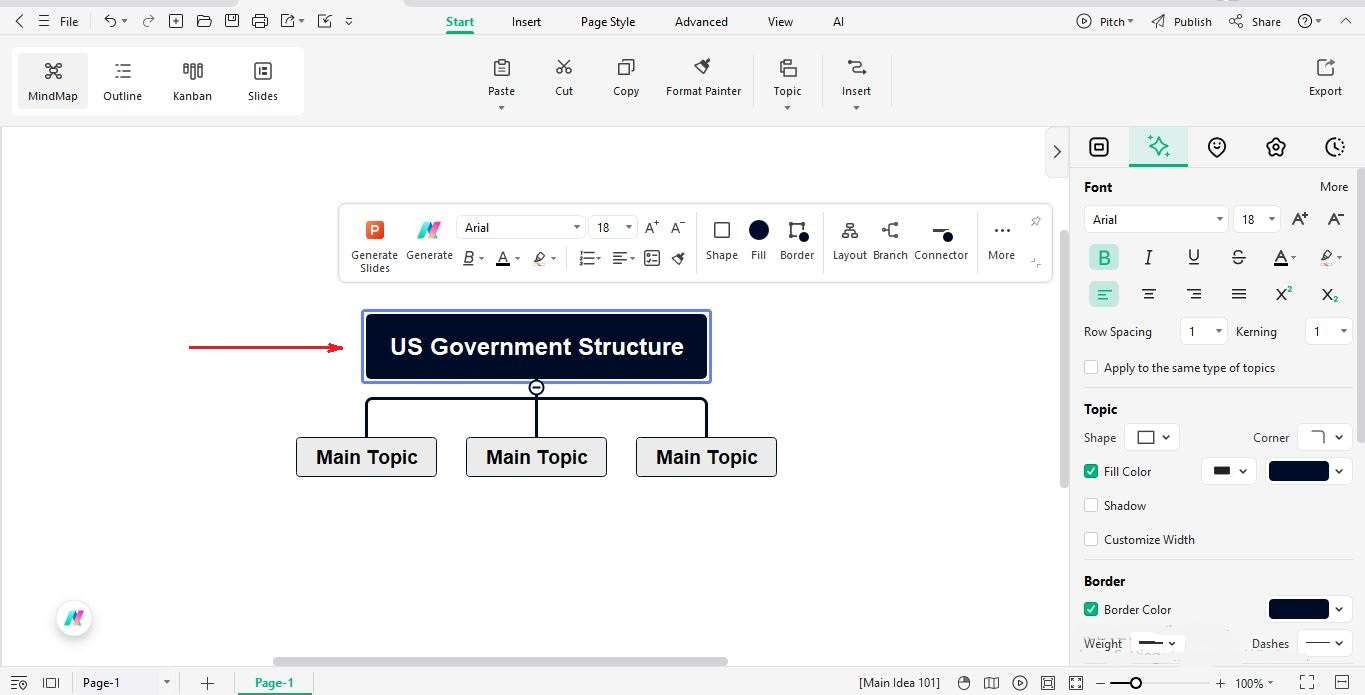
Step1 Start a New File
- Open EdrawMind and select the org chart layout.
- Insert your chart title, such as US Government Structure, in the center.
Step2 Add Main Branches
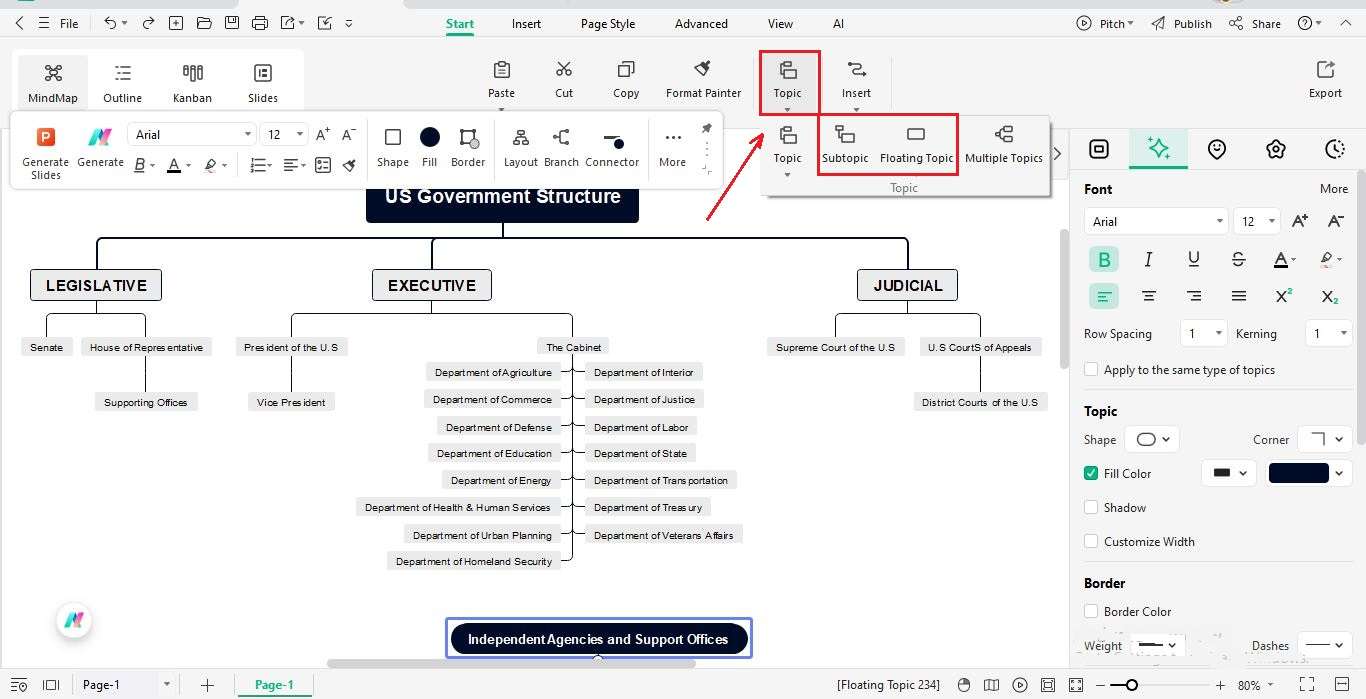
- Create branches for the Executive, Legislative, and Judicial branches.
- These represent the top level of government.

Step3 Add Subdivisions
- Use subtopics to add departments under each branch.
- Add the Department of Defense under the Executive branch or Congress under the Legislative branch.

Step4 Include Independent Agencies and Support Offices
- Add floating boxes for agencies such as the CIA, EPA, and NASA.
- Show how they relate to the main branches.
Step5 Customize & Review
- Color-code branches for easy reading.
- Use blue for Executive, green for Legislative, red for Judicial. Check for accuracy and clarity.

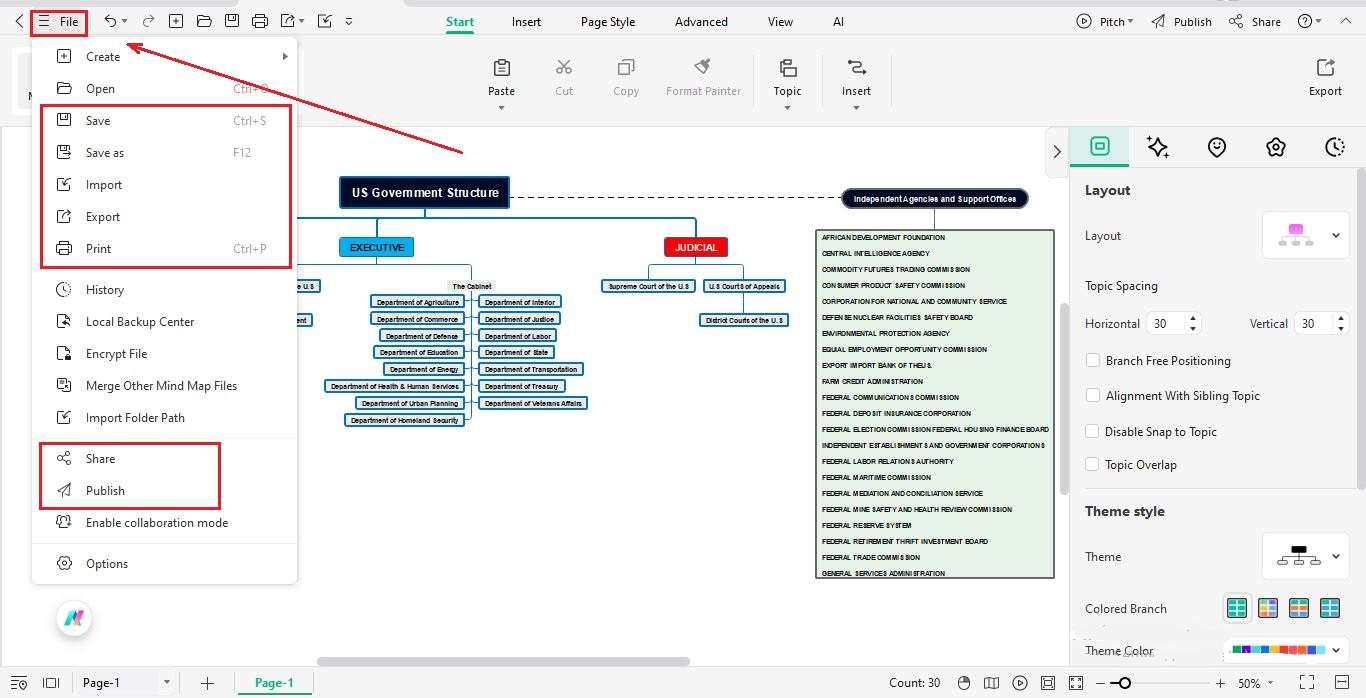
Step7 Save, Export, and Share
- Once done, export as PDF, PNG, PowerPoint, and more.
- Share your chart with your team or students to help visualize how the US government works.
Closure
The US government’s organizational structure keeps one of the world’s largest systems running smoothly. Each branch, department, and agency plays a specific role in maintaining order, balance, and service delivery. Visualizing this hierarchy helps make sense of its complexity.
With EdrawMind, you can easily create, study, and share clear org charts. This way, you can simplify learning and understand how large organizations like the US government truly operate.
 EdrawMind
AppsEdrawMind Online
EdrawMind
AppsEdrawMind Online