



When I see a rocket leave the ground, I think about the people organizing it. NASA's public face, rockets, space probes, and observatories, is supported by a massive internal network.
I wanted to follow how decisions move through that network, from leadership to the field. Most information left gaps, so I decided to explore it myself.
Here, I'll outline how everything connects within the NASA organizational structure and guide you in creating org charts for free.
In this article
NASA Organizational Structure Overview
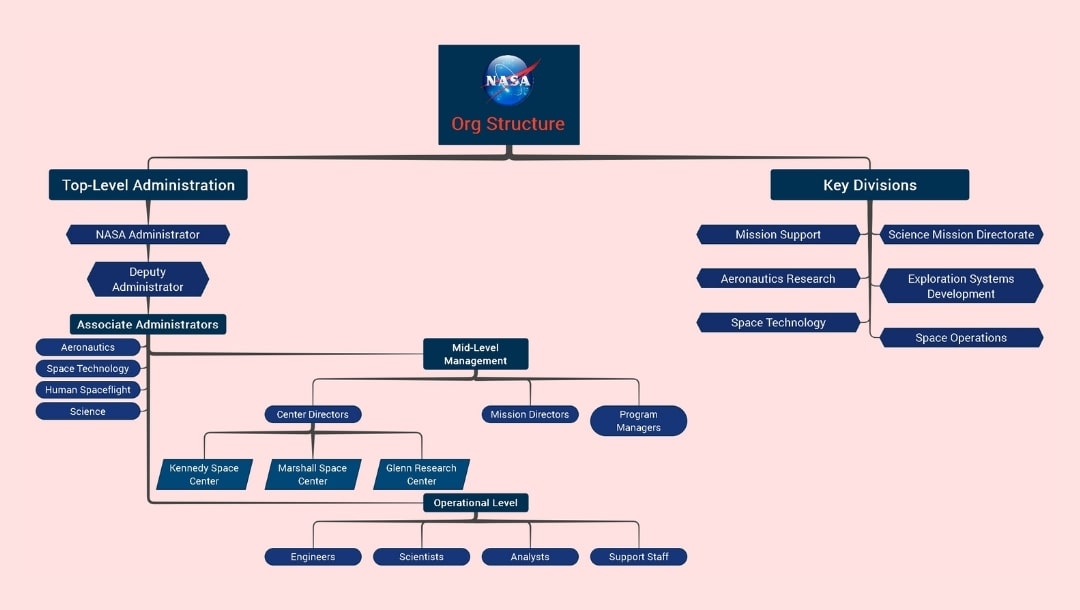


NASA splits work between permanent offices and temporary projects. Offices handle ongoing tasks, such as running the space station. Projects build new things like Mars rovers.
This dual setup has been in use for over 60 years.
Permanent teams stay in one place. In contrast, project teams are temporary; they complete their tasks and then separate. Engineers move between projects throughout their careers.
Top-Level Roles
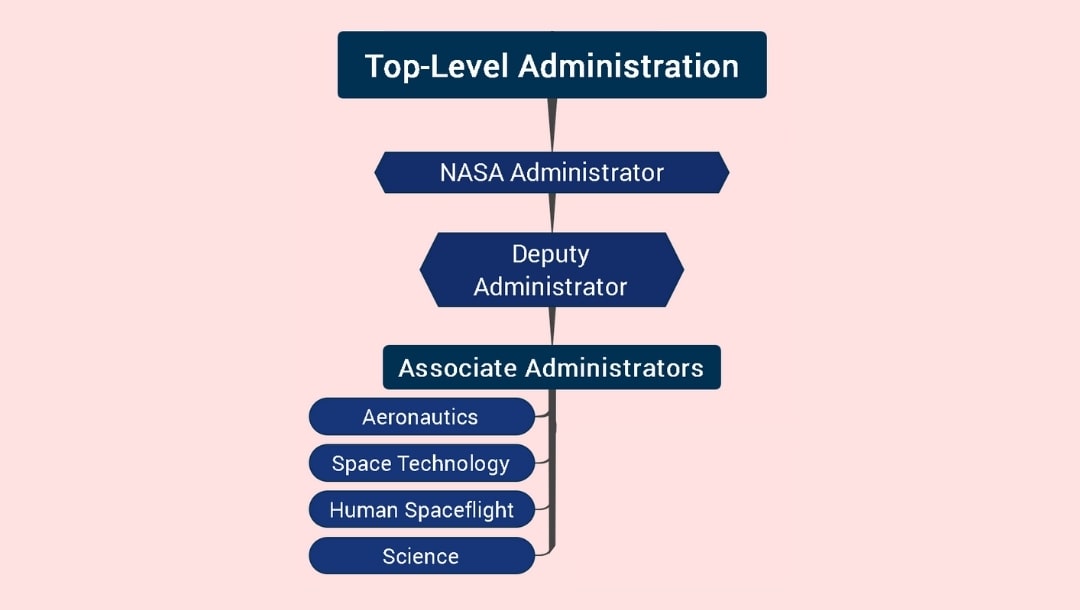
The NASA Administrator needs Senate approval to take the job. This person presents the budget to Congress every year and signs agreements with other countries.
The Deputy Administrator is the second-in-command. If the Administrator leaves or is unable to work, the Deputy assumes full authority. This person also leads major reviews of programs exceeding $250 million, checking for potential problems.
Associate Administrators run four main areas:
- Science (satellites and telescopes)
- Human Spaceflight (astronauts and rockets)
- Space Technology (research and new ideas)
- Aeronautics (airplane research)
Each area works like a separate agency inside NASA.
Mid-Level Management

Center Directors act like general managers. They control buildings, equipment, and local staff at their facility.
- Kennedy Space Center handles launches. Marshall Space Center tests rocket engines. Glenn Research Center studies propulsion.
- Each center owns unique tools that the projects need. Directors decide who gets to use those tools and when.
Mission Directors coordinate across centers. The Artemis moon program needs work from Johnson, Marshall, and Kennedy. The Mission Director ensures that all three remain aligned.
- They hold budget power but must request personnel and equipment from the Center Directors.
Program Managers run individual projects with clear start and end dates. They hire contractors, track their spending, and report progress every month.
- Most NASA hardware comes from contractors, not NASA employees. These managers closely monitor the contractor's work.
Operational Level
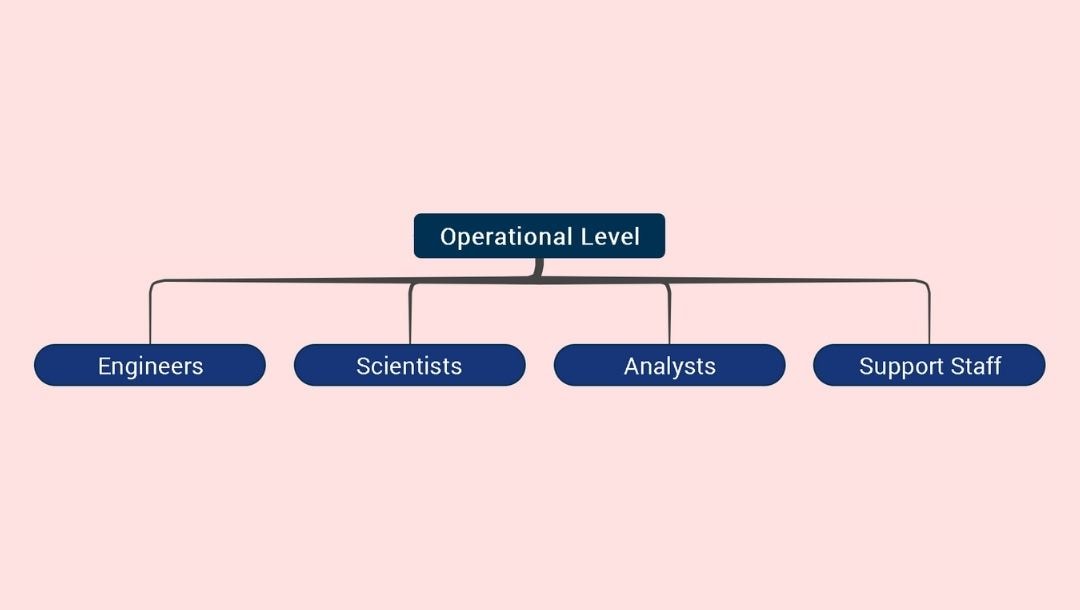
Engineers belong to technical branches with 8 to 30 people. A branch chief assigns them to projects, but project leads control daily tasks. This creates two bosses for most engineers.
Scientists often work at NASA and at a university simultaneously. They write proposals for new missions and compete for funding. NASA picks the best ideas.
Analysts provide safety checks, cost estimates, and risk tracking. They work independently of project teams to stay neutral.
Support Staff handle paperwork, IT systems, and building maintenance. These jobs remain relatively unchanged when projects start or stop.
The structure keeps technical skills sharp even when programs end.
Key Divisions in NASA Org Structure
Science Mission Directorate
- Oversees all science missions.
- Sends satellites to track climate changes, robots to Mars, and telescopes to distant galaxies.
Exploration Systems Development
- Builds spacecraft, rockets, and habitats for lunar travel.
- Runs the Artemis program to prepare for human life on the moon.
Space Operations
- Manages the space station and partnerships with companies like SpaceX.
- Operates NASA's communication systems across space.
Space Technology
- Test new ideas to shape future exploration, better propulsion, solar systems, and advanced materials.
- Most are still experimental.
Aeronautics Research
- Develops better aircraft technology.
- Focuses on making flights quieter and more efficient and shares results with manufacturers.
Mission Support
- Handles financial, legal, and planning tasks.
- The CFO oversees a $25 billion(approx) budget, while the General Counsel manages contracts and other legal matters.
How NASA's Structure Works in Practice
At Headquarters
Governance reviews control how projects move ahead. Only after approval can a mission shift from planning to building and then to launching.
At Research Centers
JPL, Kennedy, and Johnson use Spaceflight Multiteam Systems. Each team manages a specific field such as propulsion, power, guidance, or life support.
Design teams rely on interface control documents to stay aligned. They show how one team's work relates to another's, such as matching engine mounts to the main frame.
Weekly integration meetings maintain coordination. Teams report updates, raise issues, and support each other when schedules slip.
Two major reviews, Preliminary and Critical, mark key stages. Independent reviewers thoroughly check every detail before proceeding.
In Collaboration with Partners
Contractors submit monthly progress data. NASA evaluates results, visits sites, and adjusts award fees based on performance.
Better results mean higher pay; weaker ones result in reduced rewards.
Why NASA's Organizational Structure Works Well
The reason NASA's structure lasts is simple: it adapts. Apollo used it. The shuttle followed it. The space station still runs with it. Every program was unique, yet the same foundation was at work.
Flexibility keeps NASA stable even as missions evolve.
Ten centers across the country also build political strength. Each region gains jobs, creating allies in Congress when budgets are up for review.
Layered budget authority makes operations faster. A small expense can be processed without delay; large contracts require top-level approval. This keeps oversight without slowing progress.
NASA's ties with universities bring new perspectives from outside. That exchange of knowledge keeps ideas fresh and prevents isolation.
Branch chiefs manage growth and training across careers. They rotate engineers through various tasks, developing long-term capability beyond project goals.
The structure itself enforces checks and balances. No single person holds all the control.
Create an Organizational Chart Now For Free
Creating an organizational chart takes only a few minutes when you start with a ready-made template. This quick guide shows how to customize a professional org chart step by step.
 Try the app & get 500 free AI tokens


Step1 Choose a Template
Open diagramming software and search for "organizational chart" in the template gallery. Select a suitable template with multiple levels, perfect for NASA's structure.
Step2 Add Your Data
Type over the placeholder text in each box.
Start with "NASA Administrator" at the top. Work downward, adding NASA divisions.
Maintain all formatting as you type, keeping fonts and colors consistent.
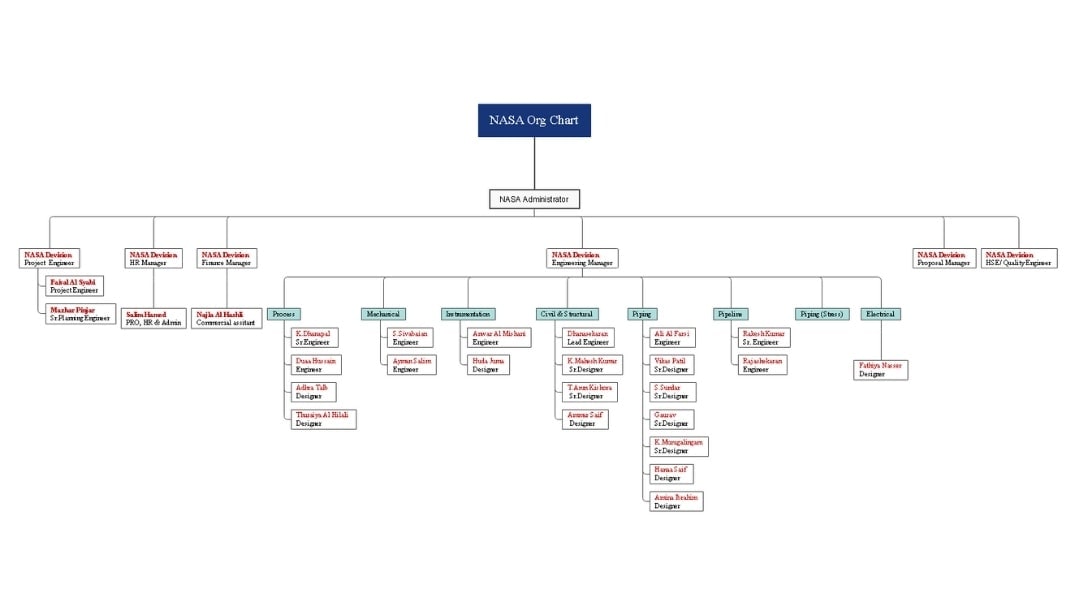
Step3 Modify the Layout
Delete the branches that you don't need to avoid the clutter Add more branches by copying and pasting existing ones.
The template's formatting automatically applies to new branches you add if you copy and paste. Change the template's default theme for enhanced personalization.
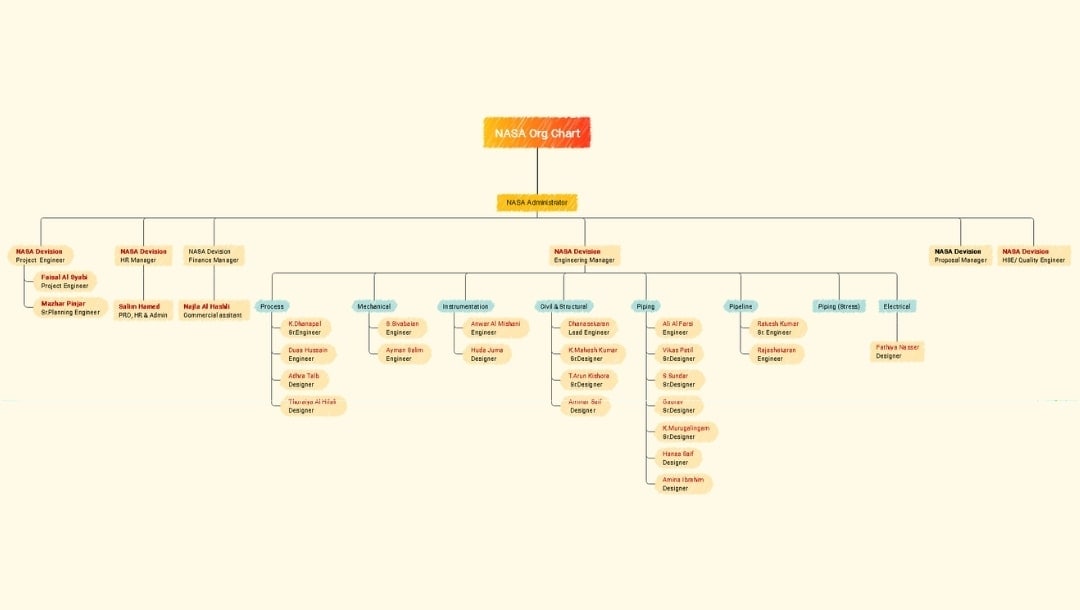
Step4 Save Template Changes
Save your modified template for future use. Export the completed chart as a PDF or an image. The template keeps its formatting in any export format you choose.
Final Thoughts
NASA's framework is proof that effective teamwork relies on a clear structure.
Its matrix approach, dual reporting, and dedicated centers create balance and accountability. That's why it's survived leadership changes, funding challenges, and failed missions.
A clear chart often reveals more than a long explanation. While mapping it in EdrawMind, I discovered patterns missing in the written format. You can explore this further by designing your own charts for school, work, or research.
FAQs
-
What is the span of control?
It refers to the number of people who report to a single manager. Five to seven direct reports is common. Very simple work can allow more, complex work often needs fewer. -
How does NASA decide what work is done in-house versus by contractors?
NASA keeps critical research, safety, and mission control work in-house. Tasks that require specialized equipment or can be performed more efficiently by private companies are typically handled by contractors. -
What is a matrix team on an org chart?
A matrix means you have a direct manager and a project lead. Show a solid line to the manager and a dotted line to the project lead. -
How does NASA work with international partners while meeting export rules?
NASA follows U.S. export control laws, including ITAR and EAR. All international projects go through review and agreements that define what data and technology can be shared safely.
 EdrawMind
AppsEdrawMind Online
EdrawMind
AppsEdrawMind Online