About this World Historical Events Timeline Template
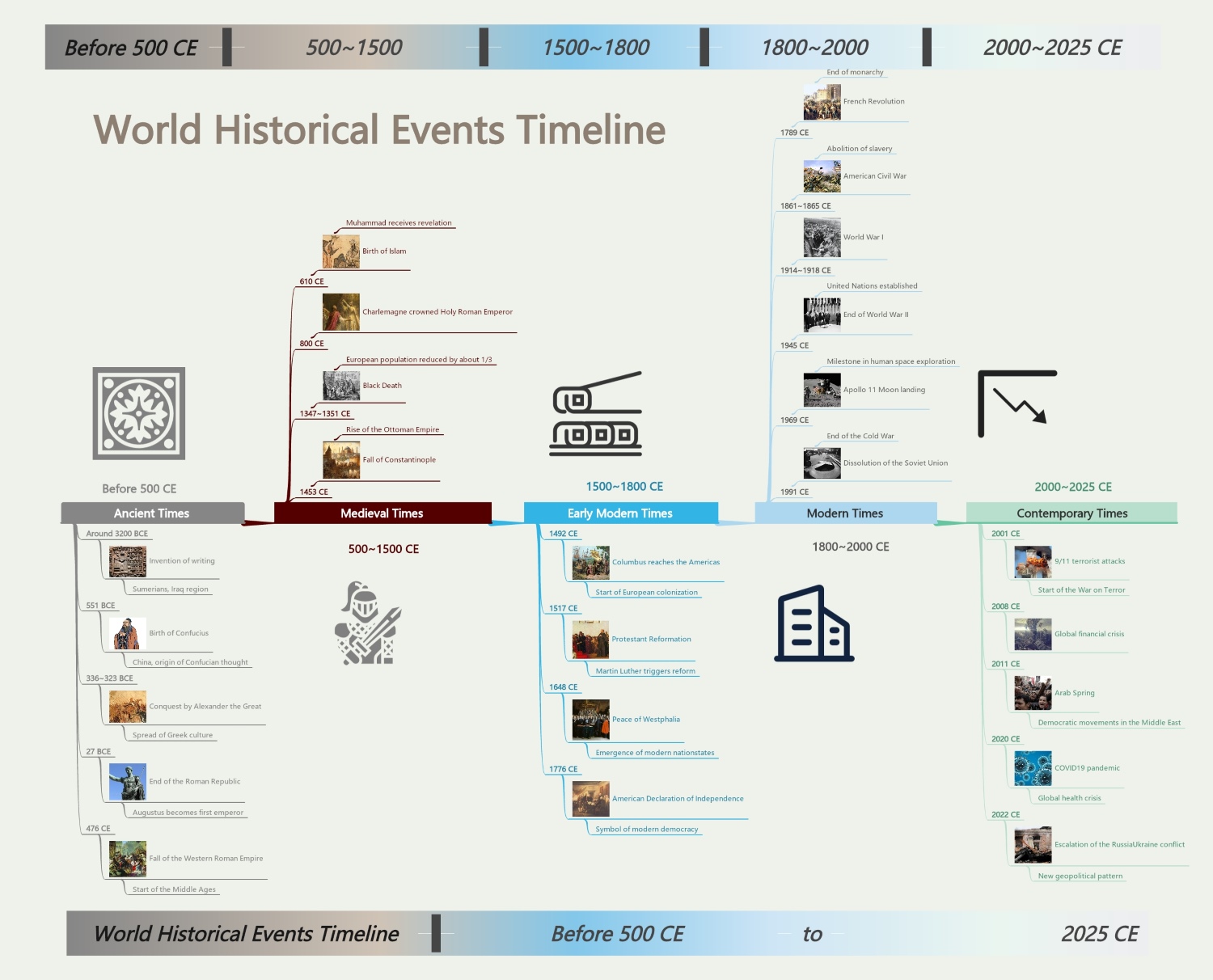
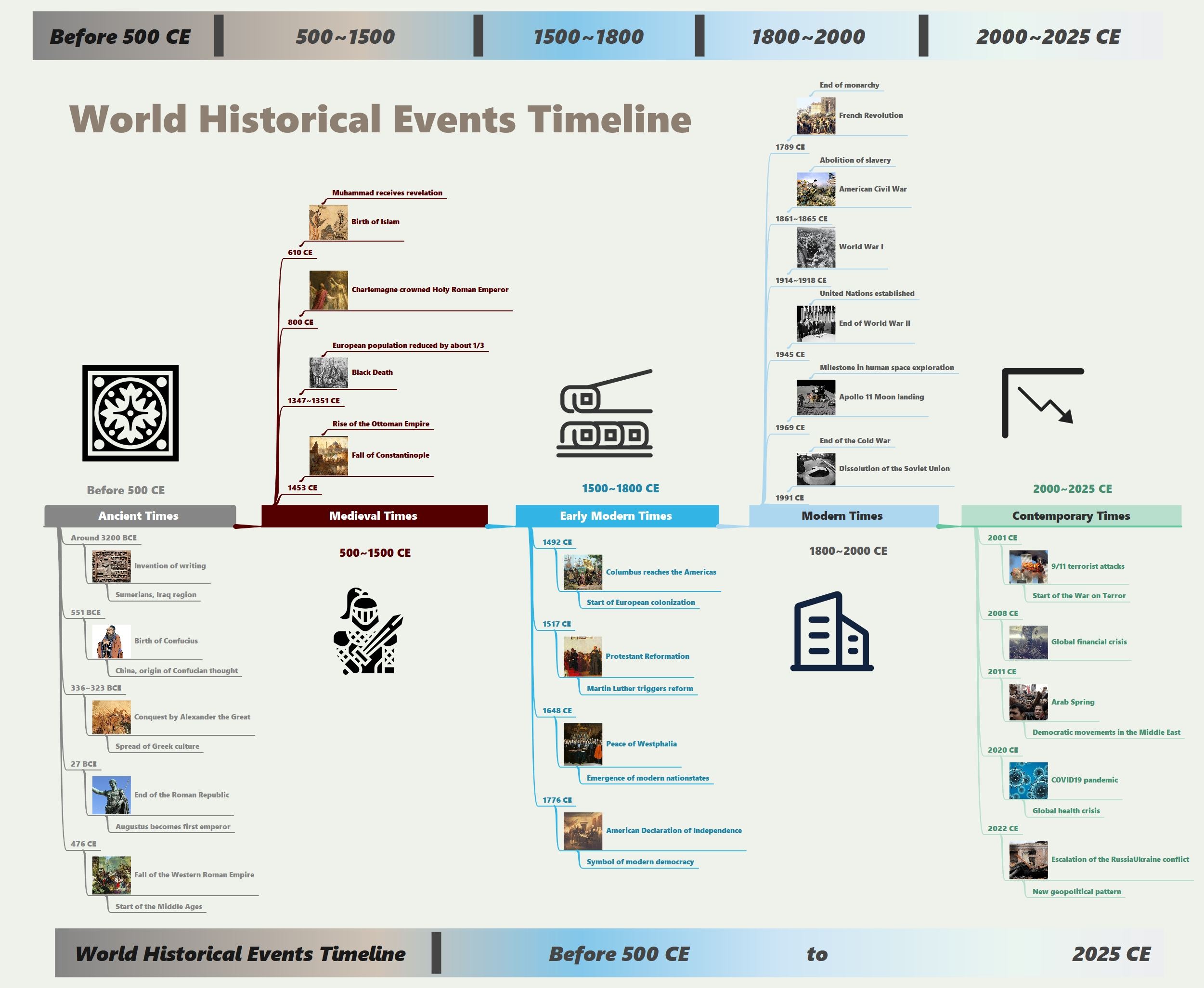
This template organizes world history by major eras instead of treating the subject as one long undifferentiated chronology. It uses time-period branches to show how key events, empires, ideas, wars, revolutions, and crises shape the transition from ancient civilization to the contemporary world.
Before 500 CE
This branch covers the ancient world and early classical period. The events shown here include the invention of writing, the birth of Confucius, the conquests of Alexander the Great, and the end of the Roman Republic, which together highlight the foundations of recorded civilization, philosophy, empire, and early state formation.
500~1500 CE
This section focuses on the medieval era. It includes the fall of the Western Roman Empire, the birth of Islam, the crowning of Charlemagne, the Black Death, and the fall of Constantinople, showing how religion, empire, plague, and regional power shifts shaped the structure of the medieval world.
1500~1800 CE
This branch represents the early modern period. It highlights Columbus reaching the Americas, the Protestant Reformation, the Peace of Westphalia, the American Declaration of Independence, and the French Revolution, which together mark colonization, religious upheaval, new state systems, and major political transformations.
1800~2000 CE
This section covers the modern era through industrial conflict and global restructuring. The timeline includes the American Civil War, World War I, the end of World War II, the Apollo 11 Moon landing, and the dissolution of the Soviet Union, helping readers connect war, emancipation, scientific progress, and geopolitical realignment.
2000~2025 CE
This branch focuses on the contemporary period. It highlights the 9/11 attacks, the global financial crisis, the Arab Spring, the COVID-19 pandemic, and the escalation of the Russia-Ukraine conflict, showing how security, economics, democratic movements, health crises, and shifting power relations define recent global history.
FAQs about this Template
-
What is a world history timeline?
A world history timeline is a structured sequence of major events used to show how different historical periods connect across time. It is useful because it helps readers move from isolated facts to a broader understanding of progression, influence, and turning points.
-
How do you build a clear historical events timeline?
A clear historical events timeline usually starts by selecting major milestones, then arranging them in sequence and adding enough context to show why each event matters. Good timelines help readers understand change over time without overcrowding the visual with minor details.
-
Why are world historical timelines useful?
World historical timelines are useful because they make it easier to compare eras, notice cause-and-effect relationships, and understand why some events had wider long-term influence than others. They turn scattered dates into a more readable story of change.
-
What's the difference between a timeline and a history overview?
A timeline emphasizes order and turning points, while a history overview is usually broader and more explanatory. Both can cover the same topic, but the timeline is especially useful when sequence itself is important to understanding.