About the world history main events timeline
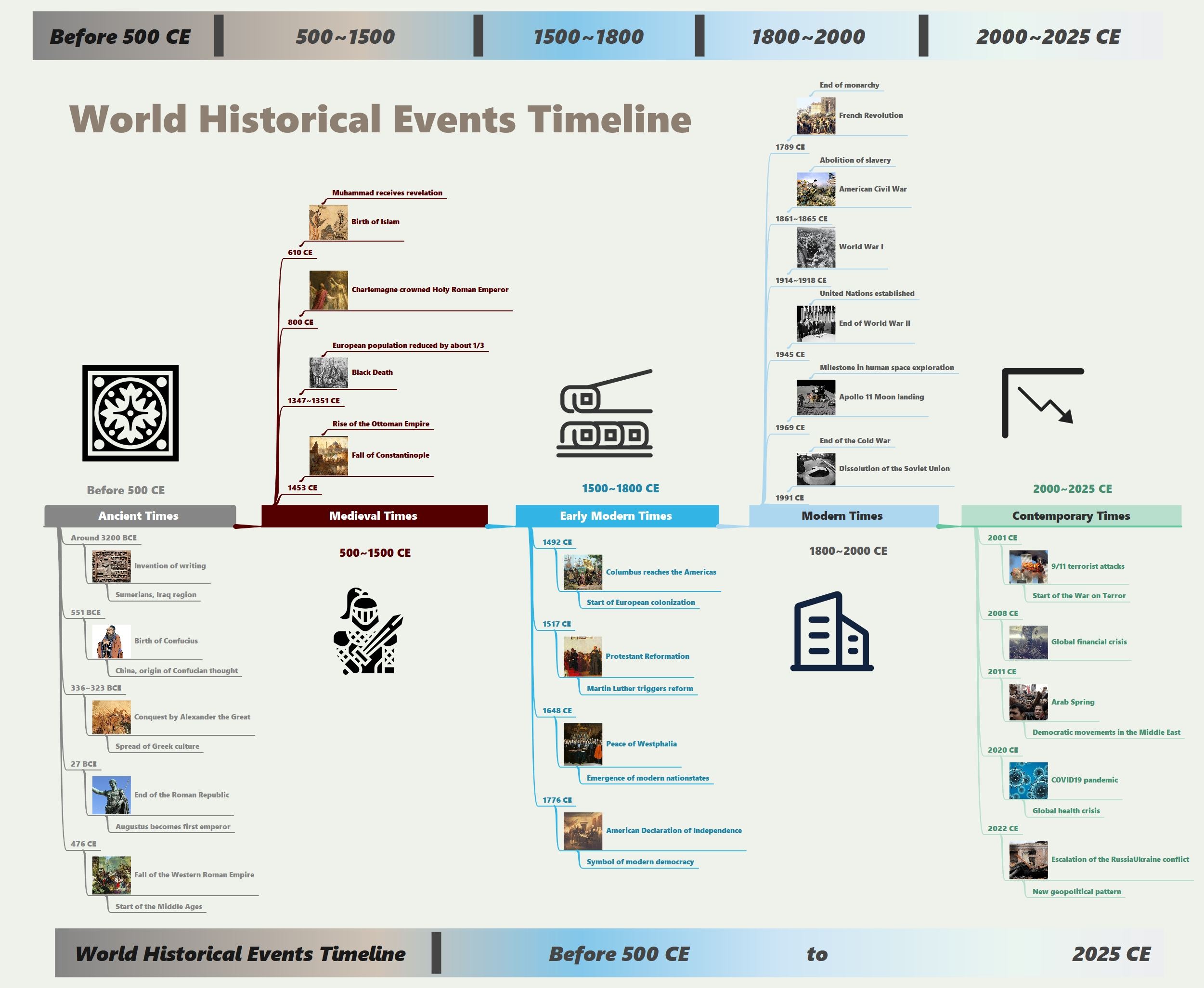
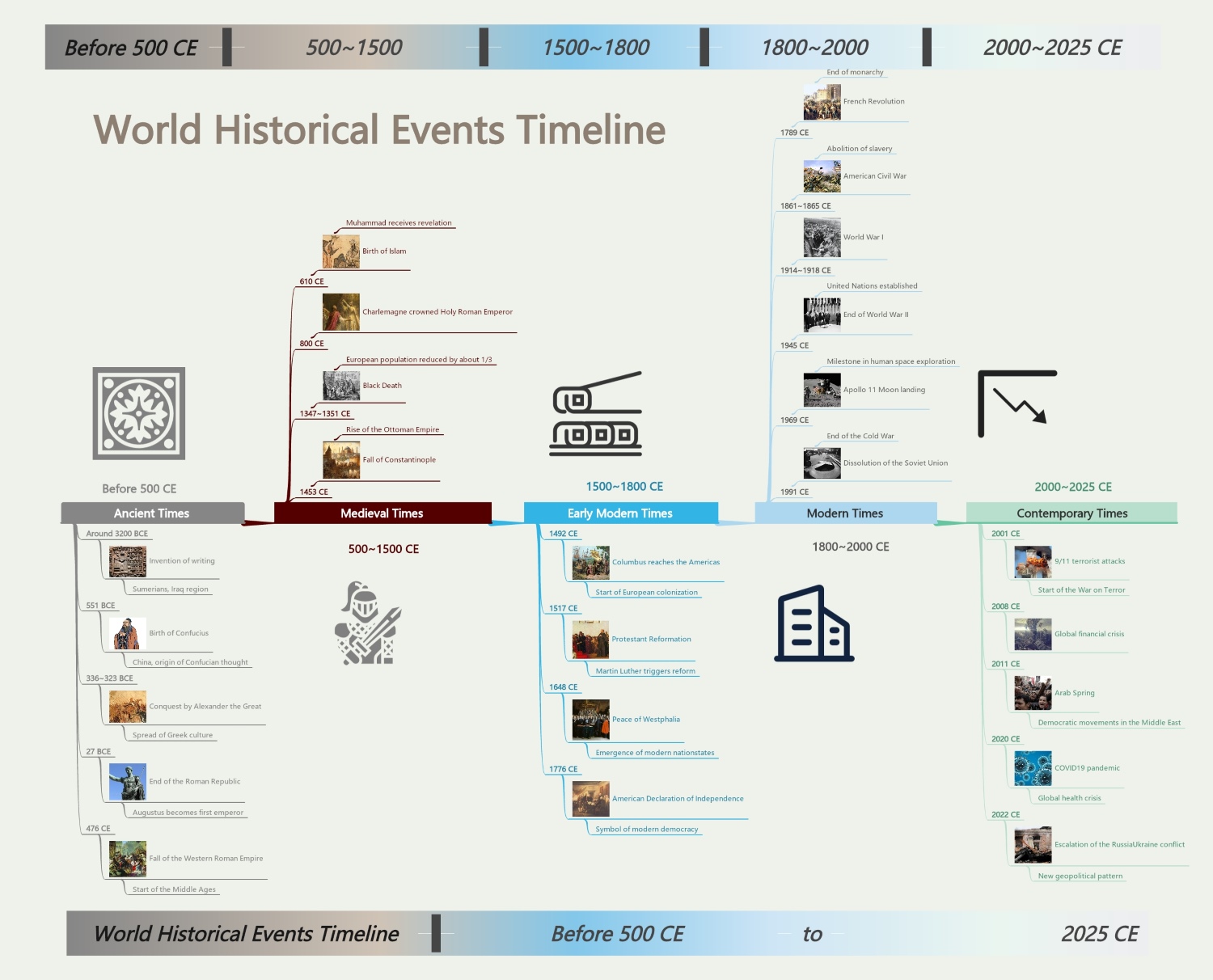
This world history timeline template provides a structured visual map of major global milestones. It categorizes historical eras from ancient times to the current day, helping students and educators visualize the flow of human progress easily and effectively.
Ancient Times (Before 500 CE)
Ancient history marks the beginning of human civilization and organized society. It covers the invention of written records, the rise of powerful empires, and the development of major philosophical and religious schools of thought worldwide.
- Invention of writing (3200 BCE)
- Birth of Confucius (551 BCE)
- Conquests of Alexander the Great (336-323 BCE)
- End of the Roman Republic (27 BCE)
- Fall of the Western Roman Empire (476 CE)
Medieval Times (500-1500 CE)
The Middle Ages were characterized by significant religious expansion and political restructuring. This era saw the spread of Islam, the unification of much of Europe under Charlemagne, and devastating events like the Black Death plague.
- Birth of Islam and Muhammad’s revelation (610 CE)
- Charlemagne was crowned Holy Roman Emperor (800 CE)
- The Black Death pandemic (1347-1351 CE)
- Fall of Constantinople and Ottoman rise (1453 CE)
Early Modern Times (1500-1800 CE)
Early modern history was defined by global exploration and intellectual revolution. Europeans reached the Americas, the church faced major reforms, and the concept of the nation-state emerged alongside the birth of modern democratic ideals in America.
- Columbus reached the Americas (1492 CE)
- Protestant Reformation by Martin Luther (1517 CE)
- Peace of Westphalia (1648 CE)
- American Declaration of Independence (1776 CE)
Modern Times (1800-2000 CE)
This era experienced rapid industrialization and global conflict. It includes major revolutions, two world wars, and the space race. These events led to the creation of the United Nations and the eventual end of the Cold War.
- French Revolution and end of monarchy (1789 CE)
- American Civil War and abolition (1861-1865 CE)
- World War I (1914-1918 CE)
- End of World War II and the UN was established (1945 CE)
- Apollo 11 moon landing (1969 CE)
- Dissolution of the Soviet Union (1991 CE)
Contemporary Times (2000-2025 CE)
The 21st century focuses on global interconnectedness and modern challenges. Key events include global terrorism, economic crises, and democratic movements. Recent years have been shaped by a worldwide health pandemic and shifting geopolitical landscapes in Eastern Europe.
- 9/11 terrorist attacks (2001 CE)
- Global financial crisis (2008 CE)
- Arab Spring movements (2011 CE)
- COVID-19 pandemic (2020 CE)
- Russia-Ukraine conflict escalation (2022 CE)
FAQs about this Template
-
Why is understanding the fall of the Roman Empire important?
Understanding the fall of the Western Roman Empire in 476 CE is crucial because it marks the end of ancient history and the start of the Middle Ages. This transition led to the decentralization of power in Europe and the rise of feudalism. It fundamentally changed the political and cultural landscape of the continent for centuries.
-
How did the Protestant Reformation change global history?
The Protestant Reformation, sparked by Martin Luther in 1517, fractured the religious unity of Western Europe. It encouraged individual interpretation of texts and reduced the political power of the Catholic Church. This movement paved the way for modern individualism, increased literacy rates, and the eventual development of the modern nation-state system.
-
What role did the industrial era play in modern history?
While not a single date, the developments within the modern era section, like the world wars and space exploration, were driven by industrial growth. This period transformed economies from agricultural to industrial. It led to urban migration, technological breakthroughs, and the complex international relations we see today, ultimately shaping our contemporary technological world.