About this Famous Female Historical Figures template
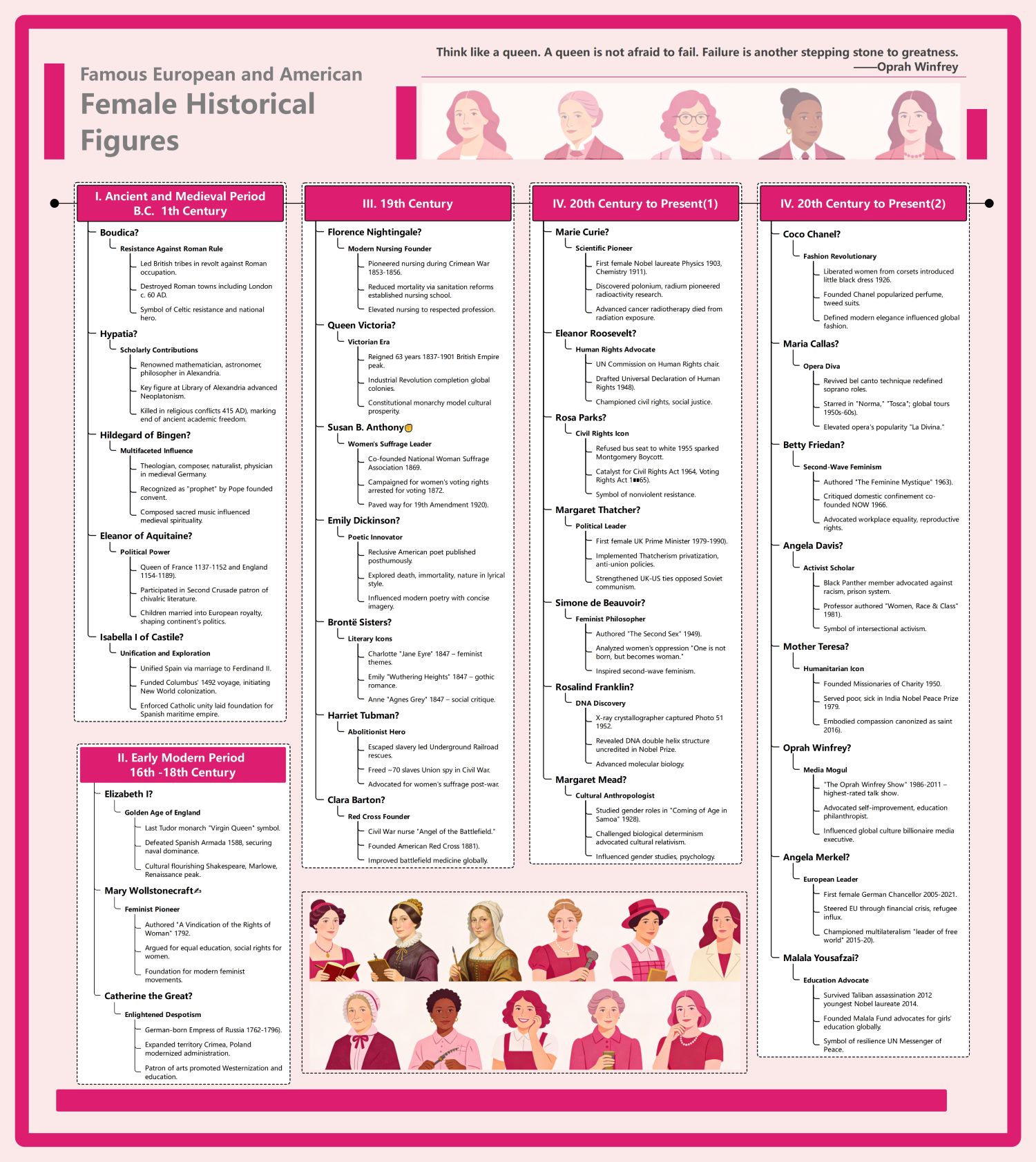
This template offers a detailed visual timeline of influential women from the 1st century to the present. It categorizes pioneers by era, making it an excellent resource for students and history enthusiasts to track progress in women's rights and global leadership.
Ancient and Medieval Period
This section highlights women who led tribal revolts or excelled in philosophy during early history. These figures managed to hold significant power and influence. They often challenged the male-dominated structures of the Roman and medieval worlds.
- Boudica: Led British tribes in revolt against Roman occupation
- Hypatia: Renowned mathematician and philosopher in Alexandria
- Hildegard of Bingen: Composer and multifaceted influencer in medieval Germany
- Eleanor of Aquitaine: Powerful queen of France and England
- Isabella I of Castile: Funded Columbus and unified Spain
Early Modern Period
During the 16th to 18th centuries, powerful queens and writers emerged to change society. They ruled large empires and began the early fight for women's rights. Their work paved the way for modern political and social movements.
- Elizabeth I: Led England during a golden age of culture and power
- Mary Wollstonecraft: Author and pioneer for equal education for women
- Catherine the Great: Modernized Russia through enlightened despotism
19th Century Pioneers
The 19th century was a turning point for women's rights and professional nursing. Many figures in this era fought for abolition and suffrage. Their literary and medical contributions continue to influence how we view human rights today.
- Florence Nightingale: Founder of modern nursing and healthcare reforms
- Queen Victoria: Symbol of Victorian values and British imperial peak
- Susan B. Anthony: Key leader in the women's suffrage movement
- Emily Dickinson: Poetic innovator who influenced modern literature
- Brontë Sisters: Literary icons behind classics like Jane Eyre
- Harriet Tubman: Abolitionist hero who led the Underground Railroad
- Clara Barton: Founder of the American Red Cross
20th Century to Present (Part 1)
This era features pioneers in science, civil rights, and political leadership. These women broke major barriers in physics and human rights advocacy. Their courage sparked massive social changes that defined the modern world and promoted global equality for everyone.
- Marie Curie: First female Nobel laureate in Physics and Chemistry
- Eleanor Roosevelt: Human rights advocate and UN commission chair
- Rosa Parks: Civil rights icon who sparked the Montgomery Boycott
- Margaret Thatcher: First female UK Prime Minister
- Simone de Beauvoir: Feminist philosopher and author of The Second Sex
- Rosalind Franklin: Key figure in the discovery of DNA structure
- Margaret Mead: Cultural anthropologist who studied gender roles
20th Century to Present (Part 2)
Recent decades have seen women dominate fashion, arts, and global politics. From education advocates to media moguls, these figures inspire millions. They represent the diverse ways women lead in the modern era, showing strength across many different professional fields.
- Coco Chanel: Fashion revolutionary who redefined modern elegance
- Maria Callas: Opera diva known for reviving bel canto technique
- Betty Friedan: Leading figure in second-wave feminism
- Angela Davis: Activist scholar and symbol of intersectional activism
- Mother Teresa: Humanitarian icon and founder of Missionaries of Charity
- Oprah Winfrey: Media mogul and influential global philanthropist
- Angela Merkel: Long-serving German Chancellor and European leader
- Malala Yousafzai: Education advocate and youngest Nobel laureate
FAQs about this Template
-
Why is it important to study female historical figures?
Studying female historical figures provides a balanced perspective on human history that was often overlooked in the past. It highlights the significant contributions women made in science, politics, and social justice despite facing systemic barriers. By learning about their struggles and triumphs, we gain a more inclusive understanding of how our current society was built and the diverse voices that shaped it.
-
Who are some notable women in science from history?
Marie Curie is perhaps the most famous, being the first woman to win a Nobel Prize for her work on radioactivity. Rosalind Franklin also played a vital role in discovering the DNA structure, though her contributions were initially uncredited. These women, along with mathematicians like Hypatia, paved the way for future generations of female scientists to excel in STEM fields worldwide.
-
How did women influence political change in the 19th and 20th centuries?
Women like Susan B. Anthony and Harriet Tubman were instrumental in pushing for suffrage and the abolition of slavery. In the 20th century, leaders like Margaret Thatcher and Angela Merkel broke the glass ceiling in high-level politics. Their leadership showed that women could effectively manage national crises, steer economic policies, and lead global alliances, fundamentally changing the political landscape forever.