About this Sequences and Series template
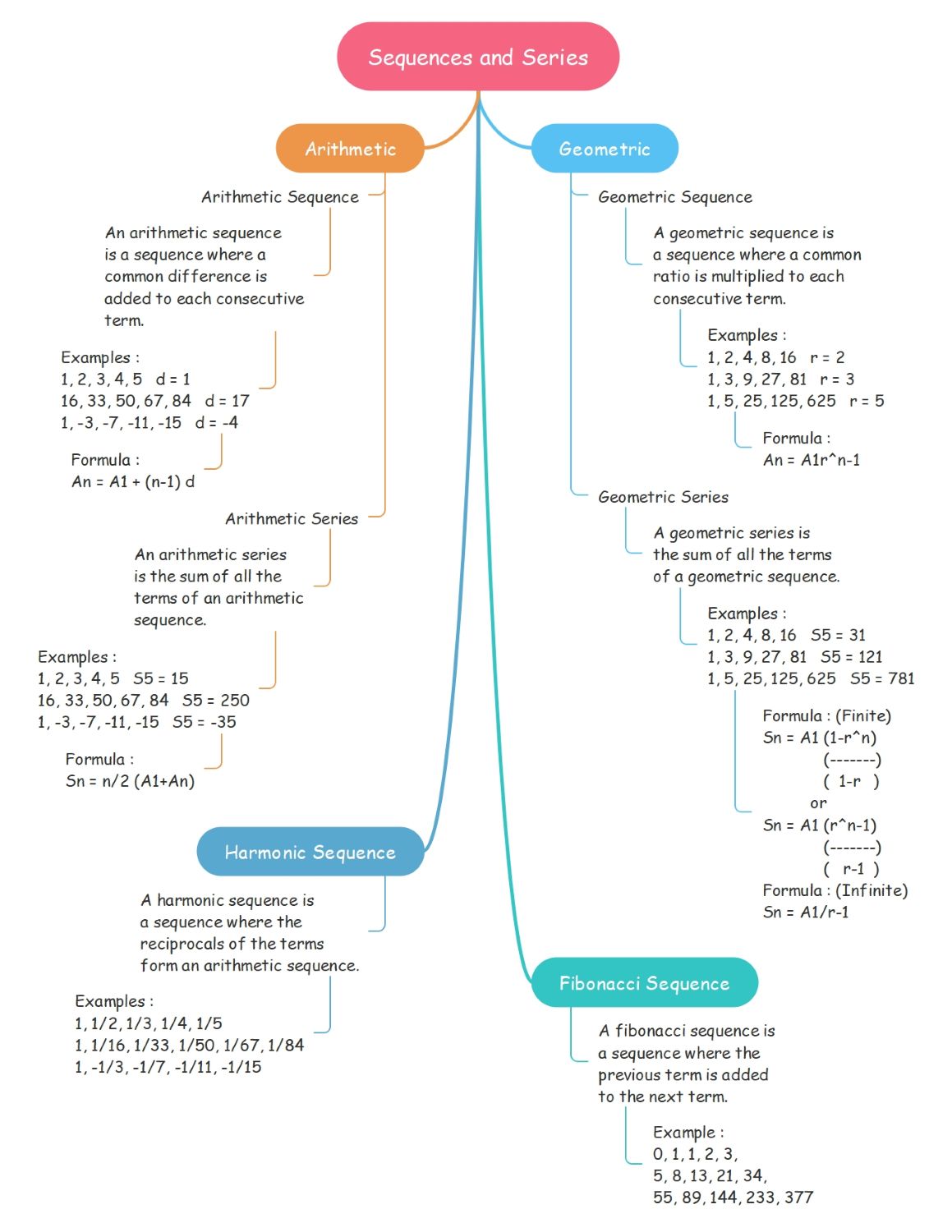
This comprehensive mind map template simplifies the study of sequences and series. It breaks down complex mathematical concepts into visual categories, making it easier for students to memorize formulas, identify specific patterns, and solve algebraic problems effectively through structured visual learning.
Arithmetic Concepts
Arithmetic sequences and series involve constant addition or subtraction. These patterns are defined by a common difference between consecutive terms, which is used to find specific values or calculate the total sum of the entire progression.
- Arithmetic Sequence: An = A1 + (n-1)d
- Arithmetic Series: The sum of terms in an arithmetic sequence
- Common Difference (d): The fixed amount added to each term
- Example: 1, 2, 3, 4, 5 where d=1
Geometric Concepts
Geometric sequences and series are based on constant multiplication or division. Every term is found by multiplying the previous one by a common ratio. This type of progression is essential for understanding exponential growth and decay models.
- Geometric Sequence: An = A1 * r^(n-1)
- Geometric Series: The total sum of a geometric progression
- Common Ratio (r): The constant multiplier between terms
- Finite and Infinite Series Formulas
Harmonic Sequence
A harmonic sequence is a unique mathematical pattern where the reciprocals of the terms create an arithmetic sequence. These are commonly used in physics and music theory to describe wave frequencies and physical resonance in different systems.
- Reciprocal Relationship with Arithmetic Sequences
- Musical Harmony Applications
- Mathematical Divergence Analysis
- Example: 1, 1/2, 1/3, 1/4, 1/5
Fibonacci Sequence
The Fibonacci sequence is a famous numerical pattern where each number is the sum of the two preceding ones. This sequence appears frequently in nature, from the arrangement of leaves to the spirals of galaxy formations.
- Recursive Addition Pattern
- Natural Growth Representation
- Golden Ratio Connection
- Example: 0, 1, 1, 2, 3, 5, 8, 13, 21
FAQs about this Template
-
What is the main difference between a sequence and a series?
A sequence is an ordered list of numbers following a specific rule, where each individual number is called a term. In contrast, a series is the sum of all the terms within that sequence. While a sequence identifies the individual components of a pattern, the series focuses on the cumulative total. Understanding this distinction is crucial for applying the correct mathematical formulas.
-
How do you find the common ratio in a geometric sequence?
To find the common ratio in a geometric sequence, you must divide any term by the term that immediately precedes it. If the result remains constant throughout the entire list, that value is the common ratio. This ratio is represented by the letter r in formulas. It determines whether the sequence grows exponentially or shrinks toward zero over time in your calculations.
-
Where are sequences and series used in real-life applications?
Sequences and series have many practical applications in the real world. In finance, they help calculate compound interest and loan repayments over time. In computer science, they are used to develop efficient algorithms and process digital signals. Engineers also use these patterns to analyze structural stability and sound waves, making them indispensable tools for modern scientific and technological advancements today.