About this scientific method steps template
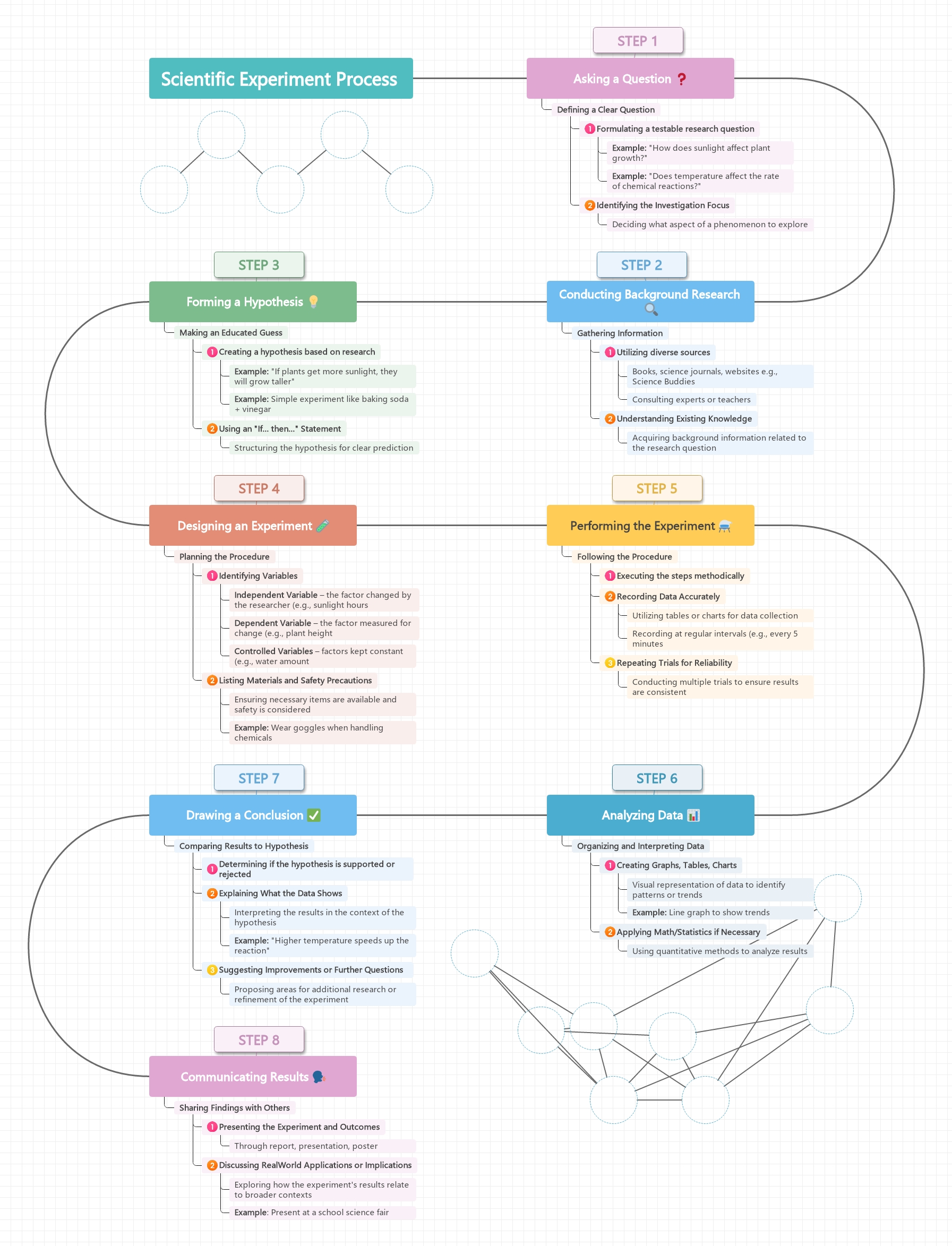
This template outlines the eight essential phases of the scientific experiment process. It helps students and researchers visualize the flow from initial inquiry to final communication. Use this map to guide your next classroom lab or professional research project effectively.
Step 1: Asking a Question
The process begins by defining a clear and testable research question. You must identify a specific phenomenon to explore and decide which aspect of that event warrants a deeper investigation to find meaningful answers.
- Formulating a testable research question
- Identifying the investigation focus
Step 2: Conducting Background Research
Before starting your experiment, you must gather information from diverse sources. Consult science journals, books, and experts to understand existing knowledge. This step ensures you are not repeating work that others have already completed.
- Utilizing diverse sources
- Understanding existing knowledge
Step 3: Forming a Hypothesis
A hypothesis is an educated guess based on your preliminary research. Scientists often use an If... then... statement to structure their predictions. This makes it easier to measure whether the experiment results actually support your original theory.
- Creating a hypothesis based on research
- Using an If... then... statement
Step 4: Designing an Experiment
Planning the procedure requires careful identification of independent, dependent, and controlled variables. You must also list all necessary materials and safety precautions. Clear planning prevents errors and keeps the researcher safe during the testing phase.
- Identifying Variables
- Listing Materials and Safety Precautions
Step 5: Performing the Experiment
Execution must be methodical to ensure the results are valid and reliable. You should record all data accurately using tables or charts at regular intervals. Repeating multiple trials helps confirm that your findings are not accidental.
- Executing the steps methodically
- Recording Data Accurately
- Repeating Trials for Reliability
Step 6: Analyzing Data
Once the experiment is complete, you must organize and interpret the collected data. Creating visual aids like graphs or charts helps identify patterns. Applying math or statistics allows for a more quantitative analysis of the outcomes.
- Creating Graphs, Tables, Charts
- Applying Math/Statistics if Necessary
Step 7: Drawing a Conclusion
Compare your results to your original hypothesis to determine if it is supported or rejected. Explain what the data shows in a broader context. You should also suggest improvements or further questions for future research.
- Comparing Results to Hypothesis
- Explaining What the Data Shows
- Suggesting Improvements or Further Questions
Step 8: Communicating Results
The final step involves sharing your findings with others through reports, posters, or presentations. Discuss the real-world implications of your work. This sharing process is vital for the scientific community to review and build upon your study.
- Presenting the Experiment and Outcomes
- Discussing Real-World Applications or Implications
FAQs about this Template
-
Why is background research necessary before forming a hypothesis?
Background research is critical because it prevents you from repeating experiments that have already been conducted. It provides a foundation of existing knowledge that informs your hypothesis. By understanding what others have discovered, you can refine your question and choose more effective methods. This ensures your study adds something valuable and original to the scientific community.
-
What is the difference between an independent and a dependent variable?
An independent variable is the factor that the researcher intentionally changes to observe its effects. In contrast, the dependent variable is the outcome being measured or tested in response to those changes. For example, if you change light levels to see how a plant grows, light is independent while growth height is the dependent variable.
-
Why should scientists repeat trials during an experiment?
Scientists repeat trials to ensure their results are consistent and reliable over time. Performing a test only once might lead to conclusions based on a random error or a fluke occurrence. By conducting multiple trials, you can average the data and reduce the impact of outliers. This verification process makes the final conclusions much more credible.