About this Transitive and Intransitive Verbs template
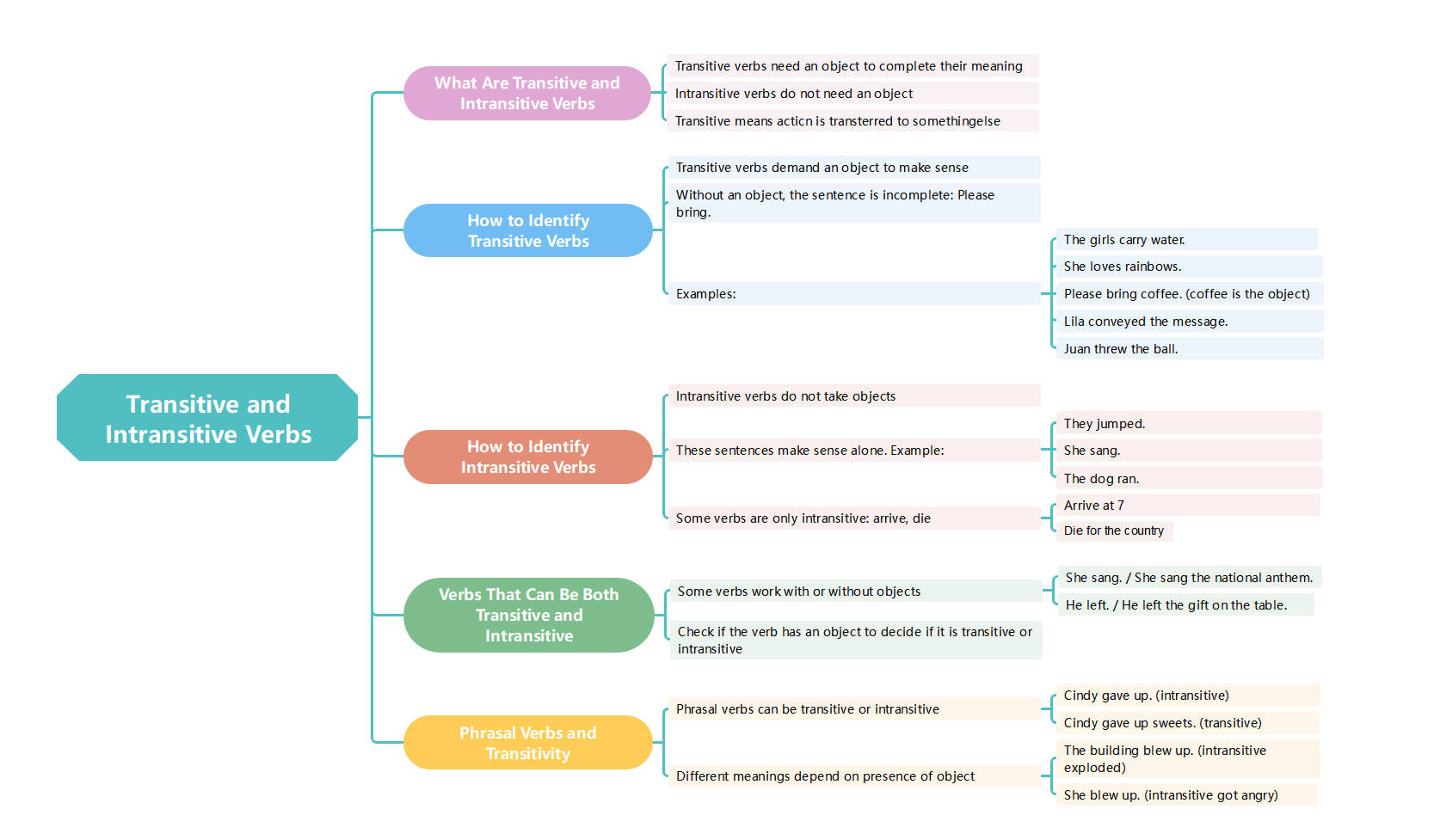
This transitive and intransitive verbs mind map template provides a clear visual breakdown of verb types. Use it to understand how objects change sentence meaning. It is a perfect tool for students, teachers, and language learners who want to improve their English grammar and writing skills effectively.
What Are Transitive and Intransitive Verbs
Transitive verbs need a direct object to convey their meaning. In contrast, intransitive verbs express an action that is complete by itself. Understanding this difference is key to forming clear sentences that correctly describe actions and subjects.
- Transitive verbs need an object to complete their meaning. Transitive means the action is transferred to something else
- Intransitive verbs do not need an object.
How to Identify Transitive Verbs
Transitive verbs always demand an object to make sense in a sentence. Without a direct object, the thought remains incomplete. You can identify them by asking 'what' or 'whom' after the verb to find the receiver.
Transitive verbs demand an object to make sense. Without an object, the sentence is incomplete (e.g., Please bring)
- The girls carry water
- She loves rainbows
- Please bring coffee
- Lila conveyed the message
- Juan threw the ball
How to Identify Intransitive Verbs
Intransitive verbs do not take direct objects because the action does not transfer to something else. These sentences make perfect sense on their own. Common examples include actions like sleeping, arriving, dying, or jumping during activities.
Intransitive verbs do not take objects. These sentences make sense alone
- They jumped
- She sang
- The dog ran
- Arrive at 7
- Die for the country
Verbs That Can Be Both Transitive and Intransitive
Some English verbs function as both transitive and intransitive depending on the context. You must check if the verb has an object in the sentence to decide. This flexibility allows for diverse sentence structures and more nuanced writing.
Some verbs work with or without objects. Check if the verb has an object to decide its type
- She sang (Intransitive) / She sang the national anthem (Transitive)
- He left (Intransitive) / He left the gift on the table (Transitive)
Phrasal Verbs and Transitivity
Phrasal verbs can be either transitive or intransitive. Their meanings often change significantly based on the presence of an object. Careful use of these phrases is important for conveying the correct message in your daily English communication.
Phrasal verbs can be transitive or intransitive. Different meanings depend on the presence of the object:
- Cindy gave up (Intransitive) / Cindy gave up sweets (Transitive)
- The building blew up (Intransitive) / She blew up (Intransitive got angry.
FAQs about this Template
-
How do I tell if a verb is transitive or intransitive?
To determine the type of verb, look for a direct object following the action. Ask the question 'What?' or 'Who?' after the verb. If there is a clear answer receiving the action, the verb is transitive. If the sentence is complete and makes sense without an object, then the verb is intransitive. Checking for these objects is the fastest method.
-
Can a single verb be both transitive and intransitive?
Yes, many English verbs are ergative or ambitransitive, meaning they function in both ways. For instance, in the sentence 'She sang,' the verb is intransitive. However, in 'She sang a song,' it becomes transitive because 'song' is the object. The classification depends entirely on how the verb is used within a specific sentence to convey a complete thought or action.
-
Why is it important to learn about verb transitivity?
Learning about verb transitivity is vital for mastering sentence structure and punctuation. It helps you avoid common grammatical errors like dangling modifiers or incomplete thoughts. By knowing which verbs require objects, you can write more precisely and clearly. This knowledge is especially helpful when learning passive voice, as only transitive verbs can be changed into a passive form during writing.