About this Class Schedule template
A weekly class schedule template organizes courses by day and time so students can see lectures, labs, study blocks, locations, and instructors in one place. This mind map version is especially useful for college students whose schedules vary by day or mix classes with labs and independent study.
What should a weekly class schedule include?
- Course name and section so repeated subjects are easy to distinguish.
- Day and start/end time for every lecture, lab, tutorial, or study group.
- Room or online location to reduce last-minute searching.
- Instructor or professor when multiple sections use the same course name.
- Study and assignment blocks when you want the schedule to support time planning, not just attendance.
Best fit and limitation
Best fit: students who want an at-a-glance weekly routine for recurring classes and study commitments. Limitation: a static weekly schedule is less suitable for one-off deadlines, changing shifts, or detailed assignment tracking; use a calendar or task planner alongside it for those items.
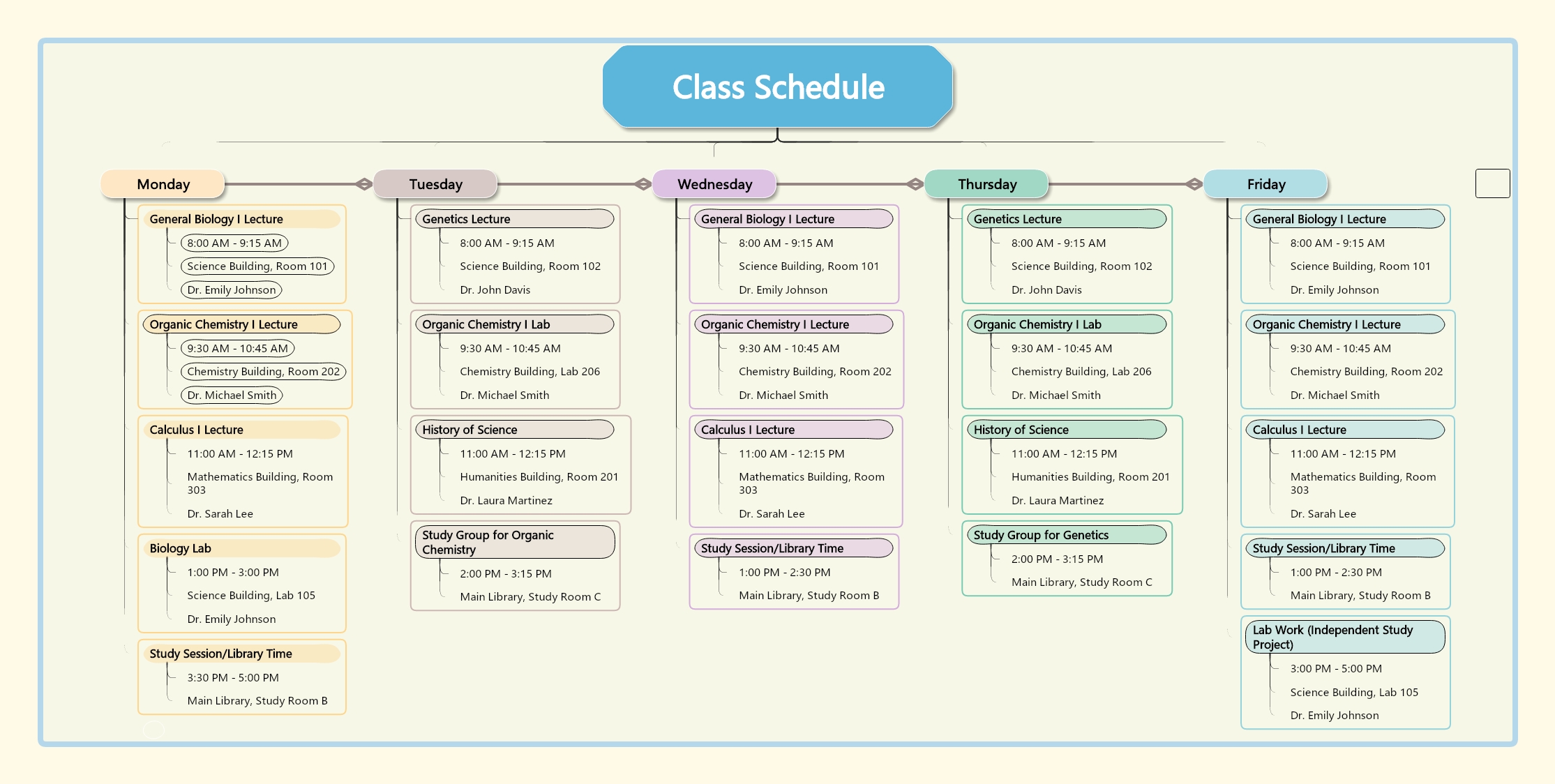
Monday
Start the week strong with core lectures in biology, chemistry, and calculus. This structured schedule provides a balance between classroom learning and essential lab work, with a dedicated study block at the end of the day.
- General Biology I Lecture (8:00 AM - 9:15 AM)
- Organic Chemistry I Lecture (9:30 AM - 10:45 AM)
- Calculus I Lecture (11:00 AM - 12:15 PM)
- Biology Lab (1:00 PM - 3:00 PM)
- Study Session/Library Time (3:30 PM - 5:00 PM)
Tuesday
Tuesday's routine emphasizes genetics and scientific history, offering a mix of complex lectures and practical lab experience. The afternoon features a collaborative study group session, allowing students to review difficult chemistry material with their peers.
- Genetics Lecture (8:00 AM - 9:15 AM)
- Organic Chemistry I Lab (9:30 AM - 10:45 AM)
- History of Science (11:00 AM - 12:15 PM)
- Study Group for Organic Chemistry (2:00 PM - 3:15 PM)
Wednesday
Midweek repeats the foundational lecture series, ensuring consistent progress in major subjects. The schedule concludes with a flexible library time slot, giving students space to catch up on readings or start working on upcoming assignments.
- General Biology I Lecture (8:00 AM - 9:15 AM)
- Organic Chemistry I Lecture (9:30 AM - 10:45 AM)
- Calculus I Lecture (11:00 AM - 12:15 PM)
- Study Session/Library Time (1:00 PM - 2:30 PM)
Thursday
Thursday mirrors the Tuesday schedule to maintain a stable academic rhythm. It combines specialized genetics lectures with an organic chemistry lab and a peer-led study group to help reinforce learning and prepare for exams.
- Genetics Lecture (8:00 AM - 9:15 AM)
- Organic Chemistry I Lab (9:30 AM - 10:45 AM)
- History of Science (11:00 AM - 12:15 PM)
- Study Group for Genetics (2:00 PM - 3:15 PM)
Friday
The week wraps up with core lectures followed by a unique opportunity for independent study in the lab. This time allows students to focus on individual projects and research before heading into the weekend.
- General Biology I Lecture (8:00 AM - 9:15 AM)
- Organic Chemistry I Lecture (9:30 AM - 10:45 AM)
- Calculus I Lecture (11:00 AM - 12:15 PM)
- Study Session/Library Time (1:00 PM - 2:30 PM)
- Lab Work / Independent Study (3:00 PM - 5:00 PM)
FAQs about this Template
-
How can a class schedule template improve my grades?
A class schedule template helps you visualize your entire academic week in one place. By mapping out lectures, labs, and study sessions, you can manage your time effectively and avoid last-minute stress. This organization ensures you allocate enough focus to difficult subjects like calculus or organic chemistry, which ultimately leads to better grades and a more balanced student life.
-
What information should I include in my class schedule?
A comprehensive class schedule should include the course name, lecture time, and precise location, such as the building and room number. It is also helpful to note the professor's name and block out specific times for labs and study groups. Including dedicated slots for library time ensures you have a routine for independent study, which is vital for long-term success.
-
Why is it important to schedule study groups and library time?
Scheduling specific blocks for library time and study groups provides the discipline needed to succeed in university. While lectures provide the foundation, group sessions allow you to discuss complex topics with classmates for better understanding. Library time offers a quiet, focused environment for deep work and research, helping you stay ahead of your course requirements and reduce academic pressure.