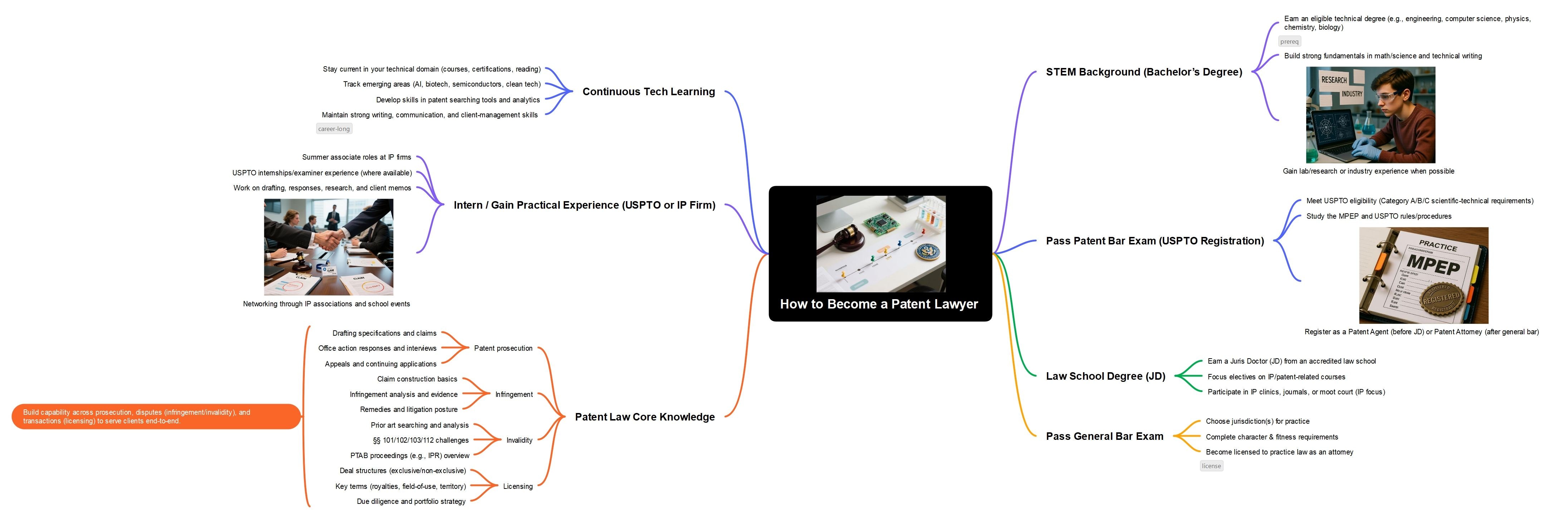
About this How to Become a Patent Lawyer Template
This template is structured as a profession-specific legal career guide. It focuses on the unusual requirement that patent lawyers need both legal training and an eligible technical background before moving into patent practice.
STEM Background
This branch highlights the technical degree requirement that distinguishes patent law from many other legal paths. It helps users understand that science or engineering preparation is a foundational part of the career, not an optional extra.
Eligible Technical Degree
This section makes the academic requirement more concrete by pointing users toward fields such as engineering, computer science, physics, chemistry, or biology. It helps connect the abstract idea of STEM training to real degree choices.
Pass Patent Bar Exam
This branch focuses on the registration process needed for patent practice before the USPTO. It gives the career path its profession-specific gate rather than treating patent law like a generic legal specialization.
Law School Degree (JD)
This section captures the conventional legal-education side of the route. It helps users connect technical eligibility with formal legal training instead of seeing the STEM background as the whole story.
Earn a Juris Doctor (JD)
This branch emphasizes completion of the degree and the transition into full legal qualification. It is useful for keeping the timeline clear between entering law school and finishing the professional credential.
Patent Practice Direction
This final section reflects the move from qualification into actual practice. It gives users room to think about prosecution, litigation, technology focus, and the kind of patent work they want to pursue.
FAQs about this Template
-
What does a patent lawyer do?
A patent lawyer usually works on legal issues connected to inventions, intellectual property protection, patent applications, and disputes over patent rights. The role often requires both legal reasoning and the ability to understand technical subject matter clearly enough to work with inventors and specialized claims.
-
How do you become a patent lawyer?
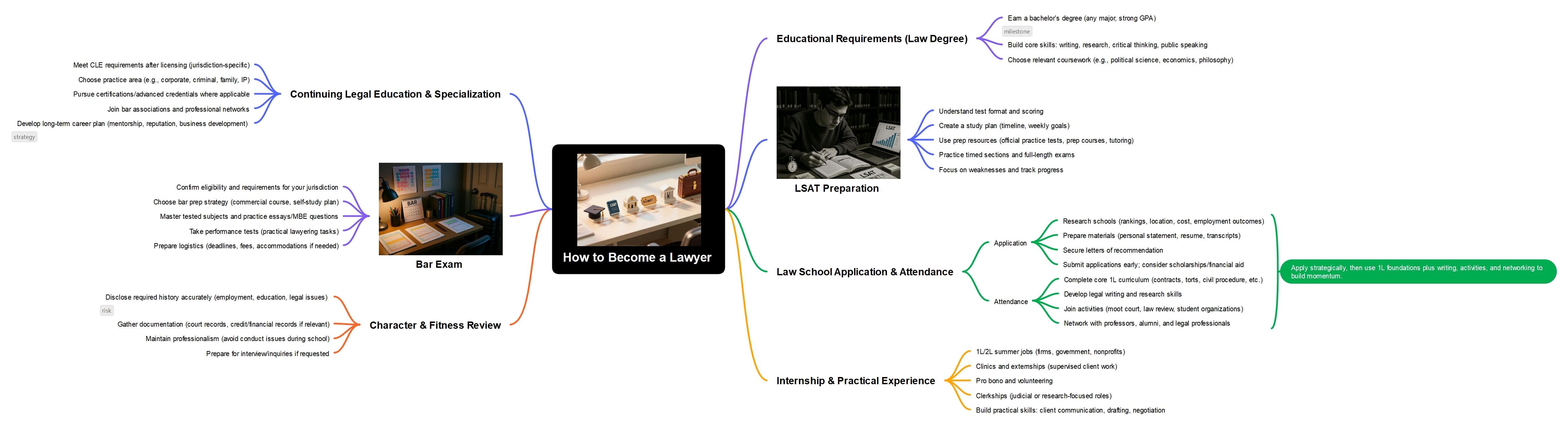
Becoming a patent lawyer usually involves completing the required legal education, meeting licensing requirements, and developing enough technical or scientific understanding to work effectively with patent-related matters. The exact path depends on the jurisdiction, but specialization is a major part of the role.
-
Why is patent law important?
Patent law is important because it helps define how inventions are protected, licensed, challenged, and commercialized. A strong understanding of patent law matters for innovation, competition, and the legal treatment of technical ideas in business and research settings.
-
What's the difference between a patent lawyer and a general corporate lawyer?
A patent lawyer focuses more on invention-related rights, applications, and disputes involving intellectual property, while a general corporate lawyer usually works more broadly on business structure, contracts, and company-related legal issues. Their practice areas can overlap, but the core expertise is different.