About this Civil Law vs Criminal Law Key Differences Template
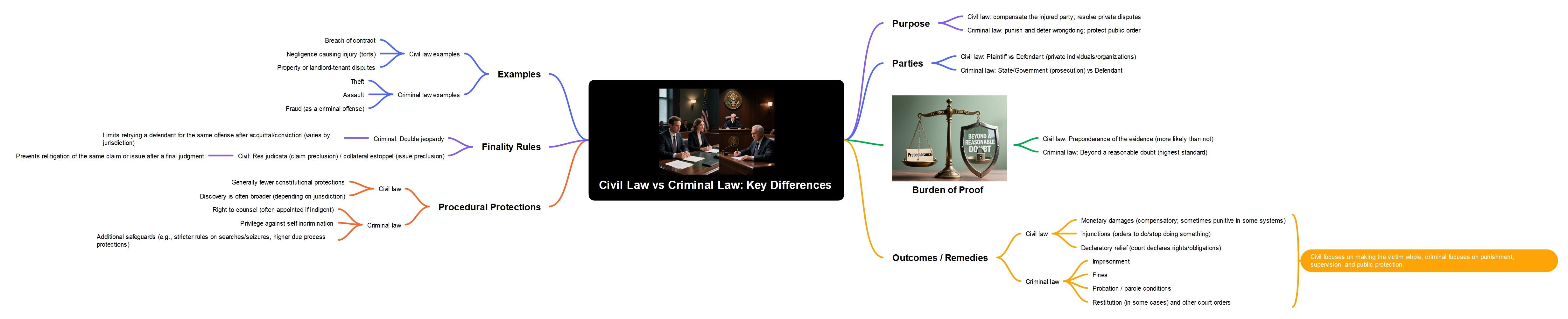
This “Civil Law vs Criminal Law: Key Differences” template organizes the comparison into direct contrast points, making legal distinctions easier to understand and remember.
Civil law: compensate the injured party; resolve private disputes
This node explains the core aim of civil law by focusing on compensation and dispute resolution between private parties.
- Use this branch to clarify the purpose of civil proceedings.
- Keep outcome-oriented wording tied to private disputes.
Criminal law: punish and deter wrongdoing; protect public order
This branch defines criminal law through punishment, deterrence, and the state’s interest in maintaining public order.
- Use this node to contrast public enforcement with private claims.
- Keep the social-order function visible.
Burden of Proof
This node introduces the evidentiary standard as a major dividing line between the two legal systems.
- Use this branch to compare legal thresholds directly.
- Attach each standard to the correct legal context.
Civil law: Preponderance of the evidence (more likely than not)
This branch explains the lower civil standard by showing that the claim only needs to be more likely true than not.
- Use this node to explain the civil threshold.
- Keep probability-based wording simple and direct.
Criminal law: Beyond a reasonable doubt (highest standard)
This branch highlights the stricter criminal standard, reflecting the higher stakes of prosecution and punishment.
- Use this node to stress why criminal proof is more demanding.
- Tie the standard to fairness and severity.
Outcomes / Remedies
This branch gathers the practical results of each legal path, helping readers compare what civil and criminal cases are meant to produce.
- Use this node to compare penalties, damages, or court-ordered results.
- Keep remedies aligned with the legal purpose of each system.
FAQs about this Template
-
What is civil law?
Civil law deals with disputes between individuals, businesses, or organizations, usually involving contracts, property, obligations, or compensation. The goal is typically to resolve a disagreement or provide a remedy rather than to punish someone for an offense against the state.
-
What is criminal law?
Criminal law deals with conduct considered an offense against the state or public order, such as theft, assault, or fraud. These cases are usually prosecuted by the government, and the consequences can include fines, probation, or imprisonment depending on the seriousness of the offense.
-
What's the difference between civil law and criminal law?
The main difference is purpose, parties, and outcome. Civil law usually resolves private disputes and focuses on remedies like damages or injunctions, while criminal law addresses public offenses and focuses on punishment, deterrence, or rehabilitation. The burden of proof and procedure are also different.
-
Why is understanding civil law and criminal law important?
Understanding the difference between civil law and criminal law helps people identify what kind of legal issue they are facing, who can bring the case, what kind of evidence matters, and what result is realistically possible. That distinction affects both legal strategy and real-world expectations.