About this Forms of corruption template
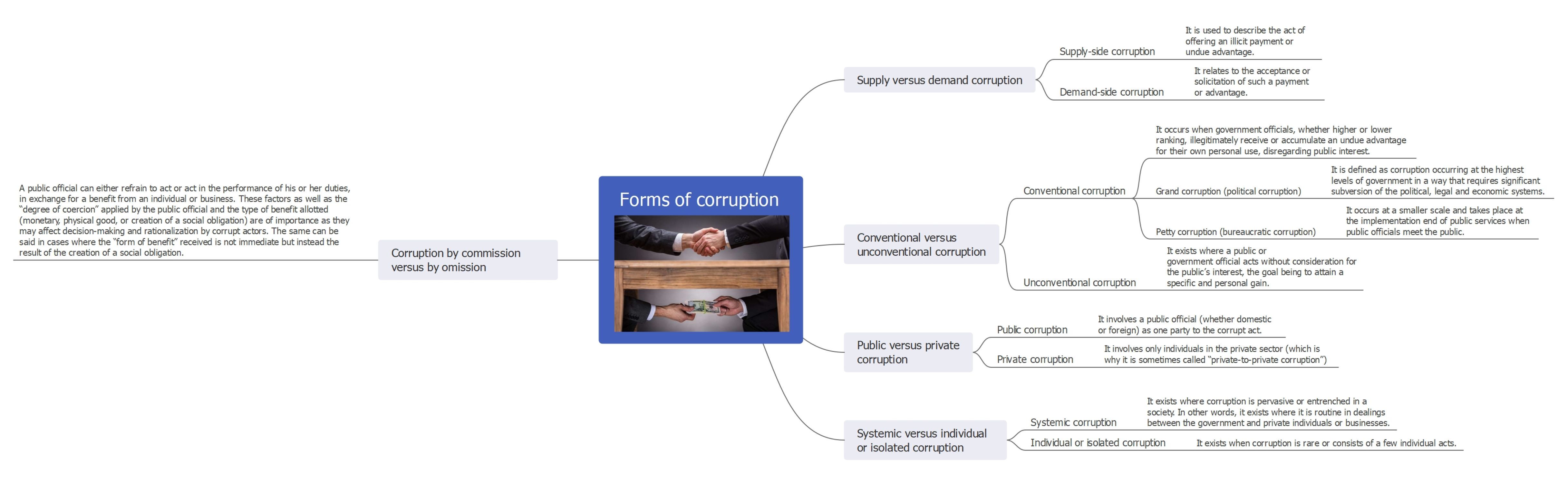
This template provides a comprehensive breakdown of the various ways corruption occurs in society. It categorizes unethical behaviors into logical branches to help students and professionals understand the nuances of systemic, public, and private misconduct.
Corruption by commission versus by omission
This section discusses how officials either act or fail to act to gain benefits. It includes factors like coercion levels and the types of rewards involved. These rewards can be physical goods or social obligations.
- Acting in performance of duties for a benefit
- Refraining from duty in exchange for a reward
- Degree of coercion applied by officials
- Creation of social obligations through benefits
Supply versus demand corruption
This category separates those who offer bribes from those who request them. Supply-side involves giving illicit payments, while demand-side focuses on soliciting or accepting these advantages. Both sides are critical to identifying corrupt exchanges.
- Supply-side: Offering illicit payments
- Demand-side: Soliciting or accepting advantages
- Undue advantages in exchange for actions
- Illicit payments for specific outcomes
Conventional versus unconventional corruption
Conventional corruption involves accumulating advantages while disregarding public interest. This can be grand, affecting entire systems, or petty, occurring at service points. Unconventional types focus on personal gain without any consideration for the public interest.
- Grand corruption at high government levels
- Petty corruption in bureaucratic services
- Political and legal subversion
- Unconventional personal gain for officials
Public versus private corruption
Public corruption always involves a government official as a party to the act. Conversely, private corruption happens entirely within the private sector. This is often referred to as private-to-private corruption and completely excludes state actors.
- Involvement of domestic or foreign public officials
- Private sector individual misconduct
- Private-to-private corrupt transactions
- Misuse of authority in non-governmental organizations
Systemic versus individual or isolated corruption
Systemic corruption is deeply entrenched and routine within a society or government. It becomes a standard way of doing business. Isolated corruption is rare and involves only a few specific, unconnected acts by individuals or groups.
- Pervasive and entrenched systemic corruption
- Routine dealings between government and business
- Rare or isolated individual acts
- Frequency and scale of corrupt behavior
FAQs about this Template
-
What is the difference between grand and petty corruption?
Grand corruption happens at the highest levels of government and significantly distorts political and legal systems. It often involves massive sums of money and top-tier officials. In contrast, petty corruption occurs during the delivery of daily public services. It usually involves small payments to low-level bureaucrats. Both forms undermine the rule of law and reduce trust in public institutions.
-
How does systemic corruption affect a society?
Systemic corruption occurs when unethical practices become routine within a government or society. It is no longer just a series of isolated incidents but a pervasive way of doing business. This form of corruption creates a high barrier for honest companies and citizens. It drains public resources and prevents economic growth by making bribery a requirement for standard administrative processes.
-
What defines private-to-private corruption?
Private-to-private corruption involves only individuals or organizations within the private sector. No public officials are involved in these transactions. An example might include a purchasing manager at one company accepting a bribe from a supplier to win a contract. While it does not involve the state, it still harms fair competition, increases costs for consumers, and violates corporate ethical standards.