


From the days when Roman legions would march across Gaul to the rise of kings and the uproar of revolution, each century has shaped the France we know today. The French history timeline reads like a dramatic novel that is filled with art and never-ending ambition.
Understanding this journey means diving headfirst into how the chronology of the Roman Empire set the foundation for France’s identity, law, and language. It will walk you through the turning points that defined not just France, but much of Europe itself. Let’s get started!
In this article
French History Timeline
France’s story is one that is full of fascinating transformations. Whether it was the tribal lands, the royal dynasties, or the major revolutions, the French history timeline has captured how a small region of Europe grew into such an influential nation.
Do you want to truly understand the roots of France? For this, we have to really go back into time, long before any kings and revolutions took place, to the days when the Roman Empire ruled most of Europe.
The journey of France’s uprising is much like that of the chronology of the Roman Empire. How so? Well, what began as a simple province of Gaul under Roman control later evolved into a massive kingdom and an empire. After that, it evolved into the republic we know today. Here’s a look back through time, and let’s see how the land of Gaul ended up becoming modern France.
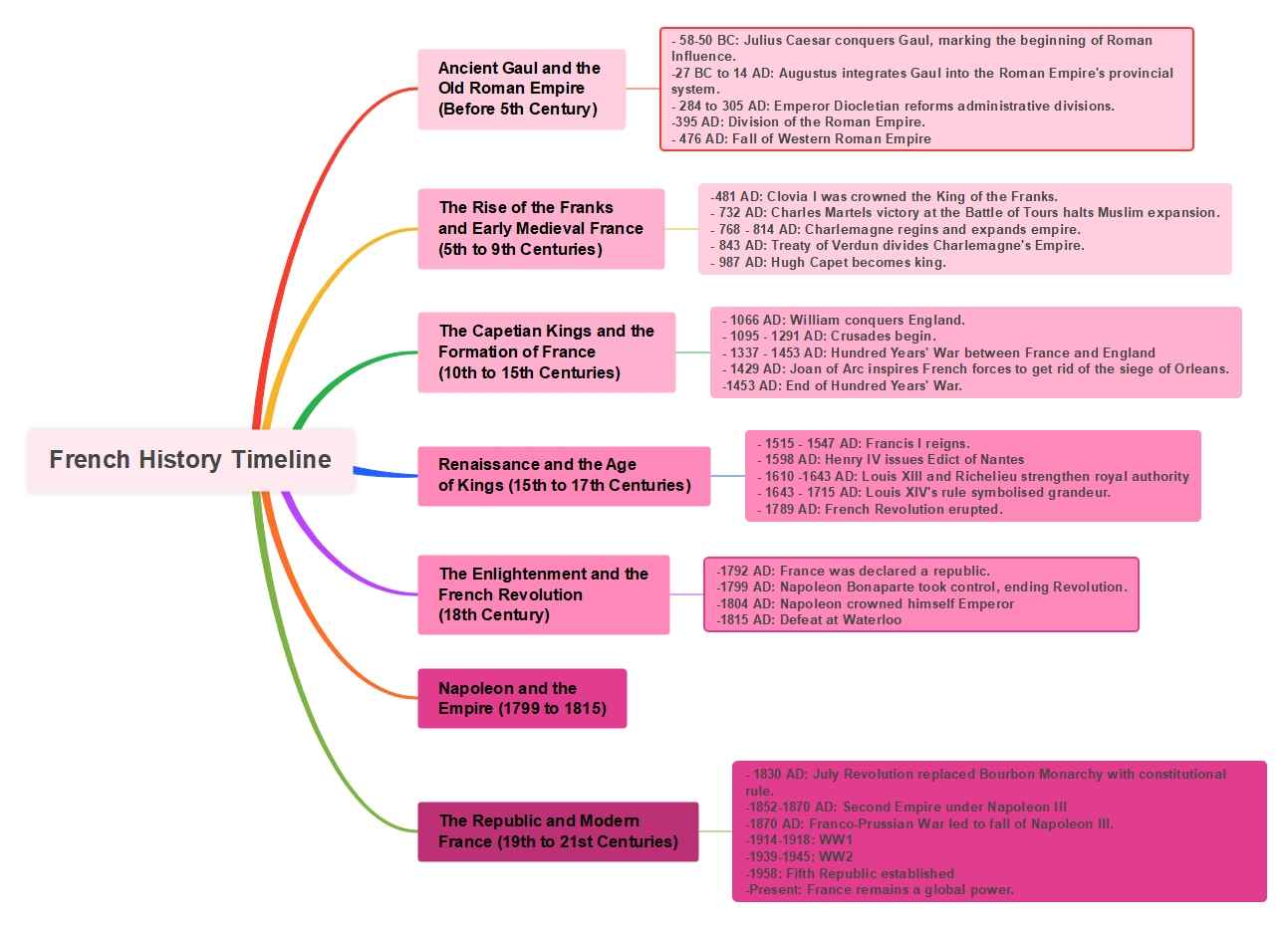


1) Ancient Gaul and the Old Roman Empire (Before 5th Century AD)
Long before the idea of France even existed in anyone’s minds, its land was known as Gaul. This land was strictly home to Celtic tribes who lived in forests and rivers. Fascinating, right? Around 58 BC, it was Julius Caesar who began his conquest to take over the land of Gaul.
Most of his victories were recorded in Commentarii de Bello Gallico. By 50 BC, the region had been fully absorbed into Roman rule. At this point, it was the age of people like Tiberius, Nero, and Augustus, who were all emperors noted down in the list of Roman emperors' timeline.
By studying the emperors of Rome in chronological order, we can clearly see how Roman leadership had managed to shape most of Gaul’s development. In this, Augustus (27 BC to AD 14) established peace. On the other hand, later emperors such as Trajan (AD 98 to 117) expanded the area’s infrastructure further.
In an unfortunate twist of events, by the 5th century AD, cracks began to show up. The reason was that the Western Roman Empire had weakened, and most Germanic tribes, like the Visigoths and Franks, were pushed into Gaul.
2) The Rise of the Franks and Early Medieval France (5th to 9th Centuries)
Let’s see here. After Rome ended up collapsing, the Franks, who were a confederation of Germanic tribes, took over the majority of control. Their first major king, Clovis I, united the major parts of Gaul under his rule by AD 496.
Another interesting thing he did was convert to Christianity, which earned him the support of the Church, and it laid down the foundation for medieval France. This new kingdom truly resembled the fallen empire that it had managed to replace.
At this point, though the Roman emperors' chronology had mostly ended, the Franks immediately saw themselves as instant successors to that same Roman legacy.
By the 8th century, another great ruler had risen, who? Charlemagne, who was also popularly known as Charles the Great. His greatest achievement at the time was that he was crowned Emperor of the Romans in AD 800. He had expanded his kingdom so far that it covered modern France, Germany, and parts of Italy.
After Charlemagne died in 814, his empire ended up being divided among his children, which unfortunately led to the creation of many smaller kingdoms.
3) The Capetian Kings and the Formation of France (10th to 15th Centuries)
After events like the death of Charlemagne, many historical twists took place. In 987 AD, we see Hugh Capet becoming King of France, who also founded the Capetian Dynasty, which would rule for 300+ years. This was a major turning point in the French history timeline, showing a shift from tribal leadership to a stable monarchy.
At this point in time, it can be seen that the early Capetians had limited power outside Paris, but over the course of time, they gained control. Kings such as Philip II (1180 to 1223) expanded their royal lands and turned France into a centralised state.
Perhaps the most interesting parts of history have to be the 13th and 14th centuries, as they saw both glory and hardship. Just as France was flourishing culturally, war soon emerged. It was basically the Hundred Years’ War (1337 to 1453) with England that really tested the nation’s overall endurance.
Important figures such as Joan of Arc (1412 to 1431) ended up becoming national heroes and managed to lead French troops towards victory. As the war came to a natural end, France became stronger than ever. It had a stronger royal authority, and its residents had a better sense of national identity.
4) Renaissance and the Age of Kings (15th to 17th Centuries)
Due to the war, everyone had been down, physically and mentally. This is where the Renaissance brought fresh energy to France. Between the years of 1450 to 1600, believe it or not, art, science, and philosophy increased massively. Important kings like Francis I (1515 to 1547) really encouraged people to dive deeper into culture and learning.
He also went as far as to invite popular artists like Leonardo da Vinci to his court. On the other hand, the 16th century would be a difficult time too. A lot of religious wars took place between Catholics and Protestants, which absolutely destroyed the country. It was all noted down in the Edict of Nantes (1598), which was issued by Henry IV and ended up granting religious freedom.
Who showed up next? Louis XIV, only the most famous monarch of the 17th century. He ruled from 1643 to 1715 and showcased his brilliant skills and power. His biggest feat was building the absolutely magnificent Palace of Versailles, and he ended up making France the cultural standard of Europe.
5) The Enlightenment and the French Revolution (18th Century)
As the 1700s progressed further, France unfortunately had to face a lot of economic troubles, class divisions, as well as a need for change. The answer? The Enlightenment, which was a movement that focused solely on bringing in reason and equality, really inspired thinkers like Voltaire and Rousseau.
In 1789, we can see that the French Revolution started making waves. The monarchy was completely destroyed from top to bottom, and King Louis XVI was executed in 1793. This turning chapter brought forth many ideologies, such as liberty, equality, and fraternity.
This era aimed to break away from the centuries of royal rule and bring forth a new sense of political order and social structure.
6) Napoleon and the Empire (1799 to 1815)
Right out of the chaos, we see the emergence of Napoleon Bonaparte, who was one of history’s most brilliant military leaders. He took control in 1799 and declared himself the emperor in 1804 (a brilliant move). While France was under his rule, it expanded further into Europe and broke through laws and borders.
His campaigns were ones that echoed through the tales of time. They completely reshaped Europe, and the Napoleonic Code made the government modern. It was a sad time when his conquests came to an end after the invasion of Russia, where he was finally defeated at Waterloo in 1815.
As the saying goes, history repeats itself, and it sure did when Napoleon’s reign brought the return of imperial power to France. It was a blunt reminder of the cycle of empires that had been seen since the Roman emperor's chronology began many millennia ago.
7) The Republic and Modern France (19th to 21st Centuries)
After Napoleon fell, France had to experience a lot of changes very quickly. It saw a lot of political uprisings, such as monarchies, empires, and republics rising and falling in quick succession.
At the turn of events, the Second Republic was declared in 1848, which was then promptly followed by the Second Empire under the rule of Napoleon III in 1852. Further ahead, this was marked by the beginning of the Third Republic in 1870.
As the late 19th century emerged, the residents saw a lot of industrial progress, as well as the expansion of institutions like culture and education. France had to unfortunately face a lot of new challenges in the 20th century, like World War I and its occupation during World War II.
After it was finally liberated, the Fourth Republic was formed, which was then quickly replaced by the Fifth Republic in 1958 under the rule of Charles de Gaulle. In the modern day, France has become an absolute powerhouse in terms of politics, art, and science.
How to Make a Similar Timeline for Other Historical Events?
If you want to create a timeline for a well-known figure, movie, or historical event, it is really easy. Follow these instructions for preparation:
- Collect background information: Start by researching important facts and figures, such as names, birth and death dates, and relationships.
- Identify generations: Find out about the relationships (sons, daughters, siblings) and build a structure before you begin designing.
- Create a general outline: Sketch out a basic design. You can decide on the layout that suits your timeline.
- Add names and dates: Fill in the chart with events in chronological order. Use connecting lines to describe dates.
- Include photos: Add photos to make it visually appealing.
- Review and verify: Check each name, date, and event for accuracy.
- Export: Once everything is complete, save your timeline digitally or print it.
Steps to Make the French History Timeline
You can use an online timeline maker rather than simply sketching it out on paper. Making it on software gives you access to unlimited revisions and edits. For my project, I have used EdrawMind to make this timeline. Here’s how you can do it too:
 Try the app & get 500 free AI tokens


Step 1 Getting Started
- Launch your application.
- Start with a blank screen to get started.

Step 2 Select Shapes and Colours
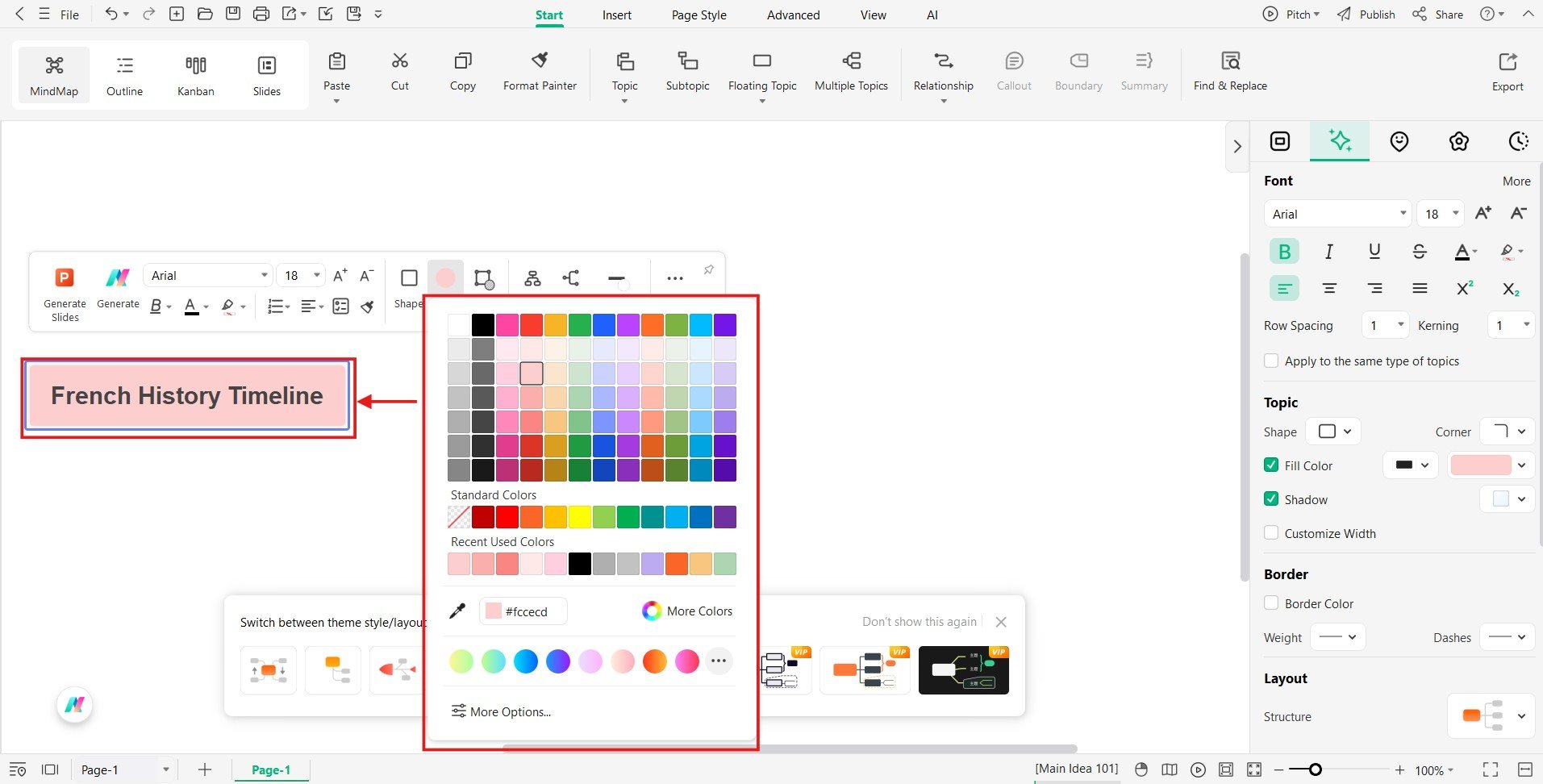
- Select your shape and place it in the middle. Write “French History Timeline” on it.
- Click the fill button next to the shape and select a colour to highlight it as the focus box.
Step 3 Adding Events
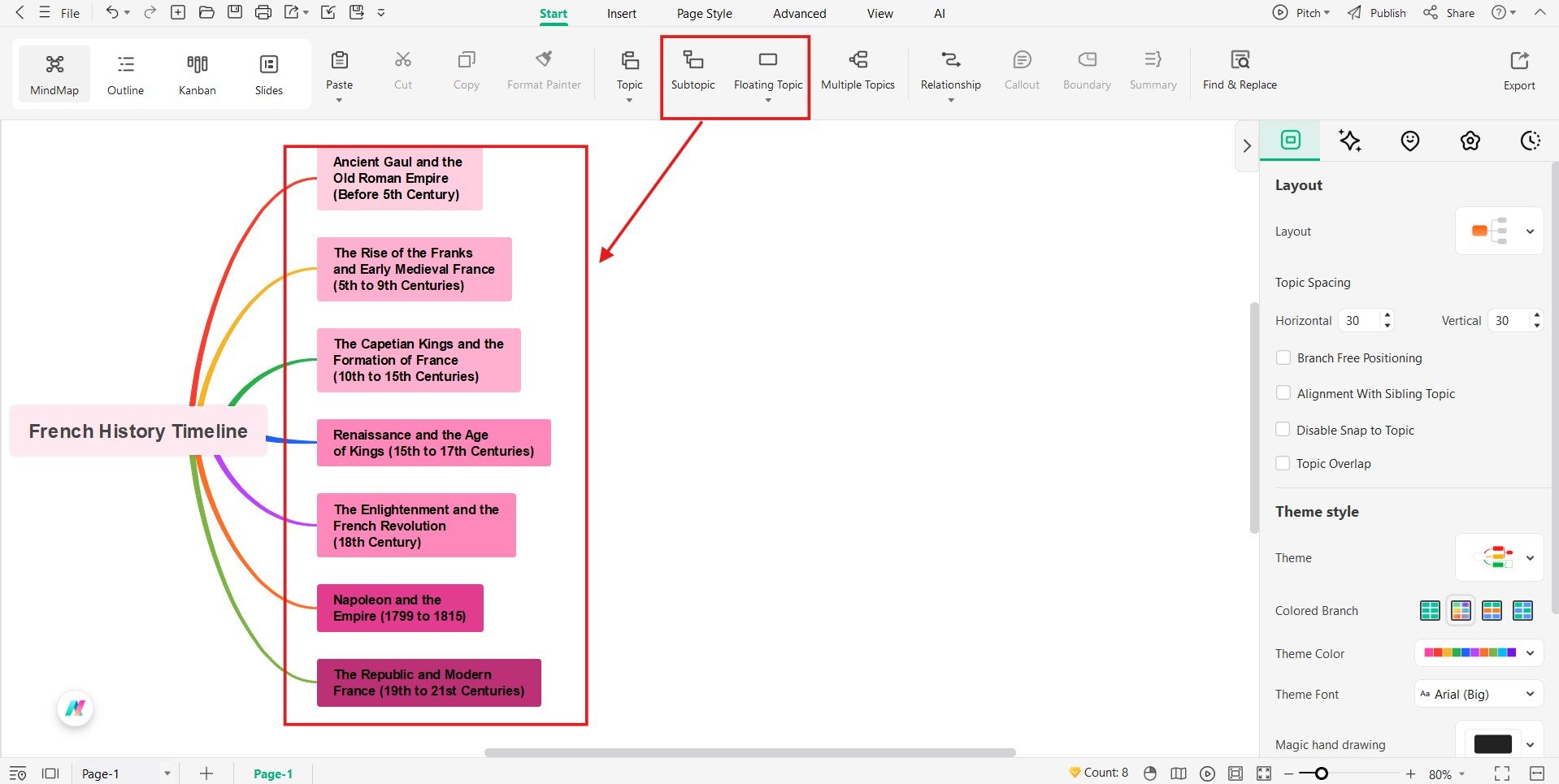
- Select floating topic from the top menu.
- Create one for each major event and continue adding until the full timeline is displayed.
Step 4 Customising Each Major Event
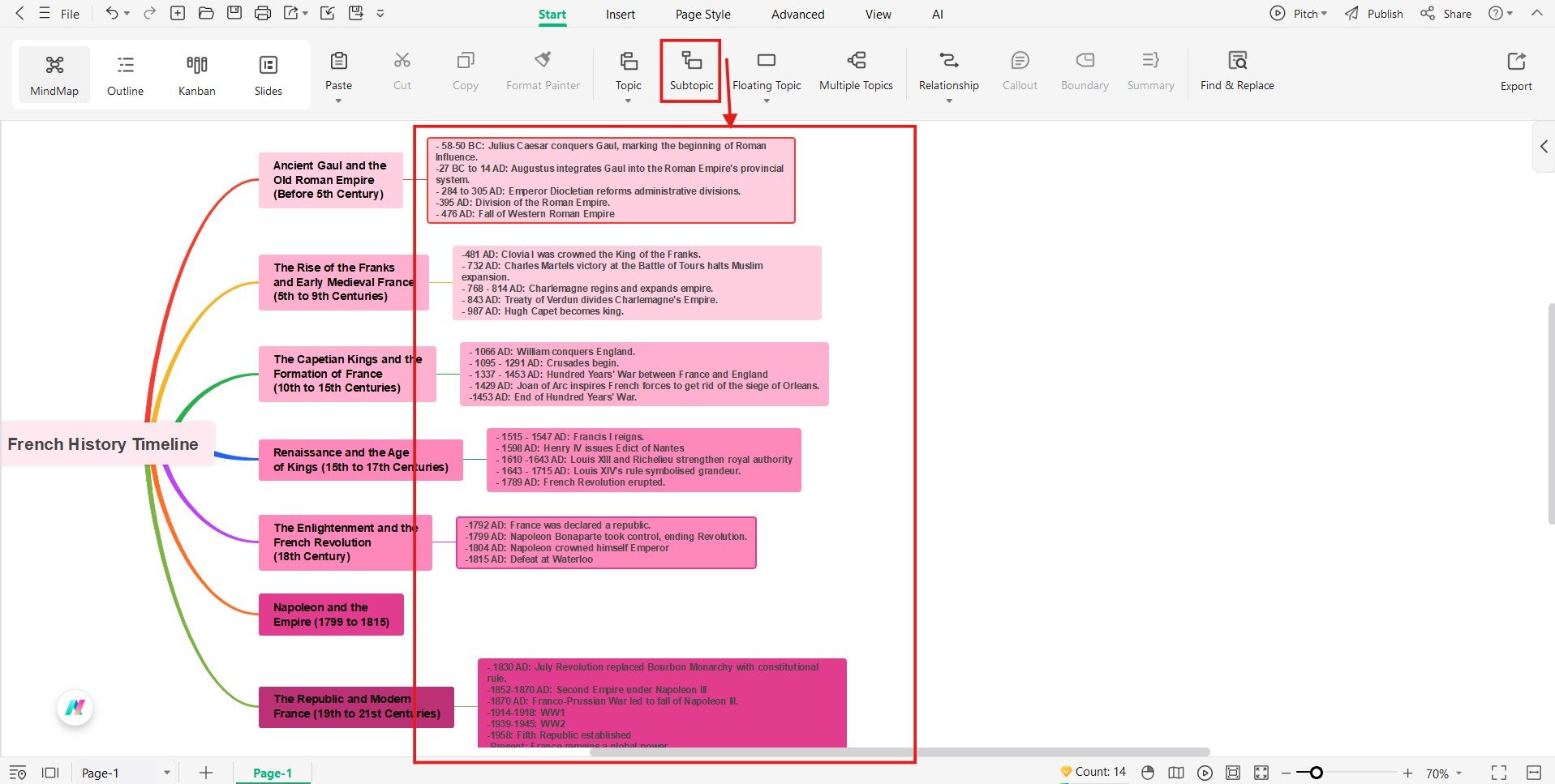
- Use the floating toolbar to change the font size, colour, or box shape for visual clarity.
- You may also colour-code each section to highlight major events.
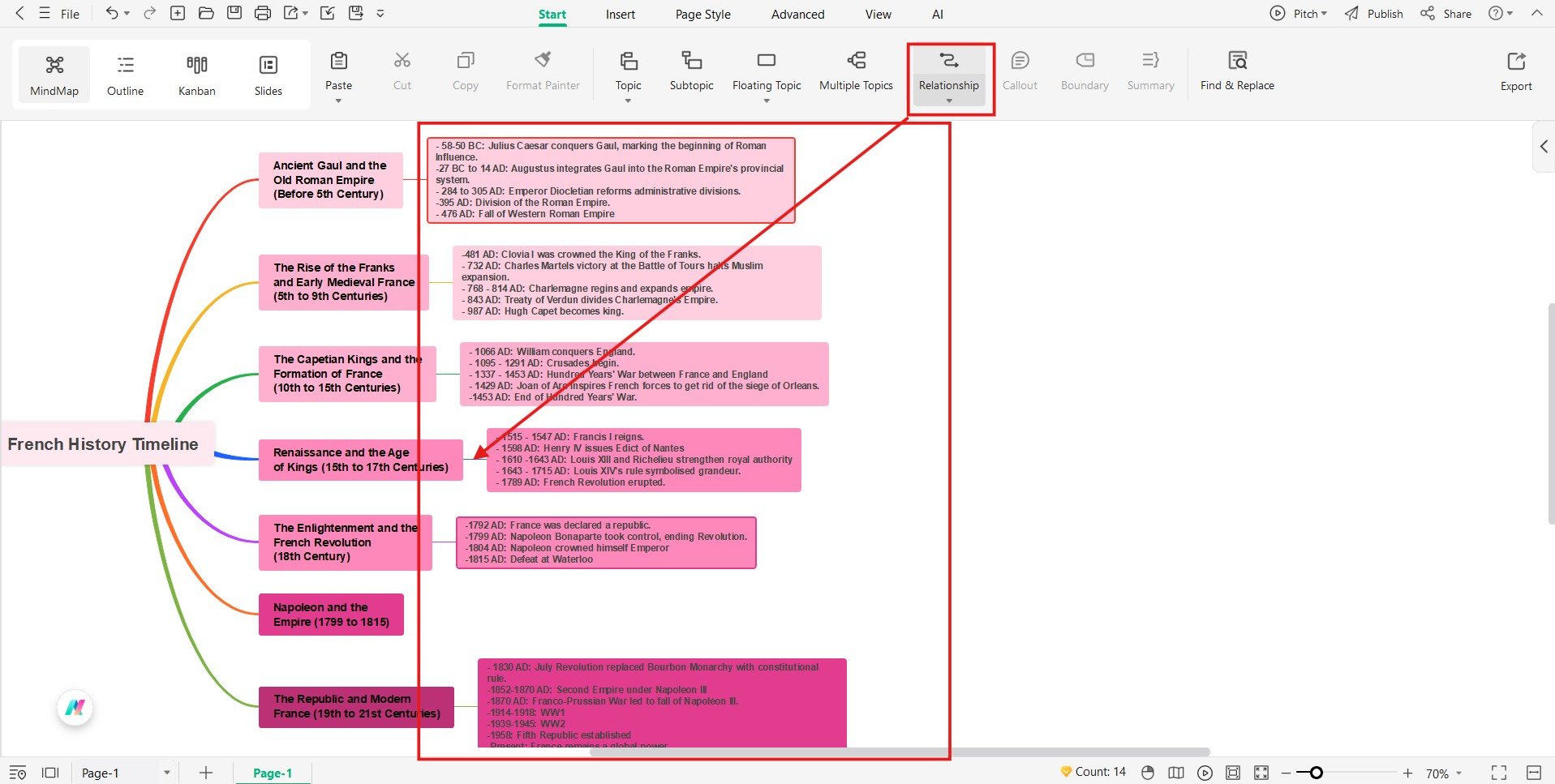
Step 5 Connecting the Events
- Select relationships from the top menu.
- Draw connecting lines between each event to show the chronology of the Roman Empire.
Step 6 Export the File
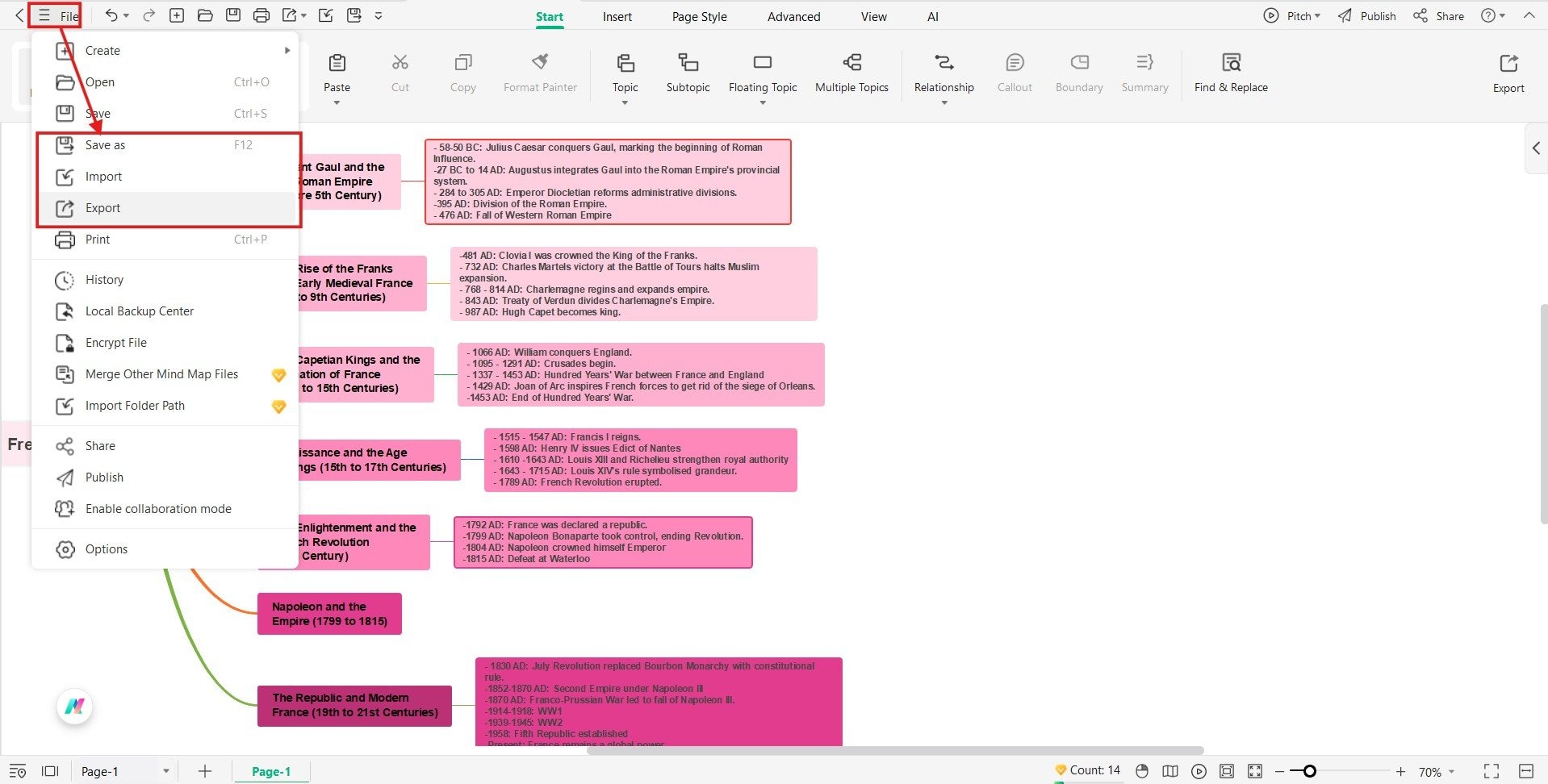
- Save your project.
- Export and choose from various formats, such as Word, Excel, PowerPoint, PDF, JPG, or PNG.
Facts About France
Here are some facts about France that you should know if you're planning to visit France or want to learn more about France.
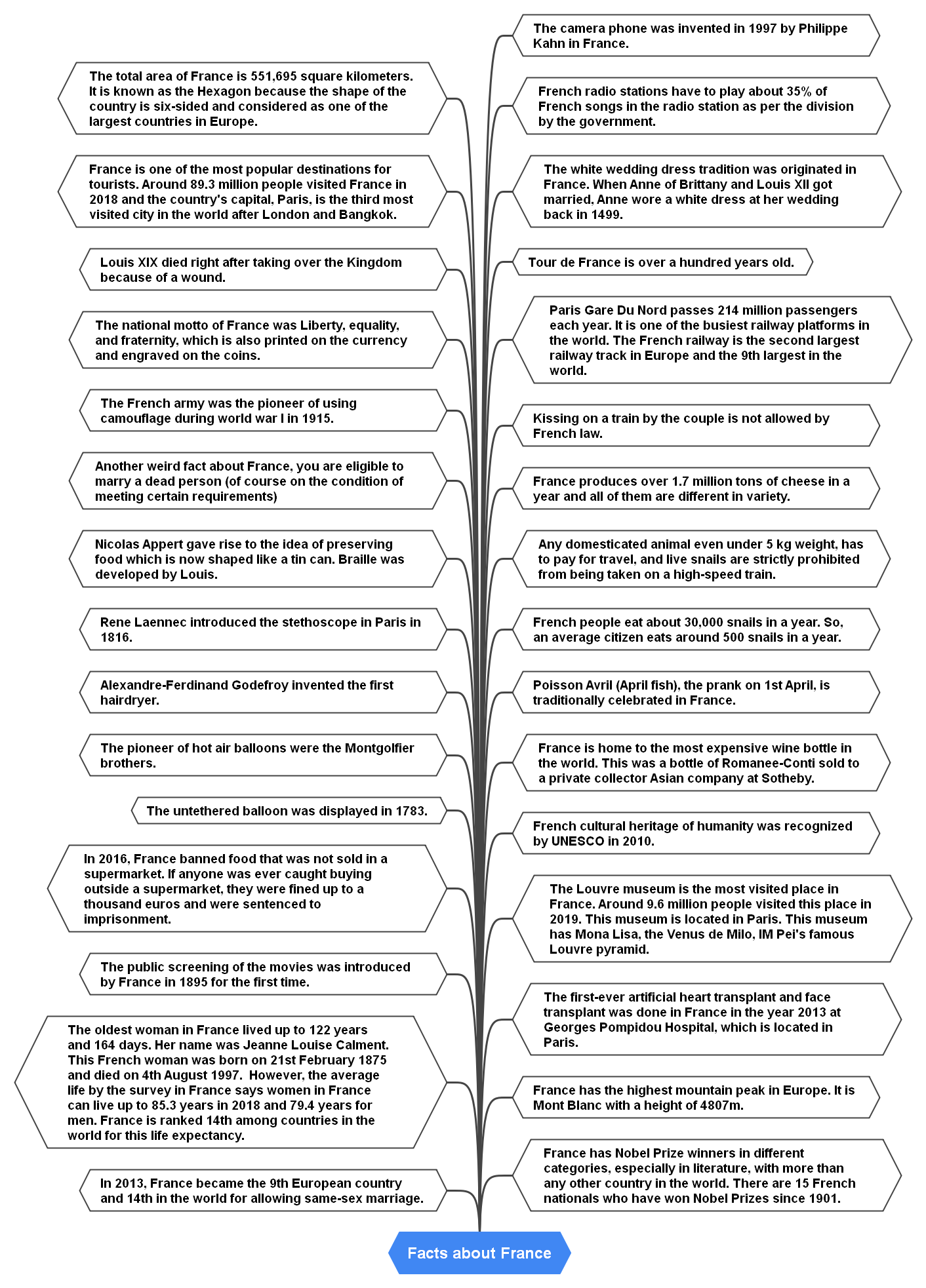
- The total area of France is 551,695 square kilometers. It is known as the Hexagon because the shape of the country is six-sided and considered as one of the largest countries in Europe.
- France is one of the most popular destinations for tourists. Around 89.3 million people visited France in 2018 and the country's capital, Paris, is the third most visited city in the world after London and Bangkok.
- Louis XIX died right after taking over the Kingdom because of a wound.
- The national motto of France was Liberty, equality, and fraternity, which is also printed on the currency and engraved on the coins.
- The French army was the pioneer of using camouflage during world war I in 1915.
- Another weird fact about France, you are eligible to marry a dead person (of course on the condition of meeting certain requirements)
- Nicolas Appert gave rise to the idea of preserving food which is now shaped like a tin can. Braille was developed by Louis.
- Rene Laennec introduced the stethoscope in Paris in 1816.
- Alexandre-Ferdinand Godefroy invented the first hairdryer.
- The pioneer of hot air balloons were the Montgolfier brothers.
- The untethered balloon was displayed in 1783.
- In 2016, France banned food that was not sold in a supermarket. If anyone was ever caught buying outside a supermarket, they were fined up to a thousand euros and were sentenced to imprisonment.
- The public screening of the movies was introduced by France in 1895 for the first time.
- The oldest woman in France lived up to 122 years and 164 days. Her name was Jeanne Louise Calment. This French woman was born on 21st February 1875 and died on 4th August 1997. However, the average life by the survey in France says women in France can live up to 85.3 years in 2018 and 79.4 years for men. France is ranked 14th among countries in the world for this life expectancy.
- In 2013, France became the 9th European country and 14th in the world for allowing same-sex marriage.
- France has Nobel Prize winners in different categories, especially in literature, with more than any other country in the world. There are 15 French nationals who have won Nobel Prizes since 1901.
- France has the highest mountain peak in Europe. It is Mont Blanc with a height of 4807m.
- The first-ever artificial heart transplant and face transplant was done in France in the year 2013 at Georges Pompidou Hospital, which is located in Paris.
- The Louvre museum is the most visited place in France. Around 9.6 million people visited this place in 2019. This museum is located in Paris. This museum has Mona Lisa, the Venus de Milo, IM Pei's famous Louvre pyramid.
- French cultural heritage of humanity was recognized by UNESCO in 2010.
- France is home to the most expensive wine bottle in the world. This was a bottle of Romanee-Conti sold to a private collector Asian company at Sotheby.
- Poisson Avril (April fish), the prank on 1st April, is traditionally celebrated in France.
- French people eat about 30,000 snails in a year. So, an average citizen eats around 500 snails in a year.
- Any domesticated animal even under 5 kg weight, has to pay for travel, and live snails are strictly prohibited from being taken on a high-speed train.
- France produces over 1.7 million tons of cheese in a year and all of them are different in variety.
- Kissing on a train by the couple is not allowed by French law.
- Paris Gare Du Nord passes 214 million passengers each year. It is one of the busiest railway platforms in the world. The French railway is the second largest railway track in Europe and the 9th largest in the world.
- Tour de France is over a hundred years old.
- The white wedding dress tradition was originated in France. When Anne of Brittany and Louis XII got married, Anne wore a white dress at her wedding back in 1499.
- French radio stations have to play about 35% of French songs in the radio station as per the division by the government.
- The camera phone was invented in 1997 by Philippe Kahn in France.
Interesting Historical Places in France
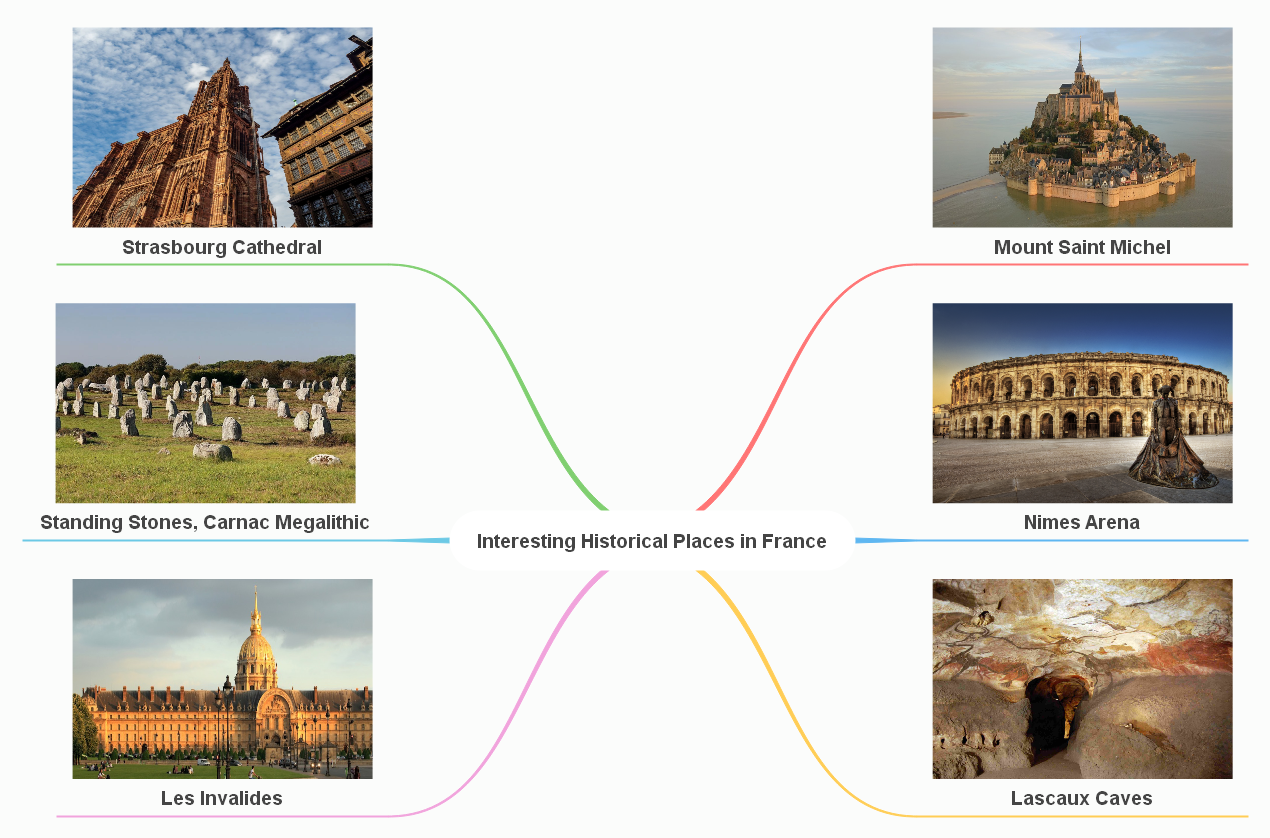
- Mount Saint Michel: This place was constructed in the 8th century and is the oldest church in France. Besides, this place is now named as a UNESCO World Heritage Site.
- Nimes Arena: Nimes Arena was used as the royal gaming area, which can accommodate almost 20,000 viewers on 34 seated rows. This place has now been transformed into a fortress.
- Lascaux Caves: This place was founded by a French teenager and his friends. The Lascaux caves are somewhat 17,000 years old. Also, these caves have more than 600 animal carving on stone since the Upper Palaeolithic time. These caves were opened for public visit after the First World War.
- Strasbourg Cathedral: This place is thousands of years old and was built by Romans. It was a Roman temple, a masterwork of Gothic art.
- Standing Stones, Carnac Megalithic: There are almost 3000 megalithic standing stones. They are of different sizes in different rows.
- Les Invalides: This place is known for a rich military history and sacrifices which were given by so many war veterans.
Wrapping Up
The French history timeline shows how each event brought Medieval France closer and closer to becoming the modern France we all know and love today. From the tribes of Gaul to the powerful Roman province, from medieval kingdoms to republics.
The chronology of the Roman Empire truly laid the foundations for Europe’s development and influenced France’s early politics, culture, and religion. It proved that no matter how many times history shifts, the spirit of France only flourishes.
A timeline perfectly summarises the key points of each event. To make your own, check out products like EdrawMind to make the timeline-making process easy.
 EdrawMind
AppsEdrawMind Online
EdrawMind
AppsEdrawMind Online