



What comes to your mind when you think about a cell? A battery? Maybe our bodies? It’s fascinating, isn’t it? When we talk about cell theory, its story has all the hallmarks of a cinematic masterpiece. From the first discovery through an early microscope to the breakthrough ideas that ended up reshaping biology forever, you are going on a fascinating journey of understanding the cell!
What simply began with Robert Hooke observing the tiniest “cells” ended up evolving into a global scientific phenomenon! Each scientist who followed suit ended up adding a new layer of insight. Through these discoveries, they were able to transform these scattered pieces of observations and compile them into a powerhouse. A mitochondrion, if you will (yes, this was THE joke).
In this article, we will walk you through the complete cell theory timeline, tracing through the discoveries, ideas, and minds that pieced together this wonderful story of life, right at its smallest building block. Are you ready? Let’s warp through time to understand what makes us, us!
In this article
Cell Theory Timeline
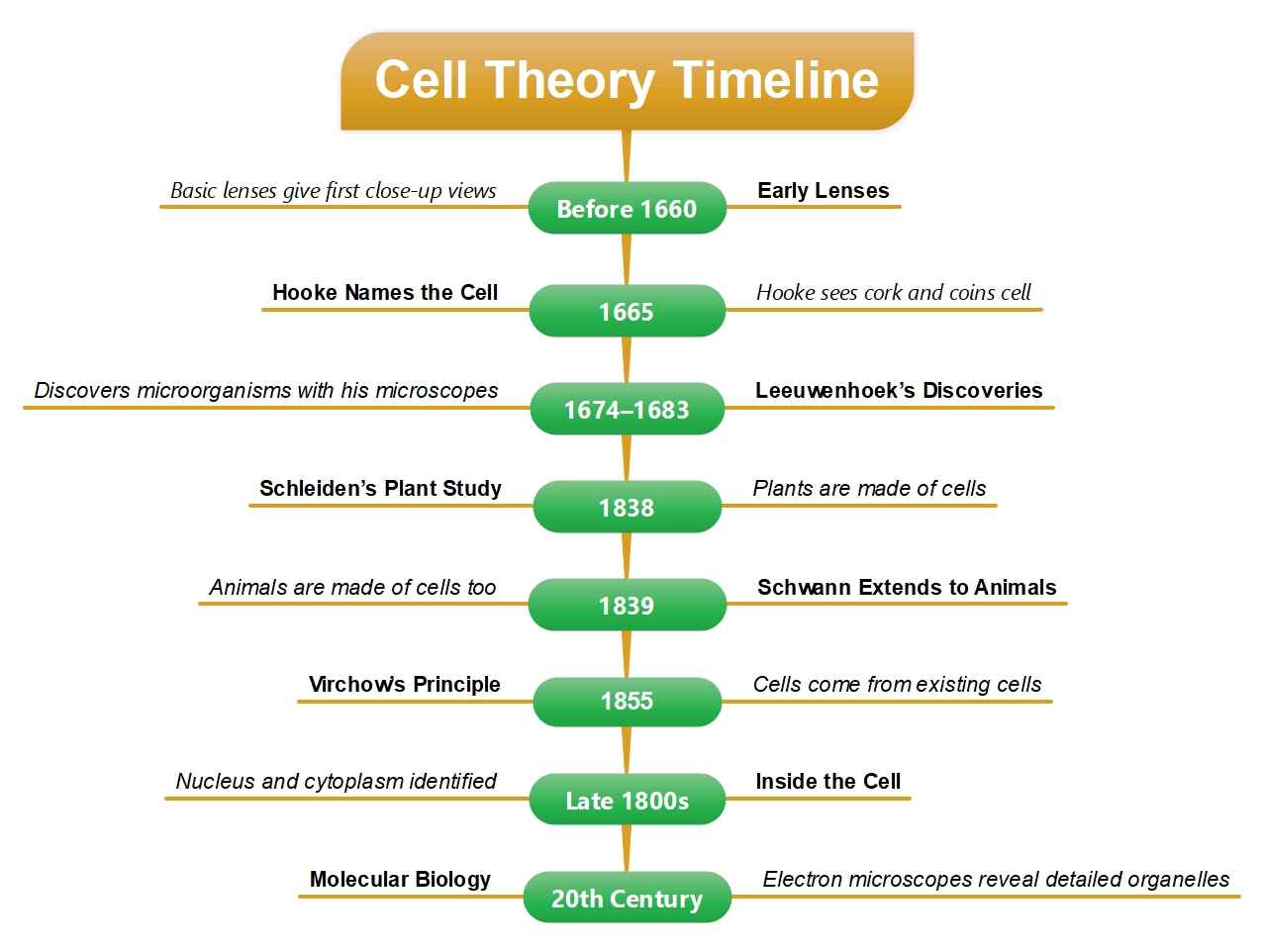


If you trace any major scientific idea back through time, you will eventually find yourself chasing a never-ending trail of experiments, mistakes, and breakthroughs. You can think of the cell theory timeline as exactly that kind of story!
It basically began as a slow journey, drawing on Robert Hooke’s first idea of a lens, and ends with you wondering what life’s actual purpose is. How our bodies function and how all living organisms are structured are all backed by the cell!
Today, you will find most students memorising the cell theory definition without realising just how many people have helped completely shape it, or just how long it took for it to all come together. From Robert Hooke’s cell theory to the use of modern equipment to develop the CRISPR-Cas9 gene, the story of the cell is a look back into how a curious mind changed biology forever.
A First Look at the Microscopic World (Before 1660)
It’s important to note that the groundwork for the cell theory timeline began quite long before anyone even realised that cells exist. The earliest glassmakers developed magnifying lenses that would allow scholars to inspect all kinds of plants, threads, and insects at close range.
Just remember that this was before 1660; these microscopes lacked clarity. That being said, they created the first opportunity for scientists to freely study structures that would have otherwise been invisible to the naked eye (isn’t that fascinating to imagine?).
Robert Hooke Names the “Cell” (1665)
This is one of the most important turning points. This is when Robert Hooke used a compound microscope to study thin slices of cork. In his famous publication, Hooke described that the cork had small, repeated compartments, like tiny rooms, or, rather, “cells.”
He had no idea that he had been observing small plant cell walls all this time. His terminology truly stuck. And this was the exact moment that marked the earliest formal entry for what a “cell” was.
Antonie Van Leeuwenhoek’s “Hidden Universe” Theory (1674 to 1683)
What happened next? Well, this is another story. Think of it like this: if Hooke had just opened the door, Antonie van Leeuwenhoek would have barged through it (full force!).
He used microscopes that he had crafted by hand (yes!), and through that, he ended up observing microorganisms that would swim in pond water. Along with that, he also observed the movement of blood cells.
With these discoveries in hand, it greatly ended up expanding the understanding the microscopic life, and it pushed future cell theory scientists to question just how living things functioned at their smallest scale.
Matthias Schleiden and His Study of Planta (1838)
For the last century, not many discoveries have been made. Though that being said, in 1838, technological improvements would end up allowing a very famous botanist, Matthias Schleiden, to confirm that plants were, in fact, composed of repeated cellular units.
His research basically suggested that cells played a really fundamental role in a plant’s overall structure and growth. Through this research, it ended up bringing science closer to establishing a universal principle that would apply to all living things.
Theodor Schwann Extends His Idea to Animals (1839)
Now that the study of plants was such a huge success, we move on to the studies of Theodor Schwann. His area of expertise was his study of animal tissues, through which he reached a conclusion that was quite similar to Schleiden’s. He announced that animals, too, were in fact composed of cells, similar to plants (crazy, right?).
At some point, the two scientists came together to compare findings and proposed what would become the earliest version of what we now call the official “cell theory definition” in its purest form:
- All living organisms are made up of one or more cells.
- The cell is the most basic unit of structure and function in all living things.
Rudolf Virchow Completes the Cell Theory (1855)
We’ve reached the finale now.
Rudolf Virchow himself devised the final piece of the basic cell theory. In a very Latin phrase, he stated, “Omnis cellula e cellula,” every cell arises from another, similar existing cell.
Though this statement was vague, it would end up challenging the common belief that had been going around. Through a bit more research, it also practically solidified the third principle of modern cell theory.
Discoveries Inside the Cell (Late 1800s)
After seeing the great work done by Virchow, scientists dove headfirst into their efforts to understand what the cell contains. With this fire burning inside them, laboratory techniques greatly improved, particularly the staining and sectioning methods.
What did it reveal? It revealed crucial structures such as the nucleus, nucleolus, and cytoplasm. After that, researchers also ended up mapping out major cell division patterns, including mitosis (the regretted biology chapter), which basically explained how genetic material is passed on during growth and reproduction.
The Rise of Molecular Biology and Electron Microscopy (20th Century)
As microscopes continued to evolve, electron imaging practically transformed biology from something simple to a complex study. For the first time ever, researchers were able to see the extreme details of membranes, mitochondria, and ribosomes, as well as other major organelles.
These were true breakthroughs, which would connect cell structure to cell function on a rather molecular scale. On top of that, the study of DNA, RNA, and protein synthesis would also greatly expand the importance of cells in energy flow.
How to Make a Similar Timeline for Other Scientific Discoveries?
Before you start making a timeline, take a moment to properly plan out what you want to include. A small amount of prep can make the timeline easier to follow. Here’s how you can make one:
- Collect background information: Start by researching important facts and figures, such as names, birth and death dates, and major discoveries.
- Identify discoveries: Find out about scientists and their discoveries. Build a general structure before you begin designing.
- Create a general outline: Sketch out a basic design. You may decide on the layout later.
- Add names and dates: Fill in the chart with events in chronological order.
- Include photos: Add photos and fonts to make the timeline visually appealing.
- Review and verify: Check each name, discovery, date, and event for perfect accuracy.
- Export: Once everything is verified, save your timeline digitally or print it.
Steps to Make the Cell Theory Timeline
Now, if you want to make a timeline, there are many options available online. Creating one can help you display all events in a neat order while making it easy to memorise. For my timeline, I have chosen EdrawMind, as it provides various free templates. If you want to try, here’s how to do it:
 Try the app & get 500 free AI tokens


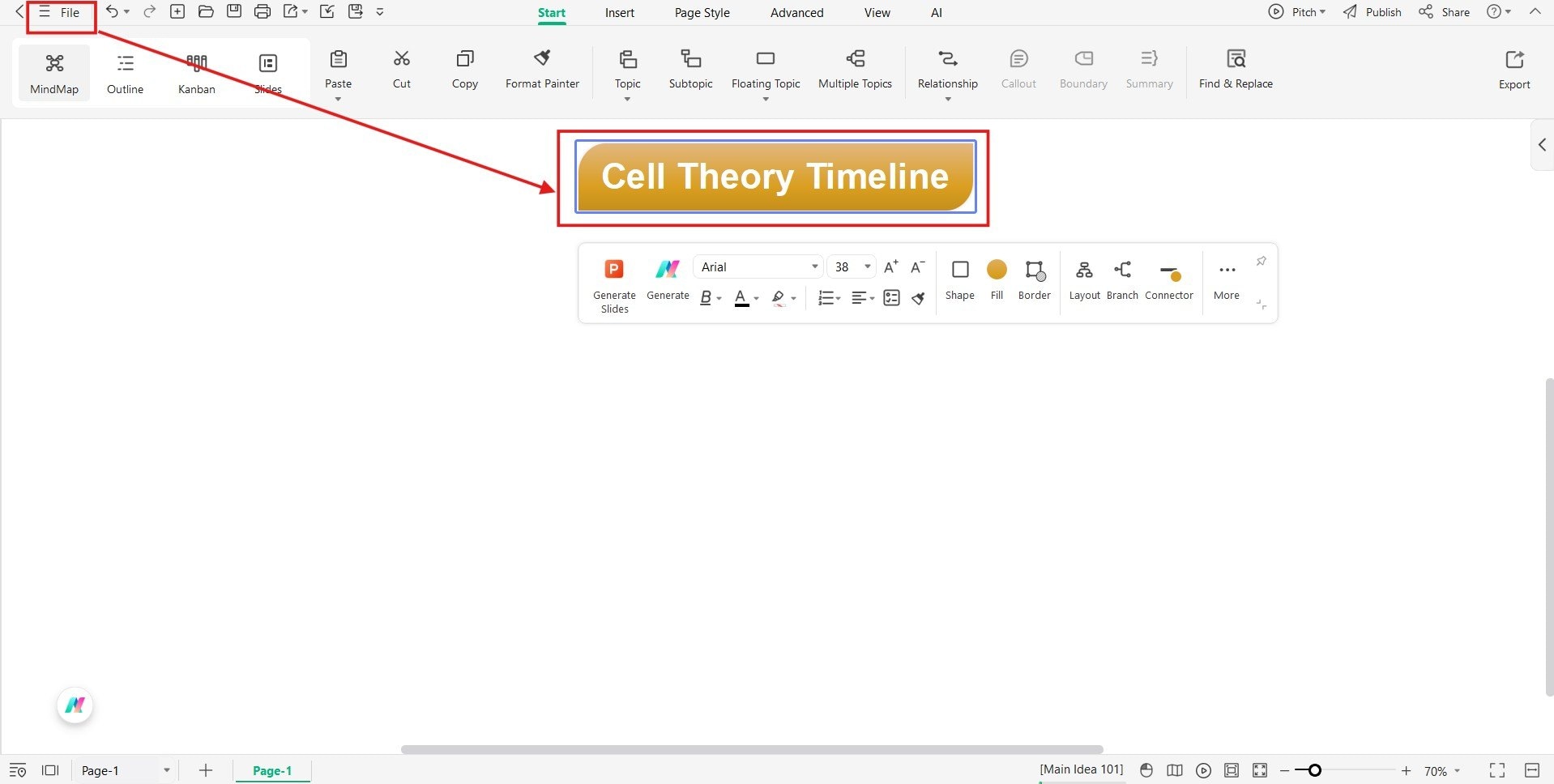
Step 1 Create a New File and Add the Title
- Open EdrawMind.
- Create a blank mind map to start with a clean canvas.
- Add a floating topic and title it “Cell Theory Timeline.”
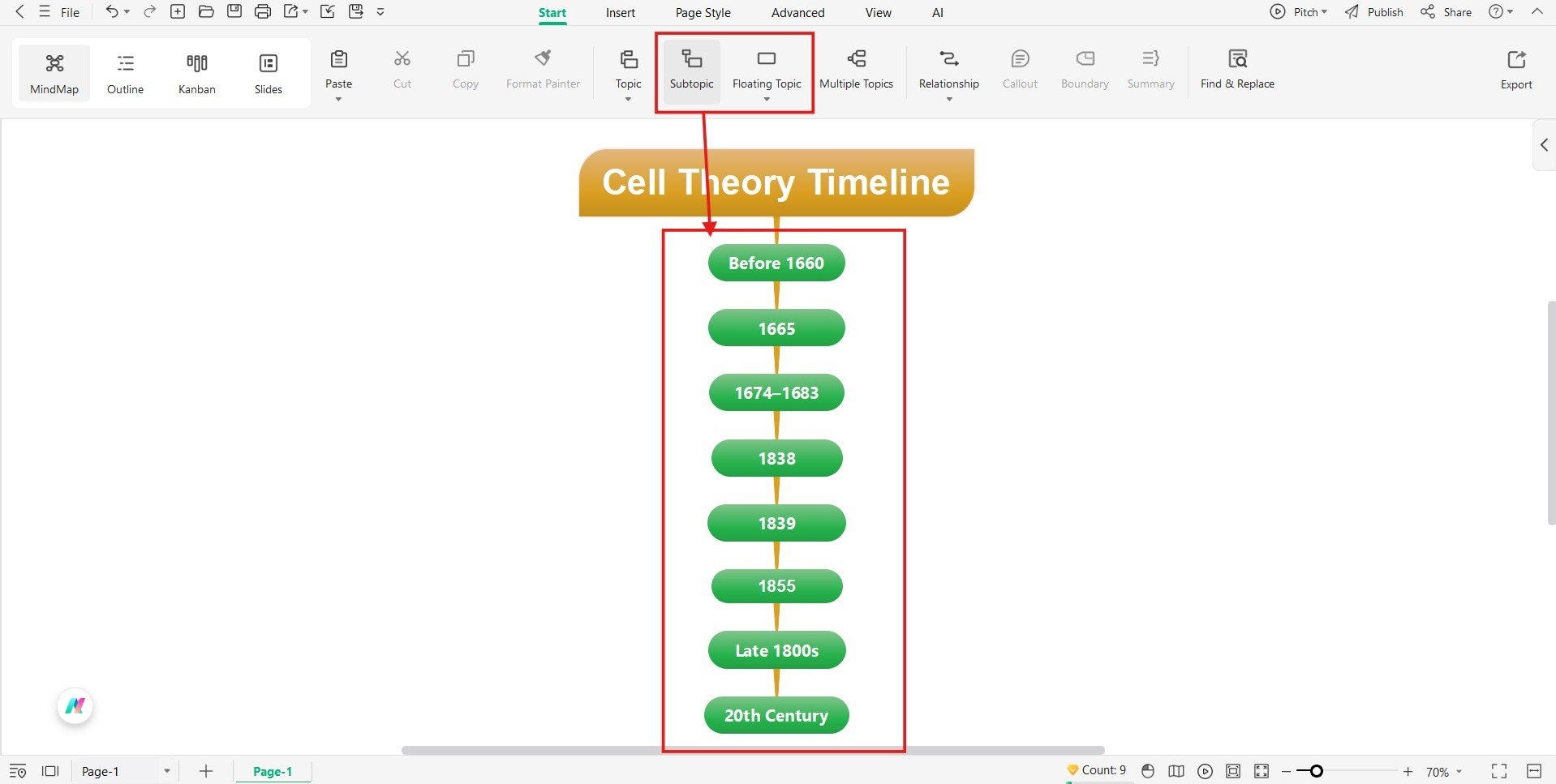
Step 2 Adding Events
- Add a floating topic from the top menu.
- Create one for each major discovery and keep adding until the entire timeline is neatly displayed.
- Add a subtopic for further explanation of each discovery and scientist.
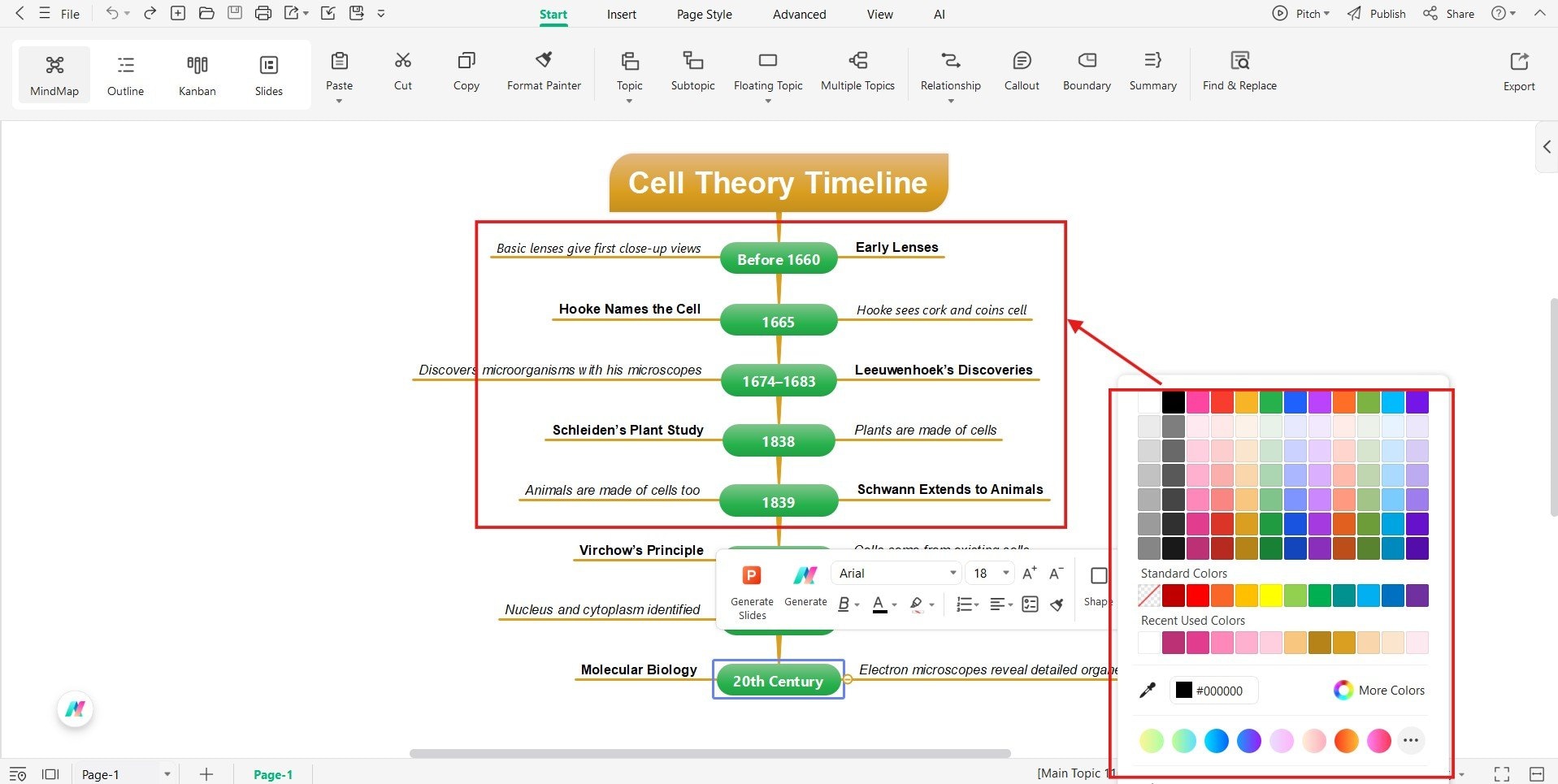
Step 3 Customising Each Major Event
- Change the font size, colour, or box shape from the floating toolbar.
- You can also colour-code each section to highlight major events. Add dates.
Step 4 Linking Each Event
- Establish a relationship between each main topic and its subtopics.
- Repeat for all until the entire timeline is connected.

Step 5 Save or Export
- Save your project.
- Or download the timeline as an image.

Wrapping Up
The cell theory timeline is a perfect amalgamation of various questions, theories, and discoveries that date back centuries. Each new discovery greatly improved the framework for the studies on which we rely today.
Understanding the individual contributions of different cell theory scientists makes the cell theory definition a whole lot easier to grasp and memorise. Products like EdrawMind help you map out these developments with a simple timeline that visually connects each event. It makes any boring biology lecture far more memorable and engaging.
 EdrawMind
AppsEdrawMind Online
EdrawMind
AppsEdrawMind Online