


Biology can feel like a lot to handle, especially when you’re trying to make sense of cells, systems, and scientific terms all at once.
Still, it’s one of the most fascinating subjects you’ll ever study. Once you start connecting what you learn to real life, everything becomes more meaningful.
You’ll see how the human body works, how medicine fights disease, and how life forms interact in nature.
The key is to approach it strategically. This guide walks you through practical ways to study biology effectively so you can understand it deeply and feel more confident in class or during exams.
In this article
Biology Study Roadmap for 4 Weeks
So, maybe you are preparing for a test, or just trying to maintain your class level. It would be beneficial to have a plan in place.
You are free to create your study schedule as you wish, but here is an example you can follow:
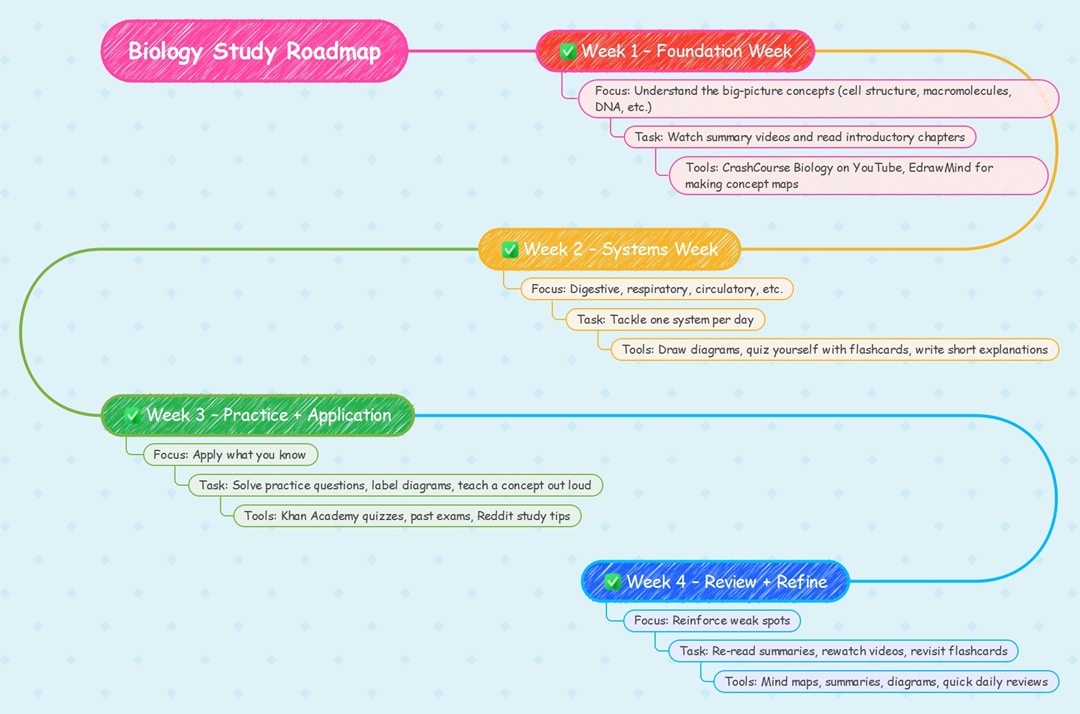


Week 1: Focus on the Basics
This is your foundation week. You would prefer to grasp the major concepts before delving into detailed work.
In fact, this also includes topics such as cell structure, DNA, macromolecules, enzymes, and genetics. All these are the main ideas from which biology has established itself.
Try the videos or the summary readings to get a first idea. Visually inclined learners may also create a mind map or make quick drawings to assist them during the reading process.
Week 2: Deep Dive Into Body Systems
The next step is to focus on the detailed study of systems after you have mastered the fundamental concepts. Consider, for instance, digestive, respiratory, circulatory, nervous, and other systems.
Working on one system a day or every two days would be a good idea, which depends on your available time.
The hard part here is concentrating on the structure and function. First, identify the different parts of the organ systems, then determine what they do and how they relate to the other systems.
Creating diagrams is crucial for this part. In fact, color-coding your notes is more efficient, as it can also assist you in recalling the information.
Week 3: Practice What You’ve Learned
This is the time to check what you really know. Testing is the main activity of the week. Quizzes, practice tests, and online questions reveal which topics you’ve mastered and which need more attention.
You might find this method quite peculiar, but it is effective.
Try to explain difficult subjects to a friend or think out loud. Rephrasing the material when you explain to others is one of the easiest ways to prove that you have understood the topic.
Week 4: Review and Reinforce
Now’s the time to polish up what you already know. Go back to the topics that confused you. Rewatch videos, redraw diagrams, and refresh your flashcards.
Keep things light, but steady. Instead of cramming, spend shorter sessions reviewing often. You’ll also want to perform daily assessments of older topics to see if you still understand them.
Resource Recommendations for Studying Biology
Studying for a test? Catching up on classwork? This set of resources has you covered. Some focus on key ideas, others let you quiz yourself, and a few are more visual.
For Understanding the Concepts
For example, worksheets and videos could be your saviors if you are struggling to comprehend complex concepts such as mitosis or body systems.
- CrashCourse Biology on YouTube: An online video series that broadly explains biological principles, from the high school level up to the college level. Different episodes introduce various subjects, such as molecules, the immune system, and taxonomy.
- Bozeman Science: Features teaching videos by Paul Andersen. Each video includes labeled visuals and step-by-step breakdowns of biological processes.
- Campbell Biology: A widely used university lab course text known for setting the standard in introductory science courses.
- OpenStax Biology Textbook (Free PDF): A comprehensive e-text covering various topics. Each chapter ends with review questions to facilitate studying.

For Practice Tests and Self-Quizzing
Keep these close as practice tools. Once you finish reading, use them to apply what you’ve learned through questions and quick assessments.
- Khan Academy Biology: Offers quizzes and unit tests after every topic. Each correct answer includes an explanation.
- Quizlet: Lets you search and use interactive flashcard sets, tests, and activities made by other users. You can also create your own cards and test yourself using matching games or timed quizzes.
- Question Banks: For more advanced students like pre-med, online question banks like UWorld offer exam practice questions with detailed visual explanations.
For Diagrams and Visual Study Aids
Studying detailed processes gets easier when you can see them. These resources give you visual references that make lessons stick and reinforce what you’ve learned in class.
- BioRender: An online tool for creating labeled science diagrams.
- Reddit (r/biology, r/biologystudents): Forums where users post custom notes, colorful diagrams, and more. You’ll also find study tips from people currently taking Biology.
Proven Tips for Effective Studying for Biology Class
Reading notes alone won’t help much. To truly understand biology, you need to study in a way that engages your brain and keeps it thinking.
Here are tried-and-tested tips to keep you on track and make your biology study sessions more productive.
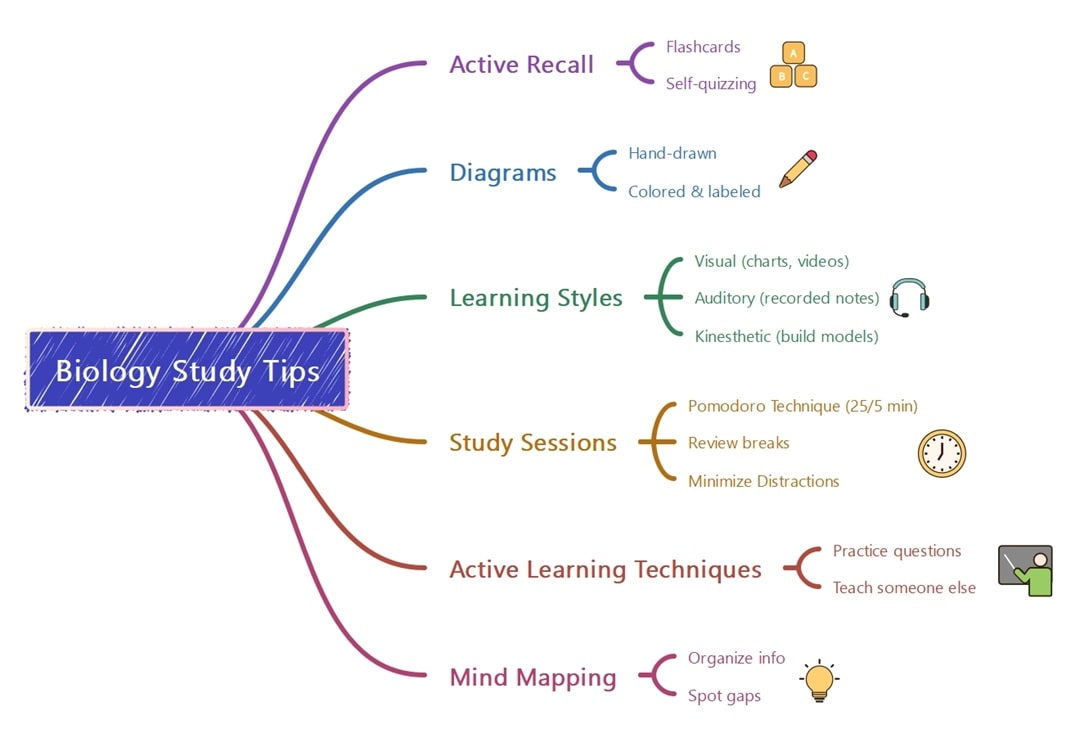
Think Like a Scientist With Application Questions
Biology is not just about learning facts by heart; it is about comprehending the processes and using the knowledge that you have.
If you come across a new concept, do not only ask "what is it?", but also "how does it work?" and "why is it important?".
Try to ask: "How would a plant be affected if a single point in the process had been stopped?"
In doing so, you are compelled to think critically, which also equips you to handle those difficult application questions in your exams.
Discover Your Learning Style
Do you understand better when you see? If that is the case, use pictures, videos, and the colorful diagrams available. Do you learn best by hearing?
Try explaining concepts out loud to a friend (or even your pet!), or listen to Biology podcasts (if there's one). Match your method to your style. Hands-on learning, like modeling or sketching, can make studying easier and more efficient.
Focus in Bursts
Your brain can only focus for a limited time. Rather than trying to work for four hours straight, why not use the Pomodoro Technique? Concentrate on your study for 25 minutes, then rest for five minutes.
After that, in four cycles, you can have a longer break of 15-30 minutes. This method maintains a high energy level and a strong concentration throughout the session.
Turn Tricky Terms Into Easy Wins
You’ve probably come across a term so long it made you stop mid-reading. Instead of skipping it, break it into smaller parts and learn what each means.
Which word root sounds familiar? Highlight it, then link the term to an image or example you already know.
Write tricky words on flashcards or sticky notes and quiz yourself daily. Say them out loud to lock them in your memory faster.
Make the Most Out of Lab
The lab is where everything you’ve studied starts to make sense.
What happens when you see theory come to life? Pay attention to every detail and ask questions whenever something confuses you.
Take notes on what you notice, not just what’s written in the manual. Look at each step and connect it to the concept behind it. Treat every experiment like a live lesson, not just another task.
Learn Through Illustrations
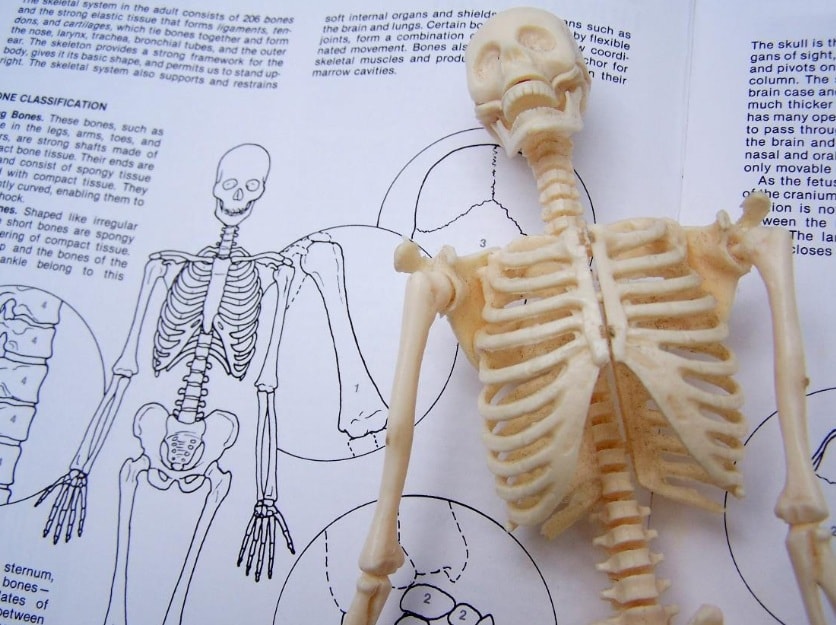
Why spend hours memorizing lists when a single picture can explain it better? A labeled skeleton, for example, makes bone names easier to remember because you can see how they connect.
Use diagrams, flowcharts, or quick sketches to simplify complex topics. Add colors, arrows, or short notes beside each part. Keep building your visual library, and soon you’ll be able to recall concepts just by picturing them in your head.
Practice Using Past Papers
Old exam papers are gold when it comes to preparing for exams. They show you how questions are framed and which topics keep coming up.
Have you noticed patterns from your previous exams? Time yourself as you answer to simulate real exam pressure. Review your mistakes and figure out where you slipped.
The more you practice with previous papers, the more confident and exam-ready you’ll become.
Connect Math and Biology
Do equations make you want to skip the page? Don’t. Math actually explains many patterns in life.
How does a population grow? Why do certain genes appear more often? Try solving quick problems using ratios or percentages to see how they connect to real data.
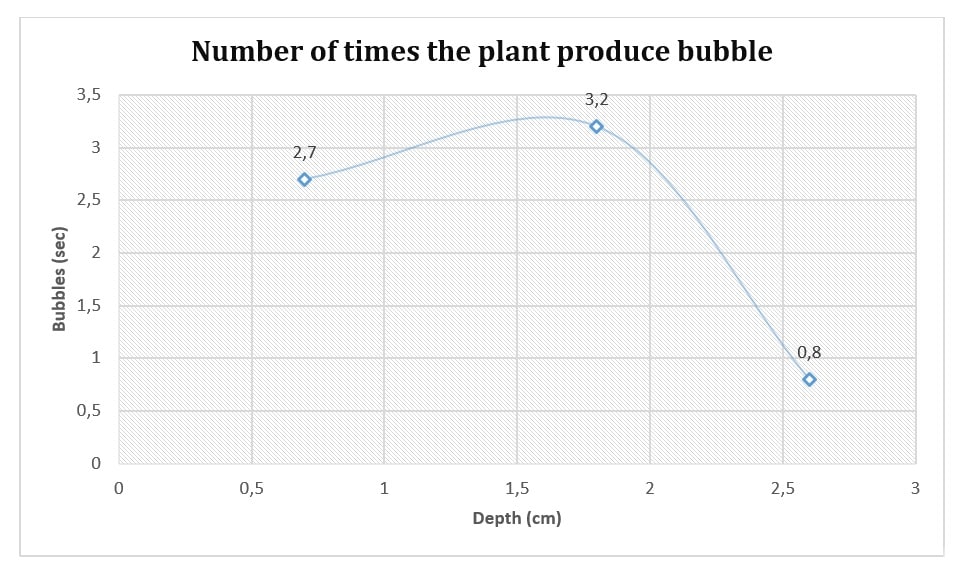
Plot graphs for experiments like enzyme reactions or heart rates. When you mix numbers with science, you’ll understand concepts faster and see the logic behind every process.
Organize Your Thoughts With a Mind Map
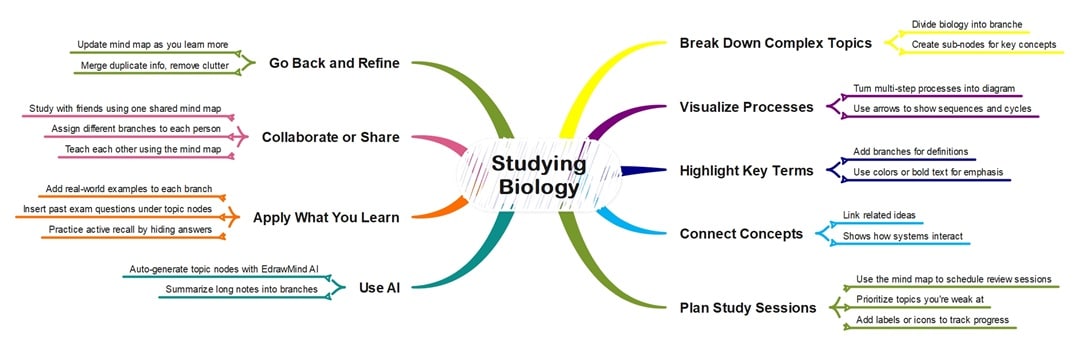
Too many topics bouncing around in your head? Start putting them in order using a mind map. Write the main idea in the center, then branch out into related concepts.
Which topics connect naturally? Add colors, arrows, or small icons to make it visual and easier to recall. Keep your mind map nearby during review sessions, and you’ll notice how fast connections start to form on their own.
How To Boost Efficiency With a Mind Map
In Biology, one concept leads to another. The cell connects to DNA, systems, and even the environment. Mind maps effectively allow you to trace connections just as your brain does, leveraging the power of associations.
Why Mind Maps Work for Studying Biology
A mind map allows you to see both the "big picture" and the fine details simultaneously. For example, you could create a mind map for The Immune System.
Your central topic would be the immune system itself. Major branches could be Innate Immunity and Adaptive Immunity.
From the Adaptive Immunity branch, you could create sub-branches for B Cells and T Cells. From B Cells, you could branch out further to Antibodies.
- Organize information logically: It transforms a lengthy chapter of text into a concise, one-page diagram.
- Reinforce memory: The combination of keywords, colors, and spatial organization engages more of your brain, making recall easier.
- Identify connections: You can easily draw lines between different branches to show relationships.
- They reduce overwhelm: Break giant topics into smaller, digestible chunks.
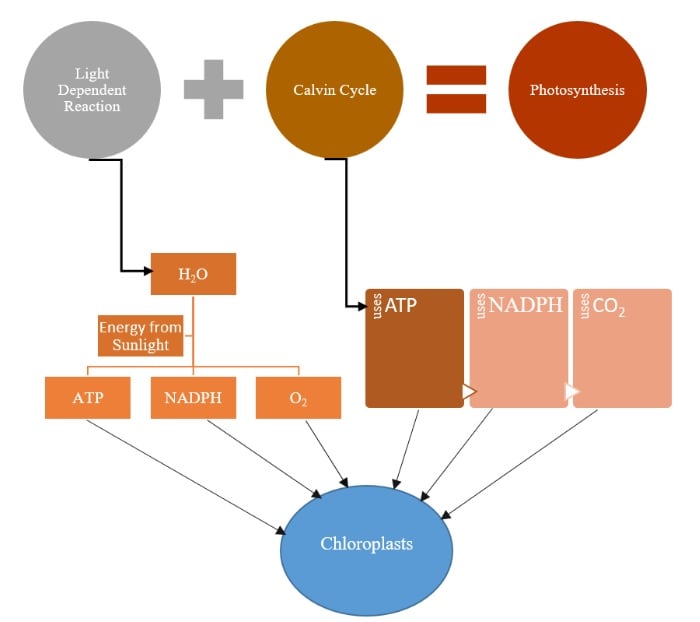
You're reviewing photosynthesis. A mind map can show:
- The two stages (light reaction, Calvin cycle)
- Where each one happens (chloroplasts, stroma)
- Key players
- Enzymes involved
Create a Biology Mind Map With a Mind Mapping Tool
Hand-drawn mind maps are great for quick notes, but digital tools give you more control. You can adjust them as you study, add details, and keep track of how your understanding grows.
Wondershare EdrawMind makes it easier to organize and manage knowledge so it remains practical and valuable throughout your learning journey.
 Try the app & get 500 free AI tokens


Try it for free across various devices:
- Start with a premade Biology study template
- Add branches with just a few clicks
- Insert images, formulas, or icons
- Customize with built-in themes and styles
- Export mind map in various file formats or collaborate with others online.
You can even use AI tools in EdrawMind to generate outlines or summaries. That means less time formatting and more time studying.
Final Thoughts
Studying biology opens a window into how life works. Every chapter, experiment, and diagram adds another layer of understanding.
As you apply the right study techniques, complex ideas become easier to follow. Using visuals, practicing with old papers, and organizing lessons with mind maps keep everything connected.
Stay curious and consistent as you learn. Each topic builds on the last, creating a clearer picture of how living systems thrive. The more you explore and apply what you study, the stronger your grasp of biology will become.
FAQ
-
How Many Hours a Day Should One Study Biology?
It’s better to study a little every day than to cram everything into one long weekend session. Spend two to three focused hours daily going over your lessons. Regular review helps the information stay in your memory longer and makes studying feel lighter. -
What Are Some Common Mistakes When Studying Biology?
One of the biggest mistakes is reading passively without engaging with the material. Highlighting or rereading won’t help you retain information for long. Another mistake is memorizing terms without understanding their meaning or purpose. Skipping diagrams is also a problem since they often show the most essential details in each process. Stay active during study sessions, ask questions, and use visuals to strengthen your understanding. -
What Is the Fastest Way To Memorize in Biology?
If you want to speed up your memory of biology facts, one effective method is to combine self-testing, the use of visual tools (such as mind maps), and the application of memory tricks (like mnemonics). -
How Can One Get an ‘A’ in Biology?
Concentrate your efforts on the use of the most effective study methods, which include the use of flashcards, creating your own questions, and regular practice tests. Additionally, familiarity with the syllabus and exam format is essential. Practice old exam papers with a set time limit and focus on understanding the concepts. -
What’s the Hardest Thing To Learn in Biology?
Although it is subjective, the three subjects of Molecular Biology, Biochemistry, and Biology are the most challenging for most students.
 EdrawMind
AppsEdrawMind Online
EdrawMind
AppsEdrawMind Online