



Long before humans walked the Earth, colossal creatures were found everywhere, ruling the land, sky, and sea. The dinosaur timeline stretches back more than 230 million years, written across layers of stone and fossils. These creatures have shaped entire ecosystems and defined an era that was unlike any other in Earth’s history.
You can think of the dinosaur timeline like unlocking a time capsule of evolution itself. Each period perfectly reveals how nature built and perfected these prehistoric marvels. Want to know more about it? Let’s journey through time and see how it shaped our modern world!
In this article
Dinosaur Timeline
It’s no secret that dinosaurs have always managed to capture the human imagination. From movies like Jurassic Park to The Lost World, humans have tried to recreate the sounds, emotions, and footsteps of a dinosaur. Their bones, scattered across every continent, have a story to tell: of survival, evolution, and finally, extinction that shaped life as we know it today.
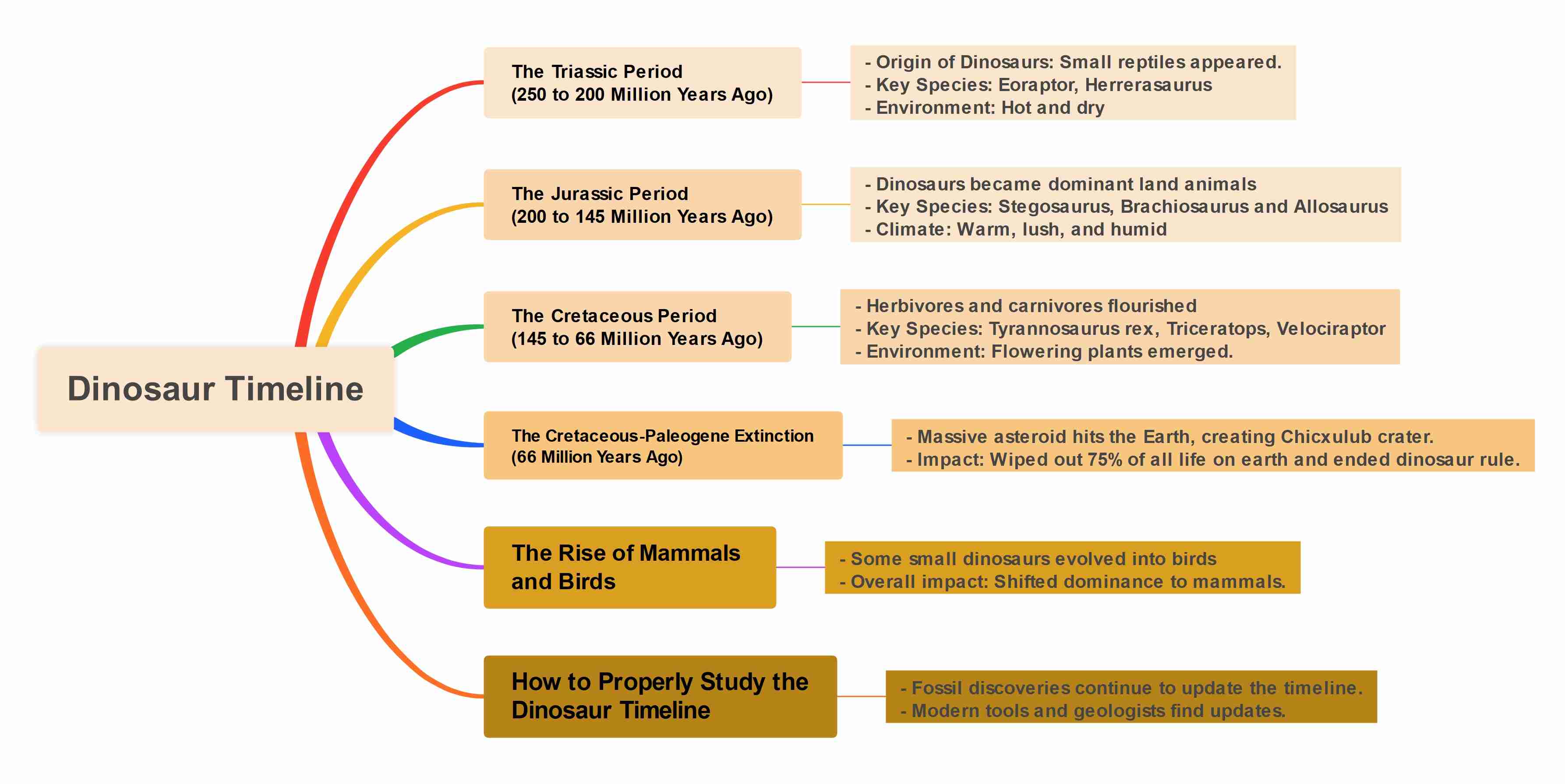
The dinosaur timeline chart is a complete map of evolution itself. It spans the three major geological periods that include the Triassic, Jurassic, and Cretaceous periods. Do you want to bring these periods to life? Let’s take a walk down memory lane, into a time when the dinosaurs ruled the earth.


1) The Triassic Period (250 to 200 Million Years Ago)
How does the story of the dinosaurs begin? It begins in the wake of catastrophe itself. Around 252 million years ago, a major event known as the Permian mass extinction occurred, which wiped out nearly 90% of all important species. As life started to slowly recover, the reptiles began to evolve and diversify, which basically paved the way for the first true dinosaurs.
The first period was the Triassic period, during which the Earth’s continents ended up being joined as one massive landmass known as Pangaea. The climate was hot and dry at best, with vast deserts and forests that were scattered everywhere.
What happened then? Right out of this harsh environment appeared small, yet agile creatures known as Eoraptor and Herrerasaurus, which are some of the earliest known dinosaurs. These species were something known as “bipedal,” which directly means that they walked on two legs.
Other early dinosaurs, such as the Plateosaurus, ended up growing larger and adapted to a herbivorous diet. This specific dinosaur showed the first hints of the diversity that would basically shape the Mesozoic era.
As the Triassic period came to an end, it was basically marked by volcanic eruptions and shifting tectonic plates that would start to split Pangaea apart.
2) The Jurassic Period (200 to 145 Million Years Ago)
After that came the Jurassic Period (the inspiration for the famous Jurassic Park movie). At this period, the planet ended up entering a warm, humid phase that would encourage the direct growth of lush vegetation everywhere. It was basically a paradise for herbivorous dinosaurs, who ended up growing to enormous size. It was the golden age of giants.
What were the most famous dinosaurs during this time? Names like Brachiosaurus, Diplodocus, and Stegosaurus ended up becoming symbols of the Jurassic world. The Brachiosaurus dinosaur had a towering neck and a quite gentle way of walking, and it could feed from treetops.
On the other hand, the Stegosaurus would basically roam the plains and was distinguished by its plates and spiked tail. Just as herbivorous dinosaurs appeared, we saw the creation of carnivorous dinosaurs who evolved to match these giants. Amongst these was the Allosaurus, one of the most ferocious (and scary) apex predators of all time!
If you were alive at the time and looked up, you could see one of the first birds taking form, namely the Archaeopteryx, which would permanently close the distance between reptiles and modern avians.
3) The Cretaceous Period (145 to 66 Million Years Ago)
The Jurassic Period was followed through with the coming of the Cretaceous Period, which ended up marking the peak and the final act of the dinosaurs. It was one of the longest of the three Mesozoic periods and one of the most diverse in both species and ecosystems.
This era ended up introducing some of the most famous dinosaurs in the history of the dinosaur timeline. The most prominent examples were the Tyrannosaurus rex, Triceratops, Velociraptor, Ankylosaurus, and Spinosaurus. What was the most famous one of them all? The T. Rex, with its bone-crushing jaws and tail, made it unbeatable!
On the other hand, the Triceratops was a herbivorous dinosaur and featured three horns and a massive frill. During all of this, the Cretaceous period also directly witnessed the rise of flowering plants everywhere, which ended up completely transforming the food chain and brought forth new kinds of herbivores.
After that, smaller theropods, such as the Velociraptor, showcased a great sense of intelligence and agility, which would basically shape the behaviours of modern birds.
4) The Cretaceous-Paleogene Extinction (66 Million Years Ago)
Just as the rise of the dinosaur timeline happened in an instant, it all ended. Around 66 million years ago, a massive asteroid ended up striking the Earth near the now famous Yucatan Peninsula. In return, this created the Chicxulub crater.
This period was known as the Cretaceous-Paleogene Extinction, and it ended up wiping out a whopping 75% of all life on Earth (can you believe it?). Only a few species, such as birds and mammals, ended up surviving this blast.
From here, the end of the Cretaceous marked the reset button for life on Earth. Mammals would then begin to rise, which led to the creation of primates, humans, and the modern world.
5) The Rise of Mammals and Birds
Once the dust settled, Earth entered a new age. The direct disappearance of the dinosaurs opened up countless new opportunities for mammals, who ended up diversifying in size, shape, and diet. Within a few million years, what happened? Basically, mammals ended up evolving into everything from small rodents to massive herbivores and predators.
Birds were basically the only surviving dinosaurs, and they continued to make their own evolutionary journey. Archaeologists have found fossils that have revealed amazing similarities between early birds and those of small theropods.
For this reason alone, the history of dinosaurs timeline doesn’t really end with extinction, but rather it continues into the present day through these birds.
6) How to Properly Study the Dinosaur Timeline
Understanding the dinosaur timeline relies on the consistent hard work of geologists, palaeontologists, and modern technology. The best primary evidence has to be fossils, which have been preserved in many layers of sediment that reveal hidden secrets.
Modern techniques such as radiometric dating have managed to allow researchers to estimate the fossil ages with insane accuracy. On top of that, important fossil sites such as the Badlands of North America, the Gobi Desert in Mongolia, and Patagonia in South America have continued to bring forth major discoveries that have reshaped our understanding of fossils.
How to Make a Similar Timeline for Other Historical Events?
Creating a timeline for a well-known historical event, movie, book, or influential figure is really easy. Want to learn how to build one? Here’s how:
- Collect background information: Start by researching facts and figures, such as names and birth and death dates.
- Identify generations: Find out about the relationships and build a structure before you begin designing.
- Create a general outline: Sketch out a basic design. You can decide the layout later.
- Add names and dates: Fill in the chart with events in descending order. Use connecting lines to describe dates.
- Include photos: Add photos to make it visually appealing.
- Review and verify: Check each name, date, and event for accuracy.
- Export: Once everything is complete, save your timeline digitally or print it.
Steps to Make the Dinosaur Timeline
You can use an online timeline maker rather than simply sketching it out on paper. For my project, I have used EdrawMind to make this dinosaur timeline. Here’s how you can do it too:
 Try the app & get 500 free AI tokens


Step 1 Getting Started
- Launch your application.
- Start making a timeline from scratch.

Step 2 Selecting Shapes and Colours
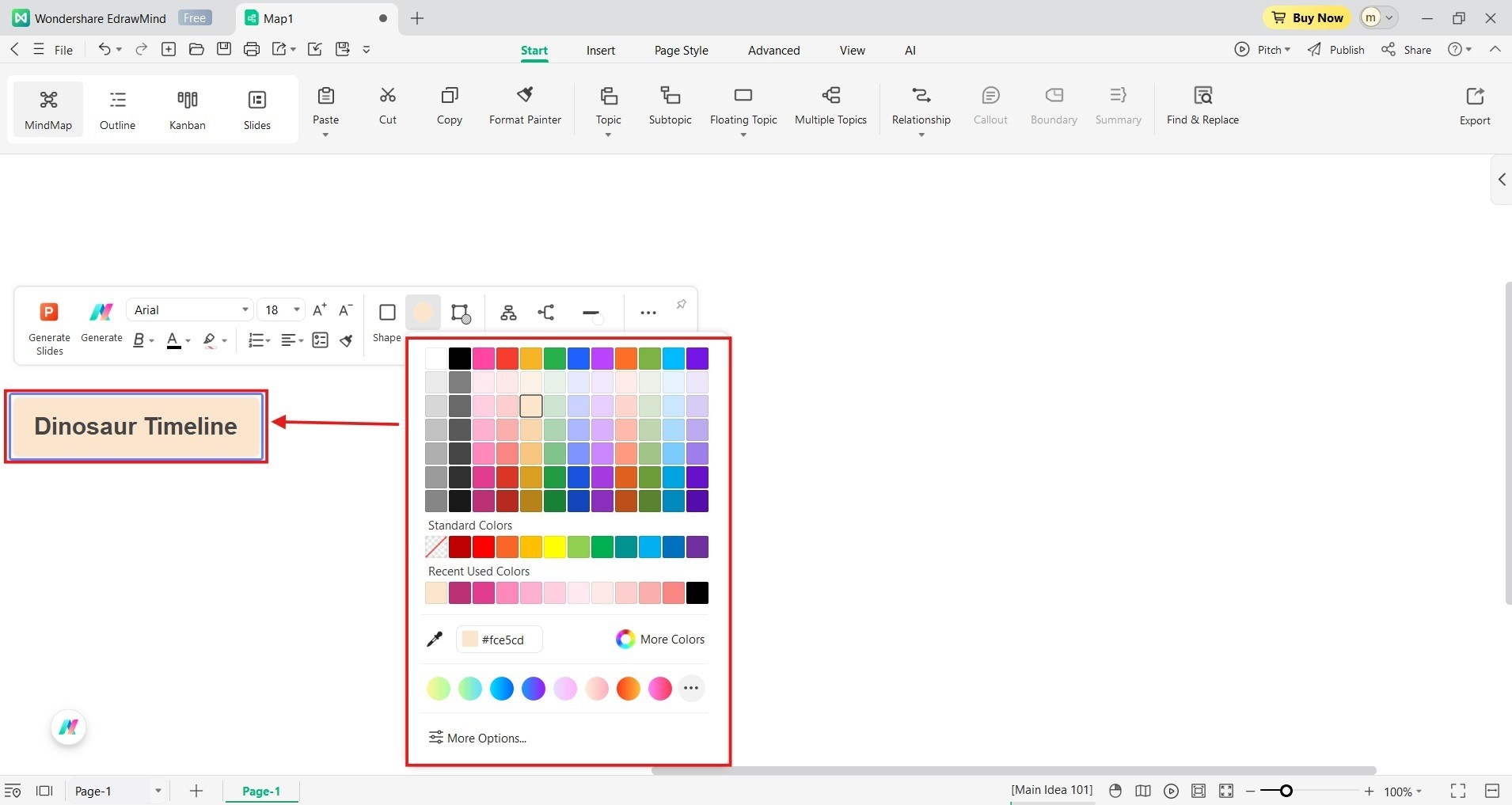
- Select your shape and place it in the middle. Write “Dinosaur Timeline” on it.
- Click the fill button next to the shape and select a colour to highlight it as the focus box.
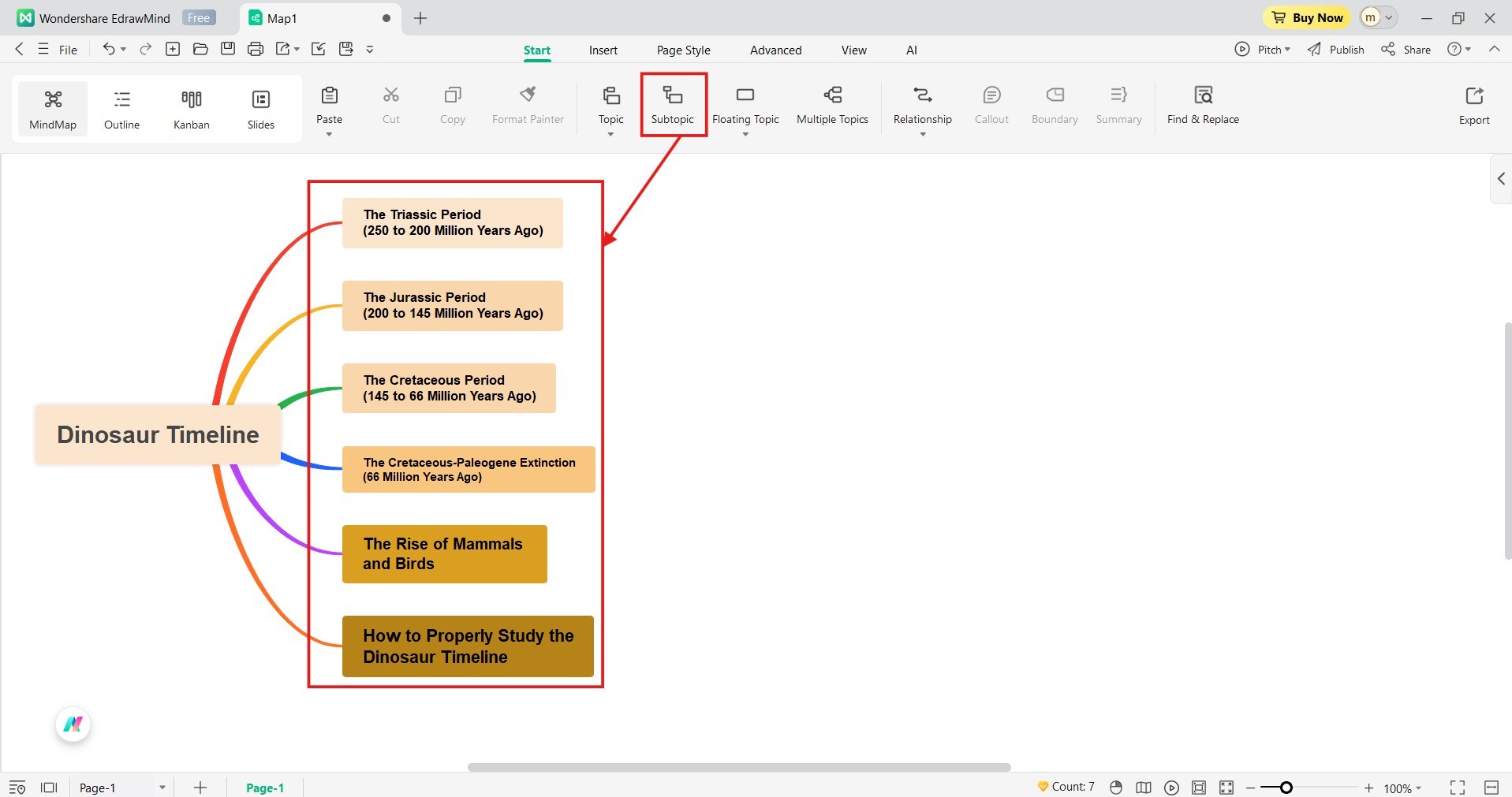
Step 3 Adding Events
- Make floating topics from the top menu.
- Create one for each major event and continue adding until the full timeline is displayed.
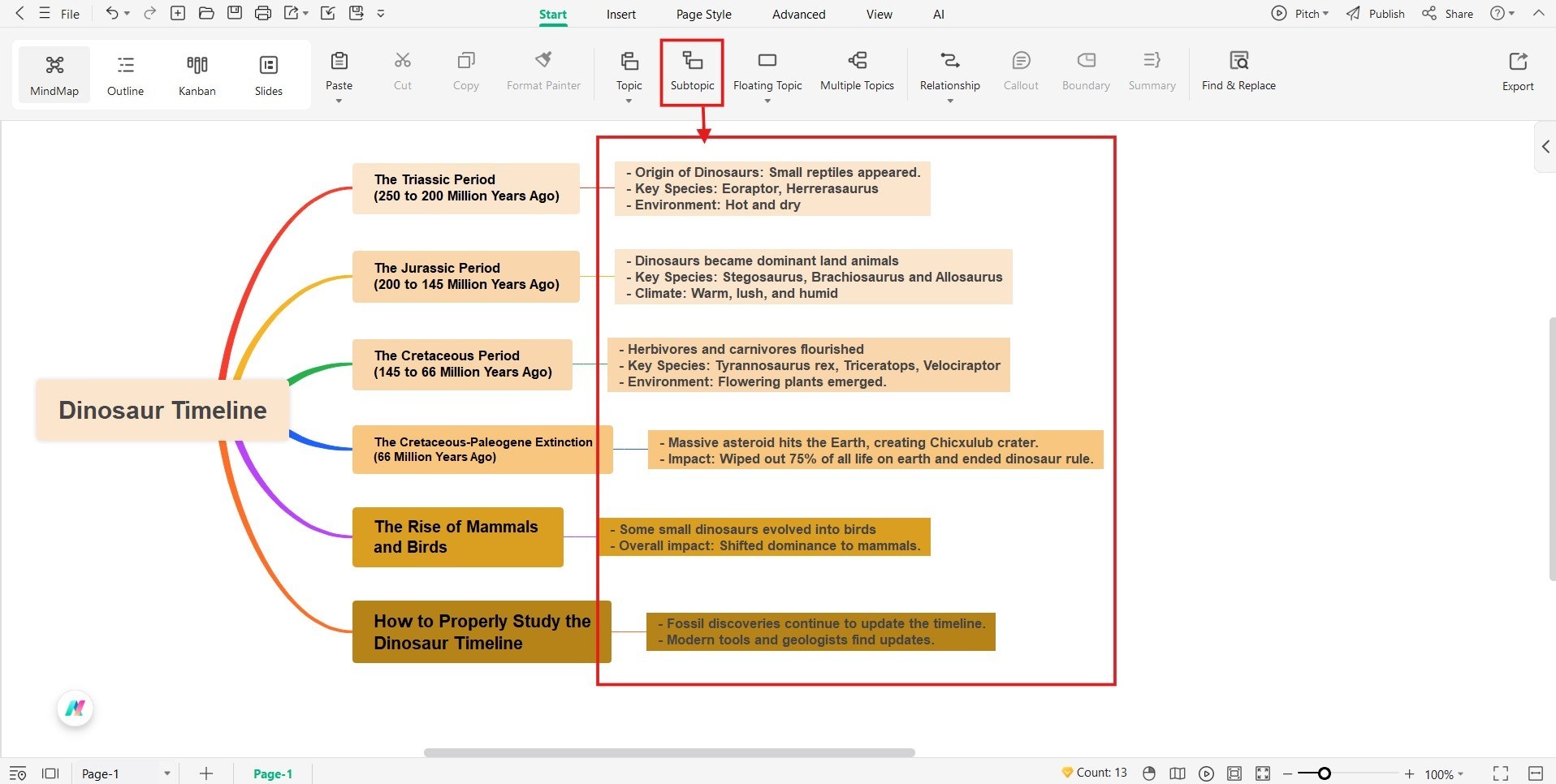
Pro Tip: You can tap Tab to efficiently add subtopics rather than having to click the subtopic button from the top menu bar again and again.
Step 4 Customising Each Major Event
- Use the floating toolbar to change the colour, font size, or box shape for clarity.
- You can also colour-code each section according to your preference.
Step 5 Connecting the Events
- Select relationships from the top menu.
- Draw connecting lines between each event to show the complete dinosaur history.
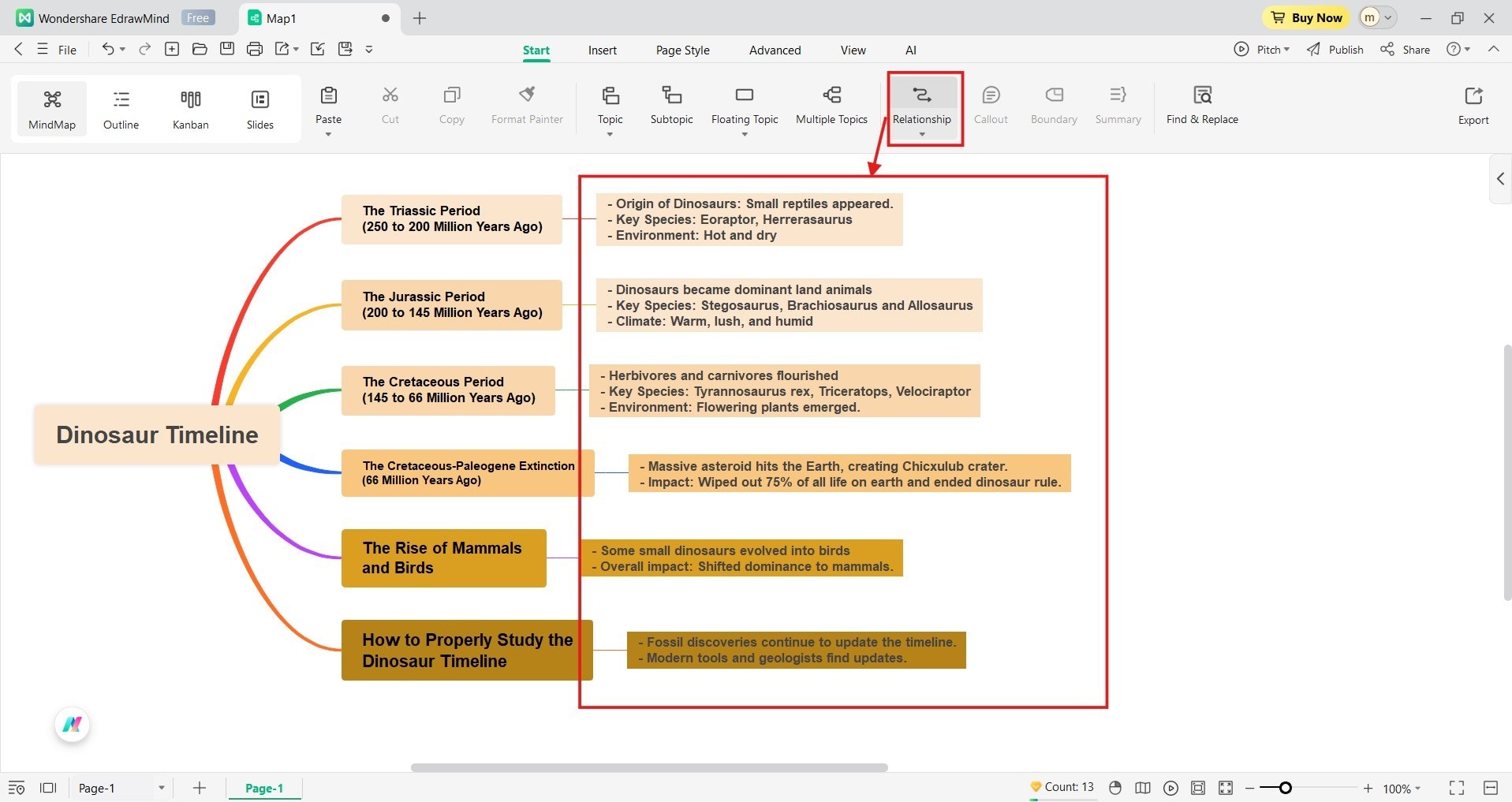
Step 6 Export the File
- Save your diagram after the final edits.
- Download in multiple formats if you need it in jpg or png formats.
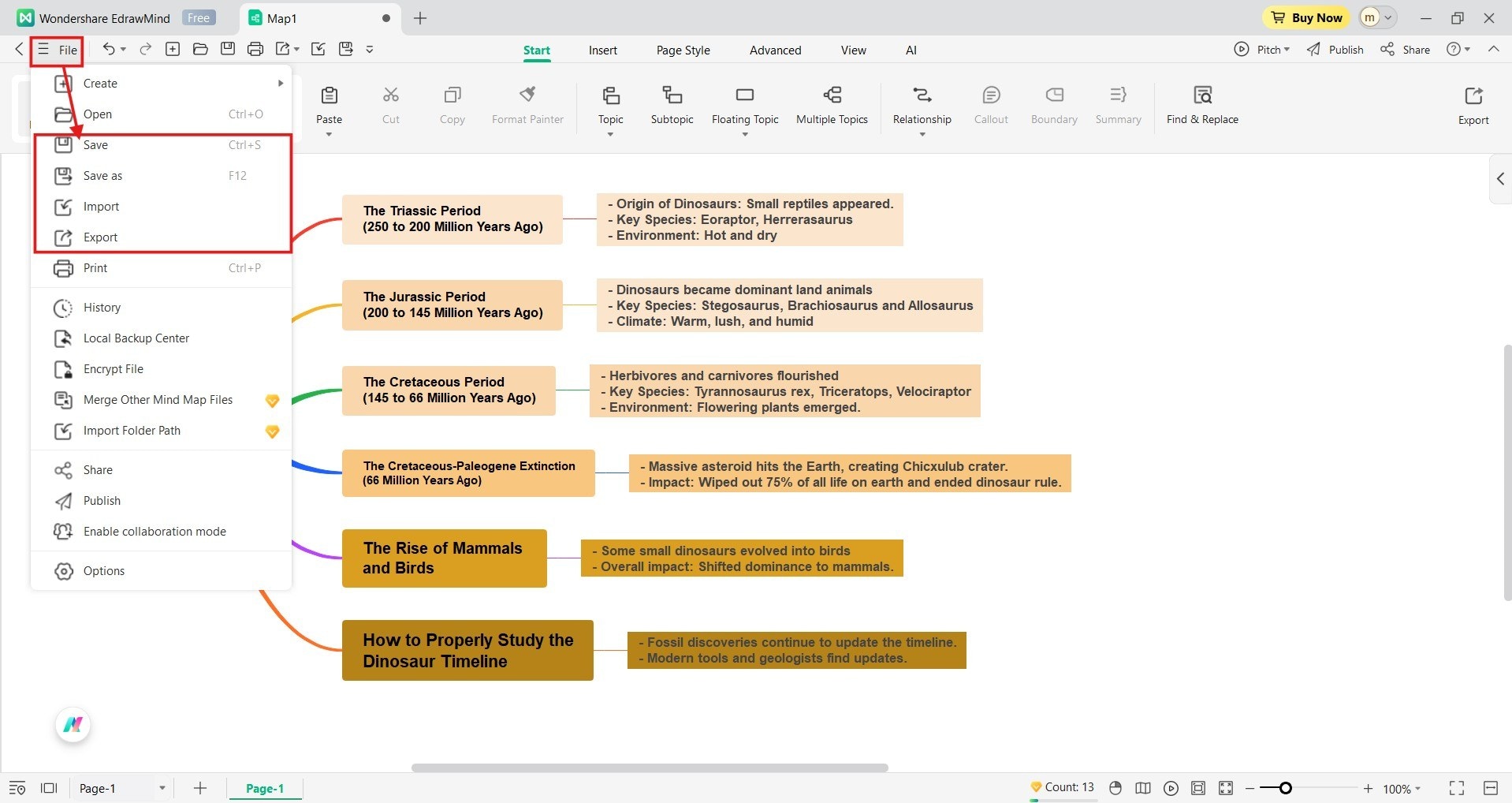
Wrapping Up
The dinosaur timeline perfectly captures the humble beginnings in the Triassic, which is followed by the grandeur during the Jurassic and the final demise of the Cretaceous period. Their rise and fall have given us great lessons about how to survive, adapt, and overcome each major challenge.
Today, we have continued to learn from their bones and fossils and have used modern tools to understand the dinosaur history timeline in ways that our ancestors could only dream of. Platforms like EdrawMind make it easy for students and teachers to map out this evolution visually, so try it out yourself today!
 EdrawMind
AppsEdrawMind Online
EdrawMind
AppsEdrawMind Online