

You may know a few famous Nobel winners. What is harder is seeing the story across decades. Dates blur. Fields mix. Significant shifts hide in long lists.
A simple timeline makes that story clear. It places each prize in time and lets you spot waves in science, literature, art, and more. It saves time and gives context for study, talks, or class notes.
In this guide, I'll lay out a clear Nobel Laureates timeline and highlight the key milestones. Moreover, I'll show you how to make a timeline with EdrawMind in minutes.
In This Article
What Makes a Nobel Prize So Special?
Alfred Nobel's Idea
Nobel was an inventor who saw both risk and promise in science. In 1895, he established the Nobel Prizes to recognize work that benefits humanity rather than status.
Nobel wanted the awards to honor discoveries that serve people beyond borders, breakthroughs that reshape science, literature, and peace.
The Six Categories for the Nobel Prize
- Physics: Nature's rules, from particles to space.
- Chemistry: How to build and transform substances.
- Physiology or Medicine: Biology that leads to better care.
- Literature: Texts that shape thought and culture.
- Peace: Practical moves that reduce violence.
- Economic Sciences (1968): Economic insight that improves decisions. (Created by Sweden’s central bank, not part of Alfred Nobel’s original 1895 prizes.)
Together, these six fields define how humanity explains, heals, creates, and progresses.
How the World’s Brightest Minds Are Chosen
Quick Background
- Each fall, trusted experts get private invites to nominate.
- Nominations close on 31 January and are screened for suitability and proof.
- Committees use external referees and build a shortlist.
- Final votes happen in October. Deliberations are kept confidential for a period of 50 years.
Who Holds the Vote
- For Physics, Chemistry, and Economic Sciences, the Royal Swedish Academy of Sciences makes the decisions.
- The Karolinska Institute handles Medicine.
- The Swedish Academy selects Literature winners.
- The Norwegian Nobel Committee manages Peace.
Why Impact Wins Over Hype
Each panel evaluates work based on documented impact.
- Has a scientific discovery been replicated?
- Does a medical advance reduce mortality?
- Did a peace initiative produce measurable results?
- Can a literary work's influence be traced through culture?
Committees focus on verified results, not visibility or status.
Why It Still Matters
- The prizes set a high standard for rigorous work and valuable outcomes.
- They spark studies, shape policy talks, and support human rights efforts.
- They give learners clear examples of impact backed by expert judgment.
That focus sustains the award's scientific and humanitarian credibility.
Nobel Laureates Timeline: How Genius Evolved Over a Century
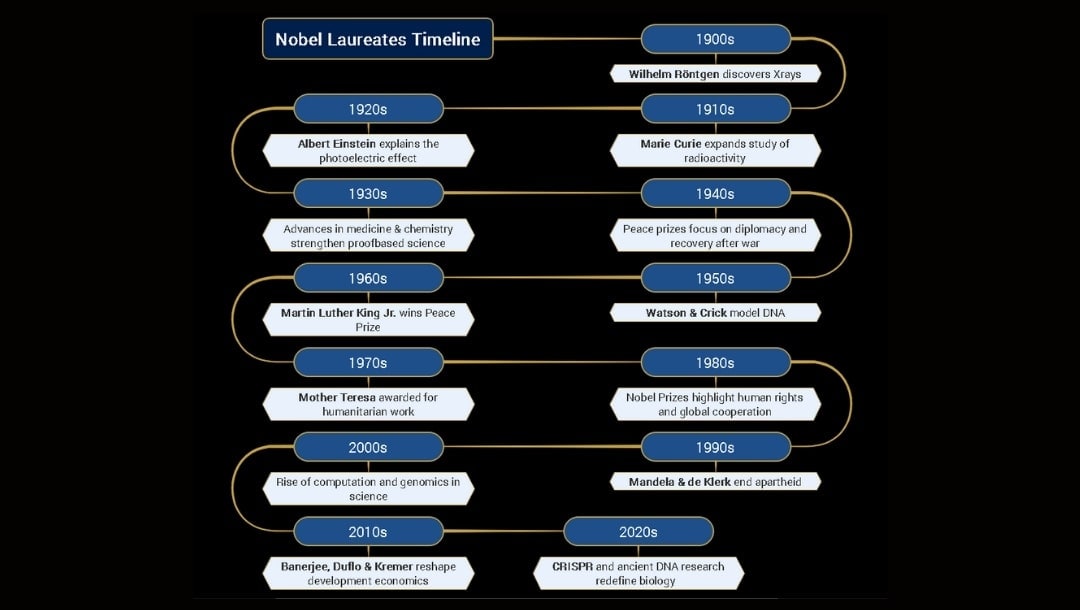


I use the Nobel Prize as a map of change. From 1901 to the present, it reflects shifts in science, peace, and culture.
Early Breakthroughs (1901–1945)
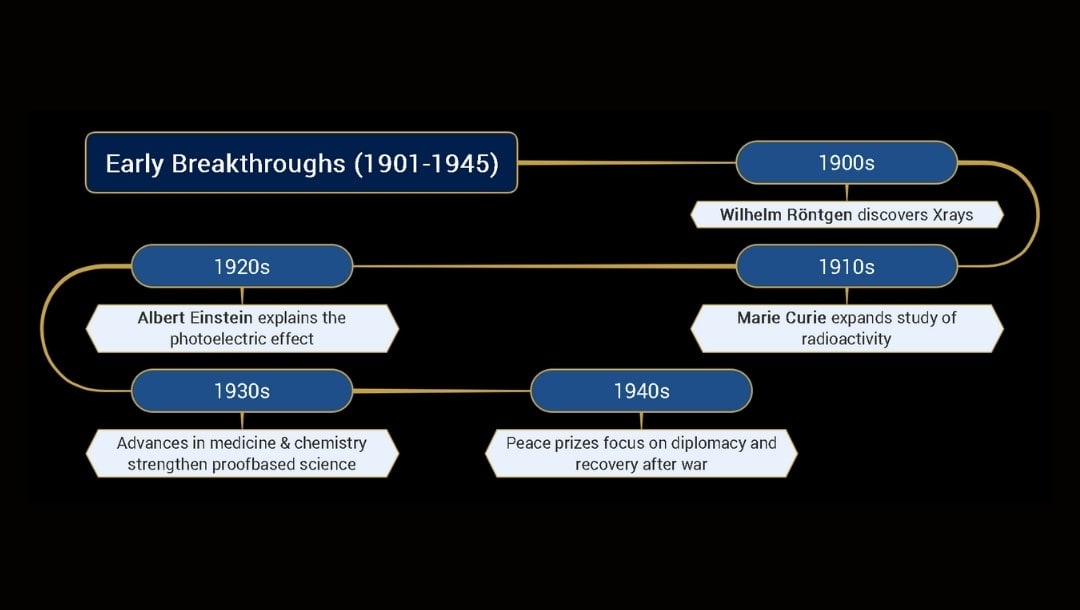
This era set the base for modern science.
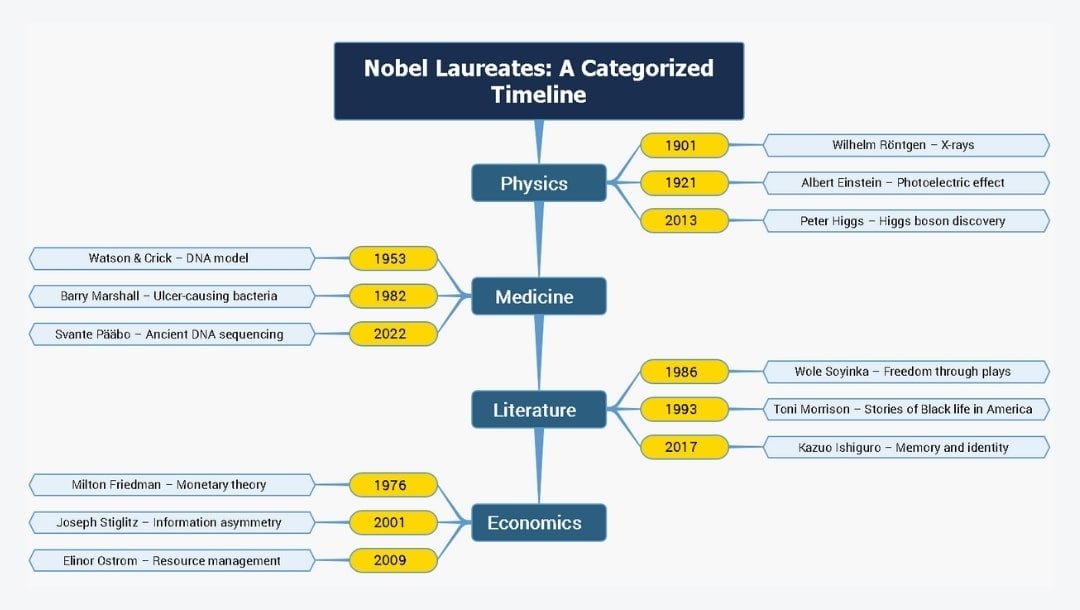
In 1901, Wilhelm Röntgen's work on X‑rays changed diagnosis in hospitals.
Marie Curie showed how careful study of radioactivity could reveal new elements and tools for therapeutic applications.
In 1921, Albert Einstein's work on the photoelectric effect explained how light frees electrons from their atoms. That insight feeds the sensors in cameras and many devices.
Peace prizes during this period often focused on diplomacy and relief efforts following conflict.
These wins made proof and method the standard.
A World Rebuilt (1946–1990)
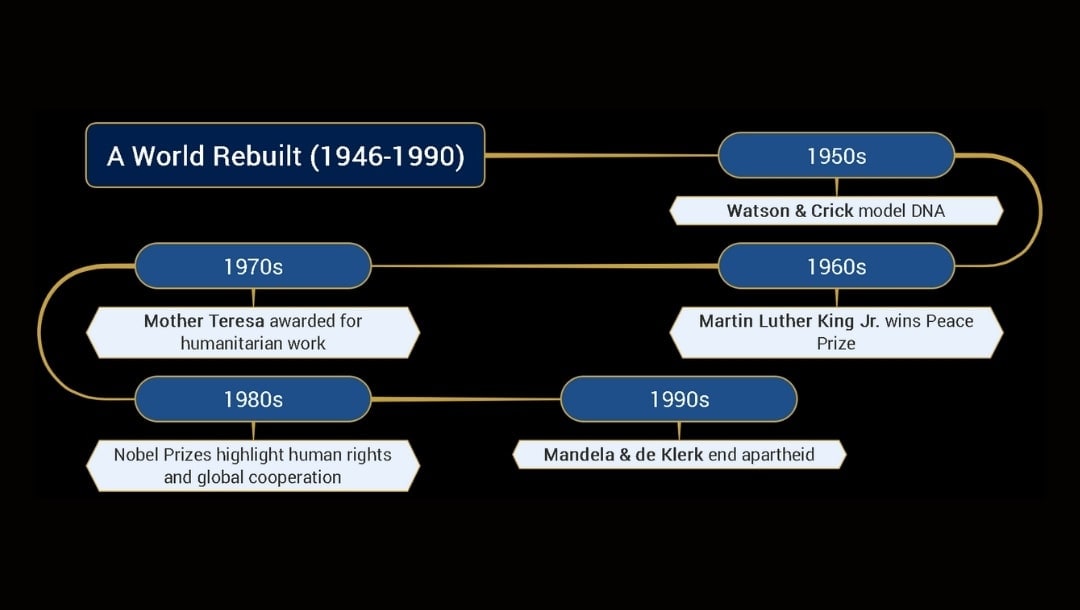
After the 2nd World War, the goal was to rebuild lives with knowledge.
In 1953, James Watson and Francis Crick’s DNA model gave medicine a codebook for life.
In 1964, Martin Luther King Jr. showed how nonviolence can shift law and practice.
Mother Teresa’s work (1979) centred on basic care as a cornerstone of peace.
Science prizes continued to push tools into clinics and farms. Peace and literature prizes lifted voices that widened rights and access.
The Modern Era (1991–Today)
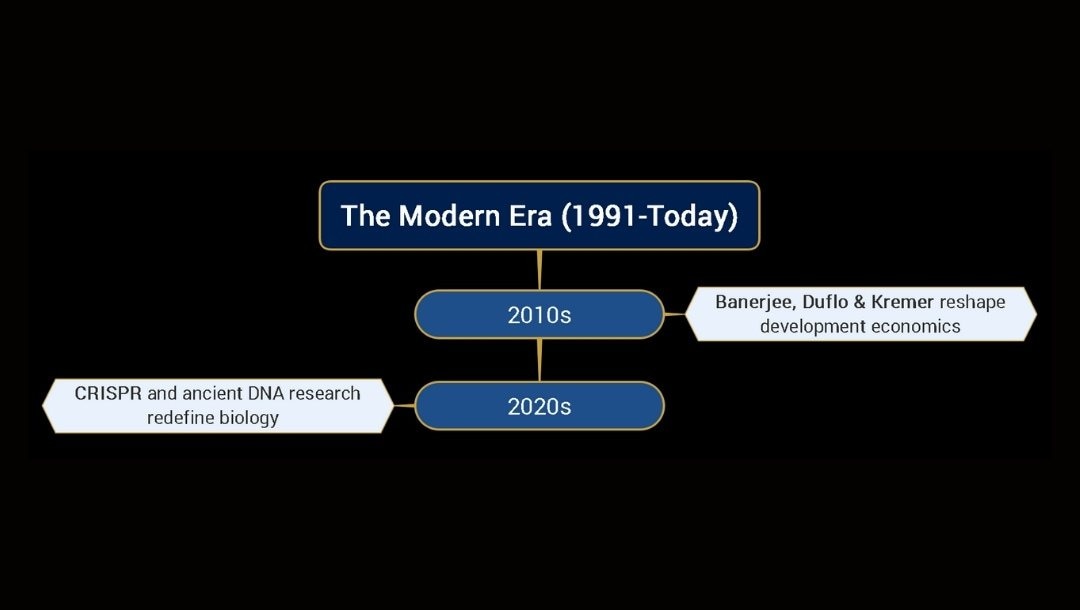
As the world became increasingly connected, new global problems required faster and more scalable solutions.
Since the 1990s, many prizes have shown this shift toward global ideas and digital transformation. Ethics has become a more significant aspect of the work.
In 1993, Mandela and F.W. de Klerk received the Peace Prize. Their work marked the end of apartheid and a hard transition for South Africa.
Literature prizes started to lift voices from many regions and tell stories about social change.
Science prizes pushed into new areas. Computation, genomics, and data work became common.
In 2019, Banerjee, Duflo, and Kremer won the Prize in Economics. Their field studies and randomized trials changed how development programs get tested.
Gene editing gained momentum following the 2020 Chemistry Prize, awarded to CRISPR. The link is clear: test ideas, share data, and aim for results people can use.
In 2022, Svante Pääbo won for sequencing ancient DNA, providing a new perspective on human history and evolution.
Two features shape today's work: cross-disciplinary methods and results that guide policy.
Famous Nobel Laureates Who Redefined Their Fields
Physics: Understanding the Universe
Niels Bohr
- He showed that electrons sit in fixed orbits around an atom.
- It helped scientists predict how atoms behave and contributed to the development of early quantum theory.
Max Planck
- He found that energy comes in tiny packets called quanta.
- That small idea started quantum physics.
Peter Higgs
- He suggested a field that gives particles their mass.
- Decades later, finding the Higgs boson proved why matter has weight.
Literature: Words That Moved the World
Toni Morrison
- She wrote about Black life in America with great depth and feeling.
- Her books opened many eyes and changed how stories were told.
Wole Soyinka
- He used plays and essays to question rulers and defend freedom.
- His words helped people see social problems in new ways.
Kazuo Ishiguro
- He writes quiet stories about memory and identity.
- His novels prompt readers to reflect on truth, loss, and what truly matters.
Medicine: Discoveries That Saved Lives
Barry Marshall
- He proved that a common stomach germ causes ulcers.
- Treating that germ with medicine changed how doctors prevent and cure ulcers.
Robert G. Edwards
- He helped develop in vitro fertilization, or IVF.
- IVF has allowed many people who could not have children before to become parents.
Harald zur Hausen
- He linked certain viruses to cervical cancer.
- That work led to the development of vaccines that prevent many cases of cancer.
Economics: Understanding How the World Works
Milton Friedman
- He showed that the money supply influences inflation and economic growth.
- His work shifted how governments and banks think about money.
Joseph Stiglitz
- He demonstrated that a lack of information can lead to market failures.
- His research enables economists to design more effective policies and programs.
Elinor Ostrom
- She proved that groups can effectively manage shared resources without violating established rules.
- Her findings gave fundamental tools for communities to protect forests, water, and fisheries.
These examples prove how one person’s idea can reshape an entire field. In each case, someone noticed a problem, tried something new, and left tools people still use today.
How to Create a Nobel Laureates Timeline in EdrawMind
I’ve made many history timelines in EdrawMind, and this is the easiest way to build one for Nobel Laureates. It keeps everything clear, visual, and simple to share.
 Try the app & get 500 free AI tokens


Step 1 Start with a Timeline Template
- Open EdrawMind on your desktop or browser, then go to the Gallery tab.
- Search for a timeline and choose a suitable layout.
- Click Duplicate to edit it in the EdrawMind canvas.
- This timeline template offers space for names, years, and categories spanning the decades.

Step 2 Set Up Eras and Add Key Details
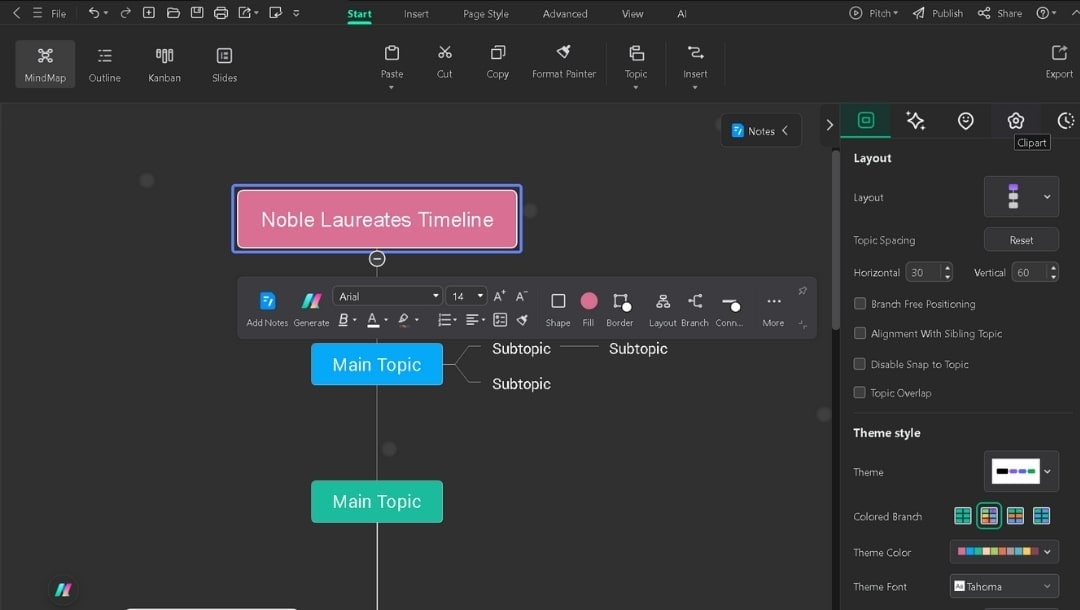
- Rename the main topic to the Nobel Laureates Timeline.
- Create main branches like:
- 1901–1945
- 1946–1990
- 1991–Today
- Add Subtopics for each decade under every era.
- Label each divider with the correct time range.
- Click a node and add one short line: Year – Name – Category – Main Contribution.
- For example: 1921 – Albert Einstein – Physics – Explained the photoelectric effect.
- Select and delete any nodes you don’t need.
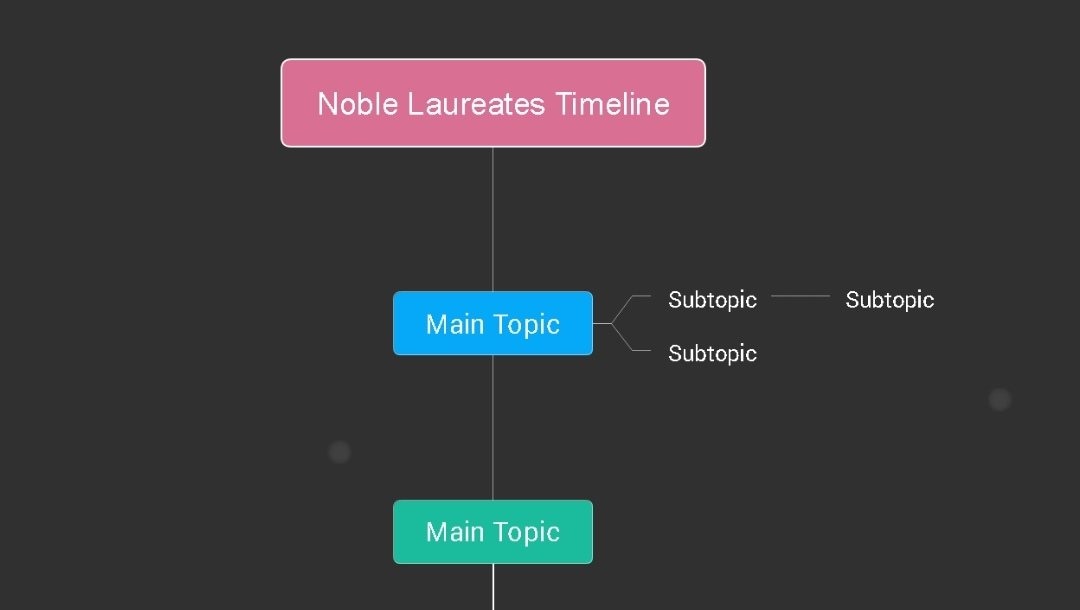
Step 3 Customize Visuals
- Select a suitable theme from the right-side panel.
- Pick one color for each category. For example: blue for Physics, green for Medicine, and orange for Literature.
- Add clip art or other elements to illustrate each field.
- Modify the connector style for further enhancement in following the timeline.
Step 4 Review, Present, and Export
- Review everything after completion.
- Check the Outline View to fix the order of dates.
- Use Slides Mode to walk through the events.
- Save as a template for later modifications.
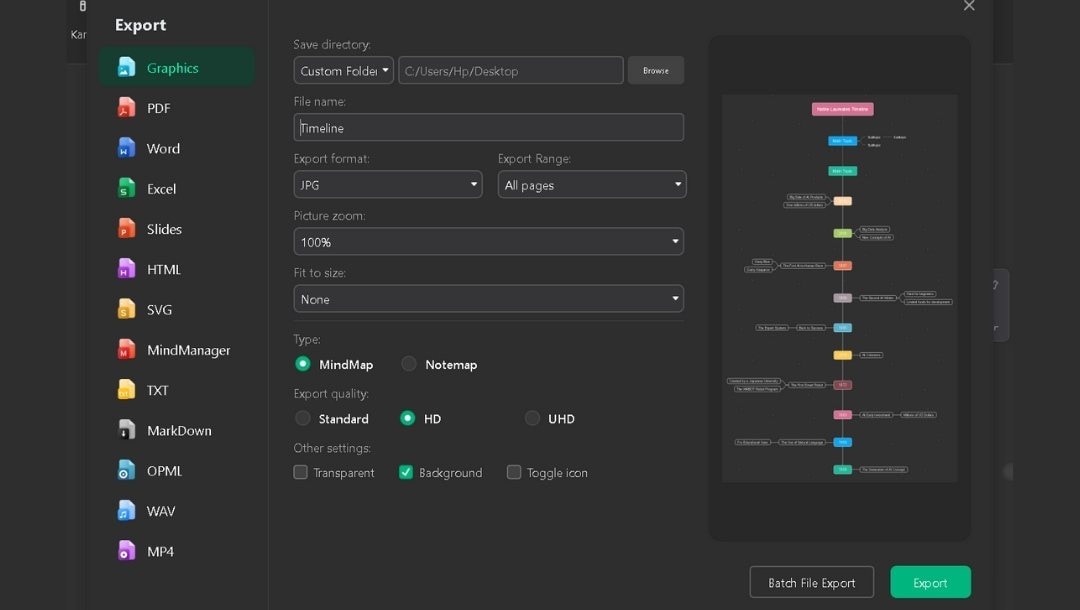
- Export as PDF, PPT, PNG, or JPEG. You can also share it online.
Why Use EdrawMind for Historical Timelines?
EdrawMind helps you turn complex historical data, such as the history of Nobel laureates, into clear, organized visual timelines.
- Pre-built templates enable you to start quickly without requiring design skills.
- Color coding helps viewers instantly understand categories.
- You can share your work online or export it for printing.
- The tool is compatible with all major platforms and devices, including Windows, macOS, Linux, Web Browsers, and Mobile Devices.
Tips for Creating a Meaningful Timeline
- Set your scope at the start. Pick your categories, your year range, and the limit per decade.
- Make a clean data sheet first. Add columns for year, name with marks, category, region, and a single impact line.
- Keep one naming style. First name, last name, and middle initials only when official.
- For joint awards, list each winner on a single line, separated by a comma. Add short notes only if needed.
- Add a tiny legend to explain any codes.
- Use quick notes to reference earlier work instead of lengthy explanations.
- Check each year on the Nobel site and another source. Fix anything unclear.
Wrap-Up
This story is easier to grasp when shown in a Nobel Laureates timeline. Eras, decades, and names become clearer when viewed together.
That is why a timeline helps study and teaching. EdrawMind is built for this. Pick a template, color eras, add notes, and filter by field. Present in the app, then export to PPT or PDF.
Start EdrawMind today and build your own timeline, which you can update each year with new awards.
 EdrawMind
AppsEdrawMind Online
EdrawMind
AppsEdrawMind Online