



The story of the Bible unfolds across countless millennia, covering a journey of faith, promise, and redemption. From the creation of the world to the rise of kings and prophets, and finally to the life of Jesus and the early Church, each chapter adds deep meaning to God’s divine plan.
The biblical timeline helps us see how all these events connect, showing the unfolding of history through the lives of ordinary people who were chosen for extraordinary purposes. For centuries, this story has guided millions, inspired hopes, and solidified belief systems across the world.
Through this Bible history timeline, you’ll walk through the key moments that define humanity’s spiritual journey from Genesis to Revelation. You will also get to witness how each event, prophecy, and covenant builds upon the next to form the greatest story ever told.
In this article
Biblical Timeline
Ever heard the phrase “The Bible is more than just a sacred book”? It’s true, it’s a complete history of humanity’s spiritual and moral journey. The biblical timeline begins with the dawn of creation and continues through centuries of struggle, faith, and comfort.
By following this Bible history timeline, we can see how God’s plan unfolds over generations, from the story of Adam and Eve to the cementing of humanity’s faith.
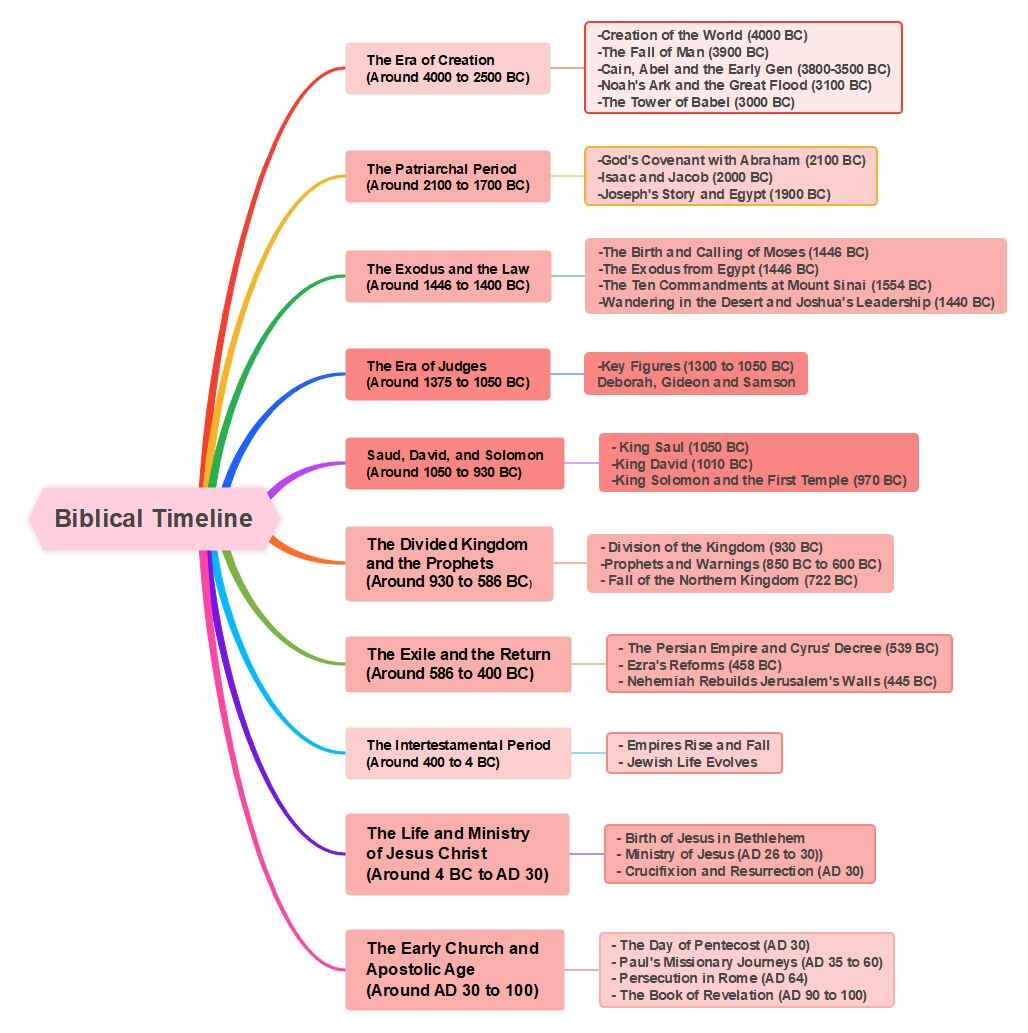


1) The Era of Creation (Around 4000 to 2500 BC)
Creation of the World (4000 BC)
God creates the earth, the heavens, and all living things in Genesis, marking the beginning of the biblical timeline. The first humans, Adam and Eve, lived comfortably in the Garden of Eden until the Fall, when humanity committed its first transgression.
The Fall of Man (3900 BC)
Eve gets tempted by the serpent, and sin manages to enter the world. At this point, Adam and Eve get cast out of Eden, beginning human history outside paradise.
Cain, Abel, and the Early Generations (3800-3500 BC)
The world's first violent act occurs when Cain kills Abel. As the descendants of Adam multiply, humanity begins to spread throughout the planet.
Noah’s Ark and the Great Flood (3100 BC)
God ultimately sends a flood to purify the world after it begins to become corrupt. In the Ark, Noah, his family, and animal pairs survive. This event establishes a new covenant between God and humanity.
The Tower of Babel (3000 BC)
People attempt to build a great tower to reach heaven. God confuses their languages and scatters them across the earth. This is how different nations and languages are born.
2) The Patriarchal Period (Around 2100 to 1700 BC)
God’s Covenant with Abraham (2100 BC)
From Ur to Canaan, God asks Abraham to come to Him and promises him Israel and a lot of descendants. One of the major turning points in the chronology of the Bible has to be this covenant.
Isaac and Jacob (2000 BC)
Isaac, the prophesied son, ends up continuing Abraham’s line. Jacob, who was later named Israel, became the father of 12 sons.
Joseph’s Story and Egypt (1900 BC)
Joseph, Jacob’s son, gets sold into slavery in Egypt but somehow manages to rise to power. Through his wisdom, Egypt easily survives famine, and his family migrates there. This truly sets the stage for the next major era incoming, the Exodus.
3) The Exodus and the Law (Around 1446 to 1400 BC)
The Birth and Calling of Moses (1446 BC)
God ends up selecting Moses to lead the Israelites out of Egyptian slavery. The Ten Plagues then demonstrate God's actual dominion over Pharaoh's empire.
The Exodus from Egypt (1446 BC)
Moses manages to lead the Israelites through the Red Sea and right into freedom. This event becomes central in the Bible history timeline.
The Ten Commandments at Mount Sinai (1445 BC)
God gives Moses the Law to help bring forth moral foundations for His people. This ultimately becomes the main core of the Old Testament covenant.
Wandering in the Desert and Joshua’s Leadership (1440 BC)
After 40 years of wandering, Joshua leads the Israelites into Canaan. The Promised Land gets conquered, and the nation of Israel begins to take form.
4) The Era of Judges (Around 1375 to 1050 BC)
After Joshua passes away, Israel enters a period where local leaders would call upon the Judges to guide the people.
Key Figures (1300 to 1050 BC)
The judges carry out the following:
- Deborah leads in wisdom.
- Gideon in courage.
- Samson in strength.
Each Judge defends Israel against all enemies and reminds the people of their covenant wth God. This part of the Bible timeline with world history shows a time of utter moral decline and spiritual renewal brought upon in cycles. It reflects humanity’s constant struggles between faith and rebellion.
5) Saud, David, and Solomon (Around 1050 to 930 BC)
King Saul (1050 BC)
Israel’s first king is chosen, marking the start of a new era in the chronology of the Bible. In an unfortunate twist of events, Saul’s disobedience leads to his ultimate downfall.
King David (1010 BC)
David (a shepherd boy) becomes king after defeating Goliath. Under his rule, Jerusalem becomes the capital, and Israel reaches new strength.
King Solomon and the First Temple (970 BC)
Solomon, David’s son, ends up building the First Temple, a sacred place for worship. His reign is remembered for three key reasons: peace, prosperity, and wisdom.
6) The Divided Kingdom and the Prophets (Around 930 to 586 BC)
Division of the Kingdom (930 BC)
After Solomon’s death, Israel was split into two: the Northern Kingdom (Israel) and the Southern Kingdom (Judah).
Prophets and Warnings (850 to 600 BC)
Prophets such as Elijah, Isaiah, Elisha, and Jeremiah appear during this timeframe. They attempt to call the people back to faith and warn of coming destruction if they turn away from God.
Fall of the Northern Kingdom (722 BC)
Assyria conquers Israel, and only Judah ends up remaining.
Fall of Judah and the Babylonian Exile (586 BC)
Nebuchadnezzar destroys Jerusalem and the Temple. The people of Judah are taken into exile in Babylon. This marks a dark but important chapter in the biblical timeline.
7) The Exile and the Return (Around 586 to 400 BC)
The Persian Empire and Cyrus’s Decree (539 BC)
Cyrus from Persia ends up conquering Babylon and lets the Jews return to their land. This event fulfils a prophecy and brings hope.
Rebuilding the Temple (520 to 515 BC)
Under the guidance of Zerubbabel, the Second Temple was built in the city of Jerusalem.
Ezra’s Reforms (458 BC)
Ezra leads a spiritual revival, teaching the Law to the people again.
Nehemiah Rebuilds Jerusalem’s Walls (445 BC)
Nehemiah restores the city’s defence system and strengthens national identity.
8) The Intertestamental Period (Around 400 to 4 BC)
Between the Old and New Testaments are about 400 years known as the “Silent Years”. No prophets speak during this period, but history continues to move on, as it does.
Empires Rise and Fall
Persia gives way to Greece under Alexander the Great. Later on, the Roman Empire rose to great power.
Jewish Life Evolves
Many synagogues and religious groups like Pharisees and Sadducees emerged, shaping the culture of Jesus’ time.
9) The Life and Ministry of Jesus Christ (Around 4 BC to AD 30)
Birth of Jesus in Bethlehem
Jesus is born during the rulership of Herod the Great. Angels announce his birth as the arrival of the Messiah.
Ministry of Jesus (AD 26 to 30)
He teaches lessons on love, forgiveness, and faith all across Galilee and Judea. His miracles, parables, and compassion touch countless lives.
Crucifixion and Resurrection (AD 30)
Jesus gets crucified in Jerusalem. Three days later, he rises from the dead, marking the foundation of Christian faith.
10) The Early Church and Apostolic Age (Around AD 30 to 100)
The Day of Pentecost (AD 30)
At this age, the Holy Spirit descends on the disciples, and the early Church is born.
Paul’s Missionary Journeys (AD 35 to 60)
The Apostle Paul spread Christianity throughout Asia Minor and Europe. His letters form much of the New Testament.
Persecution in Rome (AD 64)
Under Emperor Nero, Christians face persecution, but their faith spreads even stronger.
The Book of Revelation (AD 90 to 100)
John records visions of the end times while he is exiled on Patmos, concluding the chronology of the Bible.
How to Make a Similar Timeline?
Creating a timeline for a famous personality, franchise, book, or religious entity gives great insight into the events that took place. Here’s how you can build one:
- Collect background information: Start by researching important facts, including names, dates, events and relationships.
- Identify generations: Research the relationships and map out a structure before you begin designing.
- Create a general outline: Sketch out a basic design. Decide on the layout that best fits your timeline.
- Add names and dates: Fill in the timeline chart from the events, starting from the earliest to the latest. Use connecting lines to describe dates.
- Include photos: Add photos to make it easy to visualise the person or event you’re describing.
- Review and verify: Check each name, event, and date before finishing up.
- Export: Once everything is complete, save your timeline digitally or print it.
Steps to Make the Biblical Timeline
You can use an online timeline chart maker rather than drawing it out. For my project, I have used EdrawMind to describe the biblical timeline chart. Here’s how you can do it too:
 Try the app & get 500 free AI tokens


Step 1 Get Started
- Launch your application of choice.
- Click Create and then select Blank Mind Map.

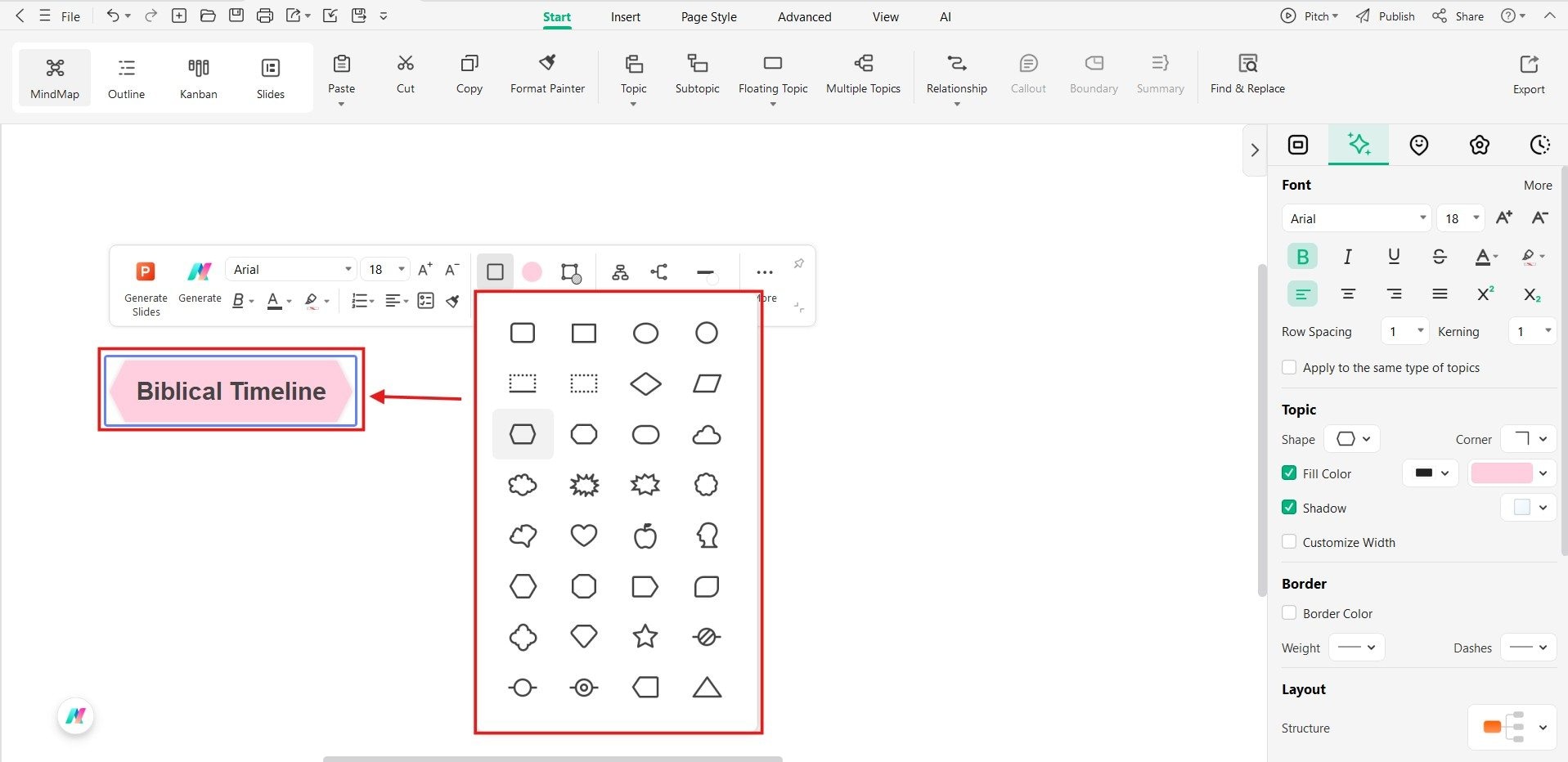
Step 2 Select Shapes and Colours
- Select your shape and place it in the middle.
- Write Biblical Timeline as text in the blank space.
- Click the fill button next to the shape and select a colour to highlight the focus box.
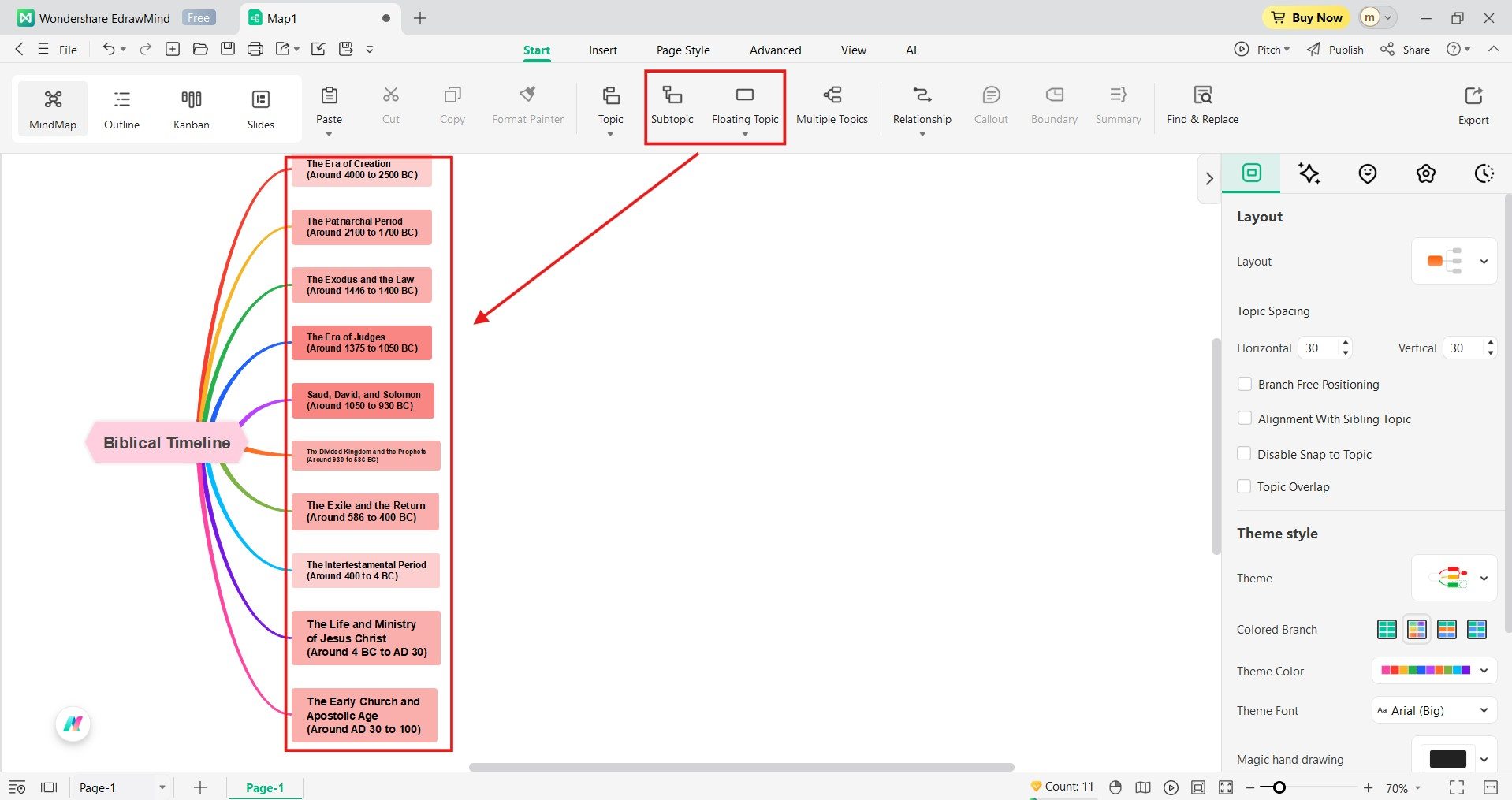
Step 3 Add Events
- Select floating topic from the top menu.
- Create one for each major event and continue adding until the full timeline is displayed.
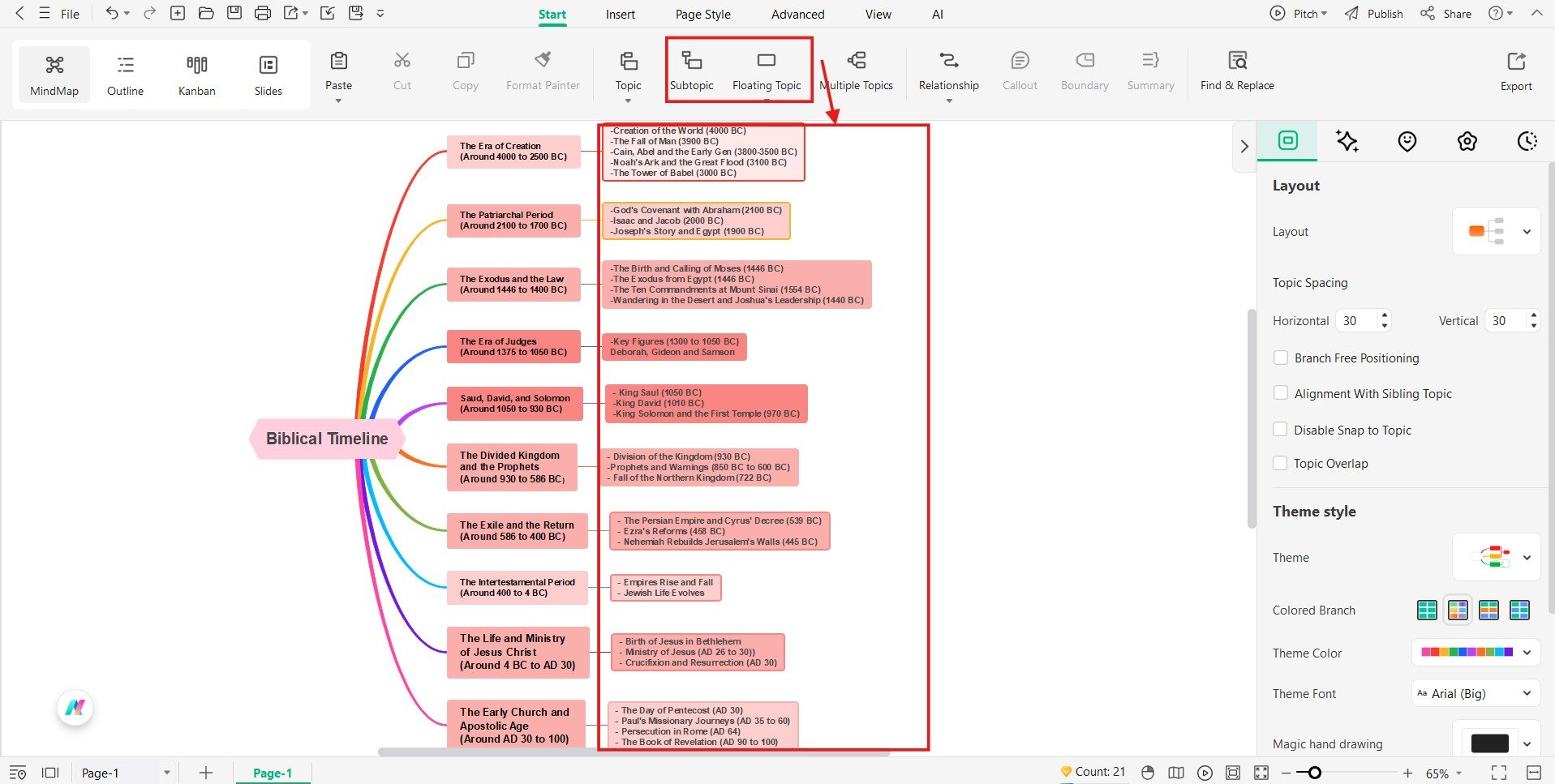
Tip: Select the Subtopic after adding the main topic to describe the events without stretching out the timeline too long.
Step 4 Customising Each Major Event
- Use the floating toolbar to change the colour, font size, or box shape for clarity.
- You can also choose to colour-code each section to highlight major events.
Step 5 Connecting the Events
- Make relationships between the boxes.
- Draw connecting lines between each event to show the chronological order of the Bible.
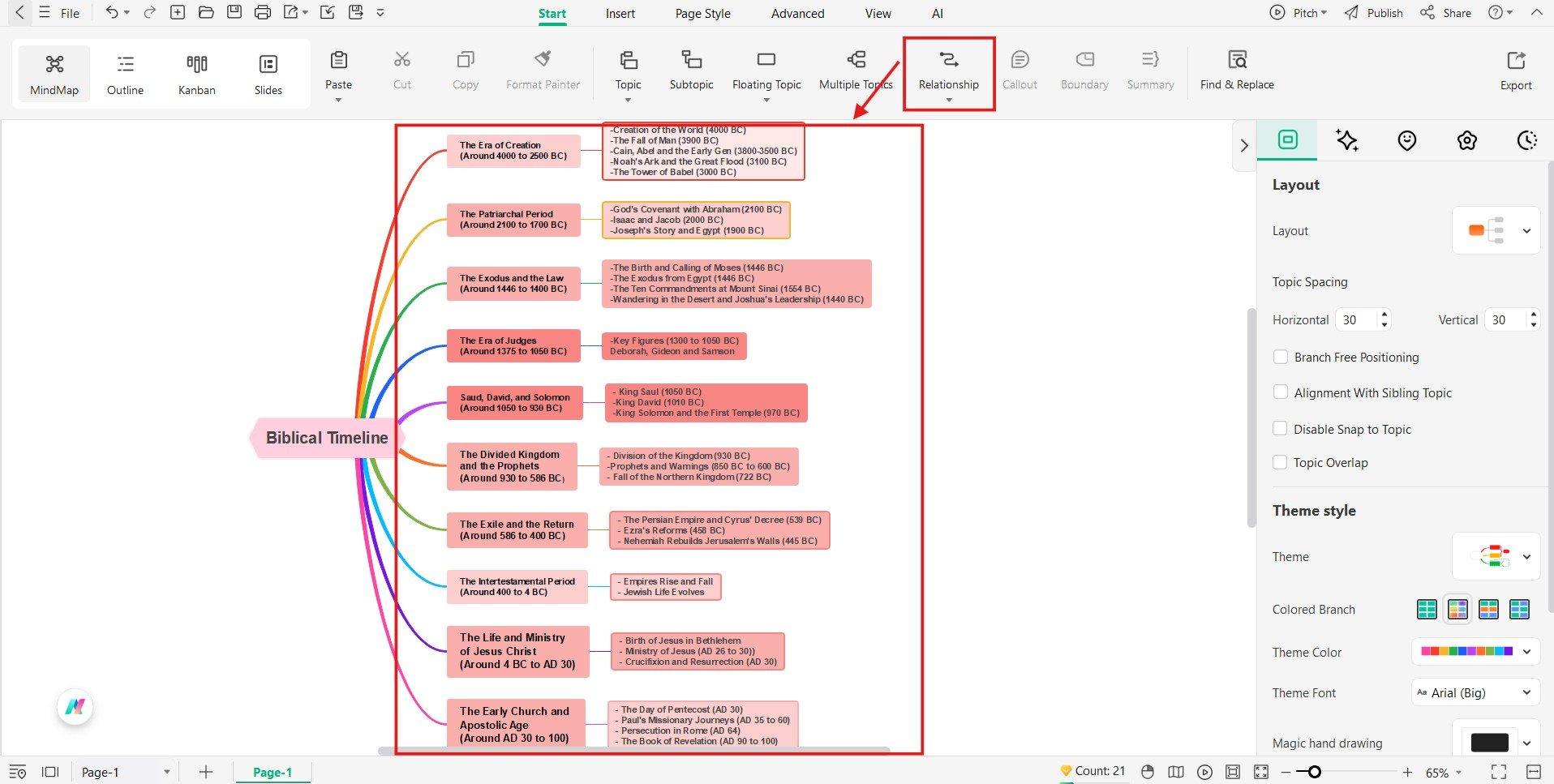
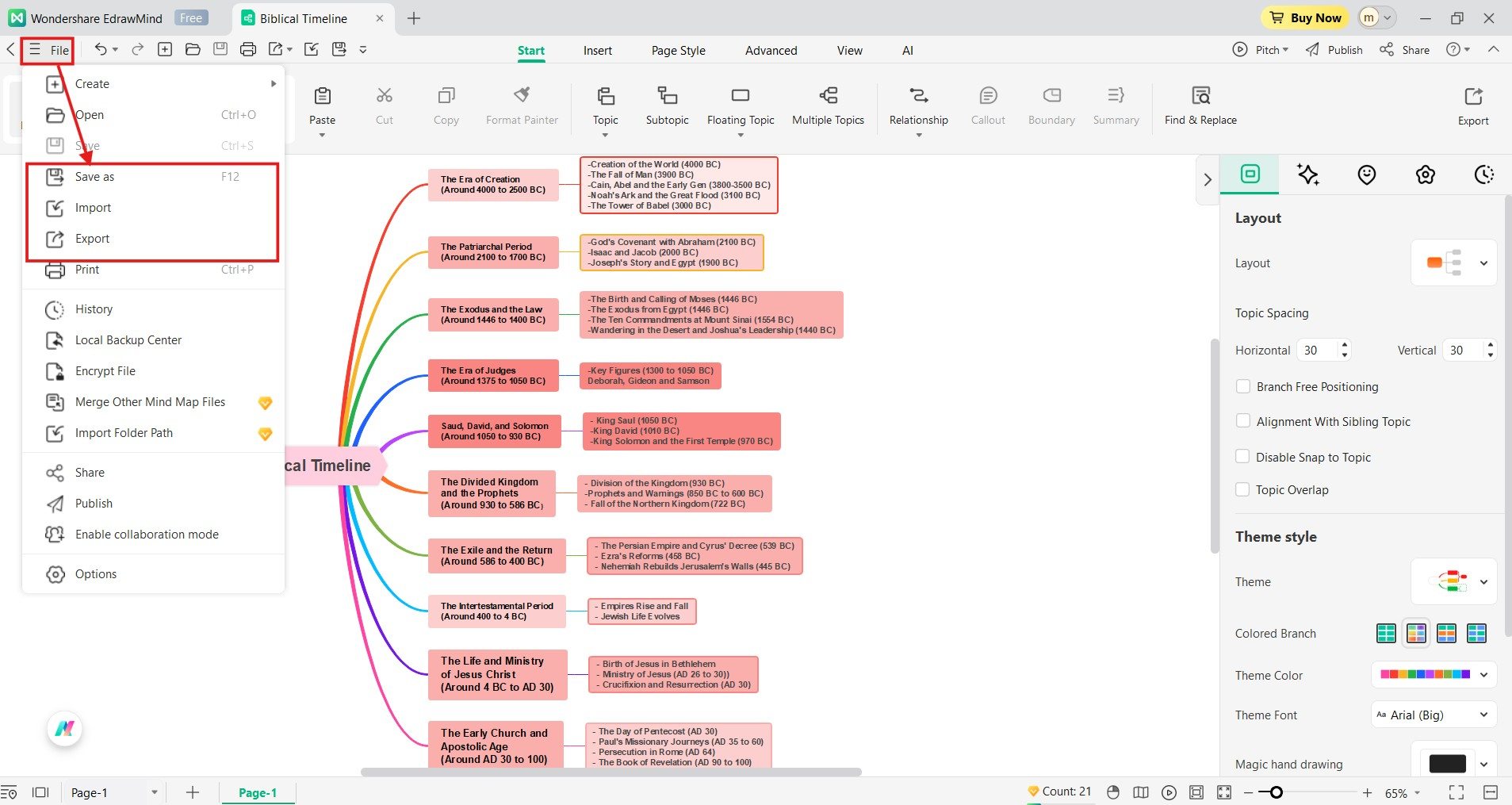
Step 6 Export the File
- Save your diagram.
- Download your diagram in other formats such as Excel, Word, PowerPoint, PDF, JPG, or PNG.
Wrapping Up
The Biblical timeline shows how each event brought humanity from its starting point to the current modern era. Humanity’s creation is the reason we see everything as it is today: love, hate, transgression, redemption, beliefs and disbeliefs.
Whether you’re studying the chronology of the Bible for religious studies or trying to become a person with stronger faith, a timeline summarises the key points perfectly. It also goes into deeper detail to help you understand each event better. To make your own timeline, check out products like EdrawMind to make the process easy.
 EdrawMind
AppsEdrawMind Online
EdrawMind
AppsEdrawMind Online