


One of the most effective ways to understand the Bible and God's word is through Bible study.
Begin with something small, focus on one verse, and allow yourself some time to reflect. Some people keep a journal, some follow a study plan, and most find that their group helps.
Any of these methods can lead you to uncover the Bible that you would not have found if you were on your own.
The goal is to understand and apply your learning in daily living. So, keep reading to cultivate a Bible study habit that complements your daily routine.
In this article
What Is the Bible?
The Bible is no ordinary book. Inside its pages, the words are almost like medicine for the soul.
In 2 Timothy 2:15, the Apostle Paul wrote, "Do your best to present yourself to God as one approved, a workman who does not need to be ashamed and who correctly handles the word of truth."
The Greek term translated as 'correctly handle' (orthotomeo) also means 'guide on a direct path.' To know how to study the Bible, you need to understand that the Bible is open for interpretation.
Interpretation is the central pillar in Bible study. Biblical interpretation is technically described as hermeneutics, which provides certain fundamental concepts to help explain the Bible more effectively.
Here, the key principle is context. The Bible states that those who hunger and thirst for righteousness will be filled (Matthew 5:6). If you're only studying the surface, then you will only comprehend the surface of God's words.
The words of God practically illuminate your world, bringing light to the darkest corners. But if you don't look for it, you can't earn the light and hope.
Studying the Bible is essential, for God's words point you in the right direction in life. It illuminates the path ahead of you so that you can see precisely where to go.
The Bible will become your lifeline into a relationship with God. Just as the body needs food to live, God's words nourish you to grow in spirit as you respond to the struggles and impulses of life.
The Bible can help guide you back on track if you find yourself on the wrong path in life.
Resources To Study the Bible
There are multiple resources available to help with Bible study. Some essential resources you don’t want to miss out on:
- Bible Study Applications - There are many software applications and websites to help simplify Bible study. They have various history and literary books for reference.
- Color Coding - All you need is a bunch of highlighters and colored pens. Color-code your bible verses based on your understanding and interpretation.
- Bible Dictionary - A dictionary will help you understand key terms and is a most resourceful and practical theological reference book for studying the Bible.
- Bible Verse Mapping - One of the most accessible resources for studying the Bible is mind mapping. EdrawMind is an intuitive software that helps you create visually appealing and detailed mind maps for use and reference.
How To Study the Bible?
 Try the app & get 500 free AI tokens


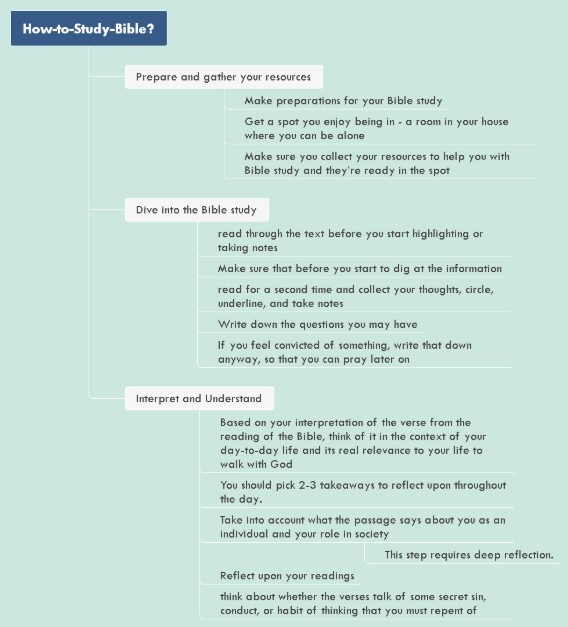
Step 1: Prepare and Gather Your Resources
Make preparations for your Bible study. Get a spot you enjoy being in - a room in your house where you can be alone or somewhere you're relaxed and sit comfortably.
Make sure you collect your resources to help you with Bible study, and they’re ready in the spot.
Step 2: Dive Into the Bible Study
First, read through the text before you start highlighting or taking notes. Make sure that you can get an outline of what the passage is conveying in your head before you begin to dig into the information.
Then read for a second time and collect your thoughts, circle, underline, and take notes. Write down the questions you may have, the stuff you found surprising, and your thoughts.
If you feel convicted about something, write that down anyway, so that you can pray about it later. Try not to have any doubts or reservations in this step.
Step 3: Interpret and Understand
Based on your interpretation of the verse from the reading of the Bible, think of it in the context of your day-to-day life and its real relevance to your life to walk with God.
You should pick 2-3 takeaways to reflect upon throughout the day. Take into account what the passage says about you as an individual and your role in society. This step requires deep reflection.
Reflect upon your readings and think about whether the verses talk of some secret sin, conduct, or habit of thinking that you must repent of. Does it ask you to seek God more? More trust in Him? Have faith?
In prayer, you must contemplate these questions and ask God to comfort you with everything he has shared through his writing.
Tips for Effective Bible Study
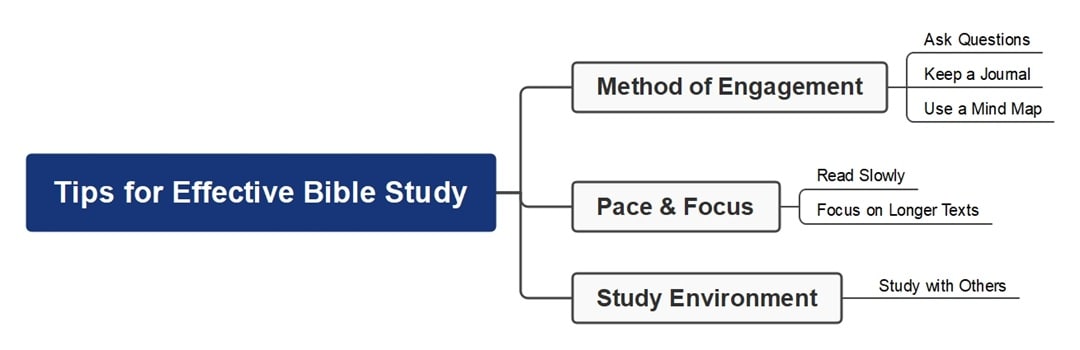


Some of the ways you can maximize your study of the Bible are as follows:
Ask Some Simple Questions
This can help you gain a deeper understanding. It might be helpful to use traditional investigative questions: Who? What? Where? When? Why? How?
These questions help locate the main topic of the passage being studied: who composed it, who interpreted it initially, and what context? Is there a central verse that might describe the passage being studied?
Read the Bible Slowly and Deliberately
Don’t read the Bible rapidly and carelessly. Sometimes, people want to clarify a point as soon as possible due to our fast-paced society.
It is better to read the Bible slowly and not skim through it if a passage has been chosen for review; carefully read through it.
Maintaining a Journal
It can be helpful to note down some devotional notes, philosophical questions, and observations that you may need answers to in the near future.
Studying the Bible Alone
Studying the Bible alone is suitable for intimate, devotional occasions, but make sure the reading of the Bible includes others as well.
Find out if any churches around you conduct Bible studies for small groups, then look for the one that interests you.
Try Not To Skip Too Much
Instead of reading short, scattered verses from numerous Bible books, focus on longer passages and texts.
Developing a Mind Map: One of the great things about a mind map is that it enables you to organize your ideas and visualize the links between various concepts in the text.
How To Boost Efficiency With a Mind Map
A mind map enables you to organize your ideas, focus on the most important aspects, and enhance your productivity. Rather than moving between tabs, notes, and files, you have all your work in one easy-to-follow visual diagram.
A mind map essentially enables you to create a network from one central theme. Besides dividing big tasks into smaller ones, you can also add more details gradually. When studying the Bible, a mind map can help you to:
- Understand the whole story: A mind map can help you to see how different verses or chapters of the Bible relate to each other.
- Manage your ideas: You can better understand and remember what you have learned by visually organizing your notes and insights.
- Expand your connections: A mind map layout can help you link new connections with old ones that you may not even realize.
- Quicker decisions: Since you have all your ideas in front of you, it’s impossible to be unsure about what to do next.
- More convenient updates: With a few clicks, you can add, move, or delete elements if you have the right tool.
Creating a mind map for Bible study is easy. You can generate one using AI, start from a template, or build from scratch. It supports real-time edits, team sharing, and color-coded branches.
Try Wondershare EdrawMind to keep your ideas organized and accessible, wherever you work, even for Bible study notes and reflections.
Here is an example of a mind map on How to Study the Bible:
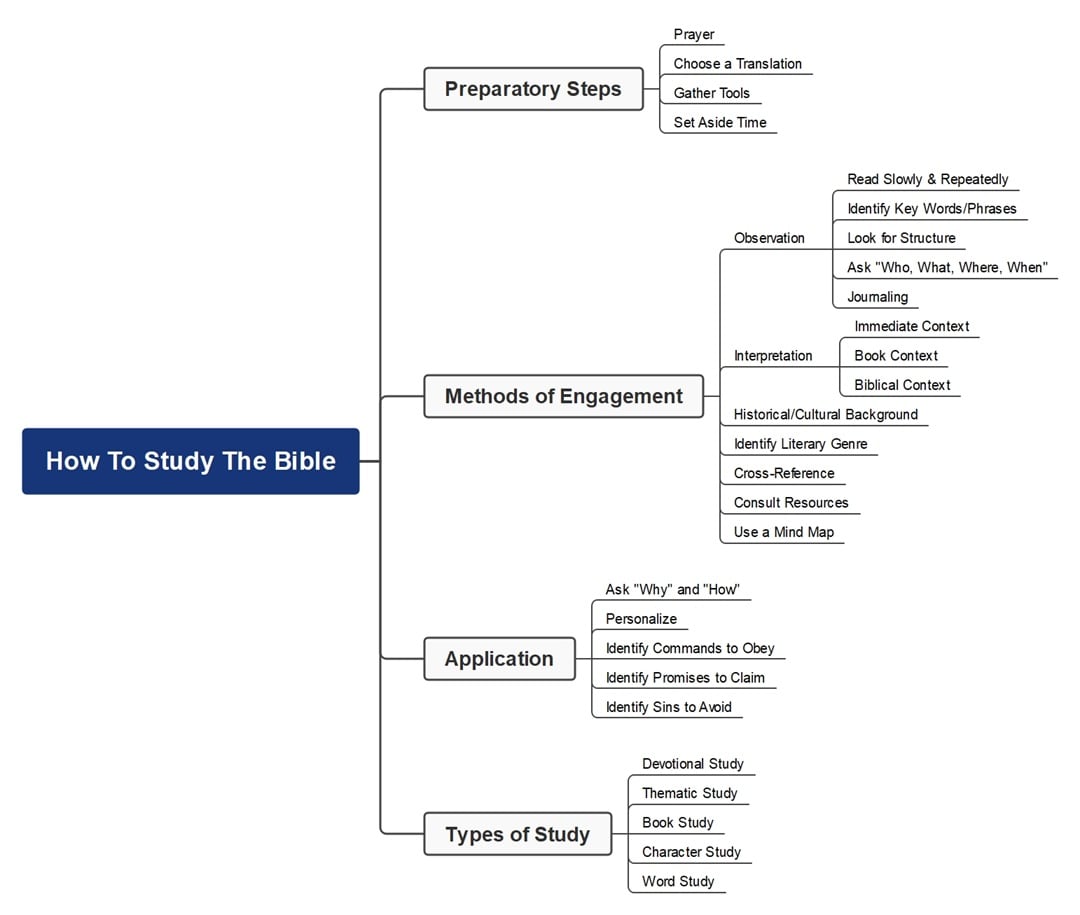
Use this as a guide. Notice how each section builds naturally, yet everything stays connected.
To create your own:
- Start with a central topic (project name, idea, goal).
- Add branches for the main categories or steps.
- Elaborate on each one with additional information, materials, or timelines.
- Customize it with images, labels, or levels of importance to suit your work process.
Mind maps can be highly effective for planning, brainstorming, taking notes during meetings, and achieving personal objectives. They not only streamline the clutter but also provide you with a quick overview of your main focus areas.
You won’t want to plan any other way after this. Try mapping your next idea and see how much smoother things can run.
Key Takeaways
God has not put any burden upon you to know anything. If you are unsure, that's great. Studying the Bible can be a learning process.
So, take a deep breath, open up your Bible, and start reading. To know how to study the Bible, you must allow yourself to go with the reading flow.
FAQ
-
What Is a Good Bible Study Method?
One effective Bible study method is the OIA approach: Observe, Interpret, Apply. You can also try topical studies, verse mapping, or scripture journaling. Stay consistent, pray, and ask God to guide you. -
What Are the 5 P’s of Bible Study?
The 5 P’s of Bible Study are Position yourself to hear God, Pour over and paraphrase the passage, Pull out lessons, Pose questions, and Plan to obey with a set time. -
What Are the 7 C’s of Bible Study?
The 7 C’s of Bible study outline key moments in God’s plan: Creation, Corruption, Catastrophe, Confusion, Christ, Cross, and Consummation. These events help you understand the Bible as one connected story from beginning to end. -
How To Study the Bible and Pray as a Beginner?
Start by reading a short passage, like something from the Gospels. Pray for guidance, take your time, and jot down any thoughts or questions that come to mind.Using a reading plan or devotional can also help you stay on track and make it easier to understand and apply what you’ve read. -
How To Choose a Passage of the Bible To Study?
Choose a Bible passage by following what speaks to you, using a plan, or focusing on the Gospels. You can also use verses from sermons or groups.Study it in context by considering the audience, history, and culture to gain a deeper understanding and connection.
 EdrawMind
AppsEdrawMind Online
EdrawMind
AppsEdrawMind Online