


The United Kingdom has witnessed a fascinating evolution of leadership through centuries of political transformation. From the 18th-century foundations of Parliament to modern global diplomacy, each Prime Minister has played a vital role in shaping Britain’s story.
This article provides a detailed timeline of UK Prime Ministers, tracing key figures, milestones, and events that defined their time in office. By organizing these leaders chronologically, we can better understand how British governance evolved and adapted to global challenges.
In this article, you will learn about:
- Major Prime Ministers and their periods of governance.
- Key historical events that shaped modern Britain.
In the end, you will also understand how EdrawMind can help visualize the UK Prime Minister timeline through dynamic mind maps and timelines.
In this Article
UK Prime Minister Timeline: From 1721 to the Present
Here is the complete timeline of the prime ministers of the United Kingdom.
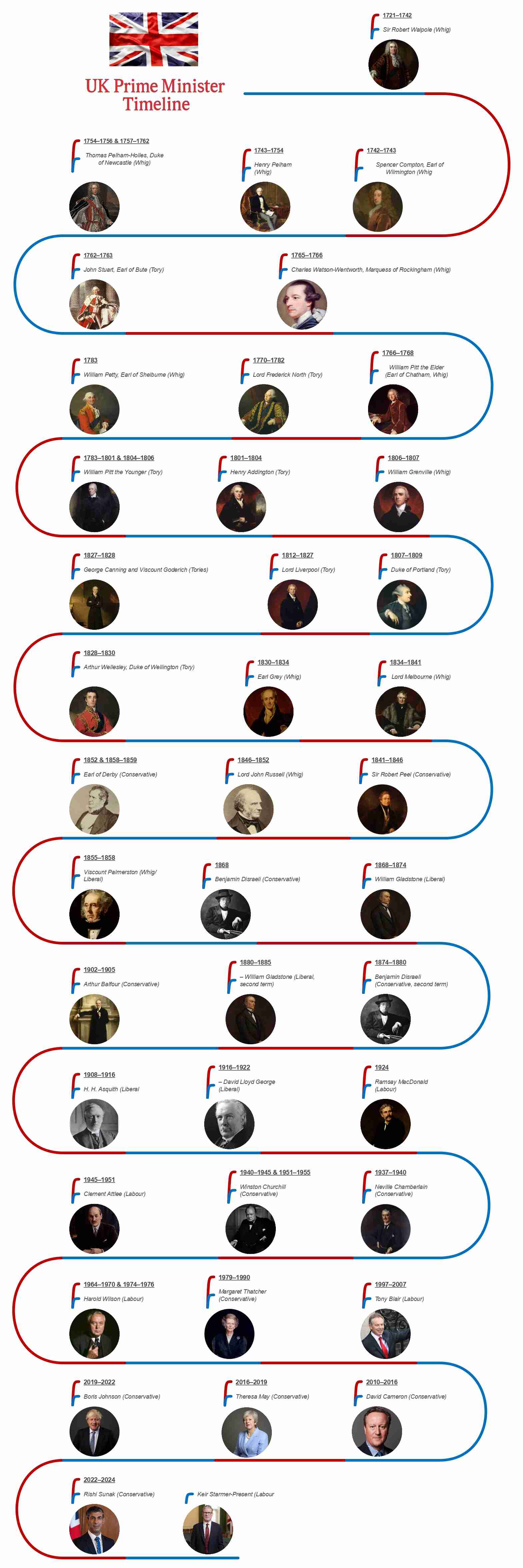


- 1721–1742 – Sir Robert Walpole (Whig)
Recognized as Britain’s first Prime Minister, Walpole stabilized the country after the South Sea Bubble crisis and laid the foundation for cabinet government. - 1742–1743 – Spencer Compton, Earl of Wilmington (Whig)
Served briefly, continuing Walpole’s moderate policies but without significant reform. - 1743–1754 – Henry Pelham (Whig)
Brought stability through peace and financial management; his death marked the end of a calm political era. - 1754–1756 & 1757–1762 – Thomas Pelham-Holles, Duke of Newcastle (Whig)
Thomas Pelham-Holles oversaw the early stages of the Seven Years' War and shaped colonial administration. - 1762–1763 – John Stuart, Earl of Bute (Tory)
John Stuart was the first Scottish Prime Minister, ending the Whig dominance and signing the Treaty of Paris, concluding the Seven Years’ War. - 1765–1766 – Charles Watson-Wentworth, Marquess of Rockingham (Whig)
Charles Watson repealed the unpopular Stamp Act and eased tensions with the American colonies. - 1766–1768 – William Pitt the Elder (Earl of Chatham, Whig)
William Pitt the Elder was known for his leadership during Britain's imperial expansion. He promoted economic growth and naval strength. - 1770–1782 – Lord Frederick North (Tory)
Lord Frederick North was the Prime Minister during the American War of Independence; his tenure ended after Britain’s defeat. - 1783 – William Petty, Earl of Shelburne (Whig)
William Petty concluded peace with the United States, officially recognizing American independence. - 1783–1801 & 1804–1806 – William Pitt the Younger (Tory)
William Pitt the Younger was a reformer and strong wartime leader during the French Revolutionary Wars. He modernized financial systems and government structures. - 1801–1804 – Henry Addington (Tory)
Henry Addington negotiated the short-lived Peace of Amiens with France. - 1806–1807 – William Grenville (Whig)
William Grenville abolished the slave trade across the British Empire — one of Britain’s most transformative moral achievements. - 1807–1809 – Duke of Portland (Tory)
He served as a transitional figure during the early Napoleonic conflicts. - 1812–1827 – Lord Liverpool (Tory)
He presided over the post-war recovery and the early expansion of the Industrial Revolution. - 1827–1828 – George Canning and Viscount Goderich (Tories)
Both of the prime ministers had brief terms, focusing on foreign policy and trade expansion. - 1828–1830 – Arthur Wellesley, Duke of Wellington (Tory)
Arthur Wellesley was a military hero who opposed early democratic reforms but passed the Catholic Relief Act. - 1830–1834 – Earl Grey (Whig)
Earl Grey introduced the Reform Act of 1832, expanding the electorate — a landmark in British democracy. - 1834–1841 – Lord Melbourne (Whig)
Lord Melbourne mentored Queen Victoria and stabilized the monarchy’s relationship with Parliament. - 1841–1846 – Sir Robert Peel (Conservative)
He introduced modern policing (“Bobbies”) and repealed the Corn Laws, reshaping trade policy. - 1846–1852 – Lord John Russell (Whig)
He advocated for civil liberties and reform during the Irish famine crisis. - 1852 & 1858–1859 – Earl of Derby (Conservative)
He served three times, overseeing the Second Reform Act, which expanded voting rights. - 1855–1858 – Viscount Palmerston (Whig/Liberal)
He dominated mid-Victorian politics, promoting a confident and expansionist foreign policy. - 1868 – Benjamin Disraeli (Conservative)
Benjamin Disraeli became the first Jewish-born Prime Minister and expanded the British Empire's influence. - 1868–1874 – William Gladstone (Liberal)
He introduced sweeping reforms in education, administration, and Ireland’s governance. - 1874–1880 – Benjamin Disraeli (Conservative, second term)
He focused on imperial unity and social reform, instrumental in acquiring the Suez Canal shares. - 1880–1885 – William Gladstone (Liberal, second term)
He continued reformist policies, promoting Irish Home Rule and equality. - 1902–1905 – Arthur Balfour (Conservative)
He introduced educational reforms and managed growing global competition. - 1908–1916 – H. H. Asquith (Liberal)
Guided Britain into World War I, implementing constitutional reforms like the Parliament Act 1911. - 1916–1922 – David Lloyd George (Liberal)
Led Britain to victory in World War I and spearheaded post-war reconstruction. - 1924 – Ramsay MacDonald (Labour)
First Labour Prime Minister, representing working-class Britain. - 1937–1940 – Neville Chamberlain (Conservative)
He was known for the policy of appeasement before World War II. - 1940–1945 & 1951–1955 – Winston Churchill (Conservative)
He is one of history's most celebrated leaders; he led Britain through World War II with courage and resilience. - 1945–1951 – Clement Attlee (Labour)
He established the National Health Service (NHS) and expanded welfare systems. - 1964–1970 & 1974–1976 – Harold Wilson (Labour)
Harold modernized British industry and introduced progressive social reforms. - 1979–1990 – Margaret Thatcher (Conservative)
She was Britain's first female Prime Minister; she led economic reforms, privatization, and strengthened Britain's global position. - 1997–2007 – Tony Blair (Labour)
He promoted “New Labour,” peace in Northern Ireland, and Britain’s active global role. - 2010–2016 – David Cameron (Conservative)
He introduced austerity measures and held the Brexit referendum. - 2016–2019 – Theresa May (Conservative)
She faced major challenges negotiating Brexit with the EU. - 2019–2022 – Boris Johnson (Conservative)
He oversaw Brexit completion and managed the COVID-19 pandemic response. - 2022–2024 – Rishi Sunak (Conservative)
He was Britain’s first British-Indian Prime Minister, focusing on economic recovery and modern governance. - Keir Starmer-Present (Labour)
Keir Starmer is the current Prime Minister of the United Kingdom.
How to Create a UK Prime Minister Timeline with EdrawMind
EdrawMind, developed by Wondershare, is a powerful mind mapping and visualization software designed to make complex information simple and engaging. When studying political history — such as the UK Prime Minister timeline — EdrawMind allows users to create structured, chronological mind maps that show relationships, influences, and eras clearly.
- Timeline Mind Maps: EdrawMind can create interactive chronological diagrams with just a few clicks.
- AI-Powered Mind Map Builder: EdrawMind automatically organizes data into logical formats, saving hours of manual editing.
- Customizable Templates: It offers professional designs for history, politics, and education-related projects.
- Cross-Platform Collaboration: EdrawMind is available on desktop and mobile. You are allowed to use the web version of EdrawMind.
- Presentation Mode: It instantly converts mind maps into dynamic slide decks for classes or presentations.
Using EdrawMind, educators, historians, and students can bring the UK’s political evolution to life — connecting leaders, events, and eras in a visually clear and interactive way that enhances learning and engagement.
Steps to Create a UK Prime Minister Timeline
Follow the guide below to complete your UK Prime Minister timeline.
 Try the app & get 500 free AI tokens


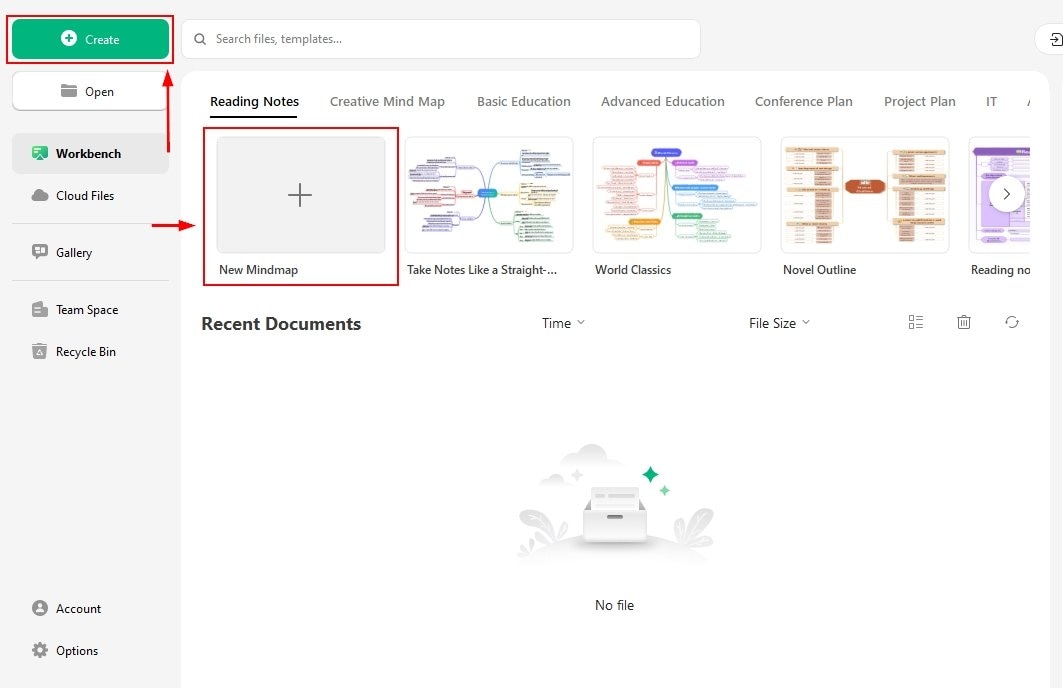
Step 1 Open the Empty Canvas
- Launch EdrawMind and click Create, and then Local Mind Map to create a fresh central workspace.
- Name the central topic “UK Prime Minister” (double-click the central node) to set the focus of your map.
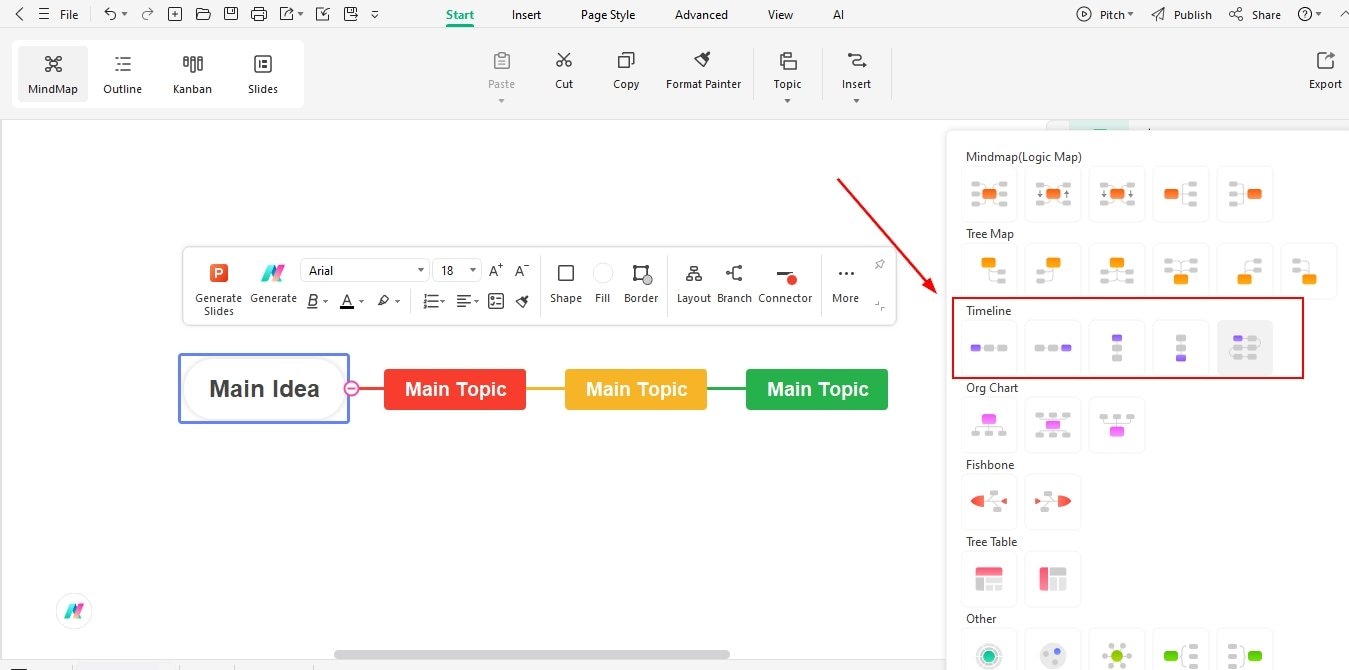
Step 2 Add Topic Containers and Change the Layout
- Use Add Subtopic to create primary branches for categories such as Prime Ministers, Political Parties, Timeline, Major Policies, and Biographies.
- Change the layout of the timeline to suit your design.
Step 3 Add Details for Each Leader
- Select a leader topic and double-click to add relevant information, like the names of the prime minister and their tenure.
- Attach notes and sub-nodes with details: lifespan/term dates, party, key policies, significant events, and quick facts.
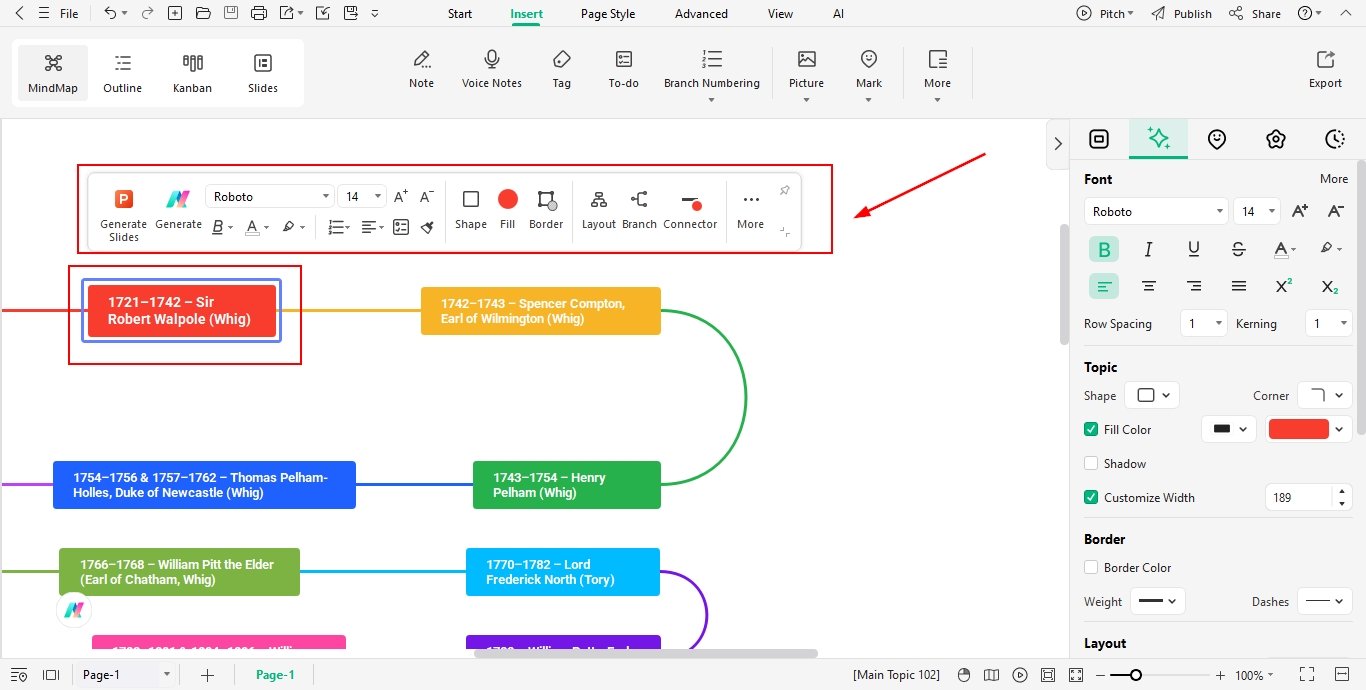
Step 4 Change Colors for Topics and Subtopics
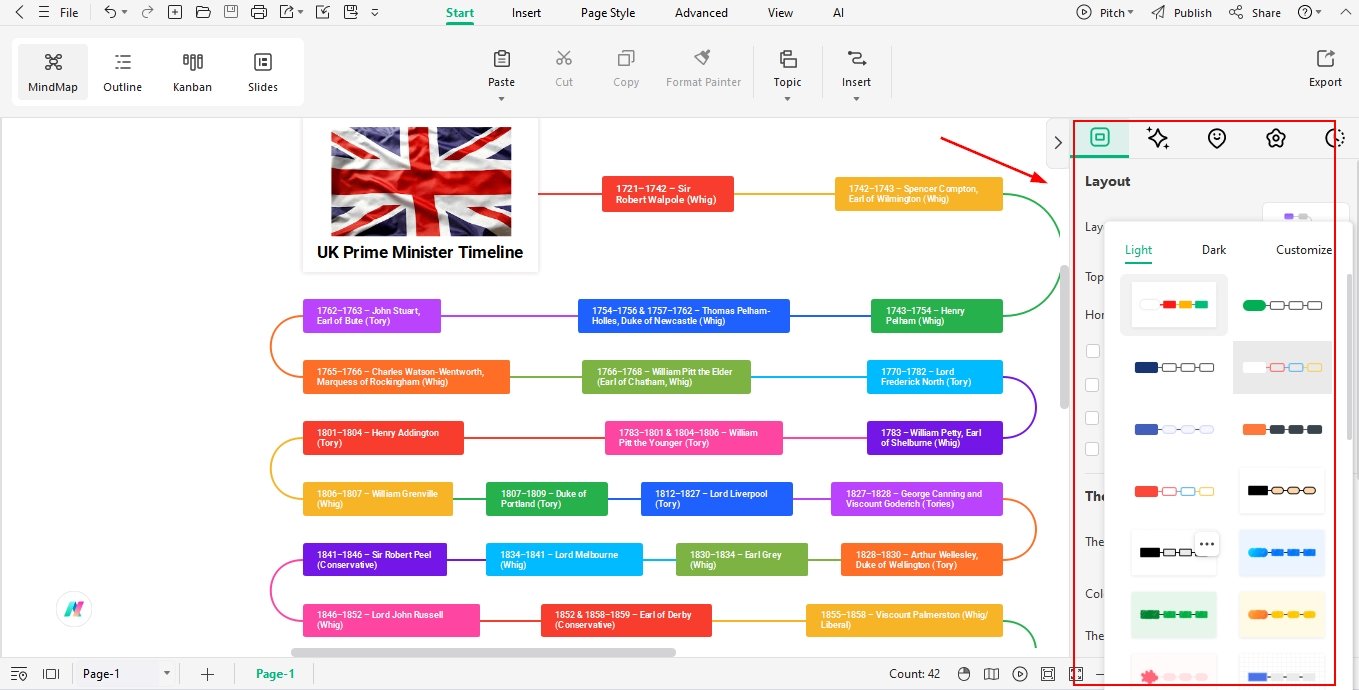
- Use the right-hand side toolbar to change the colors, themes, and fonts.
- Keep different colors to distinguish themselves.
Step 5 Organize, Style & Export
- Use Icons, Colors, and Layouts (radial, tree, org-chart) to differentiate parties, ideology, or historical periods and improve readability.
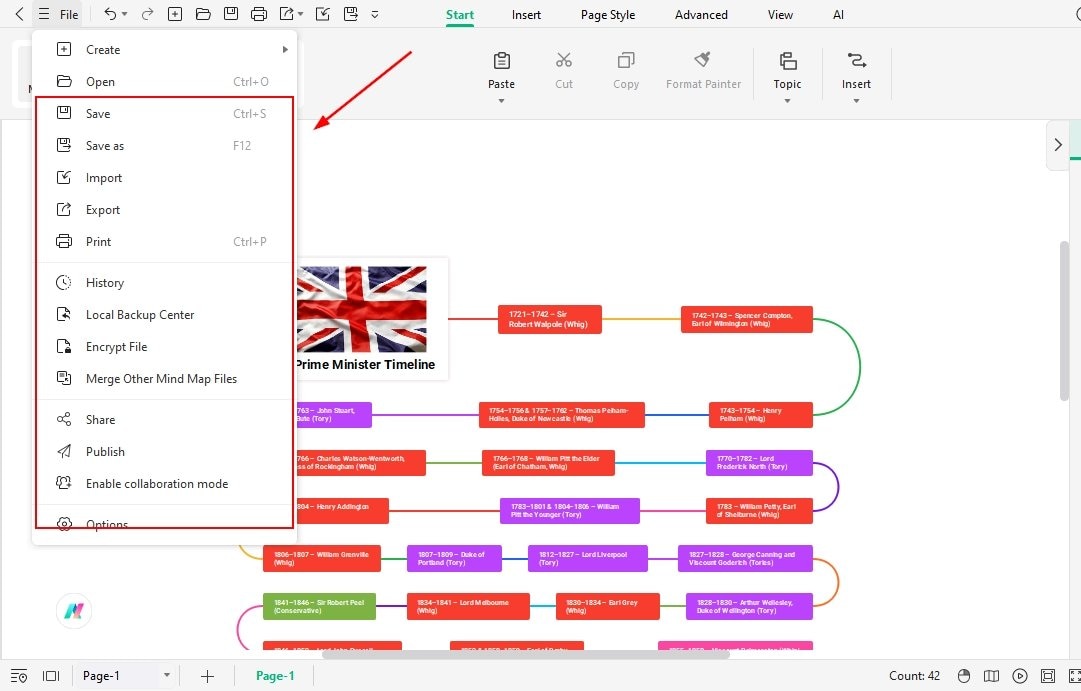
- Export via File > Export to PDF, PNG, Word, or share the map via EdrawMind Cloud for collaboration and presentation.
Final Words
The UK Prime Minister timeline reflects centuries of transformation, innovation, and resilience. Each leader contributed uniquely to Britain’s global identity and democratic legacy. With EdrawMind, these intricate historical timelines become easier to explore and visualize.
By converting dates and data into intuitive mind maps, EdrawMind bridges the gap between history and modern learning, making the story of Britain's leadership both accessible and inspiring for generations to come.
 EdrawMind
AppsEdrawMind Online
EdrawMind
AppsEdrawMind Online