



In this article
Why Conduct a Competitive Product Analysis?
In a nutshell, when you have an initial product idea, you need to determine its potential.
You should ask yourself questions like: Can it meet customer needs? Are there similar products already available? How do your competitors operate? What is their business performance like?
A competitive product analysis helps you answer key questions using clear, data-driven methods. This enables you to make more informed decisions before launching your product or business.
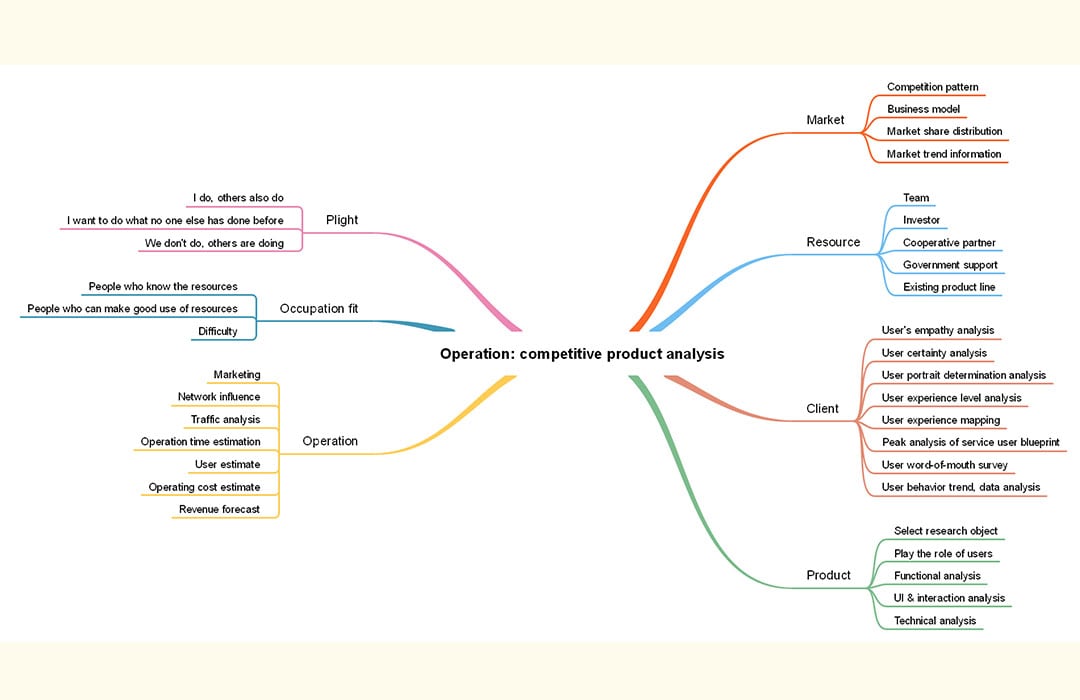
Below is an example of a competitive product analysis.


How To Conduct a Competitive Product Analysis
A competitive product analysis involves various aspects. Aside from analyzing your product, it is also essential to analyze the market, product operations, and your resources.
This process not only helps you improve your product but also guides strategic decisions in marketing, pricing, and development.
Product Analysis
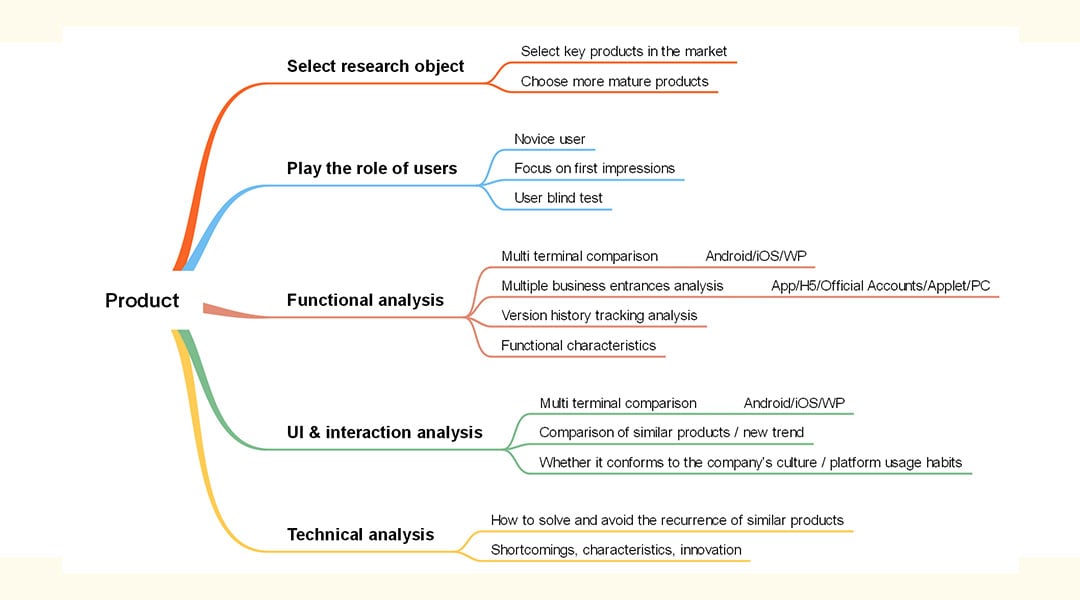
Product analysis involves researching your competitors, acting as users for your products, and analyzing your product’s functions, UI, and interaction, as well as some technicalities.
Select Research Objects
First, identify relevant competitive products based on the products you want to operate or are already managing.
When choosing research targets, focus on the main products in the market or those that are more mature or developed than your own.
Play the Role of Users
Next, you need to act as new users of the product and make an objective evaluation. Focus on first impressions and conduct a blind test to compare it to competitors and identify its strengths and weaknesses.
Functional Analysis
You also need to analyze the functionality of products by evaluating their performance, usability, and how well they meet customer needs and expectations.
UI and Interaction Analysis
For online products, you can compare functions across different terminals and understand the functions of features. Online products are also inseparable from UI design. Therefore, you also need to conduct related analysis on their interface.
Technical Analysis
Once you have completed the above steps, you also need to assess the technical feasibility, pros, and cons of the product. To properly organize this information, you can use mind maps, like the one below.
Market Analysis
If you have a great product but less market share, or if you're entering a market that's hard to break into. In this case, how do you approach market analysis?
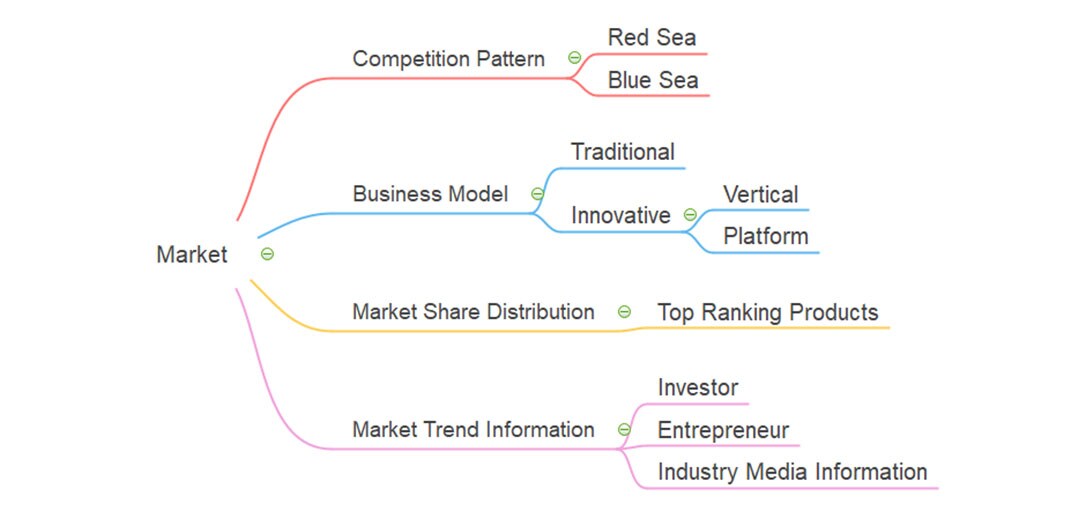
You need to focus on four key areas: the competitive landscape, business model, market share breakdown, and market trend data.
For the competitive conditions, you need to determine whether the market you are involved in or plan to enter is the Red Sea or the Blue Sea.
- Red Sea: refers to an existing market space where all industries are already established.
- Blue Sea: indicates that there are still sectors that do not yet exist, representing the unknown market space.
Among these, the distribution of market share is the key point to focus on. You can look at hot-selling products in the market. This way, you can assess whether your products have a competitive advantage or growth potential.
Market analysis is not a one-time task. It involves transitioning from quantitative to qualitative change. Therefore, you also need to follow market trends and pay attention to relevant investors and entrepreneurs. This can help you monitor the market and make adjustments.
Operations Analysis
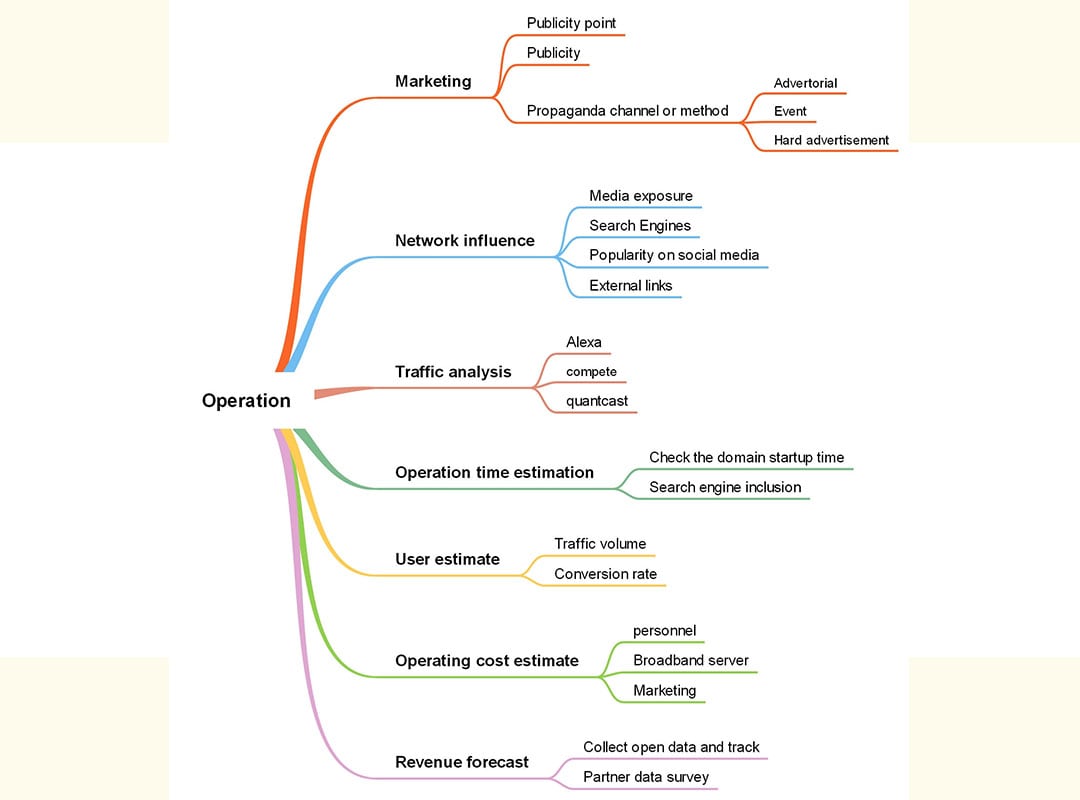
Generally, product operations are divided into seven aspects:
- Marketing
- Network influence
- Traffic analysis
- Operation time estimation
- User estimate
- Operating cost estimate
- Revenue forecast
The mind map below includes some common operation tools and analysis indicators.
It is crucial to closely monitor the revenue performance of competitive products, as this involves tracking data over a specific period or cycle, since many manufacturers may use data fraud in product packaging.
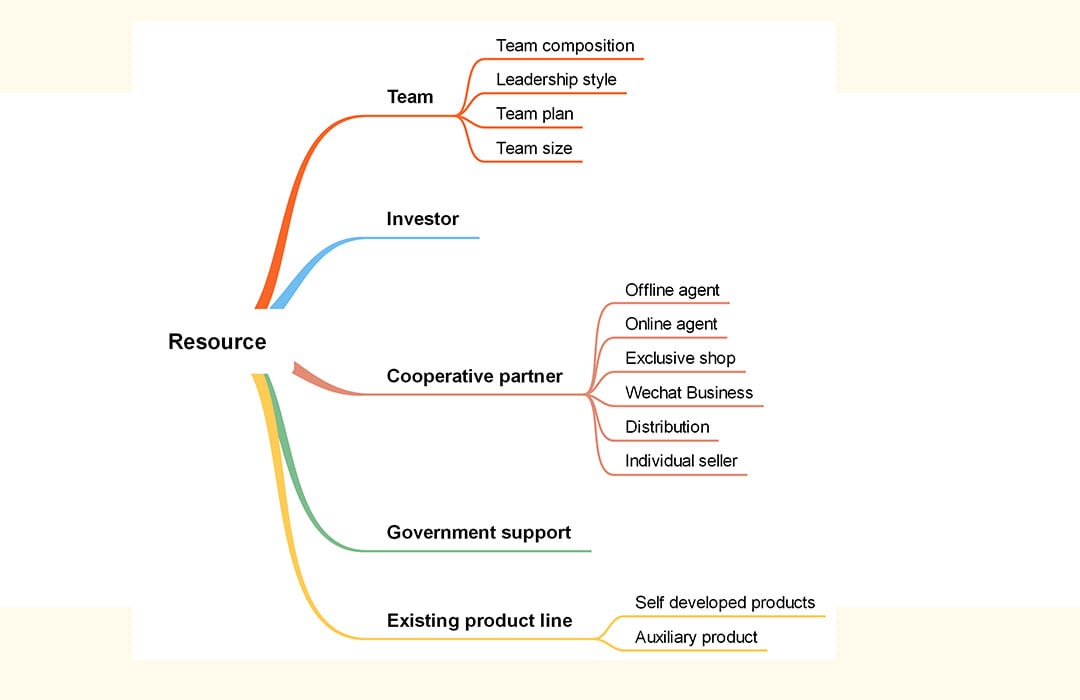
Resource Analysis
For a business to succeed, you will need the right resources. Therefore, it is essential to determine which resources can be used.
Most of these resources fall under the categories outlined in the mind map below. However, you should pay extra attention to your partners because cooperation is crucial for every business.
Competitive product analysis of operations also requires combining user analysis, situation analysis, and other elements to create a complete mind map.
Ways To Improve Competitive Product Analysis
Before you learn how to create a competitive product analysis mind map, here are some tips to improve your competitive product analysis:
- Use Competitor’s Website. Explore your competitors’ product pages for detailed insights. This can reveal plenty of information on features, messaging, and use cases. Don’t forget documentation and help sites for more details.
- Concentrate on Core Products. Identify your competitor’s core product, often their first and best-seller. Analyze its key functionalities and why it's successful.
- Compare Your Products. Compare your products with those of competitors to identify strengths and weaknesses. This helps pinpoint areas for improvement.
- Watch Product Videos. Videos highlight features and user experience, giving a clearer view of competitors' products. Check YouTube and their website.
- Collect Customer Feedback. Speak with current or past customers of competitors to identify pain points and preferences. Online reviews and forums can also provide valuable insights.
- Analyze Marketing Strategy. Study competitors’ messaging, positioning, and taglines. This reveals how they market their product and can help differentiate your own.
- Track Product Changes. Monitor updates to competitors’ products, including new features, hires, or launches. These trends reveal their future direction.
This streamlined approach can help you gather actionable insights more efficiently.
How To Make a Competitive Product Analysis Mind Map
Conducting a competitive product analysis involves a lot of information. Using mind maps is a great way to organize and visualize this information.
Mind maps can help you to clarify logic and build a knowledge network. They also help break down complex data into digestible segments.
WonderShare EdrawMind is a useful tool for making mind maps to help you organize your ideas. With various features and AI tools, you can quickly create mind maps for your competitive product analysis with just a few clicks.
Here’s how to make a competitive product analysis mind map using EdrawMind:
Step 1
Open the EdrawMind app or online.
 Try the app & get 500 free AI tokens


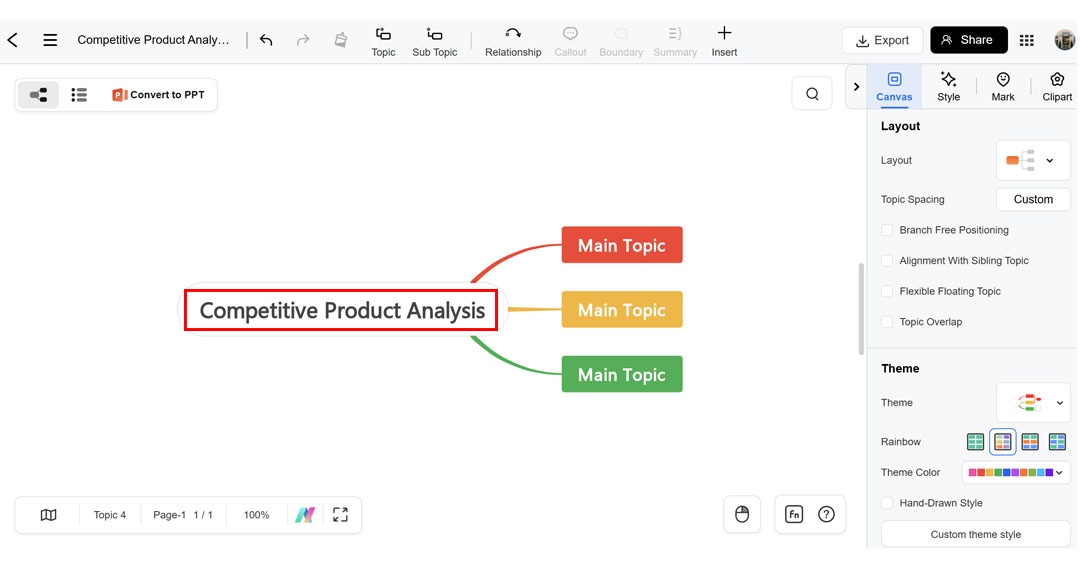
Step 2
Create a central node with your main idea.
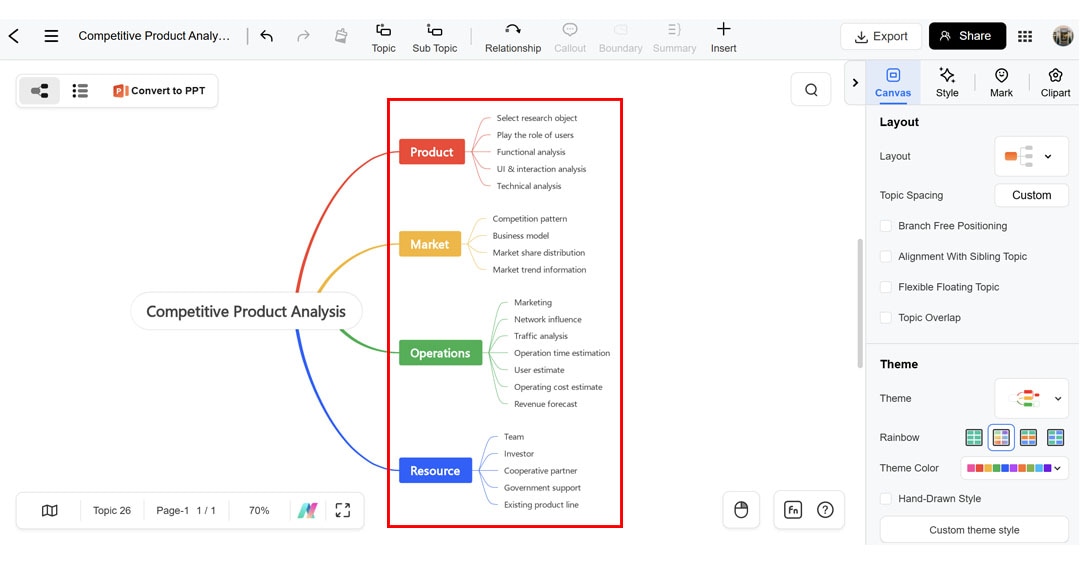
Step 3
Next, create the main branches for the main aspects of the competitive product analysis. You can create more sub-branches as needed.
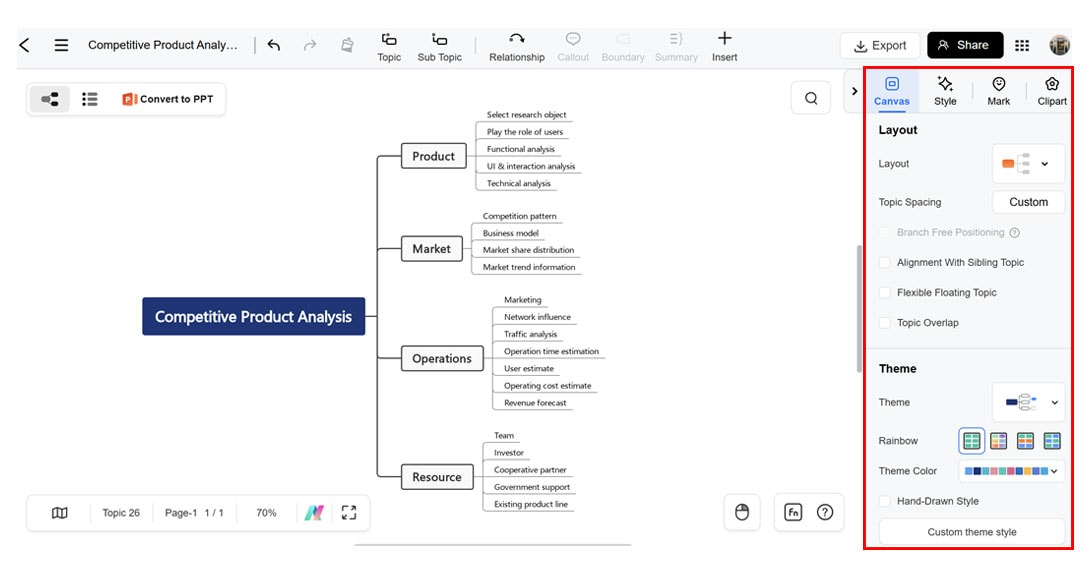
Step 4
Then, you can customize your mind map’s theme, style, or colors. You can also add images or icons to make it visually appealing.
Step 5
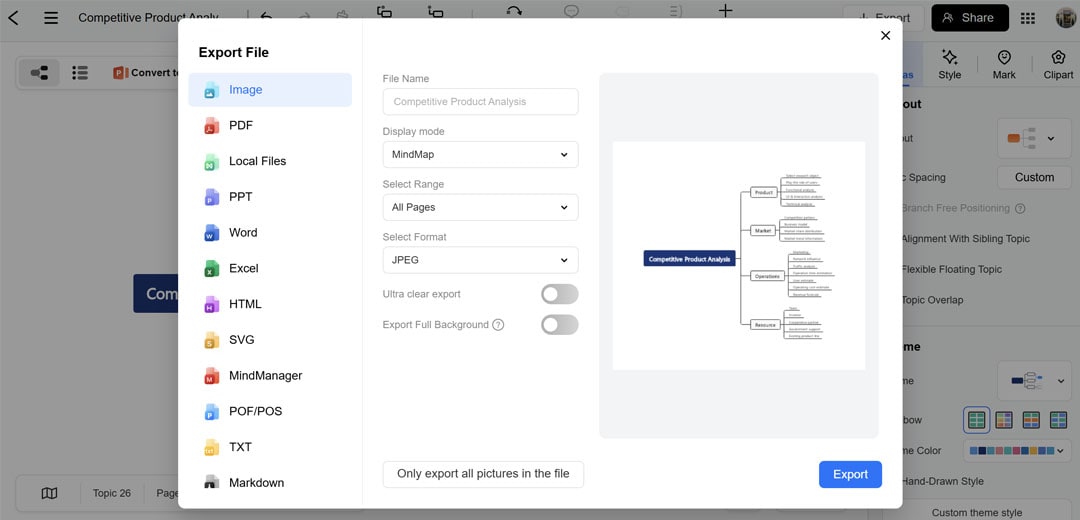
Finally, you can export your mind map into various supported formats like JPG, PNG, and PDF.
You can also use EdrawMind for many other purposes. Here are some of EdrawMind’s useful AI features:
- AI Mapping: Enter your main idea, and the AI will organize related topics for you.
- AI Presentation: Create polished presentations from texts or files with just a few clicks.
- Text-to-Mindmap Maker: Simplify long texts into visually appealing mind maps.
- Word-to-PPT Maker: Effortlessly convert Word files into slides with designs you can personalize.
- Image-to-PPT Maker: Transform photos into slides with this feature.
- Concept Map Maker: Create diagrams showing how certain words or ideas are connected.
These tools can help simplify your analysis process and highlight important details. They can also make complex data easier to understand.
Benefits of Using Mind Maps in Competitive Product Analysis
Mind maps help you organize and break down complex information, making them useful in competitive product analysis. Here are some benefits of a mind map:
- Simplifies Complex Data: Mind maps can help simplify complicated data and turn it into easy-to-understand concepts through visual presentation.
- Enhances Clarity and Focus: Mind maps break down complex information into branches. This provides a clear structure that enables you to focus better.
- Helps Comparison: Mind maps help you compare topics through a side-by-side visual representation. This enables you to evaluate your analysis at a glance.
- Boosts Collaboration: You can share mind maps with your team and collaborate and edit online. This way, you can easily share ideas in one visual framework.
Key Takeaways
A competitive product analysis is essential for evaluating a product’s potential success before its launch. It enables businesses to make informed decisions, adjust strategies, and stay competitive in the market.
Although very useful, a competitive analysis can be complex with so much information to grasp. Mind maps are effective tools for simplifying this process.
EdrawMind is recommended for creating mind maps for competitive product analysis. It offers various tools and AI features to help you streamline your work and easily build comprehensive analysis maps.
Additionally, mind maps can significantly help you conduct a competitive product analysis by simplifying complex data, improving clarity, facilitating comparisons, and boosting collaboration.
FAQs
-
1. What Is Competitive Product Analysis?
Competitive product analysis is crucial for helping businesses identify areas for improvement and growth.
It is the process of evaluating a product's market potential by comparing it with that of competitors. This helps you assess whether your product has potential in the market.
-
2. What Do Red Sea and Blue Sea Mean in Market Analysis?
In market analysis, the terms Red Sea and Blue Sea describe the level of competition and opportunity in a particular market.
The Red Sea represents the known market space. This suggests that all industries are already established. The Blue Sea represents the unknown market space, suggesting that there are still sectors that do not yet exist.
-
3. What Are the Benefits of Competitive Product Analysis?
A competitive product analysis can help you understand your product’s market potential, identify opportunities for innovation, and identify gaps in the market. This can ultimately guide product development and help you stay ahead of competitors.
 EdrawMind
AppsEdrawMind Online
EdrawMind
AppsEdrawMind Online