
Ever wished you could learn a new language fast without spending years on grammar courses? Learning a new language can be overwhelming, but it doesn’t have to be this way. With the right method, fluency can come quicker than you think.
Instead of exhausting yourself with endless lessons, a few simple but powerful techniques can speed up your learning process. The key is to adapt smart learning habits while using modern tools to save time and simplify the learning process.
These 15 tips will help you learn and speak a new language with confidence, and they won’t require months of practice. Let’s have a look:

In this article
- Set clear goals
- Start with everyday vocabulary
- Practice speaking from day one
- Study with a realistic routine
- Learn through context, not translation
- Carry a pocket dictionary
- Start a journal
- Break grammar into chunks
- Keep practicing in your head
- Listen with focus
- Consume media
- Connect with native speakers
- Combine reading with visuals
- Accept and review mistakes
- Stay consistent
- Conclusion
- FAQs
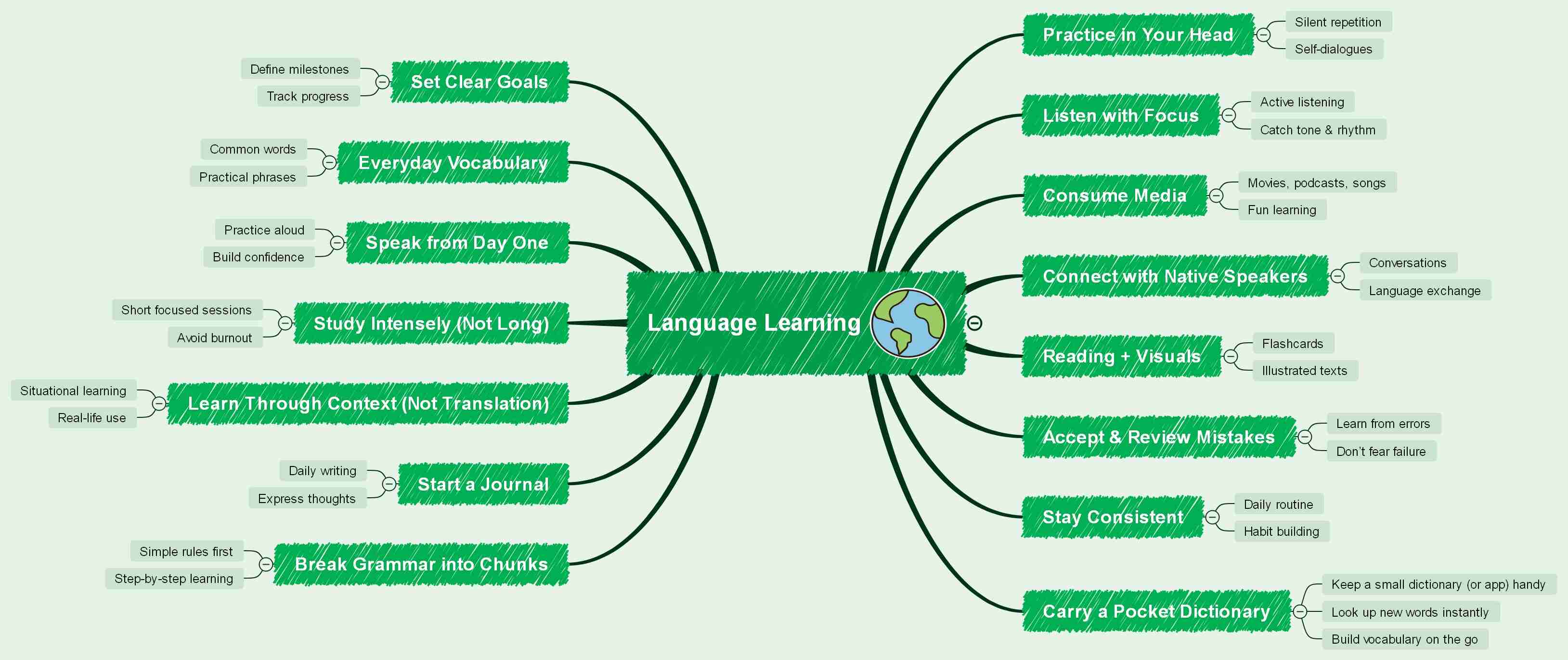


Set clear goals
Before starting mindlessly, you should know exactly why you want to learn the target language. Is it for studies or business? Are you starting a new life in a foreign country? Or you simply want to become multilingual. Once you’ve set this motivation straight, it will be easier for you to set everyday goals.
Instead of giving yourself impossible challenges, start by picking up 100 basic words and learn them. The goal is to start small but efficiently as opposed to burdening your brain with immense knowledge.
Start with everyday vocabulary
You cannot jump into technical jargon when learning a new language. You must take small but steady steps by learning everyday vocabulary. Create a list of words that you use frequently throughout the day, prioritizing names of food, greetings, and honorifics over more complex phrases.
Use EdrawMind AI Mind Map
EdrawMind’s Mind Map is a great way of learning vocabulary in a new language. It allows you to create visual word clusters to help you connect every word with its origin. For example, a “Food” Mind Map will have linking words of bread, rice, names of veggies and fruits, etc. This way, you can create mind maps as you progress and keep tabs on your learning.
Practice speaking from day one
You don’t have to learn grammar by heart to start talking in a language. Once you have mastered some of the basic everyday words, start speaking them out loud. Interchange the new words into your native language. Even if you sound clumsy, this practice is worth it in the long run.
Study intensely, not long
Set a realistic routine for yourself instead of a lengthy one that you cannot commit to. 15 dedicated minutes of studying the target language is better than the three long hours where you constantly lose focus. Divide your time throughout the day and keep practicing whenever you can.
Learn through context, not translation
One of the worst mistakes you can make while learning a new language is to translate every word back into your native language. You will learn that every language has exclusive vocabulary that cannot be traced back to your own language. Instead of getting lost in translation, try to focus on the context and treat the new language as a separate entity.
Carry a pocket dictionary
We don’t expect you to carry a hard copy of a dictionary with you, but you can easily find translation apps and dictionaries for your smart devices. This tip works exceptionally well if you are already in a foreign country. But even if you aren’t, pocket dictionaries are a great way of learning on the go. You can quickly find how to pronounce something in the new language as you run errands or travel anywhere.
Start a journal
Just like keeping a daily journal, you can write about your day but this time, incorporate the newly learnt words in it. Writing is one of the most effective ways of learning a new language. The more you write it, the more fluent you will be.
Use EdrawMind’s file-to-slide feature
Enhance your study sessions by converting your notes into PowerPoint slides. EdrawMind’s file-to-slide feature lets you upload files and convert them into a neatly-made presentation. You can use this presentation to review a week’s progress and compare it with your previous documents.
Break grammar into chunks
Grammar of a language is often regarded as one of the most difficult things to master. The rules and tenses just make everything seem super complex. You can overcome this fear of grammar rules by dividing it into chunks - tenses, sentence order, and connectors. You don’t have to do it in a day; give yourself time and learn one concept properly before moving on to the next.
Use EdrawMind’s concept map maker
EdrawMind’s concept map maker is ideal for you to organize grammar rules in one place. It allows you to create a web that you can connect with different rules and structures. For example, you can use it to show how the past tense connects to regular and irregular verbs, making patterns easier to grasp.
Keep practicing in your head
We all have a monologue running through our heads all day. You can use this monologue to speed up your learning process. Try to think in the target language instead of your native one. This is one of the few times when overthinking can benefit you.
Make up imaginary scenarios and talk to yourself about how you will respond to certain questions or situations. They can be a conversation with your local vendor, or even a job interview. This practice will also be useful to you when real-life situations come up and you’re already prepared for them.
Listen with focus
Instead of just hearing sounds, practice active listening. Listen to what the words mean and how they are being used in the sentence. Make notes of what you can understand and cross-check with the subtitles.
Consume media
This is your chance to watch movies and TV shows without any guilt. Start by watching with subtitles on. Notice what you can understand without looking at the subtitles and what is completely new to you. Similarly, listen to songs and read magazines in the target language. Once you’ve adapted these habits to your routine, you will notice drastic progress in your learning journey.
Connect with native speakers
Language is a means of communication, and that is what your next step should be. Talking to the native speakers of your target language will let you explore their natural way of talking, including slang and jargon.
You can connect with native speakers over platforms like Facebook or listen to a native speaker over podcasts, videos, and more. Try to imitate their way of speaking; their tone, accent, and rhythm. This “shadowing” technique trains your ear and improves verbal pronunciation faster than text drills.
Combine reading with visuals
Once you are a bit proficient in the new language, you can start reading short stories, blogs, and comics. Jot down keywords and visualize them in your head. You can also make digital notes on your phone with the words and pictures side-by-side. This will make your habit of reading more effective.
Use EdrawMind’s image-to-PPT feature
EdrawMind allows new learners to quickly make a PPT presentation using just the images they upload. You can use this feature to create editable slides that you can later use to visualize what you have learnt so far.
Accept and review mistakes
Once you start communicating in the new language, you are sure to be clumsy and make mistakes. Some people might try to discourage you, but you should be brave enough to accept your mistakes and reflect on them for improvement. If someone tries to correct you, let them. Accepting help from others is also part of the learning curve.
Stay consistent
Learning a new language is a slow and steady process. It can be tiresome and exhausting. But consistency is the key. You may feel tired and about to give up, but it is better to take a break, relax, and start over in a few hours. You are free to learn at your own pace, but giving up should never be an option.
Conclusion
Learning a new language is not about cramming as many new words as you can. It’s about weaving the language into your everyday life. From thinking in a new language to making awkward first conversations with a native speaker, every effort builds momentum.
With the proper use of tools like EdrawMind’s AI features, you can efficiently accelerate your learning process. These tools not only help you learn your target language, but they also help you create everlasting digital notes that could come in handy in the future as well.
FAQs
FAQ
-
What is the quickest way to learn a new language?
The quickest way is to practice with the natives using shadowing techniques, consuming media in the target language, and practicing the language in everyday life. -
What is the 15/30/15 method?
This method divides one hour of daily study into three intervals. 15 minutes of review in the morning, 30 minutes of new learning during midday, and 15 minutes of review in the evening again. -
What is the #1 hardest language?
Mandarin Chinese is often cited as the most difficult language to learn for English speakers.
 EdrawMind
AppsEdrawMind Online
EdrawMind
AppsEdrawMind Online