


We all dread that one meeting which could have easily been an email, but somehow ended up an hour-long, pointless session. The truth is, it’s not the meeting that’s the problem; it's the lack of meeting rules and structure. But how to actually turn this around?
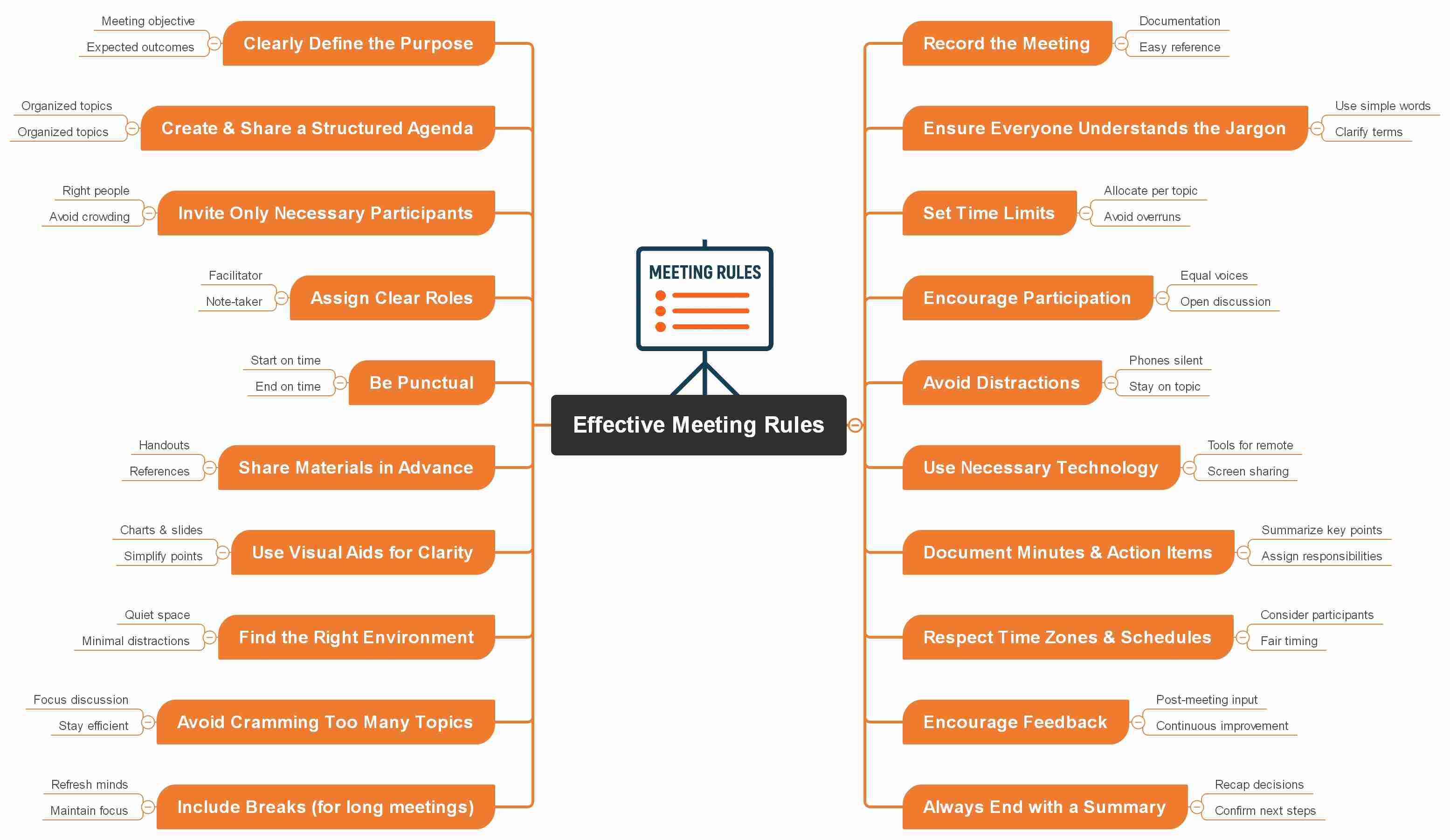
With simple yet effective meeting rules, so many organizations can save up time and effort. These rules need to be implemented before and during the meetings. Let’s take a look at these 20 meeting rules for conducting effective meetings.
In this article
- Clearly define the purpose
- Create and share a structured agenda
- Invite only the necessary participants
- Assign clear roles for everyone
- Be punctual
- Share materials in advance
- Use visual aids for clarity
- Find the right environment
- Avoid cramming too many topics
- Include breaks for longer meetings
- Record the meeting
- Ensure everyone understands the jargon
- Set time limits
- Encourage participation
- Avoid distractions
- Use necessary technology
- Document minutes and action items
- Respect time zones and work schedules
- Encourage feedback
- Always end with a summary
- Conclusion
- FAQs


Clearly define the purpose
When you call upon people for a meeting, understand that it is pulling them away from their routine work to attend to you. So, as a form of mutual respect, you should clearly state what the meeting is going to be about. Instead of being vague like “project update”, state exactly what update you are going to discuss and what elements others need to prepare.
By clearly defining the purpose of the meeting, you will find more enthusiastic individuals who know what to expect in the meeting and what they have to pitch in. It also saves unnecessary gossip and drama before and after the meeting, which usually isn’t a pleasant thing to face.
Create and share a structured agenda
Taking time out to create a structured agenda is one of the most thoughtful things to do before a meeting. A well-thought-out agenda is the backbone of an effective meeting. List down the key discussion points and assign time limits to each. Number the list in order of priority and strictly follow this agenda.
Be sure to share this agenda with the relevant participants at least 24 hours before the meeting. This way, everyone will be well-prepared with data, inputs, and reports, and will participate better during the meeting.
Use EdrawMind AI Mind Map
EdrawMind’s Mind Map is a wonderful tool to tame your thoughts into an organized agenda. It lets you create a thoughtful map out of the ideas you have with a few clicks. Start by keeping the major idea at the center, and keep on adding relevant little details as they come up. Create a web out of this and voila! You’ve got yourself a perfectly structured agenda for your next meeting.
 Try the app & get 500 free AI tokens


Invite only the necessary participants
A crammed meeting room is one of the most awkward places to be in a workplace. Even if the meeting is virtual, no one wants to see so many people trying to speak at once. The unnecessary chatter would only cause distractions. Ask yourself: “Does this person bring actual input to the agenda at hand?”. If not, don’t invite them to the meeting. Share notes and updates with them afterwards to keep them in the loop.
Assign clear roles for everyone
When the roles are not defined clearly, the meeting room is bound to get chaotic. Anyone can assume that they’re the facilitator, and anyone can interrupt to keep tabs on time. To avoid this, you must assign these important roles immediately after the meeting starts. Assign a facilitator, a notetaker, and a timekeeper.
A facilitator keeps the meeting on track and ensures no one starts anything unnecessary. The notetaker captures important points and decisions while the timekeeper keeps the agenda moving smoothly. By following this, you can easily conduct a meeting without any hassle.
Be punctual
Set a time for the meeting and start exactly at that time. Waiting for latecomers will only punish your agenda and set a bad example. Start the meeting even if not everyone has arrived. The habitual latecomers will soon learn that nothing will stop for them and will eventually fix their habits. Even if you delay the meeting by 5 minutes, it will keep multiplying in the long run, costing productivity and efficiency.
Share materials in advance
If a meeting requires that everyone have some specific material with them, ask them before the meeting starts. And if there is something that you need to share, you should share it preferably when you send invites. This allows participants to review and come prepared, saving valuable discussion time.
Use visual aids for clarity
Complex ideas and concepts can be made easier to grasp with the help of visuals. Try to make as many charts, graphs, slides, and digital mind maps like EdrawMind to simplify information and keep participants engaged. You can share these visuals with the participants after the meeting is over as well.
Find the right environment
Not every meeting needs to be in-person. In this era of hybrid working setups, some meetings can simply be done over a conference call. There is no need to go through the hassle of arranging a mini-party for the employees. Similarly, if an in-person session is necessary, you must choose a venue that is comfortable for everyone. A crowded, small office is the last place to hold a professional meeting. Arrange a spacious, well-lit conference room with fresh water and adequate refreshments.
Avoid cramming too many topics
Your meetings should never have too many topics of discussion. Even if it there is something too complex and lengthy, you can divide it into multiple parts over several meetings. Too many points in a single meeting will likely cause chaos and confusion among participants. And there’s also a high chance that you will not get your desired outcomes, no matter how much you drag out the meeting.
Include breaks for longer meetings
If a meeting has to last longer than an hour, schedule short breaks in between. Allow the participants to leave the meeting room and have some refreshments. This helps everyone pause and reset, and digest the progress so far.
Record the meeting
While this is not mandatory, you can still be a considerate boss and record meetings for absent members. Not only does it help the people who couldn’t make it to the meeting, but it also helps the present members to catch up and revisit the decisions later. Recordings also support accountability where needed and can be used as a means of building archives.
Ensure everyone understands the jargon
This one is for the meetings where a diverse group of people is involved. If there are participants from other organizations, you shouldn’t use jargon that is specific to your organization only. And if it is so necessary, make sure the facilitator explains the meaning to everyone. This is also applicable to foreign language participants. Using complex vocabulary and jargon is not considered a smart practice.
Set time limits
You should be mindful of everyone’s time and end the meeting when it should. If you’ve previously announced that the meeting will be half an hour long, it should be wrapped up by 30 minutes, not 45. Make sure that your agenda fits your set time limit. For your own convenience, you can even break down the agenda into several parts and allot time to each part.
If you think you still need some time to cover the entire agenda after the allotted time is over, schedule a follow-up instead of letting the current meeting overrun. Your colleagues and employees will respect you even more for respecting their time.
Encourage participation
The loudest voices aren’t always the most productive ones. An effective meeting is never dominated by one or two voices; diverse perspectives and opinions often lead to better solutions. Encourage quieter participants to contribute by directly asking for their input. Even if someone says something wrong, you can always politely correct it.
With enough encouragement, even the most meek participants will learn to do their homework effectively prior to the meeting. A balanced participation ensures that the decisions are made by a collective group effort and not just by the loudest voices.
Avoid distractions
Some people treat the meetings as a means of letting out their frustration or sharing irrelevant things. This situation only distracts everyone from the main agenda and wastes precious time as well. In case this happens, the facilitator should step in immediately and diffuse the situation as quickly as they can. This discipline keeps meetings productive and prevents them from turning into unfocused brainstorming sessions.
Use necessary technology
Many workplaces are still unaware of the modern gadgets that can help them conduct effective meetings. Whether the meetings are in person or virtual, you should know how to use some useful tools. Use a reliable video conference tool for recording the meeting and letting people join remotely. Introduce virtual note-taking apps that can be shared with everyone in the room. But you should also encourage participants to silence their mobile phones and avoid using them unless it’s absolutely necessary. Technology should be a means of effective communication, not another way of distraction.
EdrawMind text-to-mindmap converter
One of the most powerful and dynamic features of EdrawMind is its text-to-mindmap converter. It allows you to brainstorm ideas with a team of people on the go. All you have to do is share an editable link with everyone and ask them to pitch in their ideas as well. As the meeting progresses, you will notice a web of ideas that makes sense, and you will find it exceptionally easy to make decisions.
Try the app & get 500 free AI tokens
Document minutes and action items
Once the meeting is over, every participant should be clear about the updates and progress made during the meeting. Each of them should know what their task is. For this to happen immaculately, every decision and important point should be documented. Anything not written down is as good as nothing. You cannot expect everyone to memorize everything on their own. The note-taker should share the minutes of the meeting, preferably on the same day. Similarly, you should announce consultation hours for any relevant queries and be available during that time.
Respect time zones and work schedules
You aren’t a good meeting organizer if the meeting hours clash with the participants’ work schedules. Sure, they might turn up, but that might happen in the middle of something important. Likewise, if the meeting is supposed to happen with foreign participants, you should be mindful of their time zones. An excellent idea is to ask about a time that is feasible for everyone. This should not take more than a couple of emails. But in the long run, you will have everyone’s respect and admiration for respecting their work schedules and working hours.
Encourage feedback
When the meeting is over, take some time to ask for feedback from the participants. Allow them to speak their mind, whether it’s about work or general feedback about the meeting. Let them know that you care about their sentiments and would implement their ideas in future meetings. If there is a sensitive topic that needs private feedback, you can create an anonymous link for people to drop their opinions. This way, no one will feel left out, and you can assess the situation without intruding on anyone’s privacy.
Always end with a summary
Your meeting should not last till the very last minute - save the last 5 minutes to overview what was discussed and what was decided. Try to link up the very first thought with the very last one and have this summary documented. The facilitator should summarize and review the key points, confirm decisions, and review the next steps. This step ensures that everyone leaves the meeting on the same note and no one gets confused. Ending with a clear direction provides closure, and the meeting translates into real action.
Use EdrawMind’s File-to-Slide feature
With EdrawMind’s file-to-slide feature, you can create an attractive presentation simply by uploading a text document. When the facilitator wants to summarize the entire meeting, they can simply ask the note-taker for the notes and upload them to EdrawMind’s online or downloaded app. On a single click, you will have the slides ready to be shared with everyone.
Try the app & get 500 free AI tokens
Conclusion
Meetings don’t have to be boring and unproductive like the old days. With the right meeting rules in place, they can become powerful tools to collaboration, decision-making, and problem-solving. The key lies in staying focused and disciplined so that others may follow the lead as well. By applying these rules and with the use of modern AI tools, you can effectively conduct any meeting in person or online anytime you want. In the end, effective meetings are more about people working smartly together rather than brute force and control.
FAQs
FAQ
-
What are the 5 P’s of effective meetings?
The 5 P’s of effective meetings are:- Purpose
- Participants
- Preparation
- Process
- Payoff (or Progress)
-
What is the 40 20 40 rule for meetings?
This rule suggests an uneven breakdown of the efforts. 40% of the efforts should be put into the preparation of the meeting, 20% on the meeting itself, and 40% on the follow-ups for the actions after the meeting. -
What are the 3 C’s of a meeting?
The 3 C’s of a meeting are:- Clarity
- Consensus
- Commitment
 EdrawMind
AppsEdrawMind Online
EdrawMind
AppsEdrawMind Online