

Apple does not publish one official STP chart, so its segmentation and target-market labels should be treated as marketing analysis supported by observable product, channel, pricing, and messaging choices.
A practical model segments customers by use case, profession, lifestyle, ecosystem participation, purchase behavior, budget, and desired experience; targeting varies by product family, while positioning emphasizes integration, design, performance, privacy, services, and premium customer experience.
Source: unsplash.com
Apple’s segmentation, targeting, and positioning (STP) can be analyzed through product needs, ecosystem participation, purchase behavior, lifestyle, budget, profession, and use case rather than a single age-based target market. Because Apple does not publish one official STP chart, specific segment labels should be treated as a marketing analysis supported by observable product, channel, and messaging choices.
Quick answer: Apple segments demand by product need, use case, profession, lifestyle, behavior, budget, and ecosystem participation. It targets consumers, professionals, creators, students, developers, and organizations with different product families and configurations, while positioning the brand around integrated experiences, design, performance, privacy, and premium value.
Sources checked:Official source 1 | Official source 2
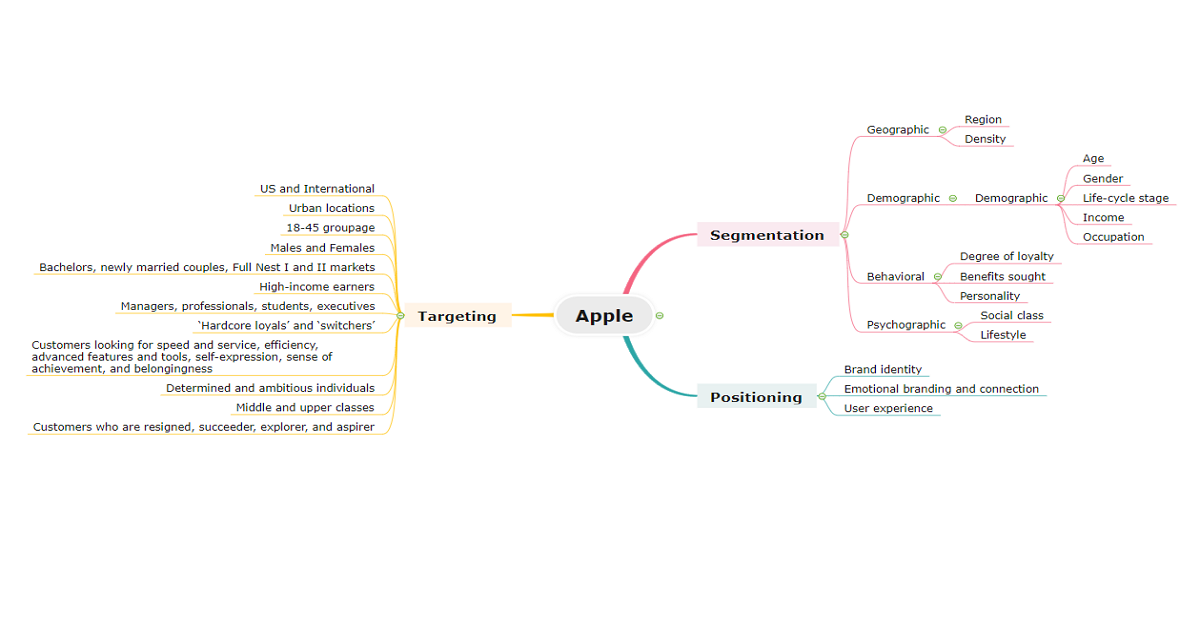
1. Apple Segmentation, Targeting, and Positioning Mind Map


2. Market Segmentation of Apple
With Apple, Market segmentation is grouped into behavioral and psychographic variables. Segmenting is a process of grouping the audience into smaller segments based on specific characteristics like occupation, gender, age, and other customer preferences. These segments or variables must be accessible, measurable, and actionable to benefit the company.

Source: unsplash.com
Since Apple caters to a broader range of global markets, geographic elements must be considered part of its segmentation. As of December 2021, Apple already has more than 500 retail stores across 25 countries worldwide. Besides its physical locations, customers can access its products through online retail stores wherever they may be in the world. This way, Apple can expand its market and reach several customers.
Apple also includes the behavioral variables of its target market in its market segment. It consists of the attitudes, usage, responses, and product knowledge. The psychographic element of Apple's market segmentation tackles developing products based on the target market's lifestyles.
3. Targeting of Apple
Apple targeting strategies involve determining the more attractive segments for the firm. This stage implies choosing particular groups identified from the segmentation process, where Apple can sell their products to. The company positions its brand as a premium provider of products and services with high-quality and advanced functions and capabilities.
Apple's target customers include the well-off individuals willing to spend more on technology products and services with advanced capabilities, functions, and designs. After years of evaluating Apple's customers' characteristics, it has revealed that most of them tend to appreciate quality, performance, and design of tech products and services over the prices.
4. Positioning of Apple
The technology industry is rapidly growing and constantly evolving, hence the continuous introduction of new products with technical resolutions and innovative features. Apple is one of the top firms in this sphere, and most of the players in the industry often look up to Apple, its new technologies and products.
This success is partially due to its solid and effective positioning based on various elements. Apple positions itself in the market as a premium brand sought by everyone. Surely, the company's products are not cheap, but you will find people, even those who cannot afford to find ways to get their hands on Apple products.
Apple positioning its brand to create an emotional connection with its customers through exceptional experiences is an excellent approach, especially in this competitive industry. In the same manner, Apple uses its positioning approach based on competition. Since competition is tight in the technology industry, Apple ensures to continuously invest in R&D and introduce innovative products and features all the time. It keeps on making unique technologies for the brand and cannot be copied anywhere else.

Source: unsplash.com
5. Table of Apple Segmentation, Targeting, and Positioning
Here's how Apple segmentation, targeting, and positioning look when organized in a chart. This is just an overview of classifying the segments and other elements. Apple has a wide array of products; hence, it can be expected to have more lists for every product and service they offer.
Apple's Targeting
Segmentation Type | Positioning | ||
Devices: iPhone, iPad, iPod, Mac | Services: Mac App Store, Apple Pay, iCloud, iTunes, and iTunes Store | Brand identity, overall user experience, emotional branding through innovation, imagination, and design, | |
Geographics | |||
Region | US and International | US and International | |
Density | Urban | Urban | |
Demographics | |||
18-45 | 18-30 | ||
Males & Females | Males & Females | ||
Bachelor, newly married couple, Full Nest I and II | Bachelor, newly married couple, Full Nest I and II | ||
Income | High Earners | High Earners | |
Occupation | Professionals, executives, and managers | Professionals, managers, and students | |
Behavioral | |||
Degree of Loyalty | 'Hardcore loyals' and 'switchers' | 'Hardcore loyals' and 'switchers' | |
Benefits sought | Self-expression, Speed of service, advanced features and tools, sense of belongingness and achievement | Efficiency and speed of service | |
Personality | Ambitious and determined | Ambitious and determined | |
Psychographic | |||
Lifestyle | Explorer, aspirer, succeeder, resigned | Succeeder, aspirer, explorer | |
Social class | Middle and upper classes | Middle and upper classes` |
 Try the app & get 500 free AI tokens


Bonus: Four More Types of Analysis of Apple
Unlock your marketing potential by using the diagrams below. Dive into the world of Apple's segmentation, targeting, and positioning. Explore the tools and insights you need to refine your brand's strategy.
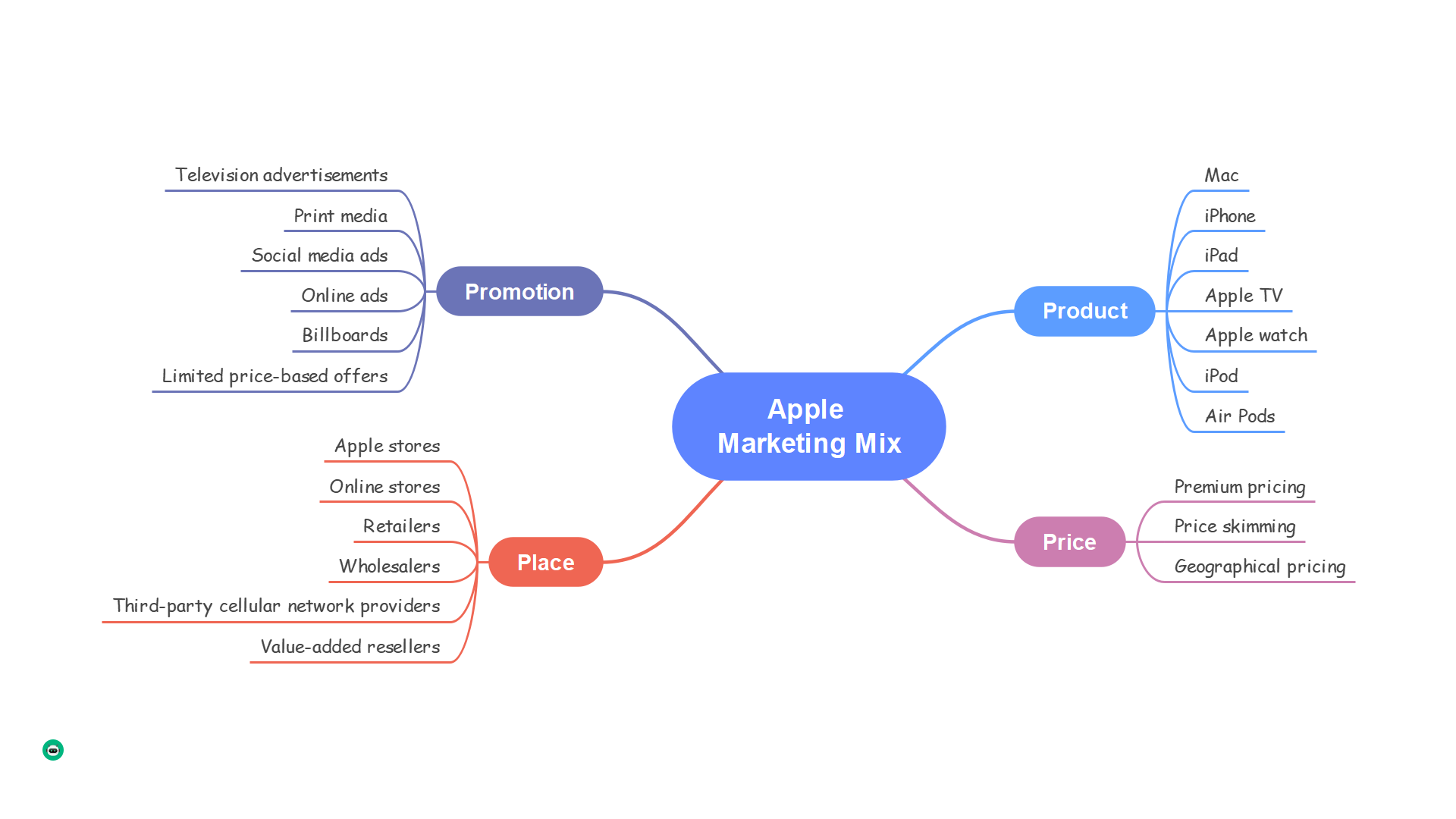
Apple Marketing Mix
The diagram below provides a straightforward overview of Apple's marketing strategy. The main topic branches into four key elements: promotion (including ads), product (current Apple offerings), place (availability), and price (product costs).
The diagram is valuable when conducting market analysis, crafting marketing strategies, or presenting insights to stakeholders. It offers a concise visual representation of Apple's approach. It's an effective tool for dissecting and learning from their successful marketing tactics. You can incorporate the diagram when devising a similar strategy for your own business.
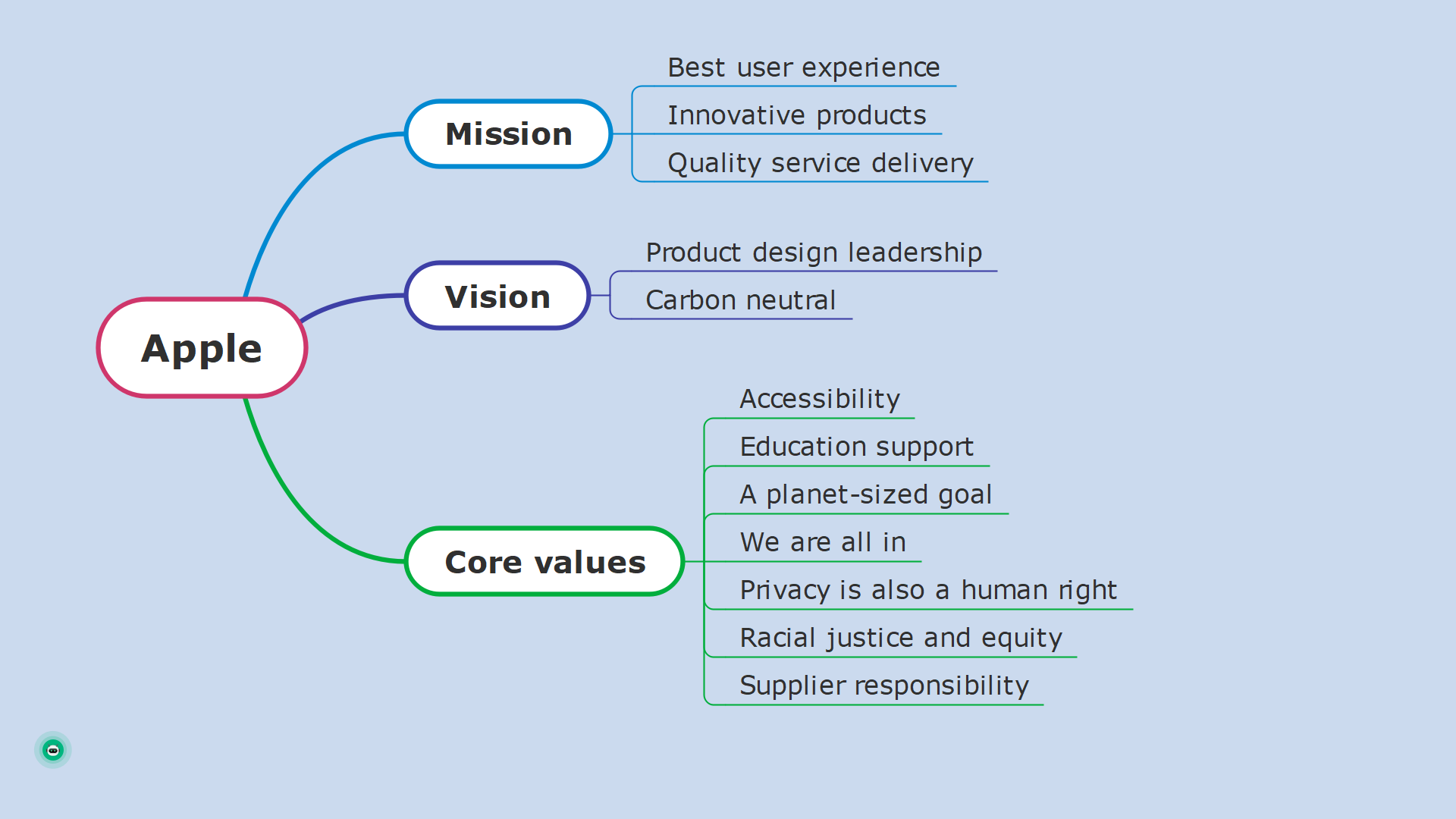
Apple's Mission, Vision, and Core Values
The "Apple's Mission, Vision, and Core Values" diagram illustrates Apple's guiding principles. The mission emphasizes an exceptional user experience, innovation, and quality service. The vision focuses on cutting-edge product design and a commitment to being carbon-neutral. Core values encompass accessibility, ambitious environmental goals, collective commitment, and privacy rights.
This diagram is beneficial when studying Apple's corporate culture. You can follow a similar strategic objective or align your company's values with industry-leading standards. It provides a visual reference for understanding and incorporating these principles into your organizational ethos.
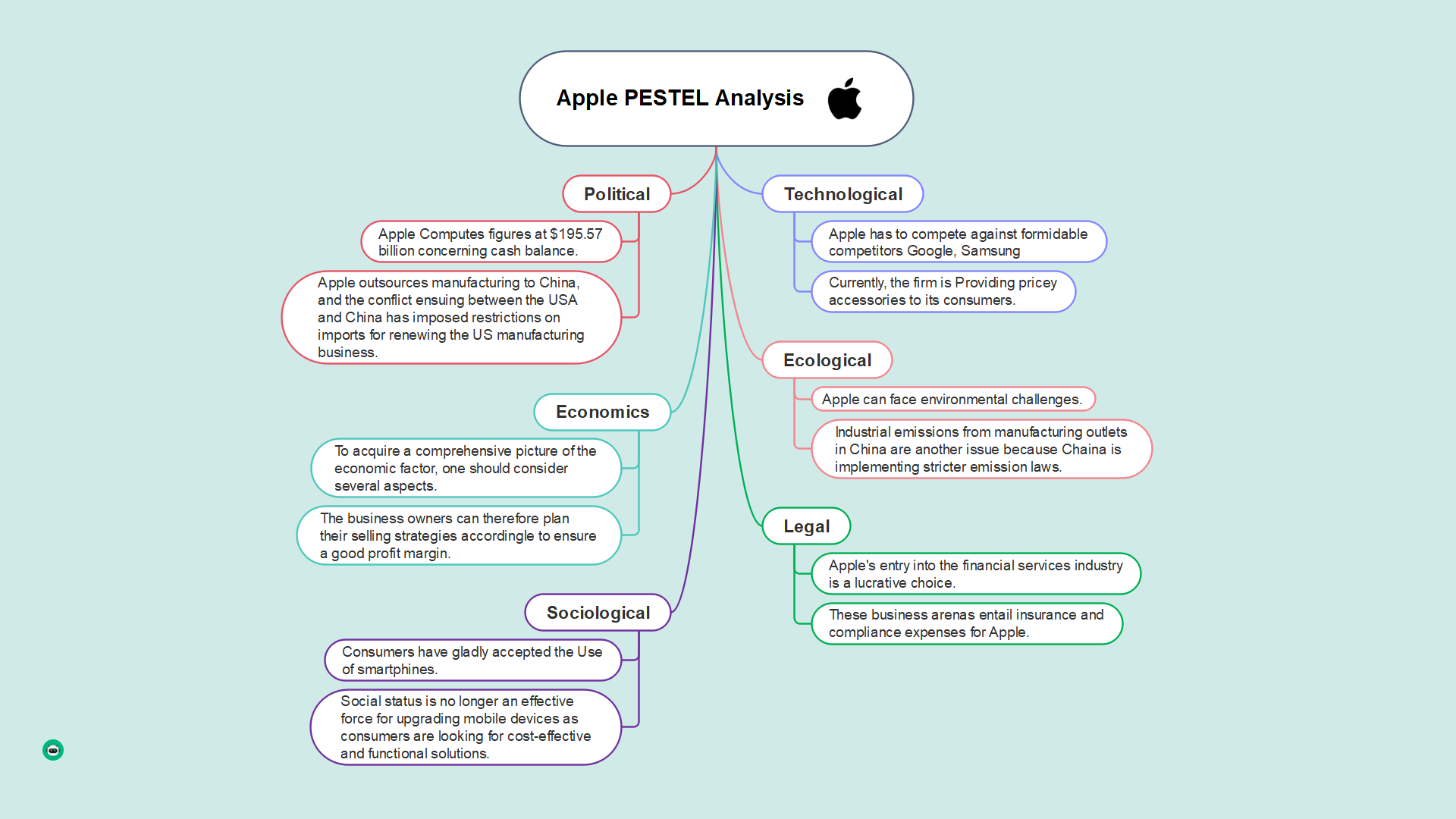
Apple PESTEL Analysis
The Apple PESTEL Analysis diagram dissects the macro-environmental factors influencing Apple. It is segmented into six main branches: Political, Technological, Ecological, Economic, Legal, and Sociological aspects. You can use this diagram when conducting market research, strategic planning, or competitor analysis.
The diagram can help businesses understand the external forces shaping Apple's decisions. It enables you to anticipate and adapt to similar factors impacting your organization. Making a similar analysis is a valuable tool for gaining insights into the broader market dynamics. It ensures informed decision-making in various industry scenarios for you and your company.
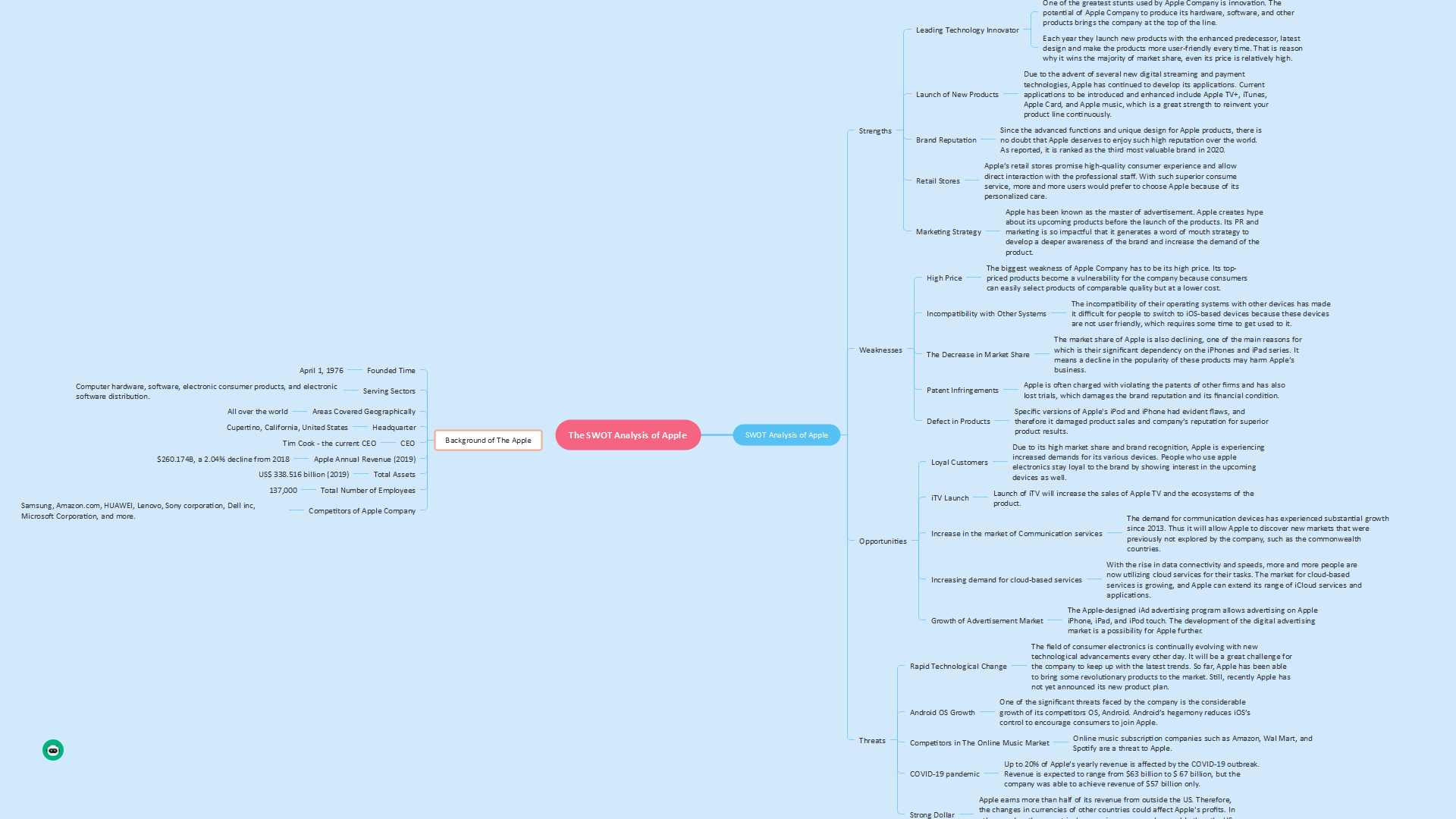
Apple SWOT Analysis
The SWOT Analysis of the Apple diagram provides a holistic view of Apple's internal and external factors. It covers strengths (innovation and brand reputation), weaknesses (high prices, incompatibility, infringements, and defects), opportunities (loyal customers and cloud-based demand), and threats (Android OS growth, technological shifts, currency fluctuations, and pandemics).
It's ideal for market strategists, investors, or competitors looking to assess Apple's position. Understanding the diagram lets you make informed decisions in a rapidly evolving tech landscape. The tool helps identify key areas for improvement, leverage strengths, and prepare for potential threats and opportunities.
Who is Apple’s target market?
Apple targets multiple groups by product and use case, including consumers, professionals, creators, students, developers, and organizations. Buyers often value design, integration, performance, privacy, support, and long-term ecosystem use.How does Apple segment its market?
Useful lenses include product need, profession, lifestyle, purchase behavior, budget, geography, desired experience, and existing participation in the Apple ecosystem. Apple does not publish one official STP chart.How does Apple position itself?
Apple is positioned around integrated hardware, software, and services; product design; performance; privacy; ease of use; and a premium end-to-end customer experience.
 EdrawMind
AppsEdrawMind Online
EdrawMind
AppsEdrawMind Online