



Power. Revolution. Legacy. The story of George Washington the Great has it all! From a mere surveyor who used to chart the wild Virginia to the man who commanded armies, Washington’s life reads like a theatrical drama, one that is a masterpiece. The George Washington timeline is essentially the blueprint of America’s rise.
Washington, who led with quiet strength, learned how he managed to turn rebellion into independence, a nation that is as free today as it was back then. His lifetime spanned war and the birth of democracy itself.
In this article, we’ll go through the George Washington timeline of major events. Ready? Let’s trace the journey that defined George Washington as a president and his ideals that guide nations today.
In this article
George Washington Timeline
History has always remembered George Washington as the true symbol of strength and utter discipline. Despite all of this, his journey from a simple boy to the first President of the United States was really anything but simple.
His lifetime had always been marked by wars and politics, in which he determinedly became an example of how constant learning, loss, and vision prove successful in the end.
By this point, you must be wanting to learn more. Let’s trace through the George Washington timeline of major events and learn how he became a world icon. Let’s get started!


1) Early Life and Education (1732 to 1749)
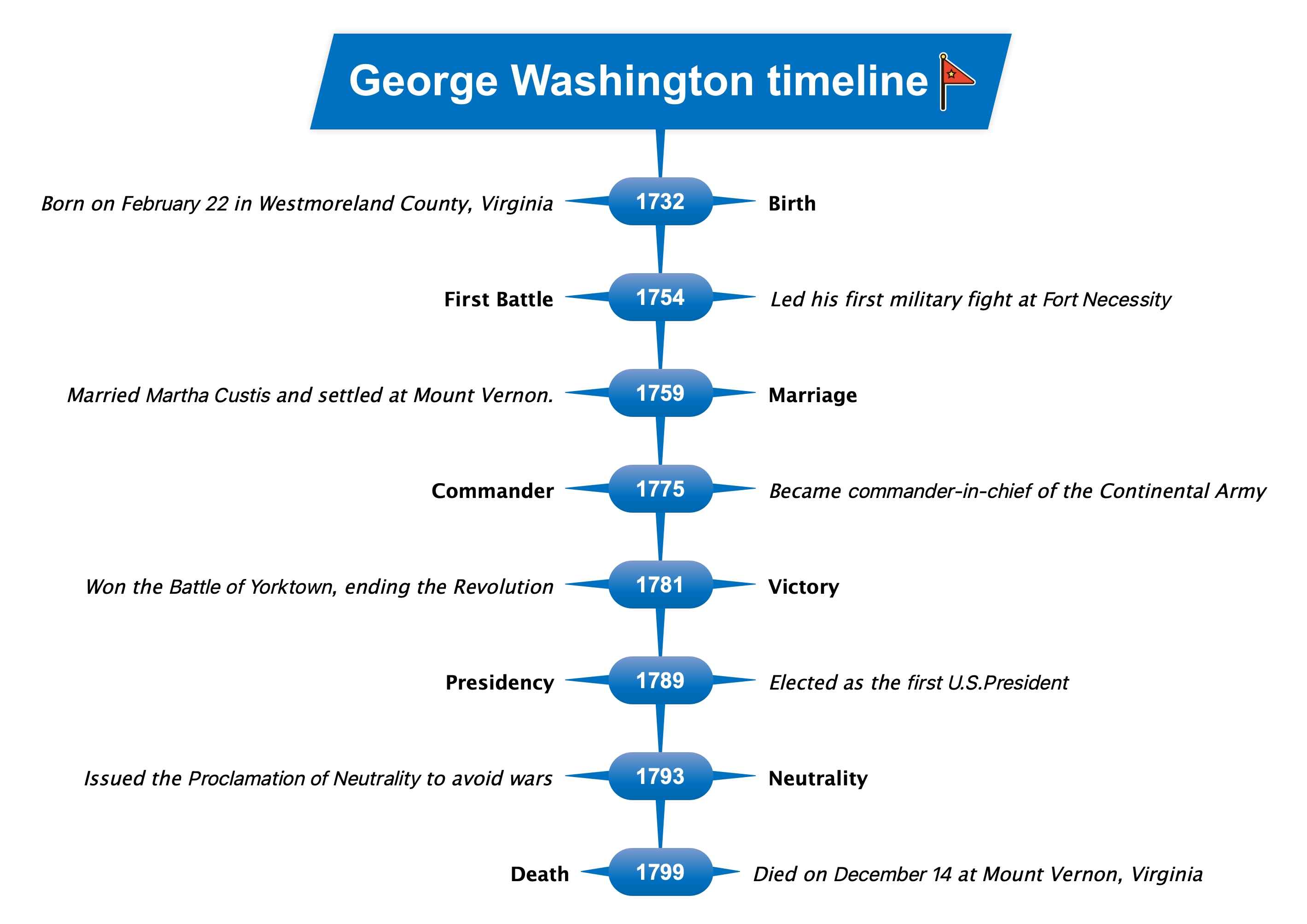
What you are about to witness is the start of the lifetime of a great leader. George Washington was born on February 22, 1732, in Westmoreland County, Virginia. His father, who was more famously known as Augustine Washington, died when George was barely 11 years old.
Because of this, it practically left him to navigate most of his early adolescence without any kind of paternal guidance. As a young boy, Washington had no access to formal education, but he was excellent in mathematics and the art of surveying (which would foreshadow his next few years).
By the time he was in his mid-teens, Washington began working as a basic surveyor in the Virginia frontier. Though it was a measly job, it would help improve his sense of precision and independence. On another note, these years would also essentially form the foundation of his leadership style, which was observant and highly practical.
2) Military Beginnings and the French and Indian War (1752 to 1758)
What happened after? We’re glad you asked! Washington’s military career took a leap when he was appointed as a major in the military at the young age of 20. The George Washington timeline has noted 1754 as a very crucial year, as it directly marked the start of the French and Indian War.
During that same time, we see Washington leading a skirmish right at Fort Necessity. It unfortunately ended in surrender, but it would greatly increase his public reputation. After this attempt, he quickly became popular for his courage and sense of discipline.
In 1758, after leading several campaigns in western Pennsylvania, Washington would end up retiring from the military and come back home a lot wiser.
3) Marriage and Civilian Life (1759 to 1774)
As the year turned 1759, George Washington would end up marrying Martha Custis, who was a very wealthy widow (which would benefit him greatly!). It instantly became the cause of his better social and financial standing. Together, they ended up settling at Mount Vernon.
During this period, he would serve in the Virginia House of Burgesses. He also expressed his strong discontent with the current taxation policies that had been imposed by the British. Events such as the Stamp Act and Townshend Acts would push Washington and his peers very close to rebellion.
4) The Revolutionary War and Command of the Continental Army (1775 to 1783)
This was a decade of wars and nothing else. It started with the outbreak of the American Revolution in 1775, which would become a major turning point in George Washington's timeline. He was chosen as the commander-in-chief of the Continental Army, which was a huge ask.
His main task was to lead what was essentially a poorly trained militia against one of the world’s strongest empires (not a big deal, right?). It was his sheer perseverance that would turn his team into a disciplined fighting force.
The key victories at Trenton (1776) and Princeton (1777) would end up reviving American morale completely after facing so many back-to-back defeats. Then came an even bigger struggle, the harsh winter at Valley Forge (1777 to 1778). This would test Washington’s sense of leadership as well as his army’s endurance greatly.
As the British surrendered at Yorktown in 1781, it sealed his career as a military hero. After so many tough battles, he resigned as commander in 1783, which was a tough decision that truly defined his character.
5) The Path to the Presidency (1783 to 1789)
After the war ended, Washington took a brief retirement to Mount Vernon, where he would hope for a moment of peace. Though this was not the case. What happened was that the weakness of the Articles of Confederation and the overall growing unrest forced him back into public service.
In 1787, he chaired the Constitutional Convention in Philadelphia. In here, his presence would provide a lot of credibility to the new U.S. Constitution. By 1789, he was unanimously elected as the nation’s first official president (the start of a new era!).
6) The George Washington Presidency (1789 to 1797)
Washington’s presidency was the reason that everyone else followed suit. As he was serving his first term, he ended up establishing some key institutions, which included the Cabinet. On the other hand, he also supported the creation of a national bank under the support of Treasury Secretary Alexander Hamilton.
During all of this, he also signed the Bill of Rights in 1791, which would grant freedom and fundamental liberties for all citizens. Though his first term was successful, his second term (1793 to 1797) was marked by major challenges he had to face.
The Whiskey Rebellion really tested the strength of the new government. On top of that, he also had to face conflicts between Britain and France, which would force Washington to take sides. To combat all of this, he issued the Proclamation of Neutrality (1793), which would end up preserving American independence completely.
7) Final Years (1797 to 1799)
After he left office in 1797, Washington would return to Mount Vernon, stepping away from public life for good. Despite all of this, his sense of duty never faded away. Why, you ask? In 1798, when the tensions with France were on the verge of threatening a war, he accepted command of the army again.
After this final act of service, he passed away peacefully on December 14, 1799, at the age of 67.
How to Make a Similar Timeline for Other Historical Events?
Before you start making a timeline, take a moment to properly plan what you want to include and how you’ll present it. A small amount of prep can make the timeline easier to follow and visually appealing. Here’s how you can make one:
- Collect background information: Start by researching important facts and figures, such as names, birth and death dates, and relationships.
- Identify generations: Find out about the basic relationships (sons, daughters, wife, husband, siblings) and build a general structure before you begin designing.
- Create a general outline: Sketch out a basic design. You can decide on the layout later.
- Add names and dates: Fill in the chart with events going in chronological order.
- Include photos: Add photos and fonts to make it visually appealing.
- Review and verify: Check each name, date, and event for perfect accuracy.
- Export: Once everything is verified, save your timeline digitally or print it.
Steps to Make the George Washington Timeline
Now, if you want to make a timeline, there are many options available online. Creating one can help you neatly display and remember important events and dates. For my timeline, I have chosen EdrawMind because it provides numerous free timeline templates. If you want to have a try, here’s how to do it:
 Try the app & get 500 free AI tokens


Step 1 Create a New File and Add the Title
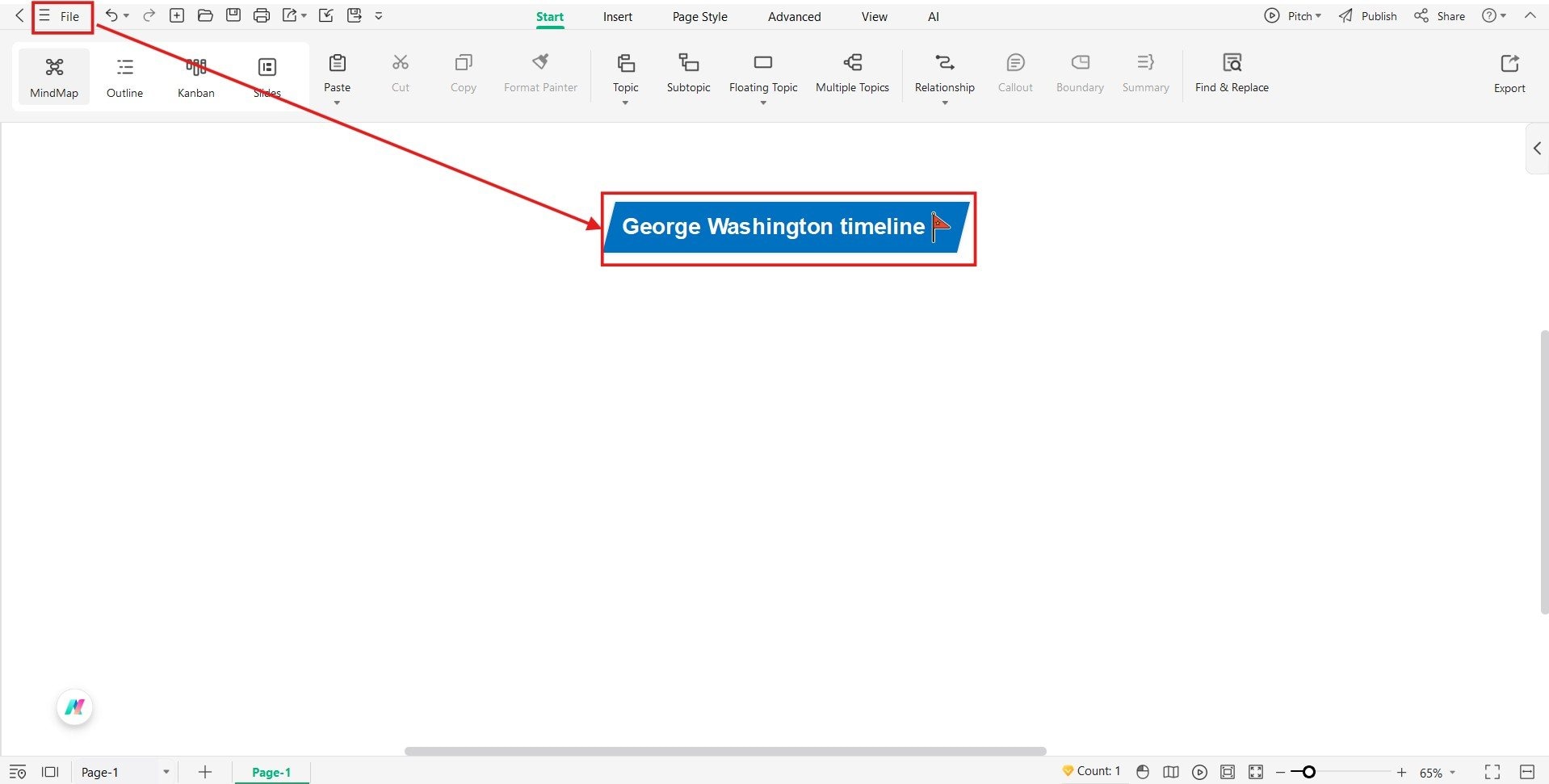
- Open EdrawMind.
- Create a blank mind map to start with a clean canvas.
- Add a floating topic and title it “George Washington Timeline.”
Step 2 Adding Events
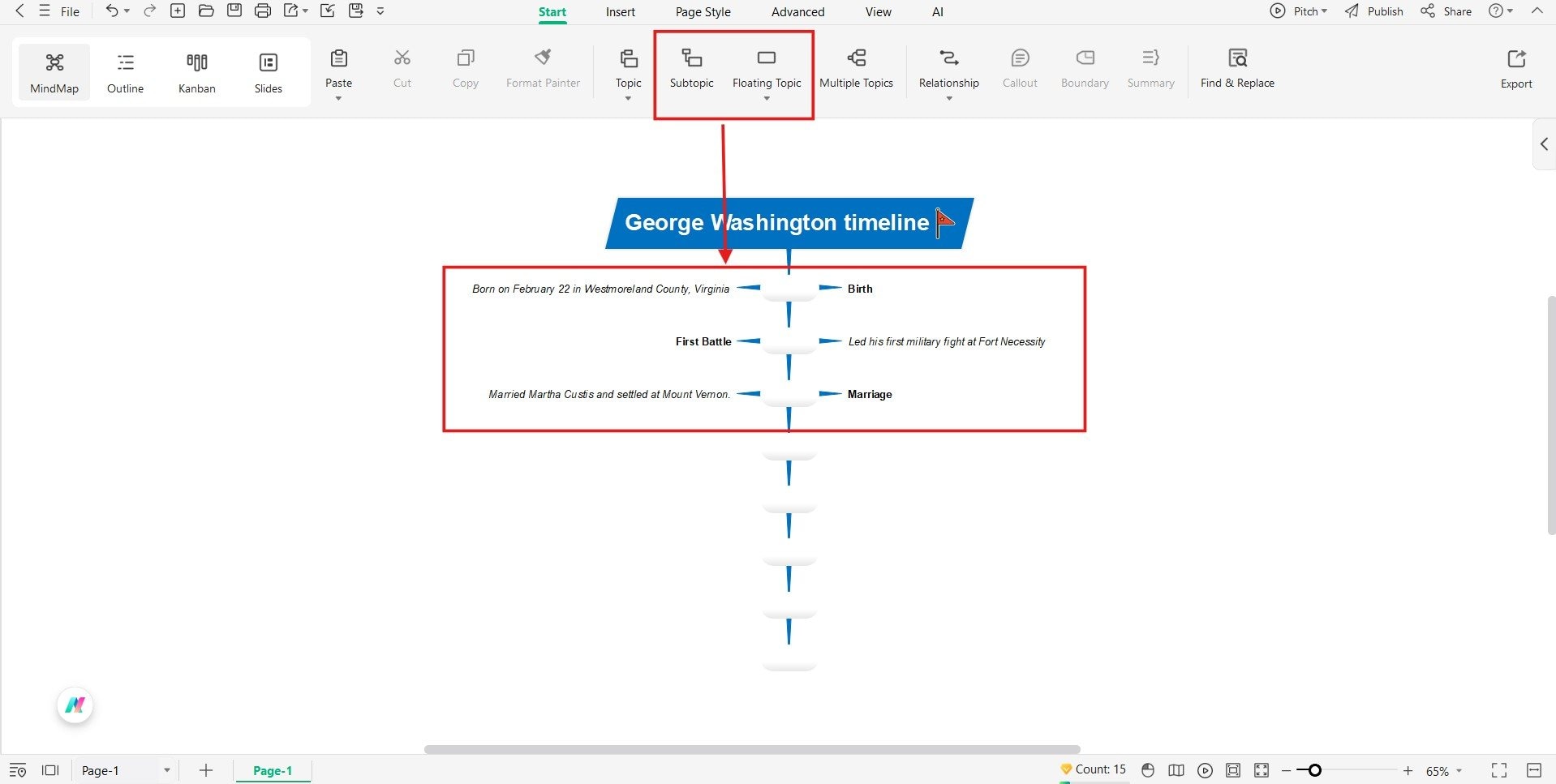
- Add a floating topic from the top menu.
- Create one for each major event and keep adding until the full timeline is displayed.
- Add a subtopic for further explanation of each event.
Tip: Arrange the events vertically to display them in chronological order and make it neater.
Step 3 Customising Each Major Event
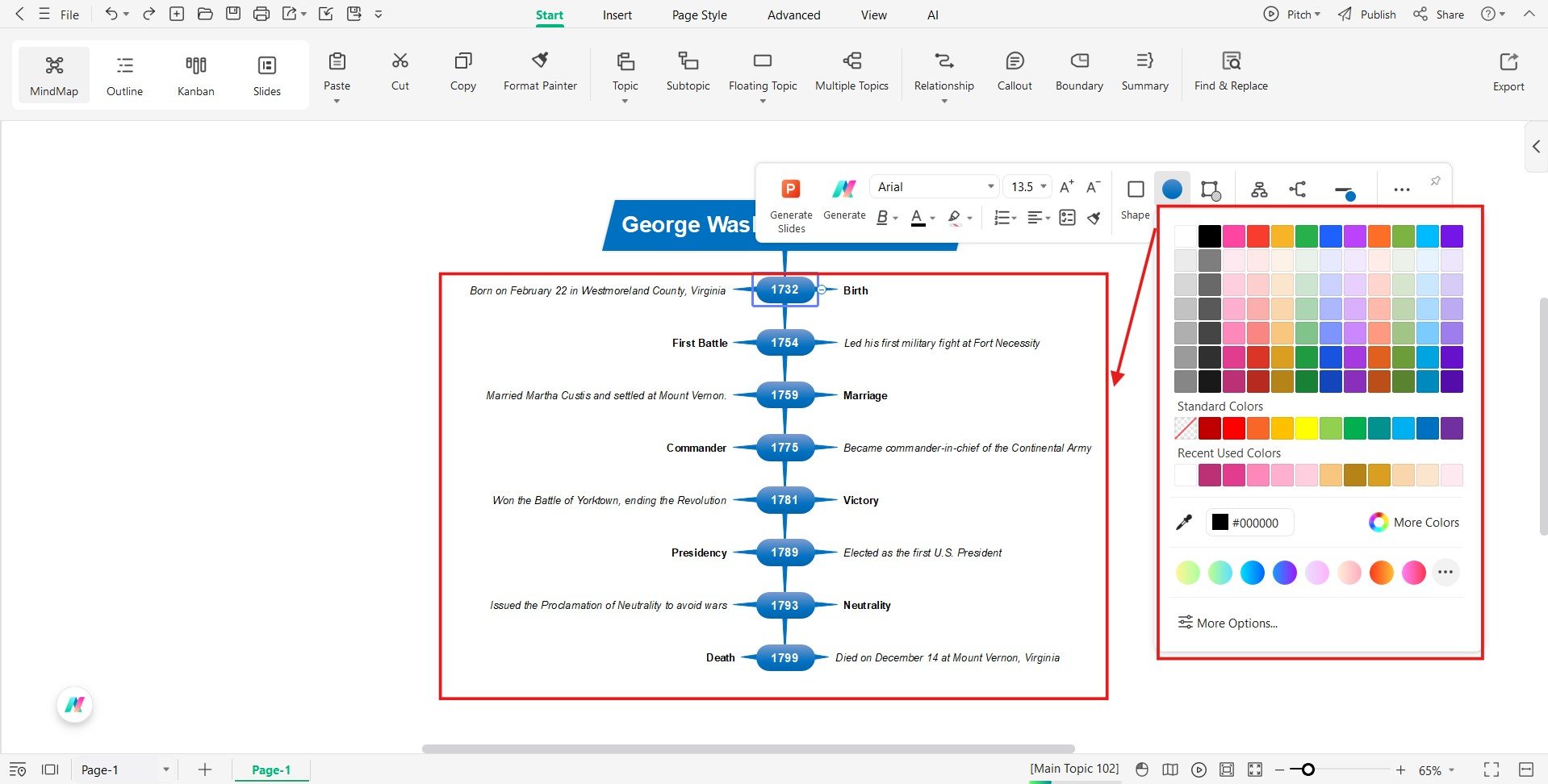
- Change the font size, colour, or box shape from the floating toolbar.
- You may also colour-code each section to highlight major events. Add dates in between.
Tip: Use Ctrl+Shift+D to make changing the font colour faster for each topic.
Step 4 Linking Each Event
- Establish a relationship between each main topic and its subtopics.
- Repeat for all 8 until the entire timeline is connected.
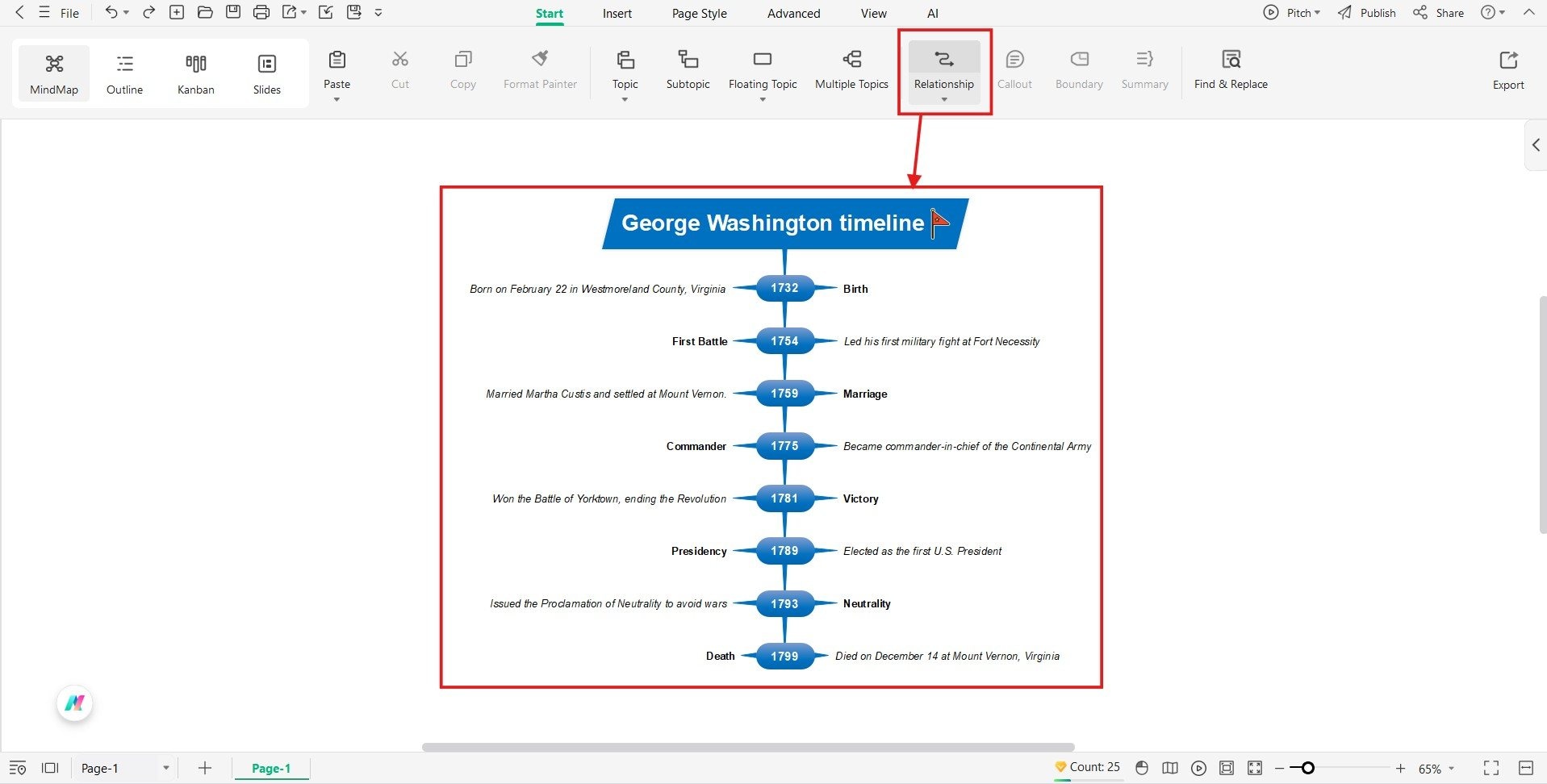
Step 5 Save or Export
- Save your project.
- Or you can download the timeline as an image (PNG, JPG), PDF, etc.
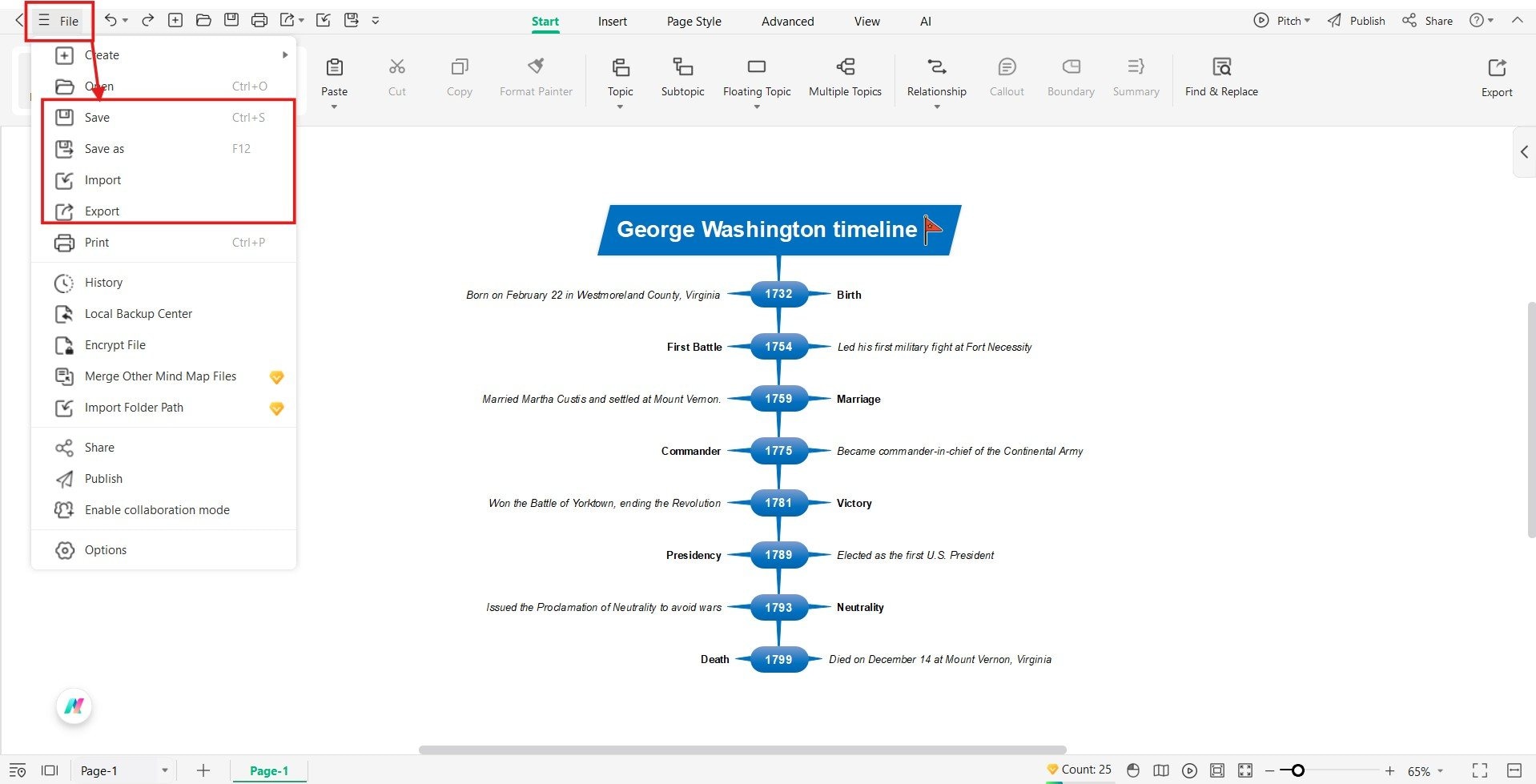
Wrapping Up
The George Washington timeline stands out as a direct blueprint of how pure vision and integrity can change the course of history for anyone. From his humble beginnings in Virginia to his crucial role in his presidency, each moment has directly contributed to the creation of the US that we all know and love today.
Washington truly lived a life of duty and discipline, one that continues to remind us that true leadership is measured by service to your country.
If you want to map complex stories or events like this one, EdrawMind makes it easy. Organise people, events, and dates in one clear visual to make each story stand out.
 EdrawMind
AppsEdrawMind Online
EdrawMind
AppsEdrawMind Online