


Do you Know the History of Osaka?
Osaka is known as one of the major attractions for tourists visiting Japan. However, have you ever wondered what the journey is behind that name? Was it called Osaka forever?
The city has been a way for trade and international commerce ever since the 15th century.
The history of Osaka is short yet interesting. This article will explore what Osaka has in store in its rich, cultural past.


In This Article
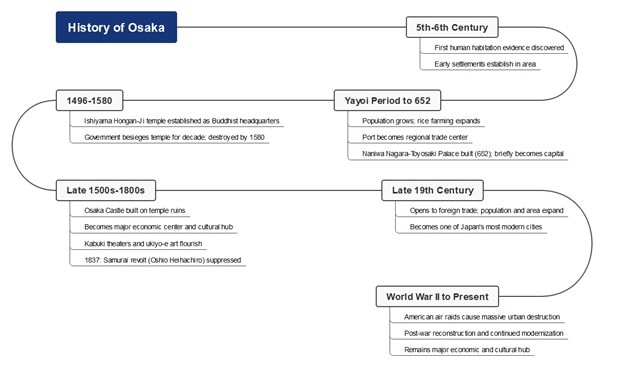
History of Osaka
Below are the three main historical stages of Osaka.
The Early Years – Remains of Naniwa-No-Miya Palace
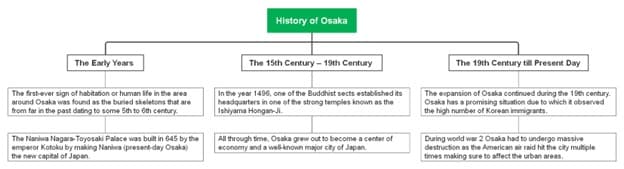
The first-ever sign of habitation or human life in the area around Osaka was discovered in the form of buried skeletons dating back to the 5th to 6th century.
It was the Yayoi period when the city of Osaka experienced a population increase. Not only that, but rice farming expanded, and the port became one of the centers for trade.
Due to the large number of tombs, scientists and researchers concluded that the city was a center for political actions.
The Naniwa Nagara-Toyosaki Palace was built in 652 by Emperor Kōtoku, making Naniwa (present-day Osaka) the new capital of Japan.
However, in a short span of time, another city was declared the capital of Japan. Nonetheless, Naniwa continued to be a focus and bridge for trade with the nearby countries and prefectures.
The 15th Century – 19th Century
In the year 1496, one of the Buddhist sects established its headquarters in one of the strong temples known as the Ishiyama Hongan-Ji, which the government besieged for over a decade (1570-1580), leading to its destruction.
Rather than rebuilding the Ishiyama Hongan-Ji temple, the very popular Osaka Castle was built in its place. All through time, Osaka grew to become a center of the economy and a well-known major city of Japan.
Besides being a developing city in terms of trade and economy, it has also worked towards creating a rich art culture by introducing Kabuki theaters and ukiyo-e pictures.
For example, in 1837, Oshio Heihachiro, a samurai, led a revolt against the government that denied helping low-income families. The locals massively supported it. The rebellion was violently put down, however.
In the late 19th century, Osaka opened its doors for trade and exchange with foreign countries, which increased the population and expanded the area.
The 19th Century Until Present Day
The expansion of Osaka continued during the 19th century. Osaka has a promising situation, which has led to a high number of Korean immigrants.
The city consistently developed rapidly, making it one of the most modern cities in Japan due to strong political policies that guided the economy and industrialization in the right direction.
During World War 2, Osaka had to undergo massive destruction as the American air raids hit the city multiple times, significantly affecting the urban areas.
Fun Facts About Osaka
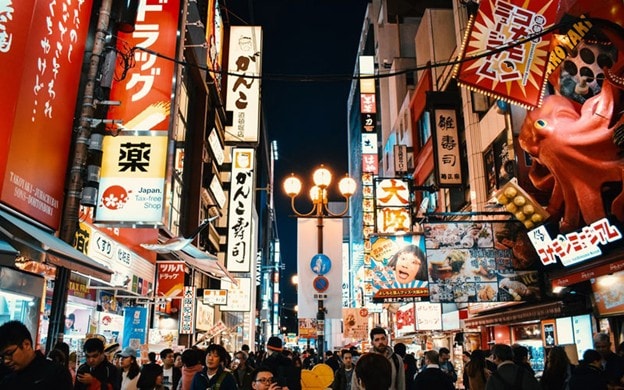
With a comprehensive yet fascinating history, Osaka today stands tall as a city in Japan. It is popular as the cuisine capital of Japan and is widely known as the city of water.
It is a unique blend of traditions and cultures from the past as well as the latest technological innovations. Here are a few facts about the city:
- Osaka is the third-largest city in Japan.
- Osaka is popular because of its underground shopping mall experience, which is ultimately one of the greatest tourist attractions.
- Osaka offers the best cruising experience.
- Osaka consists of around 3,395 shrines and temples, making it the city with the second most temples in Japan.
- Osaka is popular for its tradition of entertainment and theatre.
- Osaka has one of the six Universal Studios theme parks.
Create a Timeline To Understand History Better
If you’re a visual learner, then you probably know how timelines are really helpful in understanding the past of Osaka, or any other piece of history, for that matter. Books employ history timelines for good reason.
As such, if you’re trying to learn more about Osaka’s past, it’s good to use timelines to understand its history better. You can use it to outline the events that made it the cultural hub you know today.
Benefits of Creating a Timeline
The first benefit of making a timeline relates to your memory. Since your brain is forced to digest the key events and categorize sub-events under them, your retention and understanding of the subject improve significantly.
It also provides clarity and structure. Osaka’s history stretches across centuries, from the Yayoi period to modern Japan. A timeline helps organize this vast period into smaller, digestible segments.
Lastly, it supports review and presentation. Once you’ve completed your timeline, you can quickly revisit the major turning points without rereading lengthy text.
How To Make a Timeline with EdrawMind
When making a timeline, it’s also important to focus on a manageable span of time or a topic in a city’s history. This is so you can maximize the timeline’s third benefit – review and presentation.
If a timeline is too big, it will be hard to review and present. It’s like reading a long block of text all over again.
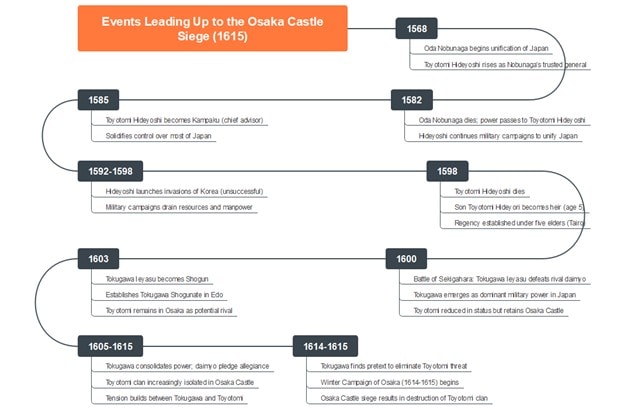
For instance, you could explore the period that led to the popular Osaka Castle Siege in 1615. Anyway, here are the relevant steps:
 Try the app & get 500 free AI tokens


Step 1
Osaka’s history spans over a millennium, so narrowing your focus can make your work more effective.

Step 2
Next, list down the key events and arrange them chronologically. For Osaka, that might include milestones such as the rise of Naniwa as a trade center, the fall of Ishiyama Hongan-Ji Temple, and other significant events, as discussed.
Step 3
Then, add short descriptions and visuals for each event to make the timeline engaging. Illustrations of historical sites can make the timeline more appealing.
Step 4
Finally, customize your timeline’s layout or design according to your theme. Pro Tip: If you want a faster way to make one, remember that several AI tools now offer automatic timeline generation for quick and simple creation.
Tool Recommendations
A timeline can be created with any traditional materials, like a pen and paper. However, it’s best to use dedicated diagramming software with AI tools, and other creative features such as Wondershare EdrawMind.
Conclusion
Although Osaka is still rebuilding since the war, it is known as one of the major stops for the tourism industry today. It still preserves the culture from the past, which always offers something for tourists as an attraction.
 EdrawMind
AppsEdrawMind Online
EdrawMind
AppsEdrawMind Online