


Marriott International is best understood through a layered organizational chart that connects corporate leadership with major business functions and regional or operating teams. The chart on this page focuses on who leads key functions, how responsibilities are grouped, and how a large hospitality company coordinates decisions across a global portfolio.
How to read this chart: Marriott publishes leadership and governance information, but not a complete internal reporting-line chart. Treat the diagram below as an explanatory reconstruction of publicly visible roles and business relationships rather than an official employee directory. Source.
In this article
Marriott Hotel Organizational Structure
Marriott International manages one of the largest and most diverse hospitality networks globally. The organization follows an integrated structure, built around functions, regions, and brands to maintain their customer’s trust in their hotels.
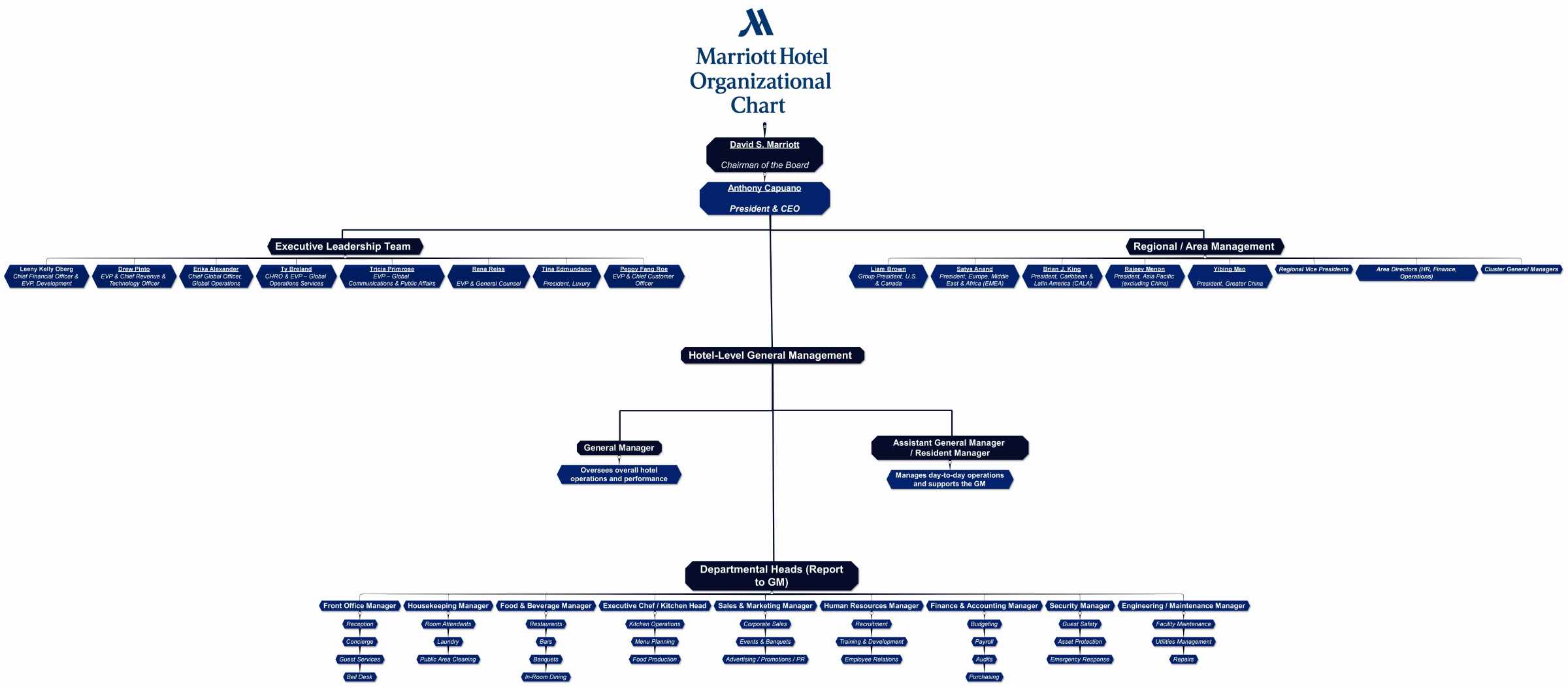


Here’s how it works:
- 1. Functional divisions: Corporate leaders oversee finance, operations, marketing, HR, and technology to maintain consistency worldwide.
- 2. Geographic divisions: Regional presidents oversee major areas like the U.S. & Canada, Europe, Asia Pacific, and Latin America. It changes strategies to fit local cultures and rules.
- 3. Brand divisions: Brand executives focus on groups such as luxury, premium, lifestyle, and budget-friendly hotels. It makes sure each brand maintains its identity.
This setup gives Marriott the best hospitality service: firm guidance on strategy and brand standards, and flexibility for regional and brand leaders to adjust to local markets.
Number of Employees & Global Footprint
Marriott’s structure must support an enormous global network:
- Employees: Over 418,000 associates worldwide
- Properties: More than 9,300 hotels globally
- Rooms: Over 1.7 million rooms in 140+ countries and territories
- Brands: A diverse portfolio of 36 brands, ranging from luxury (Ritz-Carlton, St. Regis) to select-service (Courtyard, Fairfield)
The Leaders Behind Marriott’s Success
Marriott’s structure is led by an executive team that includes top company leaders and regional presidents. Each has clear responsibilities that keep both global operations and local markets running smoothly.
Global Function Leaders
| Name | Position | Key Responsibilities |
|---|---|---|
| Anthony Capuano | President & Chief Executive Officer (CEO) | Guides overall global strategy, brand portfolio, and operational performance |
| Kathleen “Leeny” Oberg | Chief Financial Officer (CFO) & EVP, Development | Oversees financial strategy, reporting, capital allocation, and growth pipeline |
| Drew Pinto | Chief Revenue & Technology Officer | Manages sales, distribution, revenue management, and digital platforms worldwide |
| Erika Alexander | Chief Global Officer, Global Operations | Leads operational standards across Marriott’s entire property network. |
| Ty Breland | Chief Human Resources Officer (CHRO) | Directs global HR, talent acquisition, employee training, and organizational culture |
| Peggy Fang Roe | Chief Customer Officer (CCO) | Charged with customer experience, loyalty program, brand experience, and customer journey globally |
| Tricia Primrose | Chief Communications & Public Affairs Officer | Handles corporate communications, reputation, and public affairs |
| Rena Reiss | Executive Vice President & General Counsel | Legal compliance, risk, and corporate governance |
| Tina Edmundson | President, Luxury | Oversees Marriott’s luxury brands (e.g., Ritz-Carlton, St. Regis, JW Marriott, etc.) |
Regional Presidents
Marriott International’s regional executives are responsible for operations, strategy, and performance in their respective regions. They report to the CEO and coordinate brand, function, and regional needs.
- 1. Liam Brown (President, U.S. & Canada)
- 2. Satya Anand (President, Europe, Middle East & Africa)
- 3. Brian J. King (President, Caribbean & Latin America)
- 4. Rajeev Menon (President, Asia Pacific)
- 5. Yibing Mao (President, Greater China)
How Marriott Stays Adaptive with its Structure?
Marriott’s massive size could easily make it rigid. However, the company has built flexibility into its structure. Here’s how:
Flexibility in the Workforce & Job Design
After the pandemic, Marriott looked for new ways to support its staff. Because most hotel jobs can’t be done remotely, it focused on other kinds of flexibility. It added role sharing with two team members dividing one position, part-time choices and adjustable shift schedules. It allows staff to select their timings. This helped raise motivation and reduce turnover.
It also combined some front-line roles. For example, a front desk agent could sometimes take on concierge responsibilities. It helps service run faster, improves overall guest satisfaction, and keeps the work more interesting for staff.
Market & Brand Adaptation
Marriott can adjust its framework for each market thanks to its strong network of regional leaders and brand-focused teams.
In regions like the Caribbean and Latin America (CALA), high building expenses and lengthy approval procedures make new hotel construction more challenging.
So, regional teams focus on conversions, including rebranding existing properties. As a result, about 32% of new rooms in CALA came from conversions in 2024.
At the brand level, Marriott aligns its offerings to match the expectations and tastes of travelers in each region. In CALA, this means adding more all-inclusive resorts, expanding mid-scale brands like City Express by Marriott, and moving into new markets such as Costa Rica and the Dominican Republic. It helped the company grow faster with reduced risk.
Sustainability, Infrastructure, and Risk Management
Beyond business and HR, Marriott’s structure also supports long-term resilience in infrastructure and environmental risk.
Through its Marriott Infrastructure Resilience & Adaptation (MIRA) Program, the company evaluates climate-related risks across more than 8,600 properties in 139 countries and territories.
MIRA follows a four-step approach:
- 1. Identify current and future risks
- 2. Plan mitigation measures
- 3. Strengthen property resiliency
- 4. Reduce potential damage from climate or weather events
This system helps make long-term stability and safety planning a core part of Marriott’s corporate strategy, with dedicated teams in each region leading the effort.
Tech and Loyalty Adaptation
Marriott relies on technology and data to stay in tune with changing guest needs. A big part of this is the Marriott Bonvoy loyalty program. This program helps the company understand how guests like their trip and what they like. Using that information, Marriott can quickly update its offers and services to make stays more personal.
After the pandemic, Marriott also focused more on technology. It improved revenue systems, booking platforms, and online guest services. This helped the company adjust to new travel trends and higher expectations for easy access.
What Makes Marriott’s Structure Work?
Marriott’s structure works by giving corporate teams control over overall standards while letting regional leaders and hotel managers adapt them for local markets. This approach helps the company grow quickly while preserving quality and consistency.
Here’s why it works so well:
- Clear hierarchy: Responsibilities are defined from corporate down to the property level.
- Specialized teams: HR, finance, marketing, tech, plus operations enable decisions to happen faster.
- Local adaptation: Regional leaders adjust how they plan to align with local regulations, customs, and guest needs.
- Expandable framework: The structure supports both new builds and hotel conversions.
- Strong training culture: Leadership and skills programs equip managers to run properties effectively.
- Fast response: Property leaders can promptly act on guest insights or market shifts.
- Brand-based innovation: Separate brand divisions can explore ideas without affecting other brands.
- Agile leadership: Executive roles are replanned as needed to maintain flexible and efficient decision-making.
How to Make an Org Chart like Marriott?
Creating an org chart like Marriott’s can seem complex, but breaking it into steps makes it much easier. Before you begin, clarify the purpose of the org chart (e.g., for planning, communication, or mapping roles). Then follow these steps:
Gather Information
Collect current data: names, job titles, reporting lines, team/department structure. Verify with HR and managers to ensure it's up to date.
Decide on the Structure & Scope
Select the format that best suits your company: hierarchical, matrix/hybrid, geographic, or brand-based. Decide how much detail to include, such as roles, responsibilities, locations, etc.
Select the Right Tool
Pick a tool that allows you to drag and drop, color-code, adjust layouts, and update content easily. EdrawMind lets you build visual org charts fast and flexibly with its pre-made org chart templates.
Design the Org Chart
Start with top leadership and work downward. Use consistent shapes, colors, and spacing to show hierarchy clearly. Keep titles short, and make the layout easy to read at a glance.
Review & Maintain Regularly
Share with stakeholders, get feedback, and update the chart when people or roles change. Assign someone (often HR) to keep it up to date.
Steps to Create the Organizational Chart
Once you’ve gathered all your management data and defined your hierarchy, it’s time to build the chart. I have used Wondershare EdrawMind to make this org chart. Here’s how you can make it:
 Try the app & get 500 free AI tokens


Step1 Add the Top Leadership
Start adding the Chairman of the Board (David S. Marriott) and President & CEO (Anthony Capuano) at the top of the chart.
These positions form the root of your organizational structure.

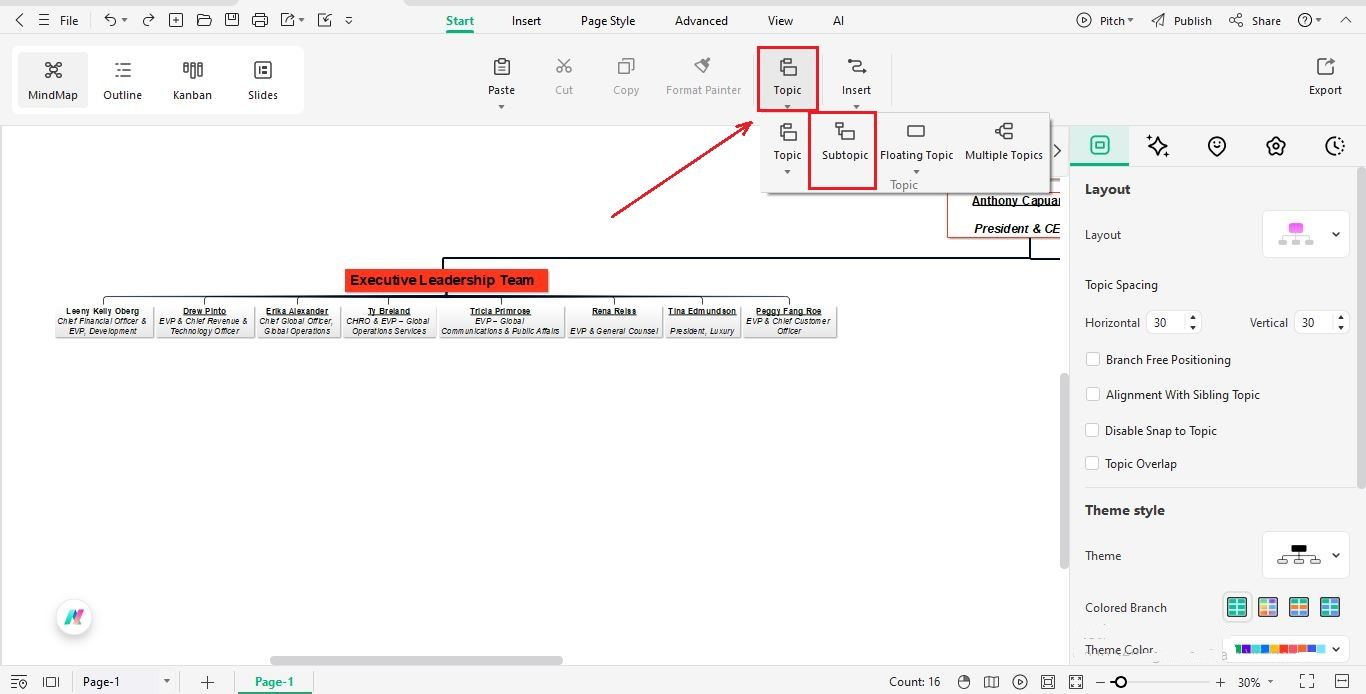
Step2 Add the Executive Leadership Team
Below the CEO, add the Executive Leadership Team, which includes roles such as Chief Financial Officer, Chief Human Resources Officer, Chief Operating Officer, and others.
Step3 Add Regional/Area Management
Next, add the Regional and Area Management roles to represent leadership across geographic regions.
Include positions like Regional Presidents, Chief Growth Officer, and Area General Managers.

Step4 Add Hotel-Level General Management
Under the corporate and regional structure, add Hotel-Level General Management.
This includes the General Manager (who oversees overall operations) and the Assistant General Manager / Resident Manager (who manages daily operations).

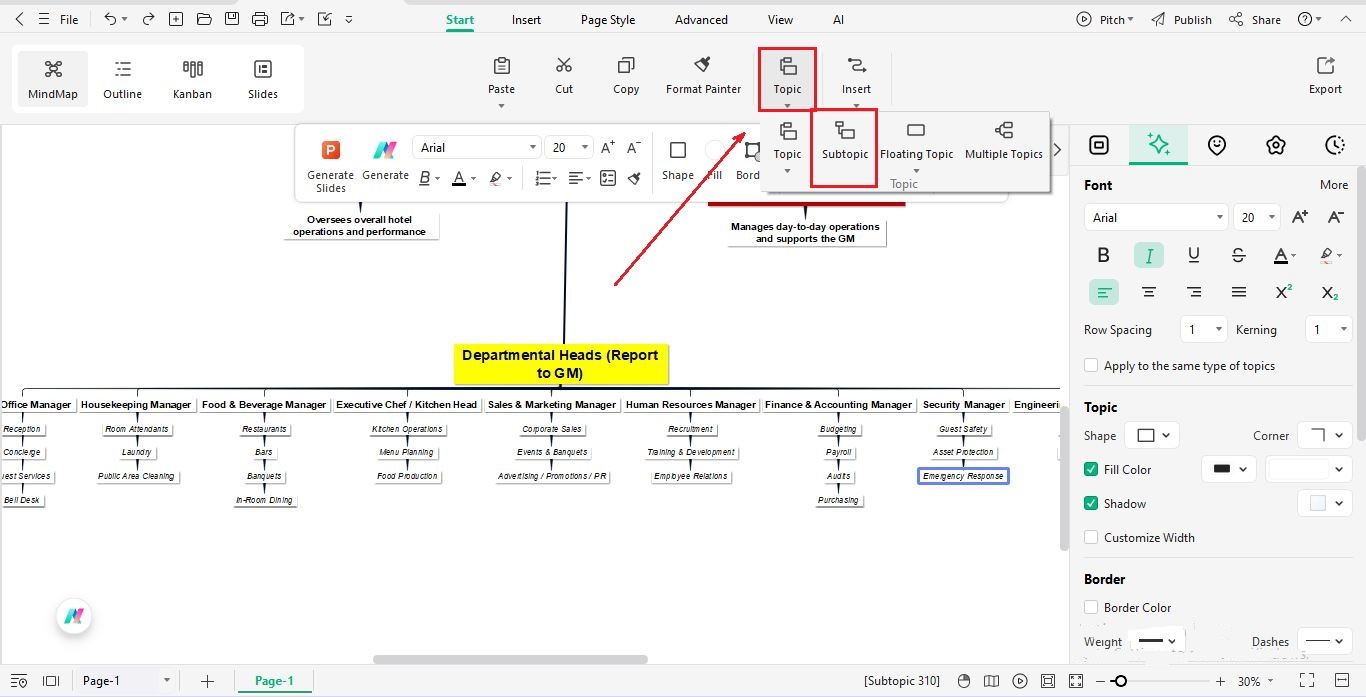
Step5 Add Departmental Heads
Below the General Manager, include Departmental Heads who report directly to the GM.
Step6 Customize, Review & Share
Make sure that all reporting lines and management levels are clearly connected.
Save or export the Marriott Hotel Organizational Chart as a PDF, PNG, or PowerPoint, or share it via a link with your team for collaboration.

Closure
In conclusion, Marriott's organizational structure shows how a large corporation can be manageable and well-structured. Everyone knows what to do and who to report to when corporate, regional, and hotel teams have clearly defined roles. By creating a basic organizational chart that keeps tasks clear and teams connected, you can apply the same concept to your own company.
If this org structure got your attention, you can easily make your own using EdrawMind. Use any premade template, do a few tweaks, and make your own org chart.
 EdrawMind
AppsEdrawMind Online
EdrawMind
AppsEdrawMind Online