About this Operating System Structure template
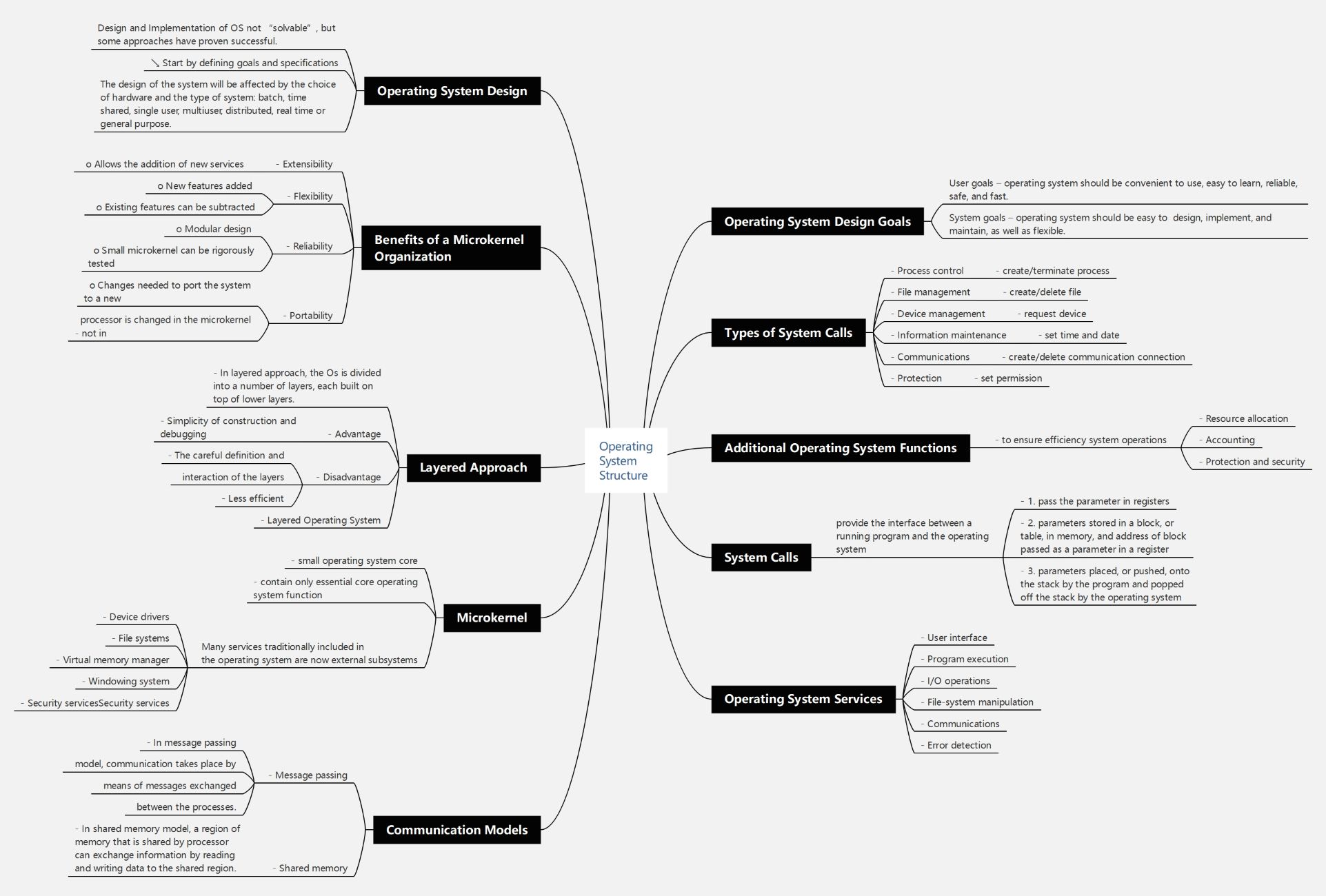
This template provides a clear visual map of how modern operating systems are built. It highlights key design goals, system call types, and structural models like microkernels and layered approaches. Use this guide to understand the essential services and communication models that power your computer.
Operating System Design and Goals
Designing an OS starts by defining specific goals based on the hardware and user needs. The process balances what users want against what developers need for easy maintenance and system stability.
- User goals: Convenience, reliability, safety, and speed.
- System goals: Easy to design, implement, and maintain.
- System types: Batch, time-shared, distributed, and real-time.
- Specification: Starting by defining clear goals for the hardware choice.
Types of System Calls
System calls act as the bridge between running programs and the operating system kernel. They allow applications to request specific tasks like moving files or managing memory safely and efficiently.
- Process control: Create, terminate, or abort processes.
- File management: Create, delete, read, and write files.
- Device management: Request and release hardware devices.
- Information maintenance: Get or set time, date, and system data.
- Communications: Create and delete communication connections between processes.
- Protection: Control access to resources and set permissions.
Core Operating System Services
Operating systems provide a suite of services to ensure programs execute correctly. These services handle everything from the user interface to background tasks that keep the hardware running without errors.
- User interface: Methods for users to interact with the system.
- Program execution: Loading and running programs in memory.
- I/O operations: Managing input and output for different devices.
- File-system manipulation: Organizing how data is stored and retrieved.
- Error detection: Identifying and fixing hardware or software issues.
- Resource allocation: Distributing CPU and memory to active tasks.
Microkernel and Layered Approaches
Modern structures often use layered or microkernel designs to improve modularity. These methods make it easier to fix bugs and add new features without breaking the entire operating system core.
- Layered Approach: Dividing the OS into levels built on top of each other.
- Microkernel: Keeping only essential core functions in a small kernel.
- Benefits: Better extensibility, flexibility, and higher system reliability.
- Portability: Easier to move the system to new hardware architectures.
- Debugging: Simpler isolation of errors in specific modules or layers.
Communication Models
Processes often need to share data or coordinate tasks through specific communication models. The choice between these models impacts the speed and complexity of how applications talk to one another.
- Message passing: Exchanging messages between processes to share data.
- Shared memory: Creating a common memory region for multiple processes.
- Efficiency: Shared memory is often faster for large data transfers.
- Security: Message passing provides better isolation between different tasks.
FAQs about this Template
-
What is the primary difference between user goals and system goals in OS design?
User goals focus on the external experience, prioritizing convenience, speed, and ease of use. In contrast, system goals focus on the internal architecture, emphasizing ease of design, implementation, and maintenance. Balancing these two is difficult because a highly flexible user interface can make the underlying code more complex and harder for developers to manage effectively over time.
-
How do system calls manage parameters between a program and the kernel?
System calls use three main methods to pass parameters to the operating system. First, they can pass information directly through CPU registers. Second, they can store parameters in a memory block or table, passing the block address to a register. Finally, programs can push parameters onto a system stack, which the operating system then pops off to execute the requested service.
-
Why is the microkernel approach considered more reliable than other structures?
The microkernel approach is reliable because it keeps the core kernel as small as possible. By moving non-essential services like file systems and device drivers into user space, a failure in one of these services will not crash the entire system. This modular design makes it easier to test components rigorously and extend the system with new features without affecting core stability.