About this application development and deployment template
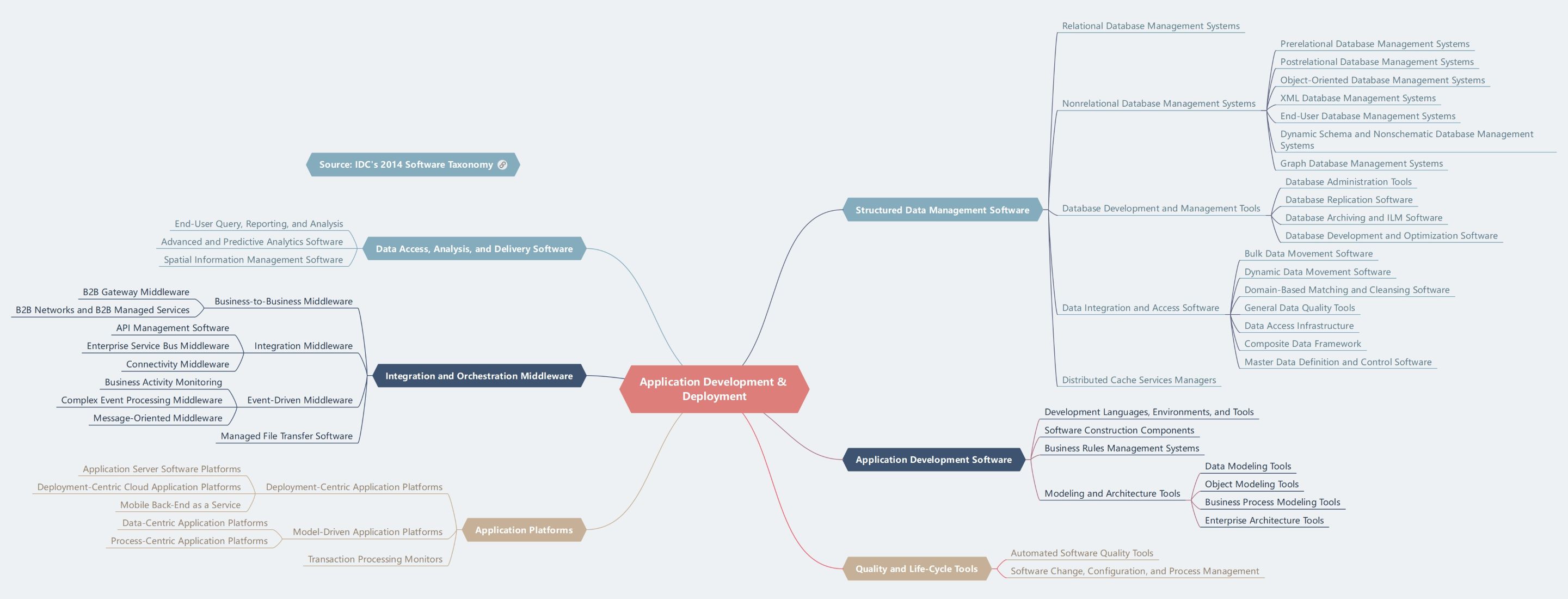
This template provides a comprehensive overview of the software taxonomy for application development and deployment. It categorizes essential tools and platforms used by developers to build, integrate, and manage modern software applications effectively.
Structured Data Management Software
This section focuses on tools used to organize and manage structured information. It covers systems for handling relational and non-relational databases. These tools ensure that data is stored securely and accessed efficiently by applications.
- Relational Database Management Systems
- Nonrelational Database Management Systems
- Database Development and Management Tools
- Data Integration and Access Software
- Distributed Cache Services Managers
Application Development Software
Application development software includes the core tools used for coding and designing programs. These resources help developers build logic, define architectures, and model business processes. They are essential for creating functional and scalable software solutions.
- Development Languages, Environments, and Tools
- Software Construction Components
- Business Rules Management Systems
- Modeling and Architecture Tools
Quality and Life-Cycle Tools
Quality and life-cycle tools ensure that software remains reliable throughout its existence. These tools focus on testing for bugs and managing configuration changes. They help teams maintain high standards and streamline the deployment process across environments.
- Automated Software Quality Tools
- Software Change, Configuration, and Process Management
Application Platforms
Application platforms provide the underlying infrastructure where software runs and operates. This includes cloud-based environments and specialized engines for transactions or process-centric tasks. These platforms offer the necessary stability and resources for modern digital applications.
- Deployment-Centric Application Platforms
- Model-Driven Application Platforms
- Transaction Processing Monitors
Integration and Orchestration Middleware
Middleware acts as a bridge between different software components and services. It handles communication, file transfers, and business-to-business connections. These tools are vital for orchestrating complex workflows and ensuring different systems can work together seamlessly.
- Business-to-Business Middleware
- Integration Middleware
- Event-Driven Middleware
- Managed File Transfer Software
Data Access, Analysis, and Delivery Software
This category includes software designed for end-user querying and reporting. It supports advanced analytics and predictive modeling to gain insights from data. These tools help deliver information across the organization in a spatial or visual format.
- End-User Query, Reporting, and Analysis
- Advanced and Predictive Analytics Software
- Spatial Information Management Software
FAQs about this Template
-
What is the role of middleware in application deployment?
Middleware plays a critical role by connecting disparate software systems and applications. It acts as a communication layer that allows different programs to share data and processes. Without middleware, integrating legacy systems with modern cloud platforms would be extremely difficult. It handles tasks like message routing, data transformation, and security. This ensures that the entire software ecosystem functions as a unified and efficient environment.
-
Why are quality and life-cycle tools important for developers?
These tools are essential because they ensure software reliability and performance throughout its lifecycle. Automated quality tools help identify bugs early in the development process, reducing repair costs. Configuration management tools track changes to code, preventing version conflicts during deployment. By using these tools, development teams can deliver high-quality products faster while maintaining consistent standards across multiple release cycles and environments.
-
How does structured data management support modern applications?
Structured data management provides the foundation for organized data storage and retrieval. It includes relational databases for structured tables and non-relational systems for flexible data formats. These tools allow applications to handle large volumes of information with speed and precision. They also offer integration features to combine data from various sources. Effective data management is key to providing users with accurate and timely information.