About this C Program Language template
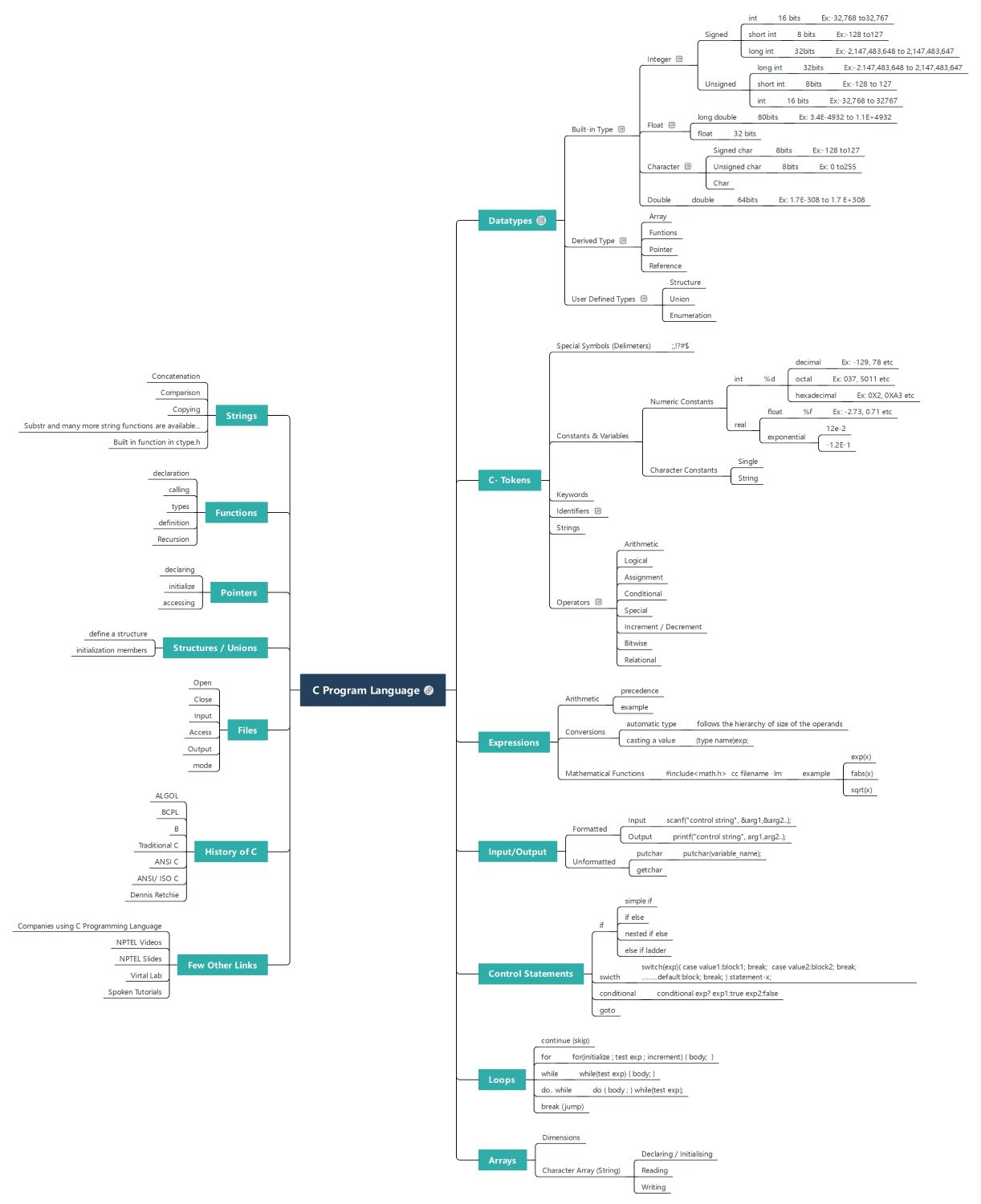
This comprehensive mind map template covers the essential components of the C programming language. It serves as a visual guide for beginners and professionals to understand data types, control structures, memory management, and file operations.
Datatypes in C
Datatypes define the kind of data a variable can hold in C. This section categorizes them into built-in, derived, and user-defined types. Understanding these categories is vital for efficient memory allocation and handling different values.
- Built-in Type (Integer, Float, Character, Double)
- Derived Type (Array, Functions, Pointer, Reference)
- User Defined Types (Structure, Union, Enumeration)
C-Tokens and Symbols
Tokens are the smallest individual units in a C program. They include symbols, constants, keywords, and operators that the compiler recognizes. Mastering tokens is the first step toward writing valid syntax and logic for programs.
- Special Symbols and Delimiters
- Numeric and Character Constants
- Keywords and Identifiers
- Arithmetic, Logical, and Bitwise Operators
- Relational and Assignment Operators
Control Statements and Loops
Control statements and loops manage the flow of execution in a program. They allow for decision-making and repetitive tasks. These structures are crucial for building complex logic and managing how data is processed within functions.
- If Statements (Simple, Nested, Else-If Ladder)
- Switch Case and Conditional Expressions
- For, While, and Do-While Loops
- Break, Continue, and Goto Statements
Functions, Pointers, and Strings
Functions promote code reusability by modularizing logic into blocks. Pointers provide direct access to memory addresses, making C highly efficient. Combining these features allows developers to create powerful programs that handle data and memory with precision.
- Function Declaration, Calling, and Recursion
- Pointer Initialization and Memory Accessing
- String Concatenation, Comparison, and Copying
- Structure and Union Initialization
- File Operations (Open, Close, Input, Output)
FAQs about this Template
-
Why is C still relevant in modern software development?
C remains relevant because of its incredible efficiency and proximity to hardware. It is the language of choice for developing operating systems, drivers, and embedded systems. Many modern languages like C++, Java, and Python are built upon or influenced by C. Learning it provides a deep understanding of how computers manage memory and execute instructions at the lowest level.
-
What are the main differences between structures and unions in C?
Structures and unions both store different data types, but they manage memory differently. In a structure, every member gets its own unique memory location. In a union, all members share the same memory space, which is sized to the largest member. This makes unions more memory-efficient when only one member needs to be accessed at any given time during execution.
-
How do pointers work and why are they important?
Pointers are variables that store the memory address of another variable rather than a direct value. They are vital in C for dynamic memory allocation, efficient array handling, and passing large data structures to functions without copying them. By manipulating addresses directly, programmers can optimize performance and create complex data structures like linked lists, trees, and graphs effectively.