About this How to Study Law on Your Own Template
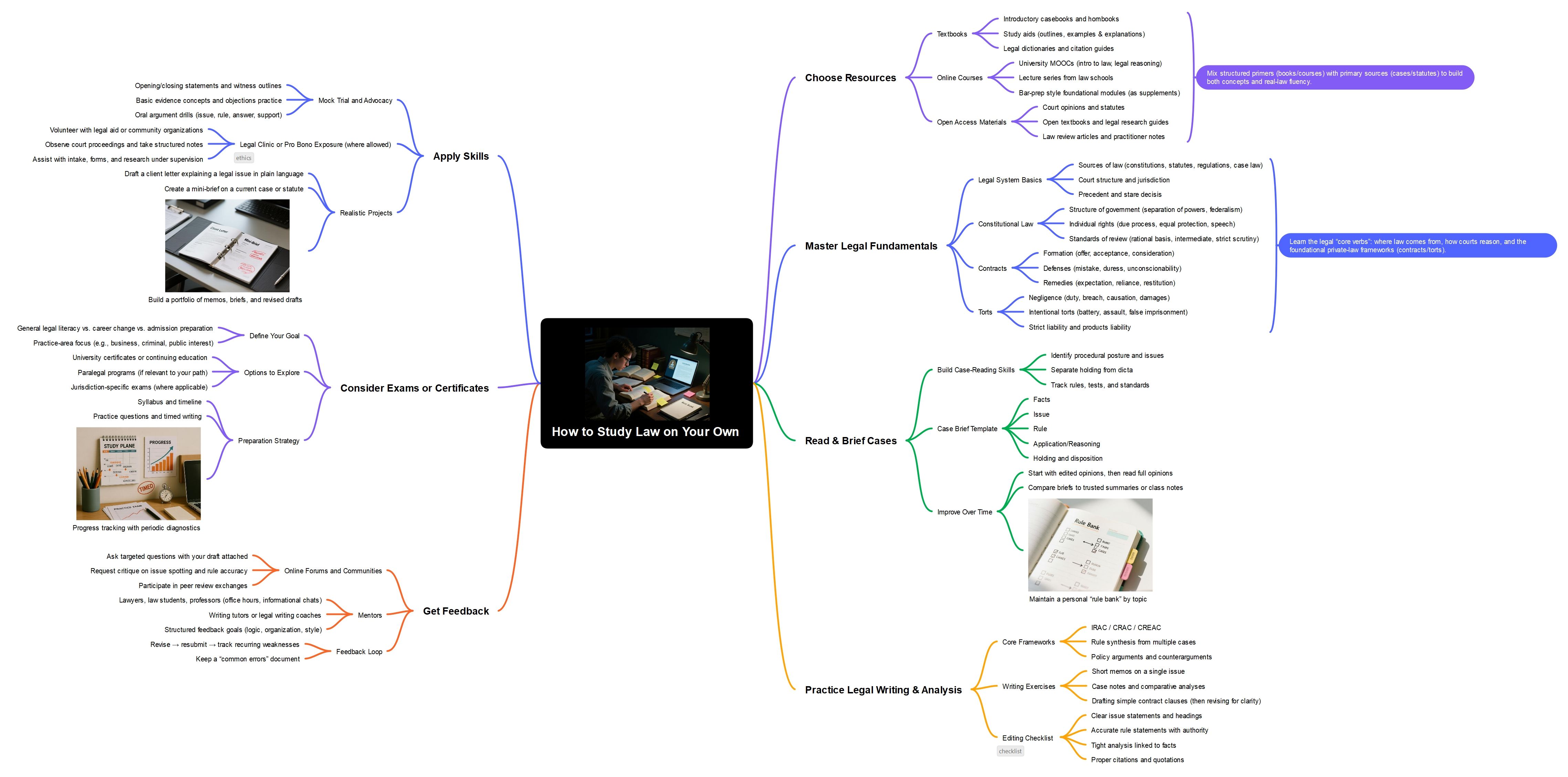
This template organizes how to study law on your own into study-ready branches, making legal concepts, preparation steps, and supporting notes easier to review.
Choose Resources
This branch explains one important legal topic inside how to study law on your own so the overall structure is easier to review.
- Use this branch to summarize the main ideas behind choose resources.
- Add examples, rules, or study notes that support faster revision.
Introductory casebooks and hornbooks
This branch explains one important legal topic inside how to study law on your own so the overall structure is easier to review.
- Use this branch to summarize the main ideas behind introductory casebooks and hornbooks.
- Add examples, rules, or study notes that support faster revision.
Study aids (outlines, examples & explanations)
This branch focuses on a core legal-study step within how to study law on your own, giving readers a clearer path for preparation and review.
- Use this branch to summarize the main ideas behind study aids (outlines, examples & explanations).
- Add examples, rules, or study notes that support faster revision.
Legal dictionaries and citation guides
This branch explains one important legal topic inside how to study law on your own so the overall structure is easier to review.
- Use this branch to summarize the main ideas behind legal dictionaries and citation guides.
- Add examples, rules, or study notes that support faster revision.
Online Courses
This branch focuses on a core legal-study step within how to study law on your own, giving readers a clearer path for preparation and review.
- Use this branch to summarize the main ideas behind online courses.
- Add examples, rules, or study notes that support faster revision.
University MOOCs (intro to law, legal reasoning)
This branch explains one important legal topic inside how to study law on your own so the overall structure is easier to review.
- Use this branch to summarize the main ideas behind university moocs (intro to law, legal reasoning).
- Add examples, rules, or study notes that support faster revision.
FAQs about this Template
-
What is law?
Law is a system of rules, principles, and institutions used to regulate behavior, resolve disputes, and organize rights and responsibilities in society. Studying law usually involves learning legal concepts, reading cases and statutes, and understanding how legal rules are interpreted and applied in different contexts.
-
How do you study law on your own?
Studying law on your own works best when you start with basic legal concepts, build a reading structure around statutes and cases, and take organized notes that force you to explain the rule in your own words. Independent study becomes easier when it follows a system instead of random topic jumping.
-
Why does self-study matter in law?
Self-study matters in law because the subject rewards consistency, close reading, and the ability to connect rules across different topics. Even formal legal training depends heavily on individual study habits, so building that discipline early makes later learning much stronger.
-
What’s the difference between self-study and formal legal training?
Self-study gives flexibility and lower barriers to entry, while formal legal training offers structured curriculum, feedback, and professional recognition. Both can improve understanding, but they do not provide the same level of guidance or career outcome.