About this Daily Data Tracking Verification Checklist Template
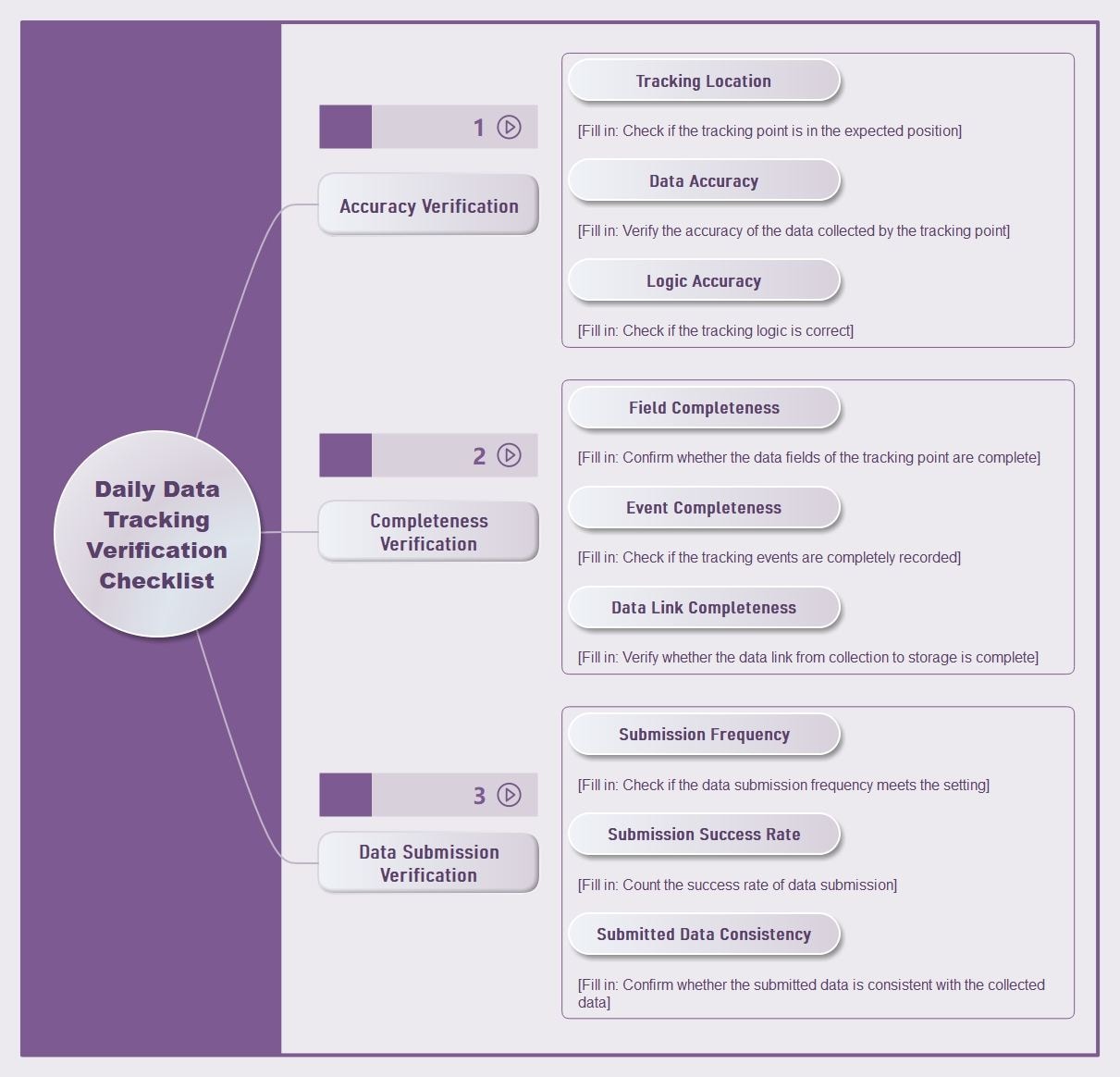
This template turns daily tracking QA into a branch-based checklist. It groups the work into accuracy verification, completeness verification, and data submission verification, while also naming the concrete items that need to be checked under each part of the process.
Accuracy Verification
This branch focuses on whether the tracking setup is correct at the source. The checklist items include tracking location, data accuracy, and logic accuracy, which helps reviewers confirm that the point is installed where expected and that the captured logic is producing reliable records.
Completeness Verification
This section checks whether the tracked dataset is structurally complete. It covers field completeness, event completeness, and data link completeness, so teams can verify that no required fields are missing, that events are fully recorded, and that the collection-to-storage chain is intact.
Data Submission Verification
This branch reviews delivery quality after collection. It includes submission frequency, submission success rate, and submitted data consistency, which makes it easier to detect whether data is being sent on time, whether transmissions are stable, and whether the submitted output matches the collected records.
FAQs about this Template
-
What should a data verification checklist include?
A data verification checklist should usually include source checks, value accuracy, completeness, format consistency, anomaly review, and any required approval or sign-off steps. The point is to make sure important data is not only captured, but also trustworthy enough to use.
-
How do teams verify data on a daily basis?
Teams usually verify data daily by checking expected sources, validating key fields, reviewing unusual movement, and confirming whether the numbers match the operational reality they are meant to represent. Daily cadence matters because it is easier to fix data problems while they are still fresh.
-
Why is daily data validation important?
Daily data validation is important because inaccurate numbers can spread quickly into reports, decisions, and downstream workflows. Catching problems early reduces rework and helps teams avoid acting on information that only looks reliable on the surface.
-
What's the difference between data tracking and data auditing?
Data tracking focuses on capturing and monitoring information over time, while data auditing is more concerned with checking quality, integrity, and compliance against expected standards. In practice, strong daily processes often need both views.