About this Customer Development Management template
This template provides a clear roadmap for managing user growth and retention. It helps teams assess their current situation, gather essential data, and execute optimization plans to ensure sustainable business growth through verified results.
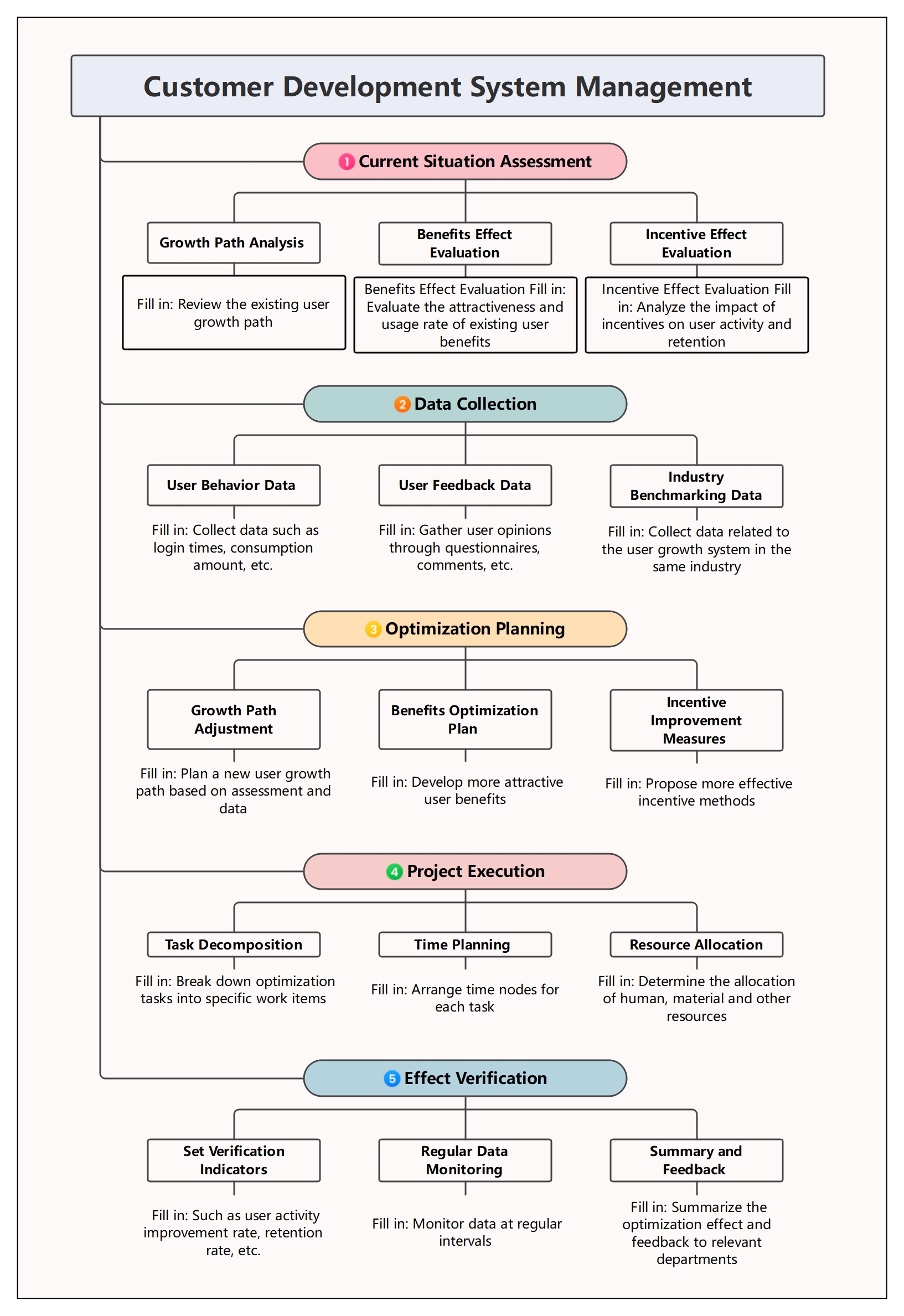
Current Situation Assessment
The first step involves evaluating your existing strategies to find gaps. You need to look at how users currently interact with your brand and determine if your incentives are truly driving engagement and long-term loyalty.
- Growth Path Analysis: Review the existing user growth path
- Benefits Effect Evaluation: Evaluate the attractiveness and usage rate of existing user benefits
- Incentive Effect Evaluation: Analyze the impact of incentives on user activity and retention
Data Collection
Accurate data is the foundation of any successful management plan. By gathering behavioral patterns and direct feedback, you gain a deep understanding of what your customers really want and how the industry is performing.
- User Behavior Data: Collect data such as login times and consumption amounts
- User Feedback Data: Gather user opinions through questionnaires and comments
- Industry Benchmarking Data: Collect data related to the user growth system in the same industry
Optimization Planning
In this phase, you use your collected data to design better user experiences. You must create more attractive benefits and improve your incentive methods to ensure users stay motivated and connected to your brand.
- Growth Path Adjustment: Plan a new user growth path based on assessment and data
- Benefits Optimization Plan: Develop more attractive user benefits
- Incentive Improvement Measures: Propose more effective incentive methods
Project Execution
Execution turns your planning into reality by organizing tasks and resources. It is vital to break down big goals into manageable steps and assign the right tools and people to complete the work efficiently.
- Task Decomposition: Break down optimization tasks into specific work items
- Time Planning: Arrange time nodes for each task
- Resource Allocation: Determine the allocation of human, material, and other resources
Effect Verification
The final stage ensures that your changes actually worked as intended. You must set clear indicators, monitor data regularly, and provide feedback to the rest of the company to improve future growth cycles.
- Set Verification Indicators: Track user activity improvement and retention rates
- Regular Data Monitoring: Monitor data at regular intervals to catch trends
- Summary and Feedback: Summarize the optimization effect and feedback to relevant departments
FAQs about this Template
-
Why is current situation assessment critical in customer development?
Assessing your current situation is critical because it identifies specific weaknesses in your user journey. Without this baseline, you cannot measure if your future optimizations are actually working. It allows you to see if your current incentives are wasting money or if the user path is too confusing. Starting with an assessment ensures your resources are focused on the right problems.
-
How does data collection improve customer development management?
Data collection turns guesses into facts. By analyzing login times, spending habits, and direct customer feedback, you understand what drives loyalty. Industry benchmarking also tells you where you stand against competitors. This information allows you to create highly targeted growth paths that meet real user needs rather than relying on assumptions that might lead to expensive mistakes.
-
What are the benefits of regular effect verification?
Regular effect verification ensures that your optimization strategies produce a positive return on investment. By tracking metrics like retention rates and activity levels over time, you can quickly pivot if a new strategy fails. It provides the proof needed to justify marketing budgets and helps the entire organization understand which specific tactics are driving long-term customer growth and business success.