



The name "Caesar" is now a part of Rome's history. And it all started with Gaius Julius Caesar III, a man whose family would one day change the Roman world. He gave us leaders, generals, and statesmen whose names are still known today. What began with his bloodline turned into a legacy of power, ambition, and empire.
This guide will show you the Julius Caesar family tree. It's a story about heritage, fate, and power that made ancient Rome what it is today.
Julius Caesar Family Tree
Julius Caesar came from one of Rome’s oldest noble families, the Julii.
He was born in 100 BC to Gaius Julius Caesar and Aurelia Cotta, both from respected Roman families. Though noble, his family wasn’t very wealthy. Still, Caesar rose to become Rome’s greatest leader, reformed its laws, and even created the Julian calendar we use today. After he died in 44 BC, his adopted son Octavian (Augustus) became Rome’s first emperor.
Now, let’s take a closer look at the Julius Caesar family tree and see where it all began.
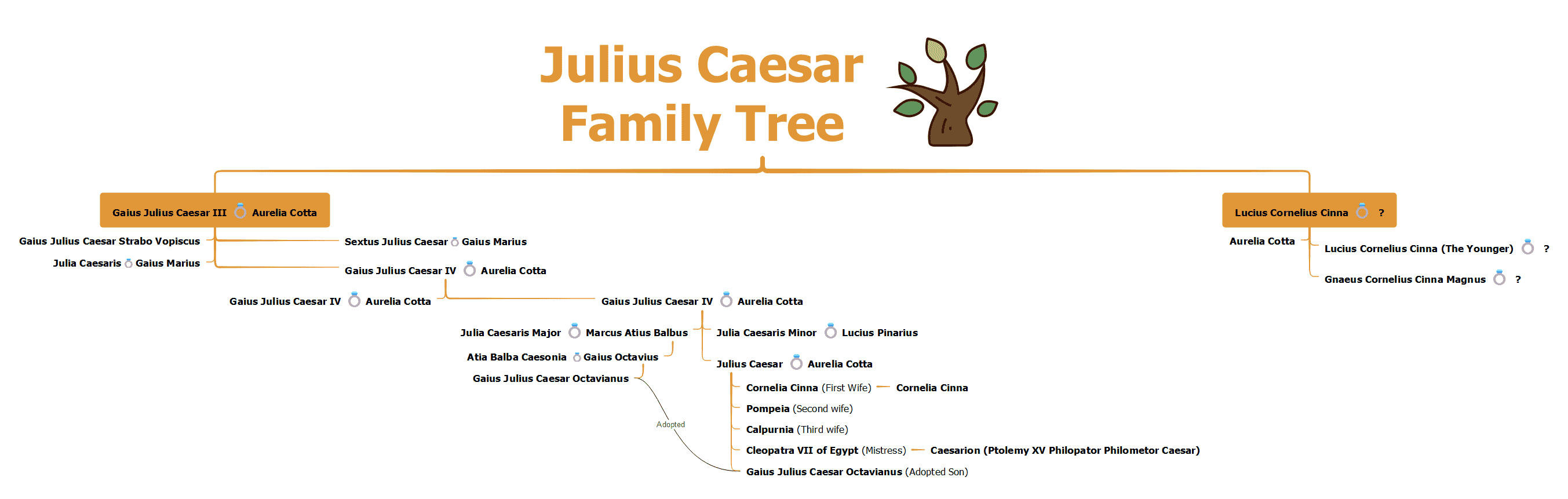


Gaius Julius Caesar III
The history of the Caesar family starts with Gaius Julius Caesar III. He was the head of the family line, a family that would rule Rome for centuries. He was part of an old patrician family known for dignity and service to the Republic.
His marriage to Aurelia Cotta strengthened the Caesar name through alliance and tradition. They both laid the roots of a powerful Roman legacy.
Aurelia Cotta
Aurelia Cotta was the wife of Gaius Julius Caesar III. She was the centre of the early Caesar household. Aurelia belonged to another respected Roman family and is remembered as a strong matron whose children carried both her grace and willpower.
Gaius Julius Caesar Strabo Vopiscus
Gaius Julius Caesar III and Aurelia Cotta had a son called Strabo Vopiscus. He was known among the Roman elite and was carrying on the political and social status of the family. His line helped the family to stay in the senate and the Roman society.
Sextus Julius Caesar
Another Caesar's son was Sextus Julius Caesar. His name was respected in the early life of the Republic, and he carried on the senatorial traditions of the family. He belonged to a generation that built the reputation, which Julius Caesar himself would later inherit.
Julia Caesaris
Julia Caesaris, who was a sister in the family, was connected to other well-known families in Rome. Her marriages and alliances connected the Caesars to personalities such as Gaius Marius, who was among the great military generals in Rome.
Gaius Marius
Gaius Marius married Julia Caesaris; the families of the two Roman nobles came together. He rose from humble beginnings to become one of Rome's greatest generals and reformers. His marriage had made his military heritage a part of the noble bloodline of the Caesars.
Gaius Julius Caesar IV
The most renowned Caesar in history was the son of Gaius Julius Caesar IV, who was a descendant in the other line. He remarried another Aurelia Cotta, and they had brought up Julius Caesar, whose future would change Rome forever.
Aurelia Cotta (mother of Julius Caesar)
One of the most popular women in Rome was the mother of Julius Caesar, called Aurelia Cotta. She was intelligent, stern, and strongly concerned about the future of her son. Her careful upbringing and strong values shaped Caesar's leadership, courage, and discipline.
Luicus Cornelius Cinna (The Younger)
Another group of Roman nobles, related to the Caesars, was Lucius Cornelius Cinna. His daughter, Cornelia Cinna, would marry Julius Caesar and his family line, and that of the Caesar family would forever be united.
Cornelia Cinna
Cornelia was the first wife of Julius Caesar, and the daughter of Lucius Cornelius Cinna. She is a loyal and strong person. She accompanied Caesar in his early death despite political inconveniences. Their marriage brought Caesar a daughter, Julia, and tied him to one of the Republic's most influential families.
Pompeia
Pompeia was the second wife of Julius Caesar. Their marriage connected him to the powerful Pompeian family. Even though it ended after the famous Bona Dea scandal, her name still belongs to the history of the early political life of Caesar.
Calpurnia
The third wife of Julius Caesar was Calpurnia. She is remembered as the woman who had warned Caesar that he was going to be killed before he was assassinated. The loyalty and the fear of him during his last days made her one of the most tragic figures in Roman history.
Cleopatra VII of Egypt
Cleopatra VII, Queen of Egypt, shared both romance and politics with Julius Caesar. Their relationship brought a connection between Rome and Egypt and had a son known as Caesarion. Cleopatra was no less brilliant and ambitious than Caesar, and their story is one of the most famous alliances in history.
Caesarion (Ptolemy XV Philopator Philometor Caesar)
Julius Caesar and Cleopatra VII had a son called Caesarion. He was born as a symbol of both empires, Rome and Egypt, united through blood. Although his life was short, he represented the dream of an empire ruled by both East and West.
Julia Caesaris Major
Julia Caesaris Major was Julius Caesar's aunt. Her marriage to Marcus Atius Balbus linked the Caesars to another noble Roman family. Through her descendants, the Caesars' bloodline continued into the age of emperors.
Marcus Atius Balbus
Marcus Atius Balbus was a reputable Roman senator and the husband of Julia Caesaris Major. He and Julia became the grandparents of Gaius Octavius, father of the first Roman Emperor.
Atia Balba Caesonia
Atia Balba Caesonia was the daughter of Julia Caesaris Major and Marcus Atius Balbus. She was known for her virtue and strength. Atia was the mother of Gaius Octavius, who became the father of Octavian (Augustus).
Gaius Octavius
Gaius Octavius was a Roman official and the husband of Atia Balba Caesonia. Together, they became the parents of Gaius Julius Caesar Octavianus, the future Augustus. His marriage to Atia tied the Octavian family directly to the Caesars' noble blood.
Gaius Julius Caesar Octavianus (Augustus)
Gaius Julius Caesar Octavianus, later known as Augustus, was the adopted son and heir of Julius Caesar. He was the first Emperor of Rome and founded the Roman Empire. Augustus carried his great-uncle's name, vision, and legacy, and transformed the Republic into an empire that would last for centuries.
How to Make a Similar Family Tree?
A family tree shows the connections between ancestors and descendants. For famous families like Julius Caesar’s, it’s useful to use software to keep everything neat. I used EdrawMind to build this family tree. Follow these steps to make your own:
- Know your goal: Are you making the tree for school, history work, or personal interest?
- Collect family information: Write down names, dates, and connections. Include main figures like Gaius Julius Caesar III, Aurelia Cotta, and Lucius Cornelius Cinna.
- Choose a method: You can draw the tree on paper, use an online tree diagram tool, or try software like EdrawMind for a neat digital version.
- Pick a style: Decide whether you want a traditional ancestor tree, a descendant layout, or side-by-side branches.
- Organize generations clearly: Start from the main ancestors at the top and work downward.
- Add visual touches: Small icons, symbols, or notes make your tree more interesting and easy to read.
Steps to Make a Family Tree
Before creating a family tree, it’s helpful to plan a little. Think about who you want to include, what details are important, and how to show relationships clearly. A little preparation makes your tree easier to follow and more organized.
 Try the app & get 500 free AI tokens


Step 1 Create a New File
- Open EdrawMind and sign in.
- Start a new blank file for your family tree.

Step 2 Add a Title
- Delete the default main topic and type your title, like “Julius Caesar Family Tree.”
- You can also add a small icon or picture, such as a tree.

Step 3 Add Main Ancestors
- Add the main family members at the top.
- Place them side by side to show the main family branches.

Step 4 Expand the Family Line
- Add their children under the main ancestors.
- Connect them properly using lines to show relationships clearly.

Step 5 Customize and Style the Tree
- Change fonts, colors, and sizes to make the tree clear and attractive.
- Use icons or symbols to highlight important members.

Step 6 Save or Export Your Family Tree
- Save your file so you can edit it later.
- Export it as PDF, PNG, or JPG to share or print.
- Print a hard copy if you want to display it.

Closing Thoughts
The Julius Caesar family tree shows a life shaped by power, ambition, and legacy. From Gaius Julius Caesar III to Julius Caesar and his adopted son Augustus, their story is full of influence and historical importance.
If this story inspires you to explore your own roots, try EdrawMind. With ready-made family tree templates and flexible tools, you can create your own family tree in minutes.
 EdrawMind
AppsEdrawMind Online
EdrawMind
AppsEdrawMind Online