


Do You Know the History of Québec?
Québec is a Canadian province and port. It is one of the oldest cities in Canada, celebrating its 400th anniversary in 2008.
It is popular for its stone buildings, rich French Canadian culture, cobblestone streets, and fortifications.
It is one of the only walled cities remaining in North America north of Mexico and was recognized as a UNESCO World Heritage Site in 1985. Québec has a particular old-world character and appeal.
Québec has remains that remind us of the history it carries. Then, jump into the old times and look at the events that have influenced the region, shaped its culture, and nation.
In This Article
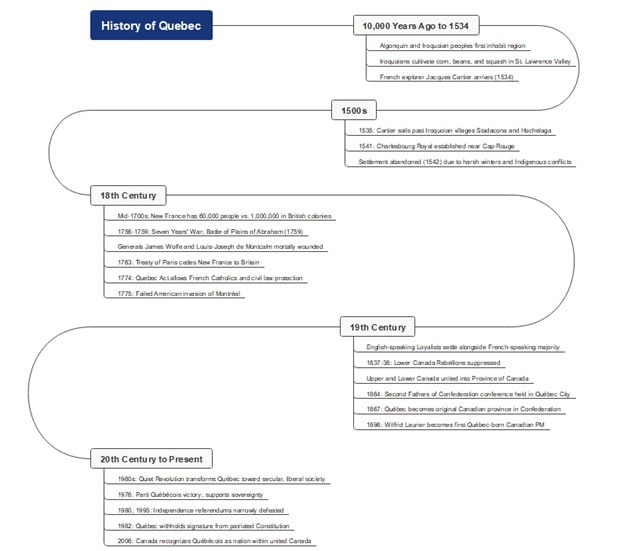


Around 10,000 years ago, the Algonquin (or other Algonquian-speaking peoples) and Iroquoian peoples were among the first to live in the region that is now Québec.
The Iroquoian farmers cultivated corn, beans, and squash in the St. Lawrence Valley centuries before Québec’s first documented European visitor, French explorer Jacques Cartier, arrived in 1534.
Cartier spent his first Québec winter at the Cartier-Brébeuf National Historic Site of Canada (175 de l’Éspinay Street, Québec City), where now models of a merchant ship and an Iroquoian longhouse stand.
The 1500s
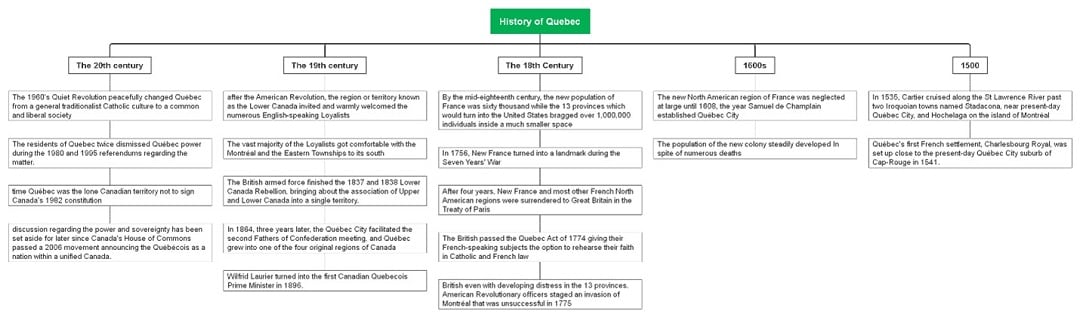
In 1535, Cartier sailed along the St. Lawrence River past two Iroquoian villages, Stadacona (near present-day Québec City) and Hochelaga (on the island of Montréal).
Québec’s first French settlement, Charlesbourg Royal, was established near the present-day Québec City suburb of Cap-Rouge in 1541.
Harsh winter weather and conflicts with local Indigenous groups forced the settlement of about 400 people to be abandoned the following year.
The 1600s
France’s North American presence was limited until 1608, when Samuel de Champlain founded Québec City, which became the first permanent French settlement in the province (and one of the oldest European-founded cities in North America).
Despite many deaths from disease, famine, and severe winters, the colony’s population grew gradually, though more slowly than British colonies to the south.
The 18th Century
By the mid-18th century, New France’s population was about 60,000, while the 13 British colonies that would become the United States had over 1,000,000 people.
In 1756, New France became embroiled in the Seven Years’ War, culminating in the 1759 Battle of the Plains of Abraham outside Québec City. Today, the Plains of Abraham (835 Wilfrid Laurier Avenue, Québec City) hosts an interactive discovery pavilion.
In that battle, British General James Wolfe and French General Louis-Joseph de Montcalm were both mortally wounded. Four years later, New France and most of France’s North American territories were ceded to Britain under the Treaty of Paris (1763).
The British passed the Québec Act of 1774, which allowed French-speaking inhabitants to practice Catholicism and to retain French civil law, in hopes of securing their loyalty amid unrest in the American colonies.
In 1775, American Revolutionary forces made an unsuccessful invasion of Montréal.
The 19th Century
After the American Revolution, the colony called Lower Canada accepted many English-speaking Loyalists alongside its French-speaking majority. Many Loyalists settled around Montréal and in the Eastern Townships.
The British suppressed the 1837–38 Lower Canada Rebellions, and later united Upper and Lower Canada into one province (the Province of Canada).
In 1864, Québec City hosted the second Fathers of Confederation conference, and in 1867, Québec became one of the four original provinces of the Canadian Confederation. Wilfrid Laurier became the first Canadian Prime Minister from Québec in 1896.
For much of its early history, Québec’s economy was primarily agricultural and based on forestry.
The 20th Century
In the 1960s, the Quiet Revolution transformed Québec from a socially conservative, largely Catholic society into a more secular, liberal society with a growing sense of nationalism.
This contributed to the 1976 election victory of the Parti Québécois, a provincial party supporting Québec sovereignty. Québec held two referendums on independence, in 1980 and 1995, both of which were narrowly defeated.
Québec did not formally consent to the patriation of Canada’s Constitution in 1982 — the province withheld its signature over disagreements about its powers and the Charter of Rights provisions.
In 2006, Canada’s House of Commons passed a motion recognizing that “the Québécois form a nation within a united Canada.
Create a Timeline to Understand History Better
As you’ve seen above, Québec’s history spans a long period. Thus, there are many events and pieces of information to learn through traditional methods, such as simply reading or taking notes.
This section will explore a not-so-unique way of studying history: through timelines. Timelines are a great way to present information and allow you to scan Québec’s history at a glance.
Benefits of Creating a Timeline
Aside from the obvious benefit of timelines (that is, the capability to scan the long history of Québec in one glance), there are several more that might not be readily obvious. Hence, the benefits are listed below:
- Improves critical thinking. Writing and arranging events in order trains your brain to spot the relationships between different parts of history. For example, you can see how the 1759 Battle of the Plains of Abraham led to British control.
- Encourages focus. History books can be scattered. They talk about different ideas or topics every time, and one aspect can lead to a wholly different rabbit hole. A timeline helps you focus on key events.
- Visual reference or review material. Lastly, a well-made timeline is a great tool for reviewing. Especially if you’re a history major, you can easily review your history materials with a timetable.
These benefits can only be properly enjoyed if you actually make the timeline yourself. The benefits of automated timelines through AI generation present a whole new set of advantages.
How To Make a Timeline
Now, you can try to make your first timeline. You should start small by choosing a specific portion of Québec’s history. As you practice your timeline skills, you can proceed to make a whole timeline yourself.
Check out the steps below:
Step 1
Determine the time span you want to talk about
As discussed above, Québec’s history spans 10,000 years. For example, you can choose to focus on the New France period (from 1608 to 1763).
 Try the app & get 500 free AI tokens



Step 2
Then, make the main nodes where you will list the key events or timeframes
Step 3
After that, add in subtopics from the main nodes, from which you can add the underlying details under them
This makes your timeline complete.
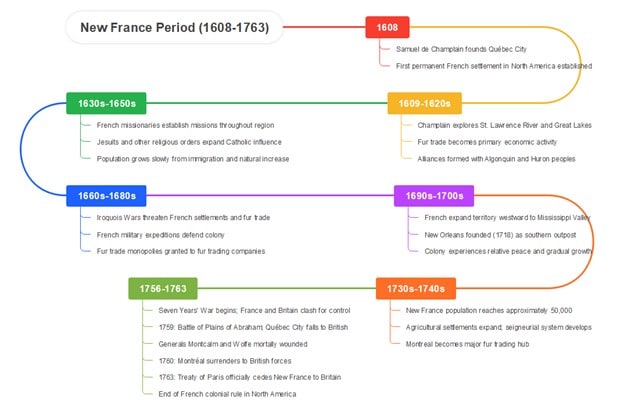
Step 4
As a final step, try to add relevant pictures of each key event
This makes your timeline more enriching.
Tool Recommendations
It’s not recommended to make a timeline via pen and paper because digesting history into one piece of paper can be limiting. Use a dedicated diagramming tool like Wondershare EdrawMind. This can help you make timelines in a limitless way.

Conclusion
Although Québec became a British territory in 1759 and joined the predominantly English-speaking nation of Canada in 1867, the 1774 Québec Act has allowed its French Catholic population to be protected until today.
Québec, be that as it may, has had a critical English-speaking population since the eighteenth century and has attracted increasing numbers of immigrants from around the globe.
 EdrawMind
AppsEdrawMind Online
EdrawMind
AppsEdrawMind Online