


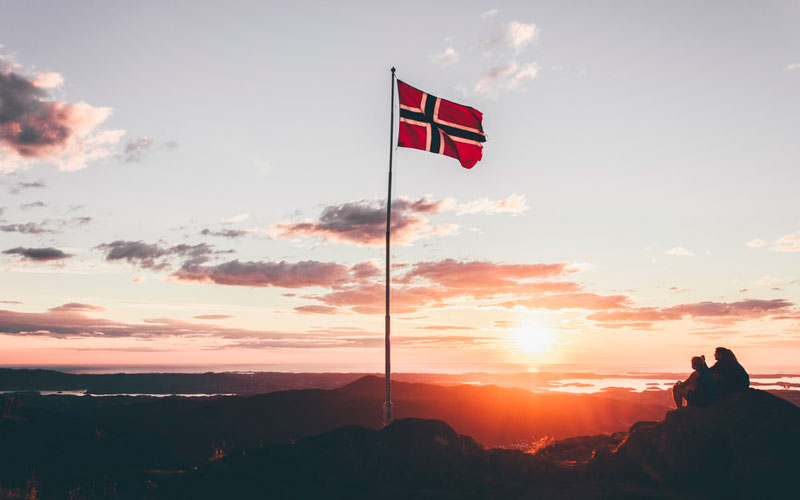
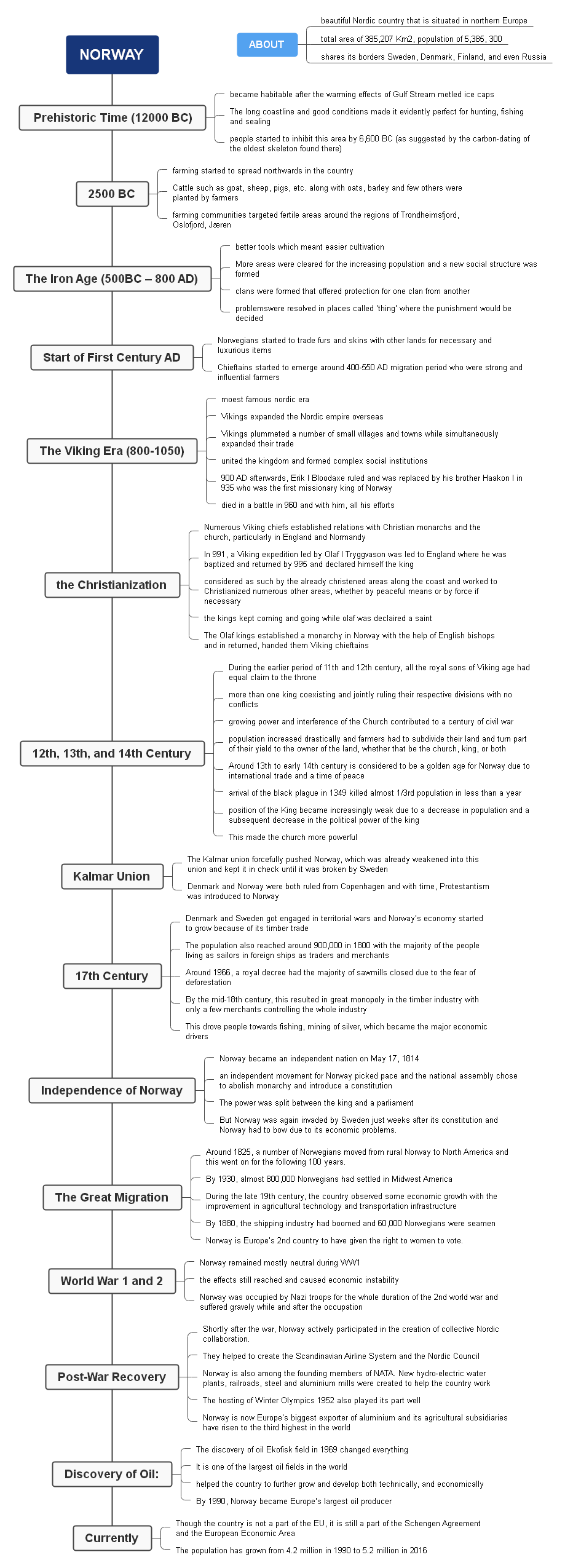
The Kingdom of Norway, or as we call it, Norway, is a beautiful Nordic country that is situated in northern Europe. It has a total area of 385,207 km² and a population of 5,385,300. It is a beautiful country with a rich history and mesmerizing mountains. The place is a paradise for people who love venturing in the outdoors. It shares its borders with Sweden, Denmark, Finland, and even Russia.
It is home to the world’s longest road tunnel and the most remote island in the world. The Nobel Prize is awarded in Oslo, which is the country’s most densely populated city. The country has given the world a number of remarkable items, such as the cheese slicer, skiing, and many others. Let’s have a look at the history of the country from ancient times to modern times.
It was only after the warming effects of the Gulf Stream that the ice that had Norway entirely covered started to melt and gave way for this land to be inhabited. The long coastline and good conditions made it evidently perfect for hunting, fishing, and sealing. Research as recent as 1994 has indicated that people started to inhabit this area by 6,600 BC (as suggested by the carbon-dating of the oldest skeleton found there), but ancient literature suggests that it was much earlier.
The people who came here to the region of Oslofjord from farther south used wooden skis and slate tools and started to make a living for themselves.
It was around this time that farming started to spread northwards in the country. Cattle, such as goats, sheep, pigs, etc., along with oats, barley, and a few others were planted by farmers. Soon they were everywhere. These farming communities targeted fertile areas around the regions of Trondheimsfjord, Oslofjord, Jæren (near Stavanger), Lake Mjøsa (near Lillehammer), and started to accumulate wealth for themselves.
With the beginning of the Iron Age came better tools, which meant easier cultivation. More areas were cleared for the increasing population, and a new social structure was formed. Sons who married were to remain in the same house and extend the family, creating a 'clan'. This system offered protection for one clan against another. In case conflicts arose, they were resolved in assemblies called 'things' where the punishment would be decided.
The Roman Empire started to expand and exert cultural influence on the surrounding regions. Meanwhile, the Norwegians started to trade furs and skins with other lands for necessary and luxurious items. Strong and influential farmer-chieftains started to emerge during the 400-550 AD migration period.
This was the most famous era, not just for Norway, but for the entire Nordic Region when Vikings expanded the Nordic empire overseas. The Vikings plundered a number of small villages and towns while simultaneously expanding their trade. However, they were powerful and highly skilled warriors with all the necessary strategies and equipment needed.
But despite having united the kingdom and forming complex social institutions, Viking chieftains oversaw the arrival of Christianity in Scandinavia. After 900 AD, Erik I Bloodaxe ruled and was replaced by his brother Haakon I in 935, who was the first missionary king of Norway. He died in a battle in 960, and with him, his efforts ended.
Numerous Viking chiefs established relations with Christian monarchs and the Church, particularly in England and Normandy. In 991, a Viking expedition led by Olaf I Tryggvason sailed to England, where he was baptized and returned in 995 and declared himself King. He was considered as such by the already christened areas along the coast and worked to Christianize numerous other areas, whether by peaceful means or by force if necessary.
The succession of kings continued, and Christianity spread all the way to Iceland (990-1000). King Olaf was declared St. Olaf and was later replaced by his son Magnus. The Olaf kings established a monarchy in Norway with the help of English bishops and in return, granted the bishops influence over Viking chieftains.
During the earlier period of 11th and 12th centuries, all the royal sons of the Viking Age had equal claim to the throne, with even more than one king coexisting and jointly ruling their respective divisions with few conflicts. But ultimately, the growing power and interference of the Church contributed to a century of civil war.
It was during this time that the population increased drastically, and farmers had to subdivide their land and turn part of their yield to the owner of the land, whether that be the Church, king, or both. This accounted for about 20% or more at times. Around the 13th to early 14th centuries is considered to be a golden age for Norway due to international trade and a time of peace. But the arrival of the Black Death in 1349 killed almost one-third of the population in less than a year.
The position of the king became increasingly weak due to a decrease in population and a subsequent decrease in the political power of the king. This made the Church more powerful.
This was around the Middle Ages, and Sweden was the main benefactor in the Christianization of Finland. Though the relation between Finland and Sweden dates before the arrival of Christianity, it was in the 11th century (according to most archaeologists) that Christianity actually got some footing in the region. The Church was still developing in Finland by the 12th century.
In the 13th century, Bishop Thomas became the first bishop of Finland and united all the Finnish tribes under his rule. The conflicts between the Finnish chieftains had weakened them significantly and it was easier for the Church to take hold. Sweden was able to take hold of Finland and had it integrated into medieval European civilization.
The Kalmar Union forcefully pushed Norway, which was already weakened, into this union, and kept it in check until it was dissolved by Sweden. Denmark and Norway were both ruled from Copenhagen, and with time, Protestantism was introduced in Norway.
Denmark and Sweden engaged in territorial wars, and Norway’s economy started to grow because of its timber trade. The population also reached around 900,000 in 1800, with the majority of the people living as sailors, traders, and merchants in foreign ships.
Around 1966, a royal decree ordered the closure of the majority of sawmills due to the threat of deforestation. By the mid-18th century, this resulted in a significant monopoly in the timber industry, with only a few merchants controlling the whole industry. This drove people towards fishing and silver mining, which became major economic drivers.
Norway became an independent nation on May 17, 1814, after an independence movement for Norway gained momentum and the national assembly chose to abolish the monarchy and introduce a constitution. The power was split between the king and a parliament. But Norway was again invaded by Sweden just weeks after its constitution was adopted, and Norway was forced to yield due to its economic problems.
Around 1825, a number of Norwegians moved from rural Norway to North America, and this went on for the following 100 years. By 1930, almost 800,000 Norwegians had settled in the American Midwest. During the late 19th century, the country experienced economic growth with improvements in agricultural technology and transportation infrastructure. By 1880, the shipping industry had boomed, and 60,000 Norwegians were seamen. Norway is Europe’s second country to have given women the right to vote.
Although Norway remained mostly neutral during World War I, its effects still reached Norway and caused economic instability. Following this, in World War II, Norway was occupied by Nazi troops for the entire duration of the war and suffered gravely during and after the occupation.
Shortly after the war, Norway actively participated in the creation of collective Nordic cooperation. They helped to create the Scandinavian Airline System and the Nordic Council. Norway is also among the founding members of NATO. New hydroelectric power plants, railroads, steel, and aluminum mills were created to help the country develop. The hosting of the 1952 Winter Olympics also played a significant role. Norway is now Europe’s biggest exporter of aluminum, and its agricultural subsidies have risen to the third highest in the world.
The discovery of the Ekofisk oil field in 1969 changed everything. It is one of the largest oil fields in the world and helped the country to further grow and develop both technologically and economically. By 1990, Norway became Europe’s largest oil producer.
Though the country is not a member of the EU, it is still a part of the Schengen Agreement and the European Economic Area. The population grew from 4.2 million in 1990 to 5.2 million in 2016. The country continues to grow and prosper to date and remains an ideal country in modern times.
 EdrawMind
AppsEdrawMind Online
EdrawMind
AppsEdrawMind Online