


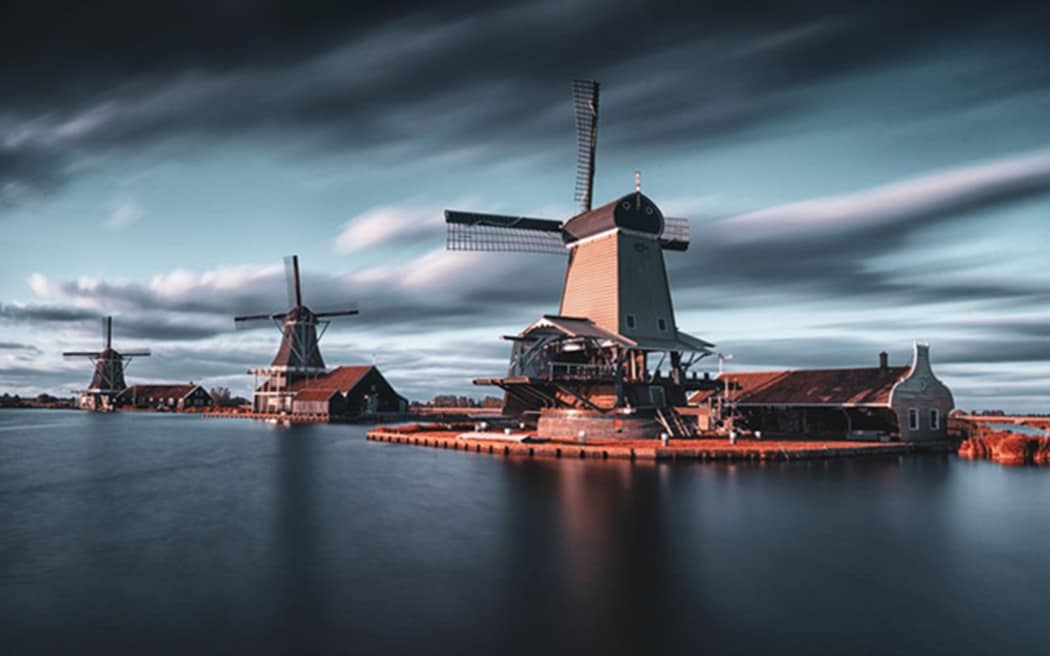
With a population of 17.33 million, the Netherlands is famous for its popular icons. It has a long and influential history that shaped European trade, politics, and culture.
Windmills, tulips, canals, and bicycles define its landscapes, while its people are known for innovation, tolerance, and a deep connection to nature.
From early settlements and medieval towns to a maritime empire, it played a vital role in global exploration and commerce.
Today, the Netherlands stands as a symbol of progress and resilience. Its journey from a small region to a modern kingdom reflects centuries of adaptation, creativity, and unity among its people.
History of the Netherlands
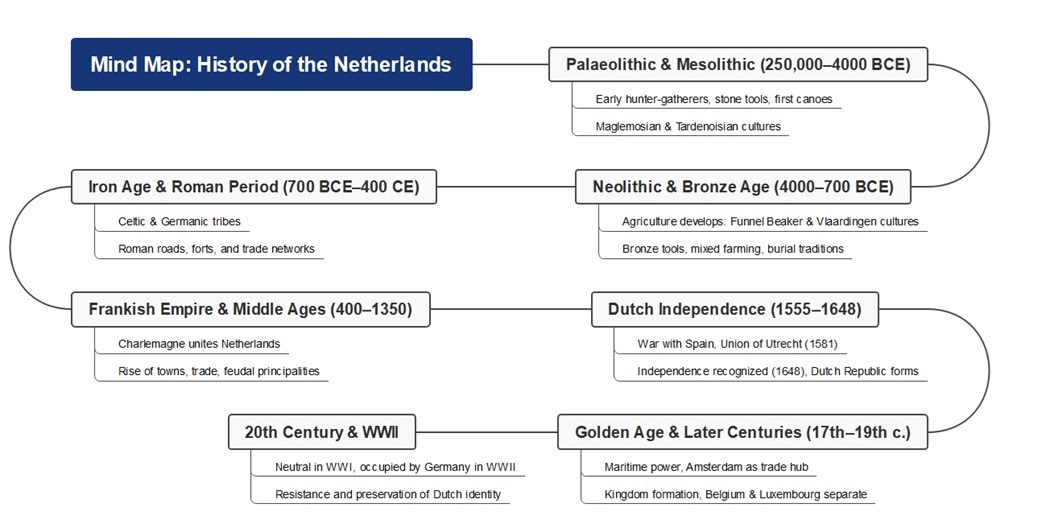
Below is a timeline of the Netherlands' history made with Wondershare EdrawMind:


The Netherlands, sometimes referred to as Holland, is the largest of four countries that form the Kingdom of the Netherlands.
With a population of nearly 17.2 million Dutch inhabitants out of a total 17.4 million in the entire kingdom, it holds roughly 98% of the kingdom's population within its twelve European provinces.
Meanwhile, the rest is divided between the municipal islands within itself and the three island countries of Aruba, Curacao, and Sint Maarten. The country spans an area of 41,865 km2. The capital city of this country is known as Amsterdam.
Amsterdam is known for its artistic and cultural heritage owing to its many conflicts, occupations, and most of all, its low-lying canals that create an intricate system of trade networks.
One of this land's most significant contributions is a painter born in the 18th century known by the name Vincent Willem van Gogh.
Palaeolithic Era (250,000 – 35,000 BP)
The earliest signs of life during the Palaeolithic era are found on the border of Belgium and the Netherlands near Maastricht, where stone flints and hand axes were found and dated to 250,000 BP.
Skeletal remains have led archaeologists to believe that early Neanderthals were indigenous to the area and lived near the now Belgian caves. During 80,000 BP and 35,000 BP, the Mousterian culture was present in northern caves in Belgium.
Evidence suggests that there was a large area of land that divided the Hamburgian culture to the north and the Magdalenian culture to the southern region. Both were mainly a culture of Hunter-Gatherers that used spears for hunting deer.
Mesolithic Era (10,000 – 4000 BCE)
It seems that during this era, the population of the Netherlands was divided by the main rivers. Bone tools, flints, and the earliest pine canoe were found and dated back to the period of 8500 BP.
This is the oldest vessel found anywhere on the planet. Two of the main cultural groups of this era are the Maglemosian group and the Tardenoisian group.
The Maglemosians often decorated their bone tools and flints with designs. On the other hand, the Tardenoisians were becoming skilled hunters who started using arrowheads and bows.
Neolithic Era (4000 – 2900 BCE)
During 4100 BP, multiple material cultures began to come into the Netherlands through Belgium.
The hunter-gatherers were slowly becoming agricultural through contact with the Michelsberg culture that was coming in from Belgium to form the Funnel Beaker culture located in the Netherlands.
These cultures were known for collective graves that spanned hundreds of feet and were characterized by a large rock or boulder at their head to signify a burial site.
Around this point, from the south, a third cultural group was beginning to take form as the Vlaardingen culture.
These were people who had developed land cultivation in its earliest stages. This led to the discovery of items such as the wheel, the plow, and the cart. All of which would transform agriculture forever.
Bronze Age (2000 – 700 BCE)
The Bronze Age can be marked as the beginning of bronze imports coming into the agrarian culture from the Isles of Britain and northern Europe.
The origins of cremation and the burial of ashes can be found during this contact between the indigenous population of the Netherlands and Britain.
Archaeological findings dated back to 1500 BCE suggest that the agricultural system had begun advancing and showed signs of developing into mixed farming.
Near the end of the Bronze Age, imports of metal weapons from Britain were starting to flow into warrior tribes in the north, where certain native bronze industries were also made.
Iron Age (700 – 1 BCE)
During the Iron Age, Celtic and German tribes were starting to come into the region. To the south, Celtic warrior tribes can be traced through their chieftain burial sites that contained chariots, weapons, wine, and tools made of bronze.
At the same time, the soil in the northern part of the country was weakening in terms of agricultural value. This led to huge advances in diverse and protective ways of agriculture and livestock.
The Roman Period (1 BCE – 400 BC)
It is hard to understand much of the history of the Netherlands before the Roman Empire, as most tribes did not have a written language in which to record information.
This means that much of the ancient literature about these tribes comes from the writings of Julius Caesar, who had invaded Holland to expand his empire during 59 – 52 BCE.
And by the mid-1st century BCE, the Roman culture had started playing a role in the lives of the people living in the northern provinces of the empire. Famous road networks and garrisons were constructed in present-day Nijmegen.
They were making it a strong military post for the Roman Empire as well as an essential part of future trade networks.
And by the 3rd century BCE, Roman power was beginning to decline in the Low Countries steadily. Eventually, the forts were abandoned due to invasions by Germanic tribes.
Julian Caesar of Gaul was able to somehow maintain power by waging war during 355 and 360 BC, but would be defeated by the Germanic tribes who led an invasion in 406 – 405 BC, leading to the end of the empire.
The Frankish Empire (400 BC – 800 BC)
With the retreat of the Roman Empire, the Franks were now able to form an empire along important routes for trade.
This allowed them to gain influence and power against the Romans and to eventually take the Netherlands in 768 BC under the rule of Charlemagne, who was nearing the end of the Frankish empire.
With the death of Louis the Pious in 840, the empire would soon fall after multiple wars between his sons. This was, in turn, accelerated by the Viking attacks that had been initiated following Charlemagne's death in the year 814.
Economic Growth in the Middle Ages
After the fall of the Charlemagne Empire in 814, the Low Countries region was divided into further smaller states that dukes and tallies controlled.
Simultaneously, in the Middle Ages, a solid economic development made the Netherlands perhaps the most extravagant region in Europe.
Along with agriculture, commerce, and crafts, important trading links and rich towns extending to Asia and North Africa changed the Netherlands into a territory where feudal power had been restricted, and economic activity and safety of movement were established.
The Territorial Principalities and the Rise of Towns (925 –C. 1350)
During this time, multiple small areas of land were under the rule of certain 'Feudal Lords' who maintained the land and gave fealty to the kings of Germany, France, and the Church or the Roman Empire.
However, certain individual rulers had decided to create secular lands, taking the law into their own hands and challenging the king's authority indirectly.
The king chose to systematically take the small secular lands under his flag but let their individual nobles rule them.
By the 10th and 11th centuries, all these counties had chosen to expand their sphere of influence by banding together and eventually forming an administrative apparatus called the curia committees.
This was based on centralized officials in charge of districts with their own military and administrative powers.
By 1100, territories such as Hainaut and Hamburg seized the chance during the weakening of the German crown to expand and form principalities.
Meanwhile, the French and the English were gaining influence and power following the death of Henry VI in 1197.
Following his death, two factions – the Ghibellines and Guelfs – are supported by the French and English, respectively, to form coalitions that would eventually fight multiple battles for control over the Low Countries.
The Demand for Independence
One very significant event to play a part in the consolidation of the territories was the development and rise to power of Flanders.
Commercial developments were playing a significant role in increasing the economic importance of Flanders, even to the point that it would become the most populous city in the region, gaining influence and value in the eyes of all the counts.
The former Duke of Burgundy and then the Habsburgs, who were the neighborhood powers, tried to rule the Netherlands and introduce their taxation there.
In the year 1555, the Netherlands was granted to Philip II, who was the son of Charles of the Habsburg dynasty and the king of Spain.
As Philip II was a Catholic and part of the Netherlands Protestants, the Dutch opposed the new taxation. In addition, the harsh and intolerant methods of administration of the Spanish king and his lead representative, Prince Alba.
An eighty-year-long war started, and while in the war, a feeling of having one's own national identity developed in the Netherlands.
In 1581, the Union of Utrecht announced independence from Spain. The new country went through a progression of turns around in the war, yet at last, in 1648, the Spanish recognized the power of the Republic.
The Dutch Republic stayed until 1794, apparently, under the force of the Austrian rule of the Habsburgs.
The Discoveries of the Era
Aside from all the destruction and difficulties from war, the Dutch continued with an extension of the oceans and disclosures of the new courses, lands, and routes.
By the mid-17th century, the Republic was the greatest of Europe's maritime powers, and Amsterdam was the main monetary focus of the continent.
Battles and wars about the rule over the seas with England and fights to oppose the developing power of France on the mainland followed naturally.
18th and 19th Centuries
At the start of the 18th century, the decline of the minuscule Dutch Republic began. A significant practical factor has likewise been the fall of Poland, which lost Ukraine to Russia and could no longer supply grain to the Netherlands.
The progress of the republican and liberal thoughts everywhere in the world and opposition to these thoughts by individuals who dominated the Dutch Republic led to the end of the 18th century.
It was further the reason behind the formation of the Kingdom of the Netherlands, which, after the fall of Napoleon, included additionally the lands of the present Belgium and Luxembourg.
The provinces of Belgium revolted in the year 1830 and isolated themselves into the Kingdom of Belgium. Luxemburg, albeit free, has been united with the Netherlands by a monarch.
Luxemburg was finally separated from the Kingdom of the Netherlands in 1890 when Dutch King William III passed on, not leaving a male beneficiary, which was a condition to lead the Duchy of Luxemburg.
In the second half of the 19th century, gradual, however steady economic development and significant reforms regarding the constitution. The Netherlands turned into a liberal and current state. During World War I, the Netherlands stayed neutral.
World War II
During World War II, from 1939 to 1945, the Netherlands was attacked and occupied by the Germans in 1940.
Following two years of relative success, when just the Jewish populace had been accused, the entire nation started to endure the burden of the fear of the Germans and the war.
The Dutch opposed against endeavors of Nazi Germany to incorporate the Netherlands into the Third Reich during World War II.
The initiative of the Royal Family in the battle with the inhabitants is still alive in the memories of the Dutch people.
Create a Timeline To Understand History Better
Studying the history of the Netherlands can be complex without a visual guide. A timeline allows you to see centuries of social, political, and economic developments at a glance.
It links events, leaders, and discoveries, showing how the nation grew from small settlements into a major European power.
Benefits of Creating a Timeline
Using a timeline has several advantages:
- Clarifies long periods: Breaks down centuries of Dutch history into understandable segments, from prehistoric settlements to modern governance.
- Shows cause and effect: Highlights how key events, like the Dutch Revolt or the Golden Age, influenced politics, trade, and culture.
- Improves memory: Visuals, symbols, and color-coding help learners recall important dates, figures, and achievements.
- Encourages analysis: Comparing different eras reveals patterns in economic growth, cultural innovation, and international influence.
- Supports project planning: teachers and students can organize events by date, making reports, presentations, or digital timelines more coherent.
By visualizing the Netherlands’ history in order, timelines make learning clear and engaging. They turn centuries of events, people, and achievements into a story of innovation, resilience, and cultural growth that continues to shape the nation today.
How To Make a Timeline
Creating a timeline provides a clear way to present the Netherlands’ long and varied history. It shows the order of important events, from medieval towns to naval expansion, and demonstrates how these moments shaped the nation’s identity over time.
Choose your focus.
Decide which part of Dutch history to emphasize, such as the maritime Golden Age, independence from Spain, or the modern constitutional monarchy.
Collect key events.
Identify key milestones, including the founding of cities, the Union of Utrecht, major trade expansions, and wartime events.
Arrange by time.
Arrange events from the earliest settlements to the present day, grouping them by theme like trade, culture, or political change.
Add visuals and notes.
Use maps, portraits, or Dutch icons to make the timeline engaging and easier to understand.
Review for accuracy.
Ensure all dates, facts, and descriptions are correct to provide a reliable historical overview.
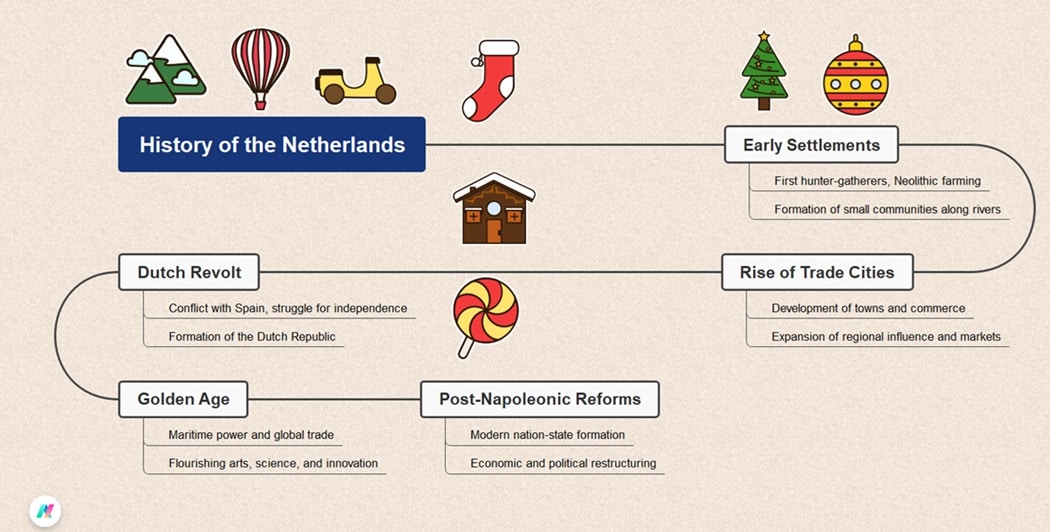
The timeline highlights important periods such as early settlements, the rise of trade cities, the Dutch Revolt, the Golden Age, and post-Napoleonic reforms.
Through these events, the Netherlands became a hub of commerce, art, and innovation, demonstrating resilience, adaptation, and cultural richness.
This visual guide shows how a small European region developed into a modern nation with lasting global influence.
Tool Recommendation
There are many tools for creating historical timelines, but Wondershare EdrawMind stands out for its simplicity and flexibility.
It provides ready-made templates, clear layouts, and visual elements that make it easy to organize the Netherlands’ history and present it accurately and engagingly.
Conclusion
After the long and difficult periods of erecting everything again right after World War II, the Netherlands supported in the second half of the 20th century that was a constant and quick economic development.
Today, the Netherlands is quite possibly the most evolved and richest nation in the world. Its cities thrive with innovation, trade, and culture. The country maintains strong social systems and sustainable practices. Tourism and international business continue to grow steadily.
The Dutch influence is felt globally through art, design, and commerce. With a rich history, resilient people, and strategic geographic position, the Netherlands remains a model of prosperity and cultural heritage in Europe and the world.
 EdrawMind
AppsEdrawMind Online
EdrawMind
AppsEdrawMind Online