


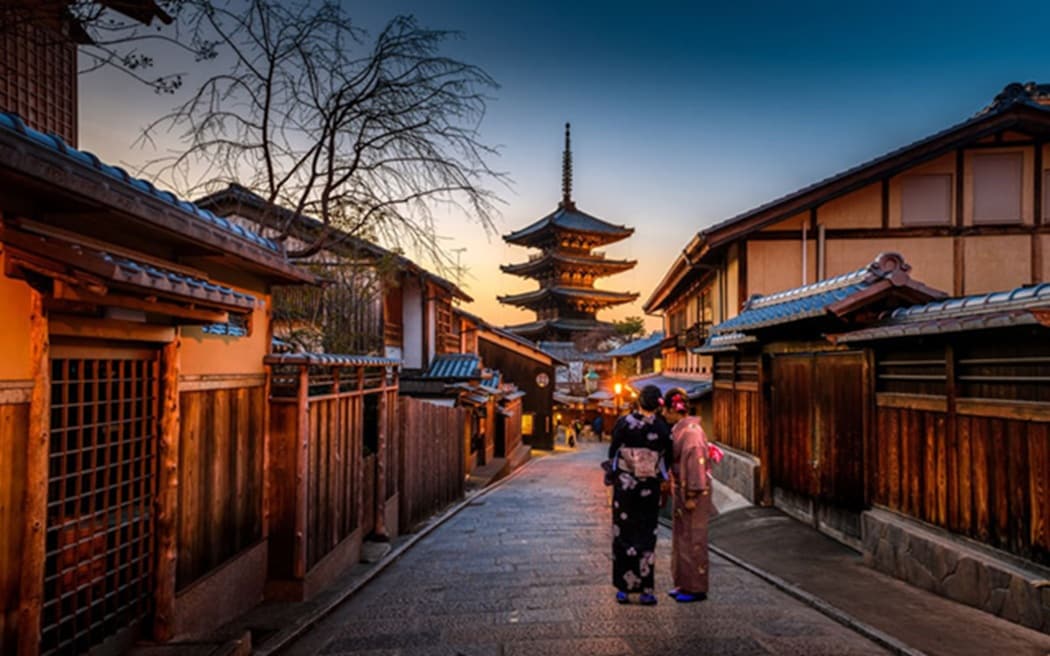
Kyoto amazes visitors with its calm shrines, beautiful places of worship, and brilliant gardens. Once Japan’s imperial capital, it stands as a living symbol of the nation’s culture and spiritual heritage.
For more than a thousand years, Kyoto witnessed the rise of emperors, shogunates, and artists. Its temples, gardens, and festivals reflect a deep respect for harmony and balance in everyday life.
Today, Kyoto remains the cultural heart of Japan. Visitors explore its shrines, tea houses, and ancient streets, discovering how the city preserves its past while embracing the future with quiet strength and grace.
In this article
History of Kyoto
Below is a timeline mind map made with Wondershare EdrawMind:
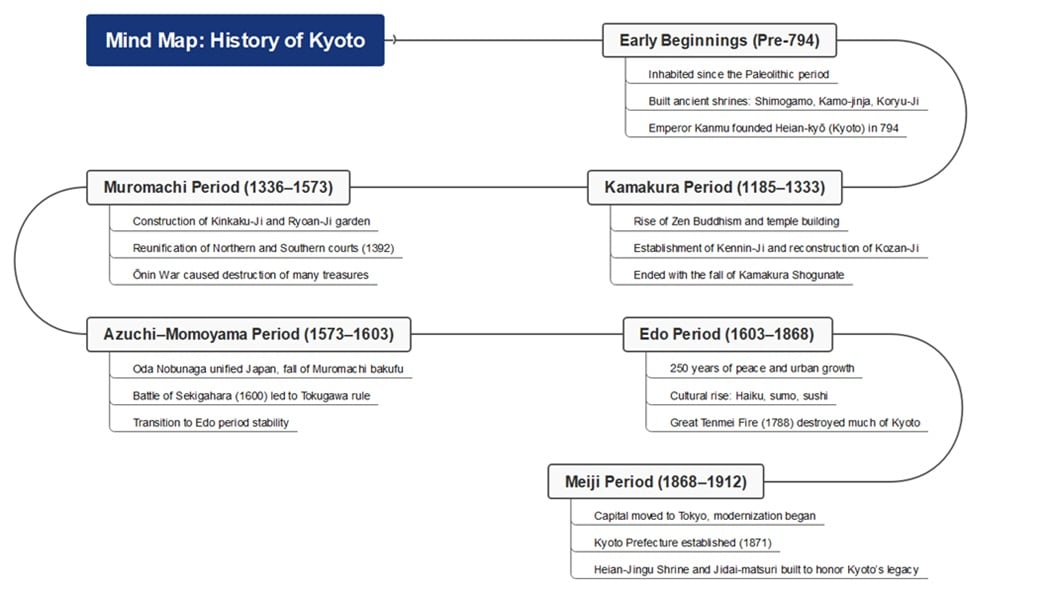


Once the magnificent capital of Japan for more than 1,000 years, Kyoto remains the Heart of Japan despite Tokyo taking on the title of the nation's capital.
The history of the city has seen the rise and fall of several Japanese shogunates and the development of some of the country's most significant temples and sanctuaries.
The historical backdrop of Kyoto endures today and offers a brief look into the conventional culture of Japan.
It is Kyoto where a significant number of Japan's cultural arts started and where they can be experienced today as well. You can explore the journey of Kyoto from its inception to becoming the heart of Japan.
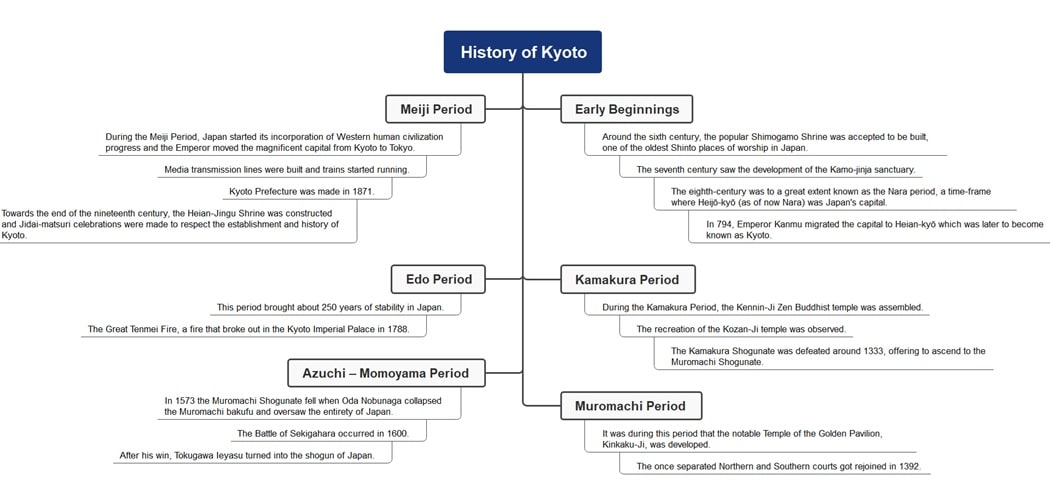
Early Beginnings
Archaeological evidence suggests the existence of humans in modern Kyoto as early as the Paleolithic period, although little is known about these early human groups.
Around the sixth century, the popular Shimogamo Shrine was constructed, becoming one of the oldest Shinto places of worship in Japan.
The seventh century saw the development of the Kamo-jinja sanctuary, the Yasaka-no-to pagoda, and Kyoto's most established sanctuary, known as Koryu-Ji.
The eighth century was largely known as the Nara period, a time frame during which Heijō-kyō (now Nara) was Japan's capital.
Japanese society was based on the village and centered on farming and religion that worshipped the spirits known as kami.
In 794, Emperor Kanmu migrated the capital to Heian-kyō, which later came to be known as Kyoto. This started the period referred to as the Heian Period, which lasted until around the twelfth century.
Kamakura Period (1185 – 1333)
The five-year-long War of Genpei between the Minamoto and Taira clans prompted the end of the Heian Period and the start of the Kamakura Period, culminating in the Minamoto's victory at the battle of Dan-no-Ura.
During the Kamakura Period, the Kennin-Ji Zen Buddhist temple was established. Today, it remains one of the Kyoto Gozan, or the five most significant Zen shrines of Kyoto.
Additionally, the recreation of the Kozan-Ji temple was observed, which was destroyed multiple times during war or by fire.
Other prominent shrines were established during this period, like Tofuku-Ji and Hongan-Ji. The Kamakura Shogunate was defeated around 1333, offering to ascend to the Muromachi Shogunate.
Muromachi Period (1336 – 1573)
It was during this period that the notable Temple of the Golden Pavilion, Kinkaku-Ji, was developed. Hosokawa Katsumoto made the renowned Zen rock garden found at the Ryoan-Ji shrine.
The once separated Northern and Southern courts rejoined in 1392 after a period of instability, during which Kyoto was consistently destroyed. Succession disputes, economic distress, and famine prompted the long-term Ōnin Civil War.
Unfortunately, a considerable number of Kyoto's distinguished historical treasures were demolished during the war.
Azuchi – Momoyama Period (1573 – 1603)
In 1573, the Muromachi Shogunate fell when Oda Nobunaga collapsed the Muromachi bakufu and oversaw the entirety of Japan.
The Battle of Sekigahara occurred in 1600, a fight that witnessed the deaths of 40,000 men between the powers of Tokugawa Ieyasu and his rivals.
After his win, Tokugawa Ieyasu became the shogun of Japan. Accordingly, the creation of the Tokugawa Shogunate went on until 1868. This came to be known as the Edo period.
Edo Period (1603 – 1868)
This period brought about 250 years of stability in Japan, a period without war. Urban areas like Kyoto prospered and saw huge population increments alongside an expansion in transportation infrastructure and agricultural production.
Japan became a closed country by severely limiting trade with the rest of the world and removing outsiders. Christianity was banned, and Japan's own residents were not permitted to travel the country.
Matsuo Bashō became an expert in the Haiku verse, and the period offered an escalation to proficient sumo wrestling and advanced sushi.
Numerous incredible fire incidents also took place in the city during this period, including the Great Tenmei Fire, which broke out in the Kyoto Imperial Palace in 1788. A large portion of the city was engulfed in fire, and numerous shrines, temples, and other constructions had to be rebuilt.
Meiji Period (1868 – 1912)
During the Meiji Period, Japan began incorporating Western advancements in human civilization, and the Emperor moved the magnificent capital from Kyoto to Tokyo.
Media transmission lines were built, and trains started running. Style and dress turned out to be more westernized, and Ito Hirobumi turned into Japan's first leader when Japan adopted the government cabinet system.
Kyoto Prefecture was established in 1871, with Kyoto being named as its capital. Lake Biwa Canal is worked alongside the making of the present cherry blossom viewing center, popularly known as Maruyama Park.
Towards the end of the nineteenth century, the Heian-Jingu Shrine was constructed, and Jidai-matsuri celebrations were held to respect the establishment and history of Kyoto.
Fun Facts About Kyoto
Kyoto is the largest city in Japan and one of the beautiful places in the world. It is lively, colorful, and highlights historical moments. Here are a few facts about Kyoto.
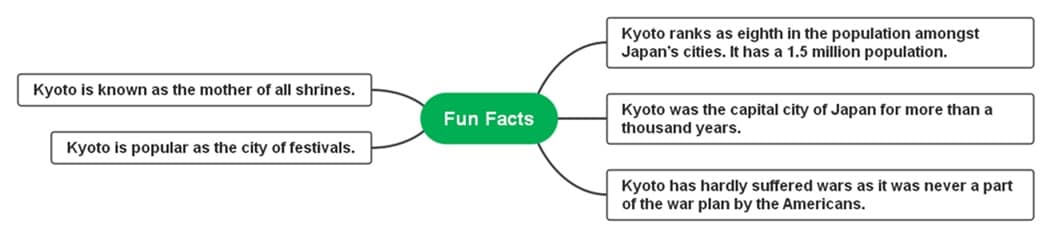
- Kyoto was the capital city of Japan for more than a thousand years.
- Kyoto is known as the mother of all shrines.
- Kyoto is popular as the city of festivals.
- Kyoto ranks as the eighth largest in population among Japan's cities. It has 1.5 million.
- Kyoto has hardly suffered wars, as it was never part of the American war plan.
Create a Timeline To Understand History Better
Studying Kyoto’s past can be challenging without a clear visual guide. A timeline helps turn centuries of culture and political change into an organized and easy-to-follow story.
It connects emperors, art, and traditions through the flow of time, showing how Kyoto grew from an imperial capital to Japan’s cultural treasure.
Benefits of Creating a Timeline
Making a timeline has many learning benefits:
- Simplifies complex history: It divides long eras into clear segments, helping learners see how Kyoto evolved through each dynasty and period.
- The timeline shows cause and effect: how major events, like the Heian Period or Meiji Restoration, influenced Kyoto’s architecture and traditions.
- Improves memory: Icons, visuals, and color-coded notes help students recall periods, rulers, and achievements more easily.
- Encourages analysis: Comparing Kyoto’s development with other cities highlights cultural progress and shifts in governance.
- Supports project planning: Historians and students can organize data by date, creating reports that flow naturally through each century.
By visualizing Kyoto’s history in order, timelines make learning both engaging and insightful. They turn information into a living narrative that connects the city’s ancient spirit to its modern charm.
How To Make a Timeline
Creating a timeline helps present Kyoto’s long history in a clear and structured way. It allows you to track rulers, cultural milestones, and transformations that shaped Japan’s identity. With proper organization, each period reveals how Kyoto’s legacy grew through time.
Follow these steps to create a meaningful Kyoto timeline:
-
Choose Your Focus
Decide which part of Kyoto’s history to highlight, such as the Heian Period’s cultural rise or its survival through World War II. A clear scope keeps your work concise and accurate.
-
Collect Key Events
Research major historical, cultural, and political developments. Include milestones like the founding of Heian-kyō, the construction of Kinkaku-ji, and the Meiji Restoration.
-
Arrange by Time
List events in chronological order, from early settlement to modern Kyoto. Group similar events to show patterns like cultural renewal or political change.
-
Add Visuals and Notes
Use maps, shrine photos, and brief captions to make the timeline engaging. Visual details help illustrate how Kyoto’s beauty and heritage evolved through the centuries.
-
Review for Accuracy
Verify dates and sources to ensure every event is factual. This guarantees that your timeline gives readers a reliable view of Kyoto’s transformation..
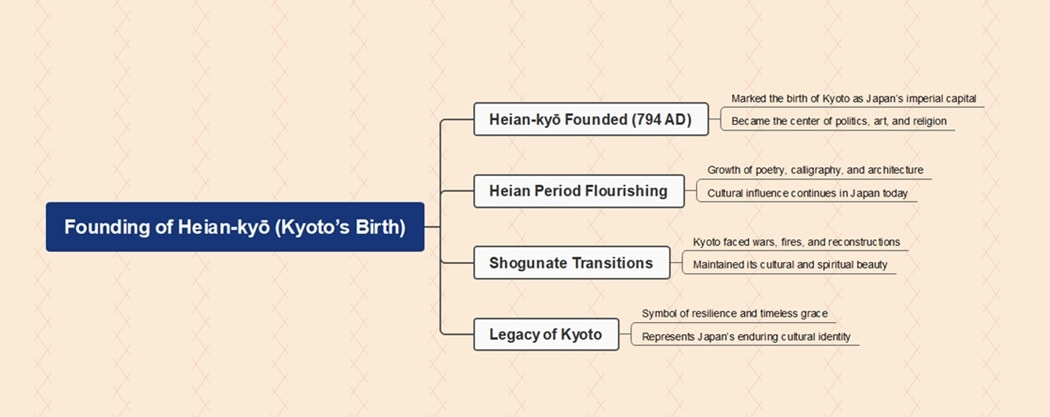
The timeline highlights the founding of Heian-kyō in 794, marking Kyoto’s birth as Japan’s imperial capital. This moment defined the city’s identity as the center of politics, art, and religion.
During the Heian Period, Kyoto flourished under imperial rule, inspiring poetry, calligraphy, and architecture that still shape Japan’s culture today. Later, as shogunates rose and fell, Kyoto endured wars, fires, and reconstructions while preserving its spiritual beauty.
The city’s survival through these transitions shows its resilience and importance in Japanese history, standing today as a symbol of timeless grace and cultural legacy.
Tool Recommendation
There are many tools available for creating historical timelines, but EdrawMind stands out for its clarity and ease of use.
It provides flexible templates, simple layouts, and clear visuals, which you can use to design and organize the Kyoto timeline above.
Conclusion
Kyoto is one of the few Japanese urban areas that, fortunately, succeeded in surviving the bombing during World War Ⅱ.
However, modernization is currently taking steps to replace authentic engineering and infrastructure with more current development.
Still, however, old customs, culture, and tradition appear to hang on and mix cordially with advancement.
 EdrawMind
AppsEdrawMind Online
EdrawMind
AppsEdrawMind Online