


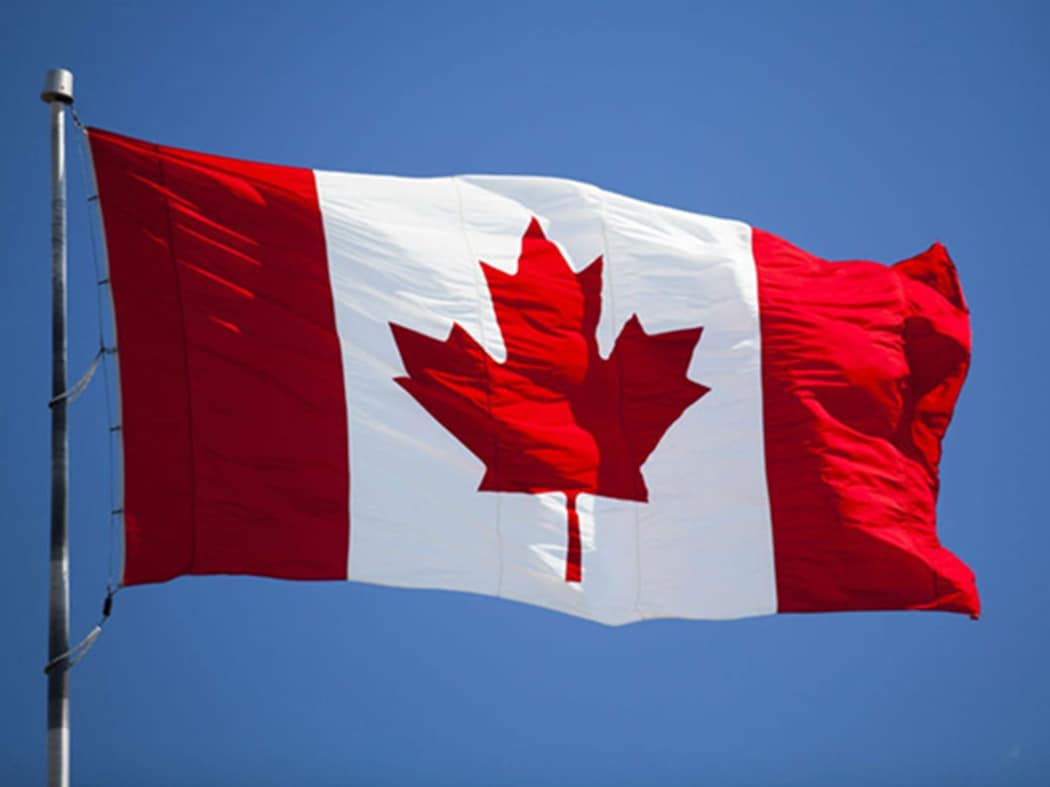
Canada’s history is filled with stories of exploration, courage, and growth. From its Indigenous roots to becoming a modern nation, every chapter reflects resilience and cooperation.
Long before European explorers arrived, Indigenous peoples lived across the land, building strong communities and rich traditions. Their heritage remains an essential part of Canada’s national identity and continues to shape its cultural landscape.
Through colonization, struggle, and unity, Canada transformed into a peaceful and multicultural country. Its timeline tells how small settlements became provinces and how people from many backgrounds built a nation known for harmony and strength.
Here is a peek into the brief history of Canada.
In this article
History of Canada
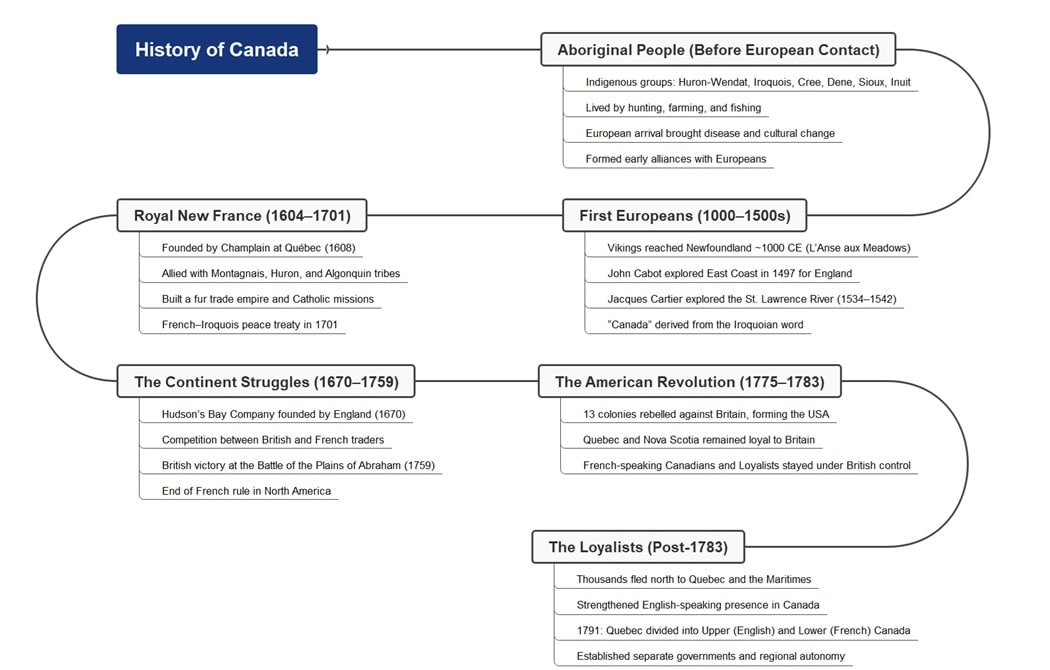
Below is a timeline of Canada’s history made with Wondershare EdrawMind:


Canadian history is full of fun. There are triumphs and tragedies, villains and heroes, incredible fights and unexpected treacheries, faithful outcasts, and long battles for social equity.
The interpretation of Canadian history may differ, yet there are still events from the past that are a major highlight and can be added to our knowledge bank.
The rich history of Canada is a set of experiences.
This article will examine the different periods and events in the history of Canada and provide relevant data regarding the advancements that helped shape this incredible country into what it is today.
Aboriginal People
When Europeans discovered Canada, they explored all the areas inhabited by local groups they called Indians, because the first explorers thought they had arrived in the East Indies.
The native individuals lived off the land, some by yielding and raising crops, others by gathering and hunting. The Great Lakes area, known as the Huron-Wendat, was similar to the Iroquois, who were ranchers and trackers.
The Cree and Dene of the Northwest were hunters and farmers. The Sioux were nomadic, following herds of buffalo or wild ox. The Inuit lived off Arctic wildlife.
West Coast natives conserved fish by drying and smoking. Fighting was normal among Aboriginal groups as they went after land, assets, and esteem.
The arrival of European soldiers, missionaries, colonists, and traders changed the local lifestyle permanently. Huge quantities of Aboriginals died from European diseases to which they lacked immunity and needed resistance.
Nonetheless, Aboriginals and Europeans shaped solid military, religious, and economic bonds in the initial 200 years of conjunction, which established the frameworks of Canada.
First Europeans
From Iceland, the Vikings arrived at the island of Newfoundland and Labrador almost 1,000 years ago and colonized Greenland. The remaining parts of their settlement, L'Anse aux Meadows, are a World Heritage site.
The exploration of Europeans began decisively in 1497 with the expedition of John Cabot, who was the first to map the East Coast of Canada.
John Cabot, an Italian migrant to England, was the first to explore the Atlantic coast of Canada, traveling to Newfoundland and Cape Breton Island in 1497 and claiming Newfoundland for England. The English settlement did not start until 1610.
Exploring a River – Canada
Somewhere between 1534 and 1542, Jacques Cartier made three journeys across the Atlantic, declaring the land for King Francis I of France.
Cartier heard two captured guides express the Iroquoian word Kanata, signifying "village." By the 1550s, the name of Canada started showing up on the maps.
Royal New France
In 1604, the first European settlement north of Florida was established by French pioneers Samuel de Champlain and Pierre de Monts, initially on St. Croix Island (in present-day Maine) and later at Port-Royal, in Acadia (present-day Nova Scotia).
In 1608, Champlain assembled a fortress at what is presently known as Québec City. The colonists battled against an unforgiving environment.
Champlain unified the province with the Montagnais, Huron, and Algonquin, notable enemies of the Iroquois, a confederation of five (later six). First Nations struggled with the French settlements for a century. The French and the Iroquois tried reconciliation in 1701.
The French and Aboriginal individuals teamed up and collaborated in the lucrative fur trade economy, driven by the demand for beaver pelts in Europe.
Extraordinary leaders like Bishop Laval, Count Frontenac, and Jean Talon assembled a French Empire in North America that came from Hudson Bay to the Gulf of Mexico.
The Continent Struggles
In 1670, King Charles II of England allowed the Hudson's Bay Company exclusive trading rights over the watershed draining into Hudson Bay.
For the following 100 years, the Company rivaled Montreal-based dealers. The brave and proficient men who traveled by kayak were called voyageurs and coureurs des Bois, and they formed solid unions with First Nations.
English provinces along the Atlantic coastline, dating from the mid-1600s, ultimately became more extravagant and crowded than New France. During the 1700s, Great Britain and France fought for control of North America.
In 1759, the British vanquished the French in the Battle of the Plains of Abraham at Québec City, marking the end of France's realm in America.
The officers of the two militaries, the Marquis de Montcalm and Brigadier James Wolfe, were murdered while leading their soldiers in a fight.
Following the war, Great Britain renamed the state the Province of Québec. The French-speaking Catholic individuals, known as habitants or Canadians, strived to save their lifestyle in the English-speaking British Empire ruled by the Protestants.
The Revolution of America
Controversy over the compromise of Québec immediately spread all through the remainder of British North America, and scarcely had the Seven Years War finished when distress started to thunder in 13 provinces of England.
In the fallout of the French thrashing, numerous New Englanders loathed the manner in which their British rulers decided to handle the new political factors of North America.
They became especially sour once London started restricting their capacity to shift and get settled in the newly acquired western territories in Britain, in the former Louisiana.
The war against France had also proven to be a significant cost for Great Britain, prompting unpopular and disliked tax hikes on colonials and the downsizing of most democratic rights to a silent conflict.
In 1776, a gathering of powerful New England legislators proclaimed autonomy from Britain and launched the Revolutionary War (1775-1783), which was supported by France.
It finished with the foundation of another country in eastern North America, liberated from British rule: The United States of America.
Not the entirety of England's states had been willing to participate.
The English settlement of Nova Scotia, the former French Acadia, is now known as the 14th state and refused to take part, as did the vanquished French subjects of Québec.
The two gatherings felt that, despite the frequently offensive rule of England, their privileges and security were ultimately better protected by stable, dependable Britain than by the extreme American protestors.
The Loyalists
The Revolutionary War was not mainstream in the 13 colonies. Like the Quebecers and Nova Scotians, large parts of New England did not defy British guidelines.
After the war broke out, numerous families escaped toward the north to Québec, seeking refuge where England was still in control.
These travelers, named Loyalists for their unfaltering faithfulness to Britain and its lord, are probably the most romanticized characters of Canadian history. However, their exact inspirations remain discussed.
The traditional version has been to portray the Loyalists as, in a general sense, a traditionalist society (named "Tories" after the moderate group in English legislative issues).
They committed to the principles of the monarchy, empire, and social progression, instead of American revolutionary ideas of egalitarianism, republicanism, and democracy.
This became a famous hypothesis among those who saw Canada as a more traditional and socially British country than the United States.
Regardless, the loyalist movement dramatically expanded the English-speaking population of Québec in a couple of brief years, raising extraordinary concern for the French inhabitants who were already anxious about the endurance of their particular culture and way of life.
In 1791, Britain endeavored to lighten these worries by partitioning Québec into two provinces: Upper Canada for the English and Lower Canada for the French.
Every province would have its own administration to give it a touch of political and social freedom from the doubtful individuals nearby.
Create a Timeline To Understand History Better
Studying Canada’s past can be overwhelming without a clear visual guide. A timeline helps organize centuries of change, from Indigenous roots to Confederation and modern growth.
It connects people, discoveries, and events through time, showing how Canada evolved from scattered settlements to a proud and diverse nation.
Benefits of Creating a Timeline
Making a timeline has many learning benefits:
- Simplifies complex history: It divides long periods into clear segments. Timelines help learners see how Canada developed from Indigenous communities to a unified country.
- Shows cause and effect: A timeline reveals how key moments, such as Confederation or major wars, shaped Canada’s political and cultural identity.
- Improves memory: Icons, visuals, and color-coded notes help students remember events, leaders, and national milestones more easily.
- Encourages analysis: Comparing different eras highlights Canada’s economic growth, independence, and contributions to world history.
- Supports project planning: Teachers, historians, and students can organize events by date and create reports or visuals that clearly trace Canada’s progress.
By visualizing Canada’s history in order, timelines make learning engaging and meaningful. They transform facts into a story of people, progress, and perseverance that continues to inspire today.
How To Make a Timeline
Creating a timeline helps present Canada’s long and complex story in a clear, organized way. It allows you to trace leaders, cultural changes, and events that shaped the nation’s identity. Each section reveals how Canada’s journey unfolded through time.
Follow these steps to create a meaningful Canada timeline:
Choose Your Focus
Decide which part of Canadian history to highlight, such as Indigenous heritage, European exploration, or Confederation. A clear scope keeps your timeline accurate and focused.
Collect Key Events
Research the main historical, cultural, and political developments. Include milestones like John Cabot’s expedition, the founding of Québec, and the signing of the British North America Act.
 Try the app & get 500 free AI tokens


Arrange by Time
List events in chronological order. Arrange them from early Indigenous civilizations to modern Canada. Group similar themes, such as exploration, colonization, and independence.
Add Visuals and Notes
Use maps, flags, or portraits to make the timeline appealing. Visuals help show how Canada grew across regions and eras.
Review for Accuracy
Verify dates and details to ensure your timeline presents a reliable view of Canada’s transformation. Accurate data helps preserve the integrity of history.
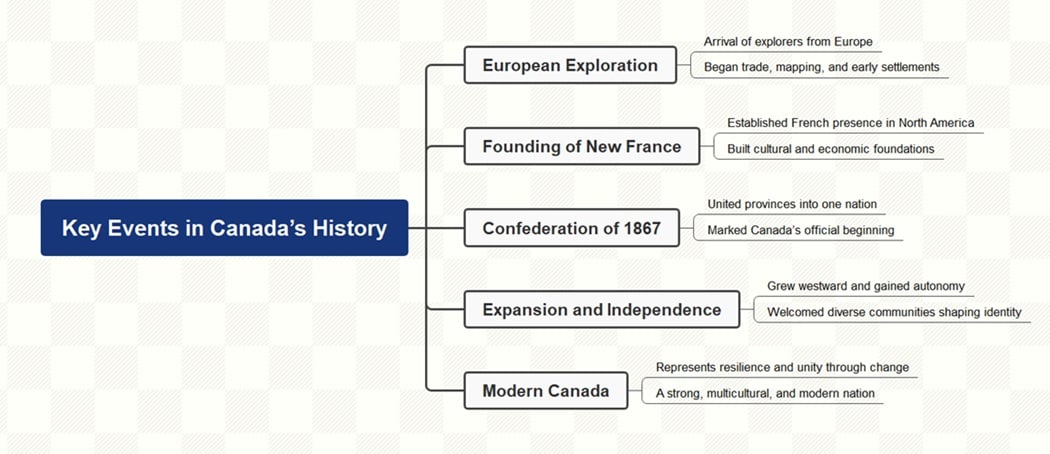
The timeline highlights major moments like the arrival of European explorers, the founding of New France, and the 1867 Confederation that united the provinces into one nation.
Over the years, Canada expanded westward, gained independence, and welcomed diverse communities that shaped its multicultural identity.
This visual journey shows Canada’s resilience and unity through change, reminding readers how a vast and varied land grew into a strong, modern country.
Tool Recommendation
There are many tools for creating historical timelines, but Wondershare EdrawMind is ideal for clarity and creativity.
It offers flexible templates, simple layouts, and engaging visuals that make it easy to organize Canada’s history and present it with accuracy and style.
Conclusion
Although Canadians are relatively few, they have created what numerous observers consider to be a model multicultural society, inviting and welcoming foreigners from all other continents.
Also, Canada's harbors export an abundance of natural resources and capital, comparable to those of other nations. Its industries, from energy to technology, continue to drive steady growth and innovation.
Combined with its strong education and social systems, these strengths have built a stable and prosperous economy admired across the globe.
Through centuries of change, Canada has preserved its values of cooperation, tolerance, and respect for human rights.
Its story reminds us that unity in diversity can lead to lasting progress and that the past continues to guide the country’s bright future.
 EdrawMind
AppsEdrawMind Online
EdrawMind
AppsEdrawMind Online