



Have you ever imagined Europe as a book? If you were to do such a thing, it would basically be a collection of stories layered on top of each other. Think of old kingdoms, uprisings, brilliant thinkers, and eras that had completely reinvented the way people lived.
One of the best ways to understand this exciting journey is through a European history timeline, where each century unveils a new era (one better than the last). Plotting down these centuries, it allows us to see just how the continent endured dangerous plagues and unlocked new worlds, as well as completely rebuilt itself after disaster struck.
Feeling excited already? In the chapters ahead, we will take a walk through the major events that shaped Europe and formed the essential backbone of its political and cultural identity.
In this article
European History Timeline
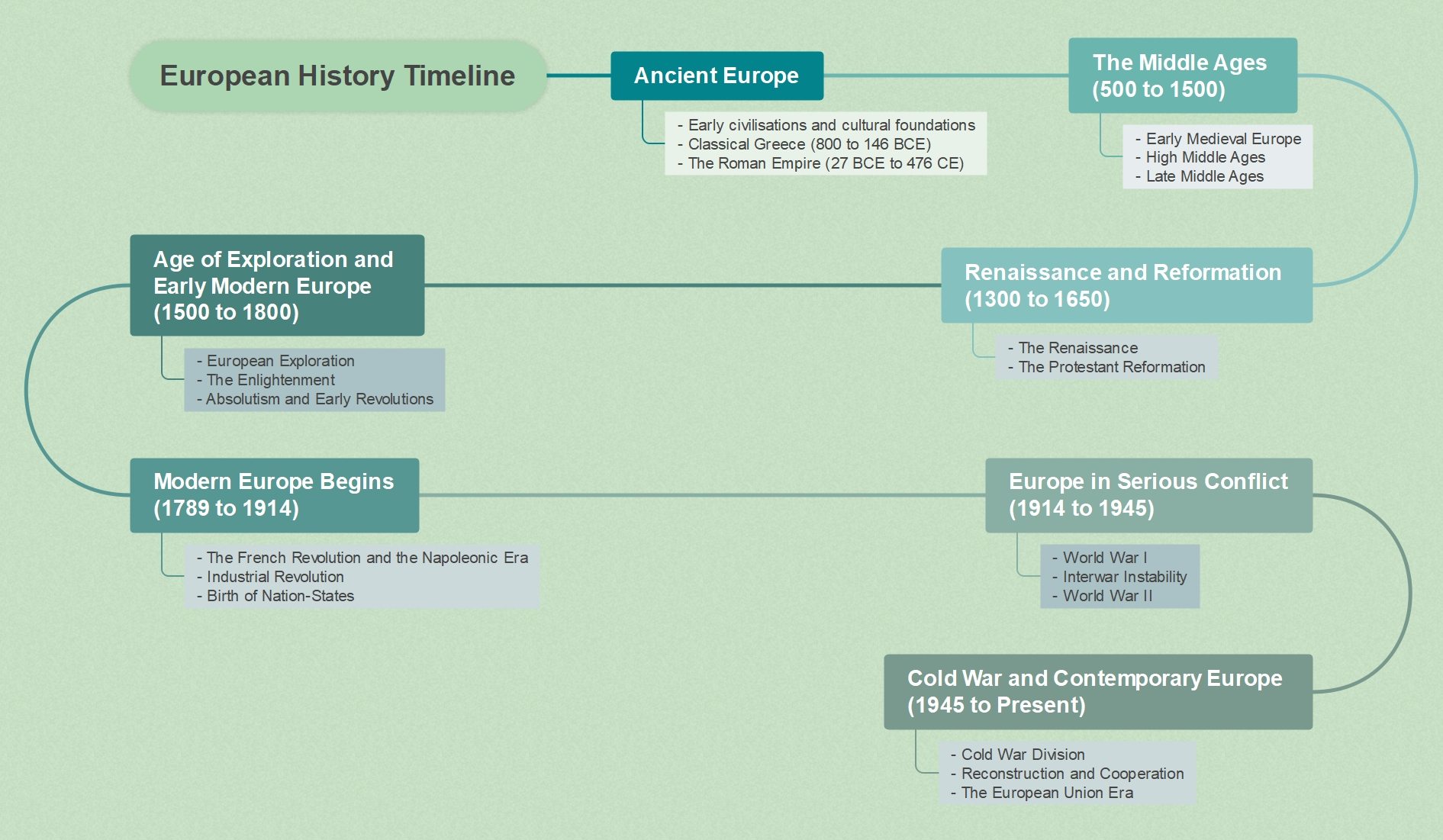


Europe’s past has stretched across thousands and thousands of years, and with that, has seen countless turning points. In order to make a proper sense of this story, historians often turn to making a European history timeline chart, which basically provides a structured look into just how entire eras have reshaped the continent.
Through this chart, you will be able to watch entire empires rise and collapse, and borders shift like tides across various centuries. Learn about thousands of years of creativity and conflict that merge into one! Ready? Let’s get started!
1) Ancient Europe (c. 3000 BCE to 500 BCE)
Early Civilisations and Cultural Foundations
Long before any of the major empires emerged, Europe had been home to several advanced cultures, including the Minoans on Crete and the Mycenaeans in mainland Greece.
What these societies did was basically lay down crucial foundations in things such as trade and early writing systems (very cool, right?). One more thing, across wider Europe, many Celtic tribes had developed strong traditions and detailed social structures.
Classical Greece (800 to 146 BCE)
Right after this, we see just how Ancient Greece ended up transforming Europe forever. What happened was that democracy was born in Athens, where philosophy flourished. The Persian Wars clearly showcased Greek unity, while on the other hand, the Peloponnesian War clearly revealed the strong tensions that were taking place between these powerful city-states.
On top of that, in the 4th century BCE, Alexander the Great (was he really all that great?) expanded much of Greek culture right across three main continents, which opened the door to the Hellenistic era.
The Roman Empire (27 BCE to 476 CE)
Let’s be very real, no European history timeline is complete without Rome, is it? It emerged from a small republic and very easily became a dominant empire that would stretch from Britain to the Middle East. During all of this, the period of Pax Romana ended up bringing a lot of stability for nearly 2 centuries.
As fate does, the empire ended up weakening over the course of time. In 476 CE, the Western Roman Empire saw its very sad demise.
2) The Middle Ages (500 to 1500)
Early Medieval Europe
Let’s keep turning the pages of this fascinating book, shall we? After the fall of Rome, Europe was fragmented into many such smaller kingdoms, for example, the Franks, Visigoths, and Lombards. Through this, it saw the rise of Christianity, which spread widely.
On the other hand, the Byzantine Empire would preserve Roman knowledge and emerge as a very powerful Eastern centre that focused mainly on trade and art.
High Middle Ages
During this era, we see society being structured in a sort of class system, with kings, nobles, and peasants. On top of that, the Norman Conquest of England in 1066 ended up shaping English culture for centuries to come (yes, that’s right!).
Another thing is that the Crusades, which started in 1095, would end up bringing Europeans into direct contact with the Middle East, which greatly influenced trade and technology.
Late Middle Ages
The late Middle Ages were when disaster struck. What happened was that the Black Death swept through Europe in the mid-14th century, and it wiped out millions. With this, another tragedy occurred, as Europe had to face serious conflicts such as the Hundred Years’ War between England and France (they just couldn’t catch a break, could they?).
3) Renaissance and Reformation (1300 to 1650)
The Renaissance
One of our personal favourite topics, the Renaissance, made its debut in Italy and quite quickly spread through Europe, and revived interest in classical knowledge. During all of this, artists such as Leonardo da Vinci and Michelangelo completely redefined art and culture.
The Protestant Reformation
Right here in 1517, Martin Luther’s 95 Theses ended up challenging the Catholic Church (can you believe that?), and it ended up spreading new and improved religious ideas right across Germany, as well as Switzerland.
On top of that, we also see how it reshaped politics, literacy, and community life for centuries to come. Also, the Catholic Church would launch its Counter-Reformation, which would establish strict reforms and make its influence strong in Southern Europe.
4) Age of Exploration and Early Modern Europe (1500 to 1800)
European Exploration
We are about halfway through these chapters. During the European exploration era, we see how Spain and Portugal would lead the best voyages that would connect Europe with Asia, Africa and the Americas. Also, the Columbian Exchange would introduce new crops (and diseases, unfortunately) across continents.
The Enlightenment
As the late 1600s rolled around, Europe had basically entered a period that was driven by one thing: it being the power of reason. Some of the most famous philosophers, such as Voltaire, Rousseau, and Montesquieu, had strong opinions on freedom and human rights.
Absolutism and Early Revolutions
During this era, countries such as France, Russia, and Prussia would end up embracing the idea of a monarchy. The rulers would build vast armies and very strongly influence artistic culture. However, it seems like dissatisfaction continued to grow, because by 1789, the French Revolution had erupted.
5) Modern Europe Begins (1789 to 1914)
The French Revolution and the Napoleonic Era
As everything stood currently, the Revolution had completely dismantled France’s old order. After years and years of facing a lot of turmoil, it was finally time for Napoleon Bonaparte to rise to power. He would transform France completely and reshape Europe.
Industrial Revolution
Let’s talk about the Industrial Revolution, shall we? It started off in Britain and spread very quickly across Europe. Its main feat was that it introduced new machinery, modern transport, and economic systems.
Birth of Nation-States
During all of this, two major political transformations were taking place, which included the unification of Italy in 1861 and Germany in 1871.
6) Europe in Serious Conflict (1914 to 1945)
World War I
As the early 20th century came around, we see the rise of militarism and alliances, as well as nationalism, taking place. On top of that, it doesn’t really help that in 1914, WW1 took place, which spread disaster all across Europe (and killed many).
When the war ended in 1918, the Treaty of Versailles would basically impose many heavy penalties on Germany.
Interwar Instability
This was probably one of the saddest eras for Europe. Wondering what the reason was? Well, it struggled a lot with economic depression as well as social tension. Dictatorships would rise time and time again in Italy, Germany, and Spain.
World War II
If you think WW1 was bad for Europe, WWII in 1939 completely destroyed it. Main events, including the Holocaust and invasion campaigns, as well as widespread devastation, would leave such deep scars that it would take ages to recover.
7) Cold War and Contemporary Europe (1945 to Present)
Cold War Division
At this point in time, we see how Europe would end up being completely split into the capitalist West and the rather communist East, and it was defined entirely by the Iron Curtain. The opposing blocs in this area would basically be symbolised by NATO and the infamous Warsaw Pact (very scary).
Reconstruction and Cooperation
While Western Europe was in shambles, the Marshall Plan had plans to rebuild it (and help it somewhat recover). New institutions were formed that would basically prevent future conflict.
The European Union Era
Europe continued to expand, as it was destined to do so, and introduced a shared currency. Despite there being challenges such as the 2008 financial crisis and Brexit, Europe continues to evolve.
How to Make a Similar Timeline for Other Historical Events?
Before you start making a timeline, take a moment to plan out what you want to include and how you’ll present it. Prepping beforehand can make the timeline easier to follow. Here’s how you can make one:
- Collect background information: Start by researching important facts, such as names, birth and death dates, and relationships.
- Identify generations: Find out about the basic relationships and build a general structure before you officially begin designing.
- Create a general outline: Sketch out a basic design. You may decide on the layout later.
- Add names and dates: Fill in the chart with events going down in chronological order.
- Include photos: Add photos and fonts to make it visually prettier.
- Review and verify: Check each name and event for perfect accuracy.
- Export: Once everything is verified, save your timeline digitally or print it.
Steps to Make the European History Timeline
Now, if you were to make a timeline, there are several options available online. Creating a timeline can help you display important information in sequence, with events and dates. For my timeline, I have chosen EdrawMind because it has many free templates to follow. If you want to try, here’s how to do it:
 Try the app & get 500 free AI tokens


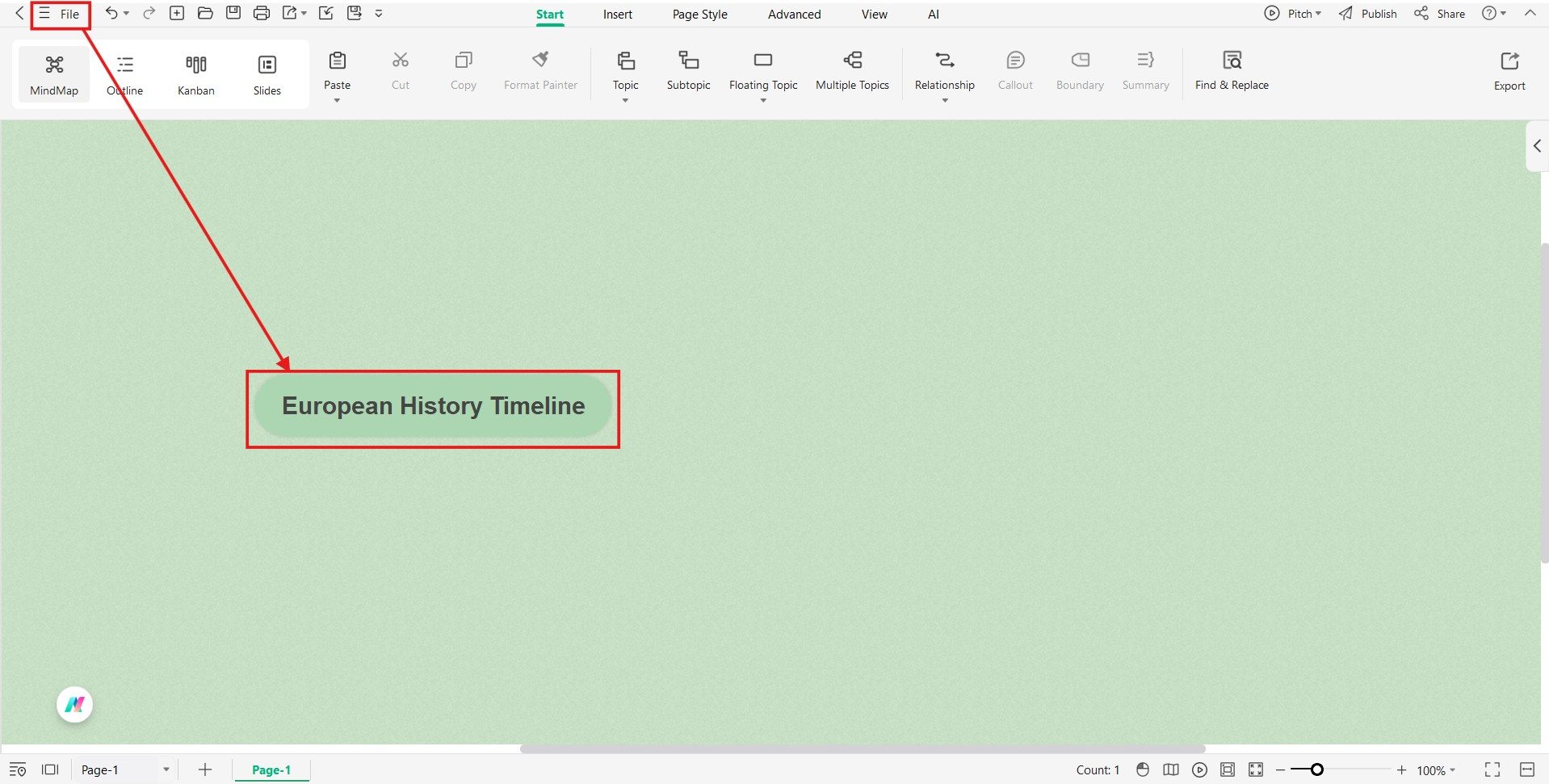
Step 1 Create a New File and Add the Title
- Open EdrawMind.
- Create a blank mind map to start with a clean canvas.
- Add a floating topic and title it “European History Timeline.”
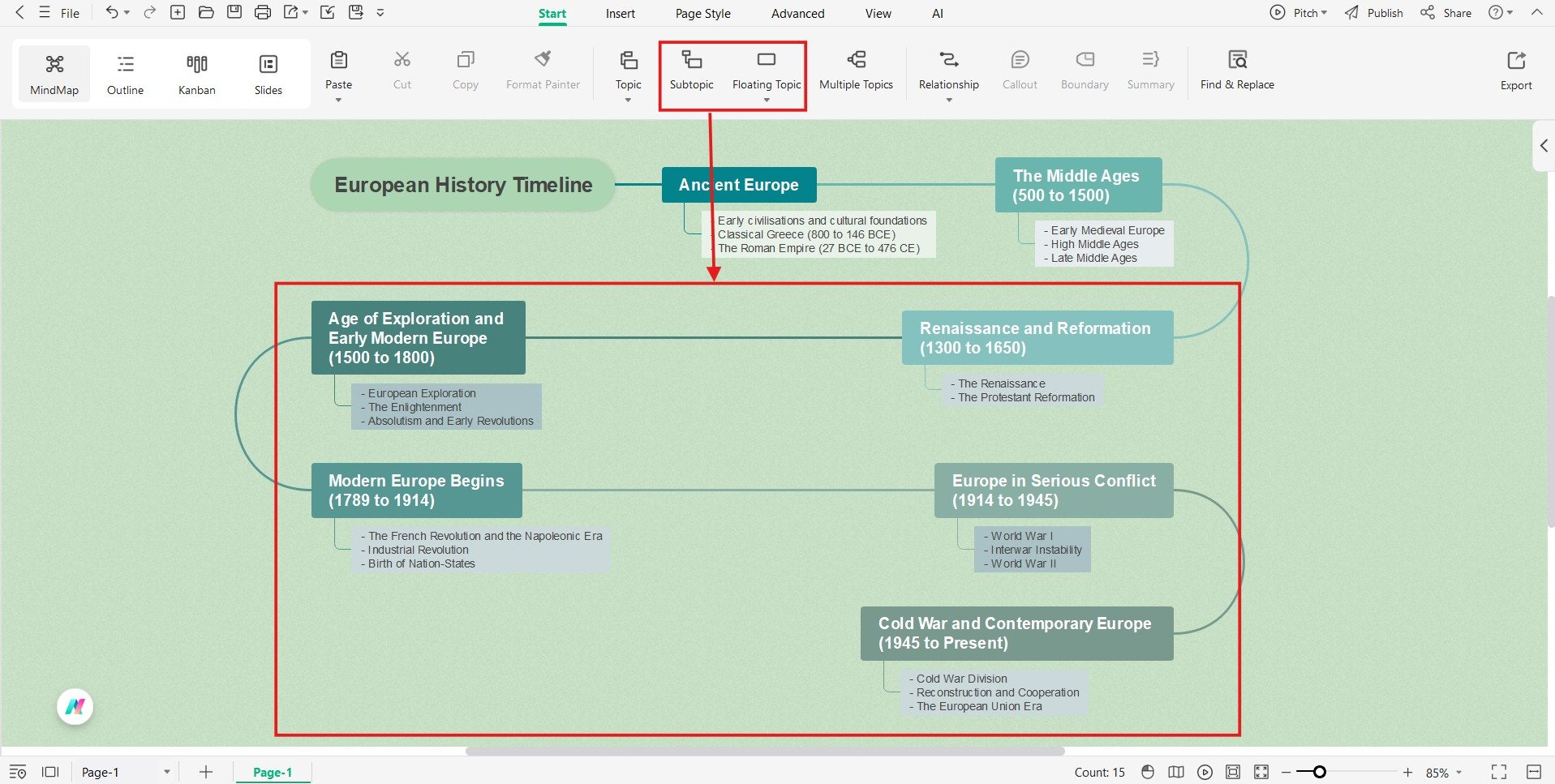
Step 2 Adding Events
- Add a floating topic from the top menu.
- Create one for each major event and keep adding until the full timeline is displayed.
- Add a subtopic for further explanation of each event under the main topic.
Tip: Use Enter to keep adding main topics and Tab to add subtopics.
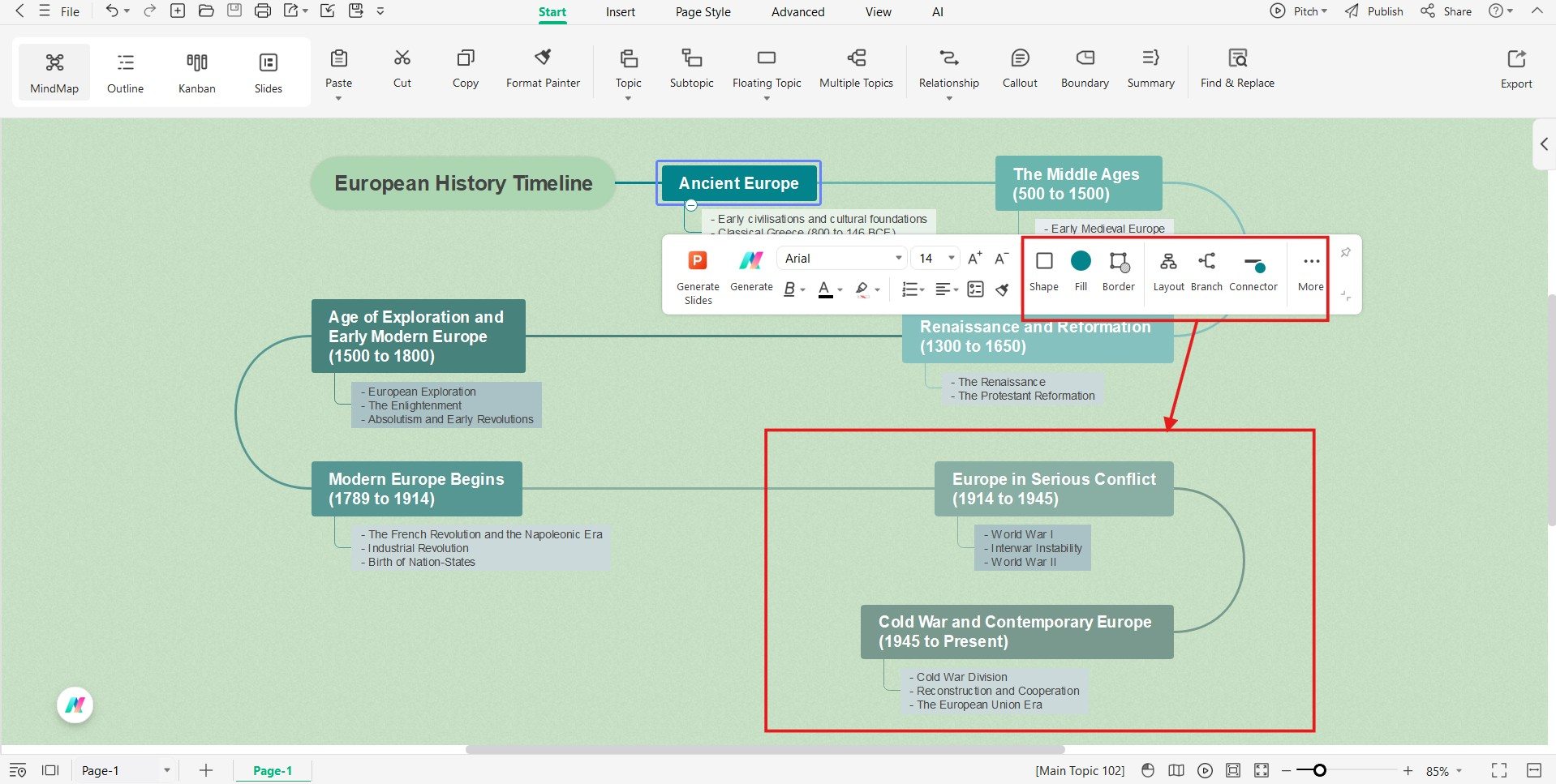
Step 3 Customising Each Major Event
- Change the font size, box shape, or colour from the floating toolbar.
- You may also colour-code each section to highlight major events. Add dates to emphasise importance.
Tip: Change connector lines to match the main theme of your timeline.
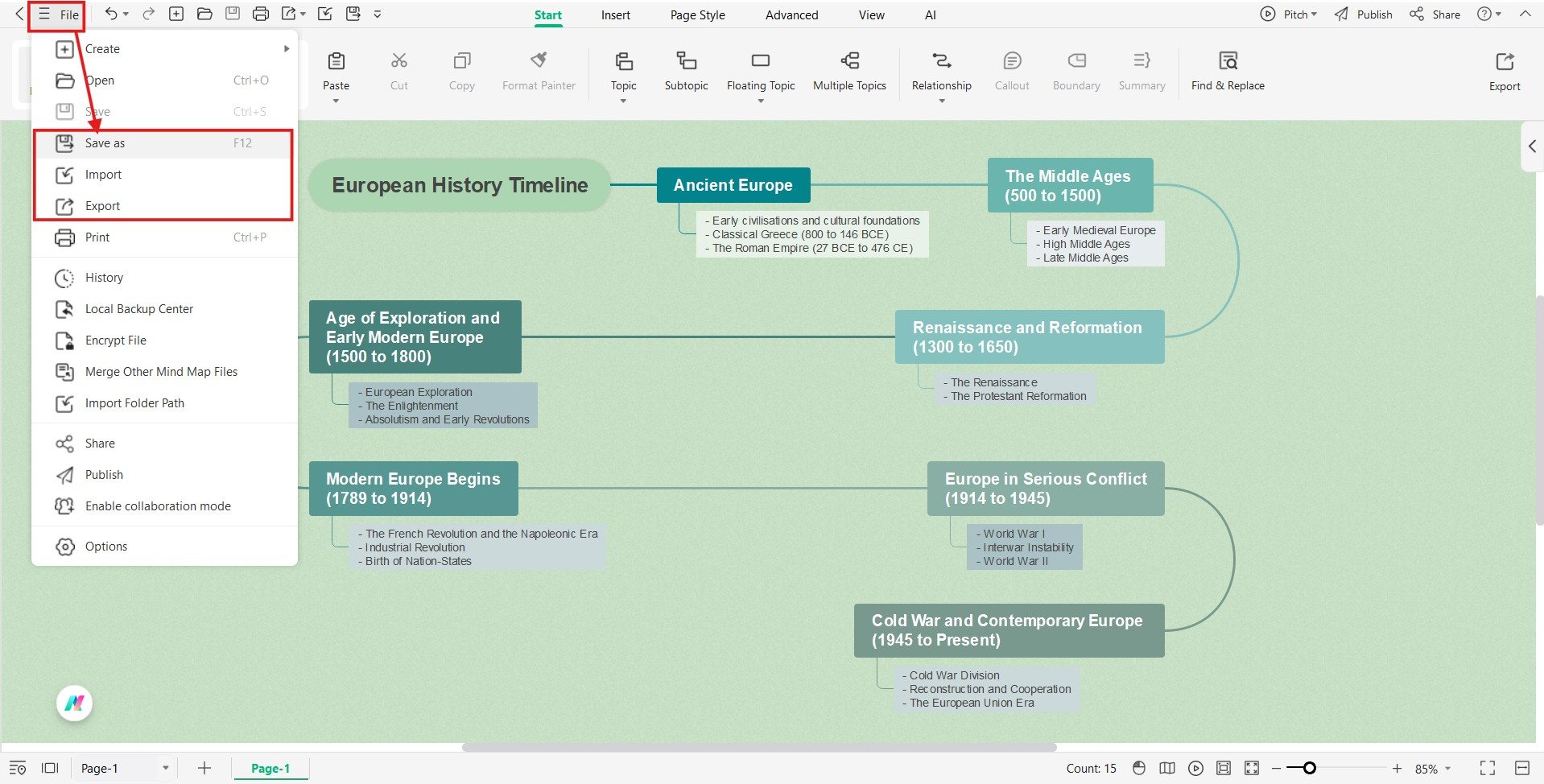
Step 4 Save or Export
- Save your project on your computer.
- Or you can download the timeline as an image (PNG, JPG), PDF, etc.
Wrapping Up
Europe’s story has managed to walk us through major historical events, from ancient kingdoms to modern democracies. Whether the European history timeline's major events are displayed visually or read through like a novel, the continent’s past is a clear reminder of three main things: culture, resilience, and reinvention.
Europe continues to grow and adapt, as it always will, and its long history remains essential to help you understand its identity today.
If you want to map out complex stories like this one, EdrawMind makes it easy. Organise dates and events in an orderly manner to make your timeline memorable.
 EdrawMind
AppsEdrawMind Online
EdrawMind
AppsEdrawMind Online