


Many organizations struggle with unclear hierarchies. When people can't easily tell who reports to whom, decisions stall, and new employees feel lost.
The lack of clear reporting paths wastes time and resources. Teams repeat work, wait for approvals, and watch projects lose momentum.
Cisco's org chart shows what clarity looks like inside a large company. In this guide, I'll explain Cisco's structure and how you can create a similar chart for your own team.
In This Article
Cisco Organizational Chart Overview


Common Structure Type
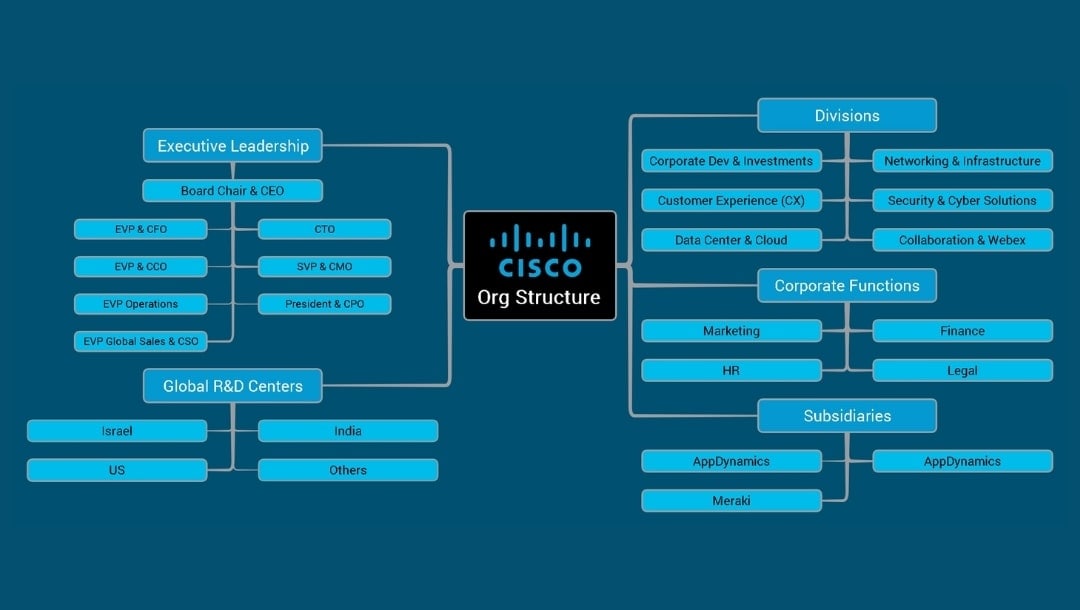
Cisco uses a hybrid model. Product groups own roadmaps and results. Shared functions provide standards and support. In practice, this creates two lines that meet at the top.
A product leader directs engineering, product management, and release plans for a single area. Functional leaders oversee finance, legal, human resources, and marketing for the entire company. Sales and CX operate across all lines and align to regions.
Number of Employees
Cisco's workforce numbers almost 86k worldwide. Engineers design routers and other physical products.
Teams build security platforms and study AI-driven business improvements. Others create security platforms and investigate AI for business applications.
Customer success teams help enterprise clients achieve their targets.
People work across offices in North America, Europe, Asia-Pacific, and Latin America. R&D hubs are set up in various countries to draw on local expertise and connect with nearby markets.
Key Executives
Board of Directors Chair & CEO
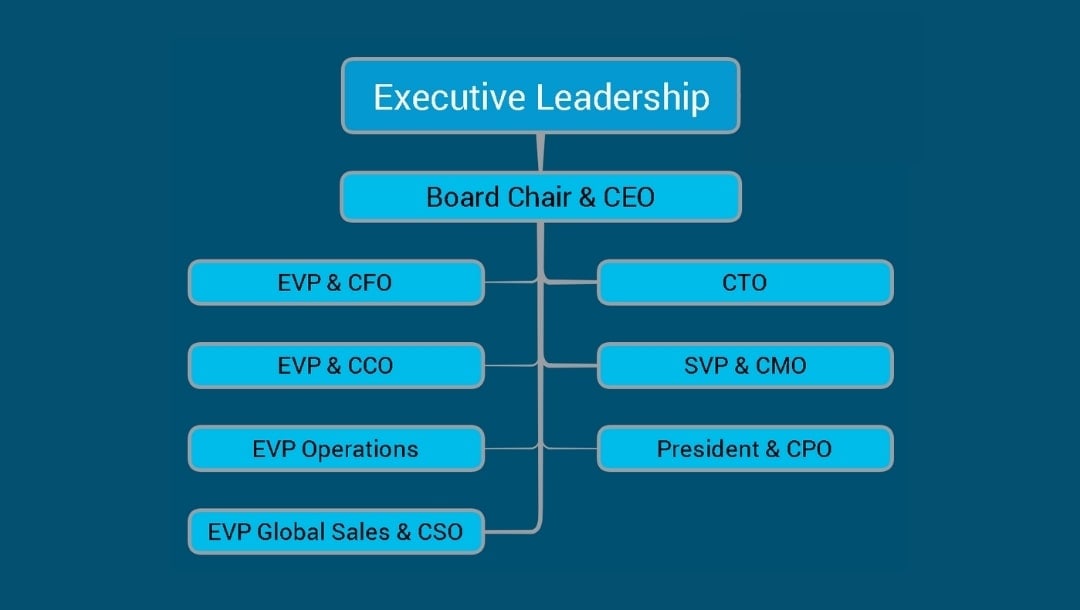
Chuck Robbins is the top leader. He represents Cisco when talking to news reporters or investors. Major final decisions are on him. He chooses how much funding each group gets.
Senior Vice President and Chief Marketing Officer
Carrie Palin manages how customers learn about Cisco. He plans advertising, sets product prices, and arranges trade shows and conferences. Also, he tracks how well marketing investments drive sales.
President and Chief Product Officer
Jeetu Patel leads product work for Networking, Security, Collaboration, and Observability. Their long-term plan focuses on the rise of AI. They turn customer needs into products that work across the platform.
Executive Vice Presidents
EVPs lead major company functions and business units. They focus on revenue results and resource planning.
EVP and Chief Financial Officer
Mark Patterson handles the finances. He creates financial reports every three months and predicts the company's revenue for the upcoming year.
EVP and Chief Customer Experience Officer
Liz Centoni directs customer success, support, and professional services globally to support adoption and renewals.
EVP Operations
Thimaya Subaiya oversees IT and supply chain operations as part of daily activities.
EVP Global Sales and Chief Sales Officer
Oliver Tuszik oversees global direct and partner sales, leading go-to-market and revenue initiatives.
Divisions Within Cisco
Collaboration & Webex
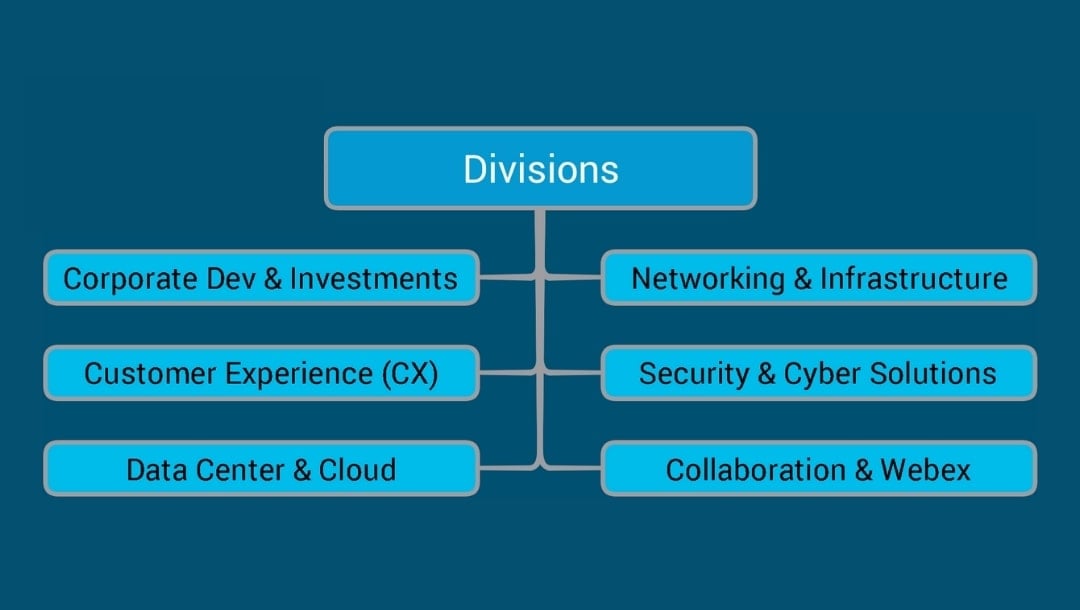
This division competes in video meetings and team messaging. Webex bundles calling, meetings, and messaging into subscription plans. Large companies use it for a business-grade option instead of consumer apps.
Data Center & Cloud
The Data Center & Cloud unit sells servers, storage, and software, enabling companies to run their own private clouds. The goal is to replicate many public cloud features within a company's own data center.
Customer Experience (CX)
CX provides services after the hardware ships. Teams assist with installation, optimize networks for improved performance, train staff, and can manage a customer's network from end to end.
Corporate Development & Investments
This team identifies companies to acquire. It conducts due diligence, negotiates deals, and leads integration following the deal's closure. Also, it invests in startups that build tech Cisco may want to acquire later.
Networking & Infrastructure
The oldest and largest group of Cisco that builds the gear to transfer data on the internet.
Products include core routers that handle terabits per second, enterprise switches that connect office devices, and wireless systems that cover whole campuses.
Security & Cyber Solutions
This division protects against hacking attempts. Firewalls keep bad traffic out, and tools detect when accounts are breached. Other systems secure valuable data from theft.
Key Functions and Subsidiaries
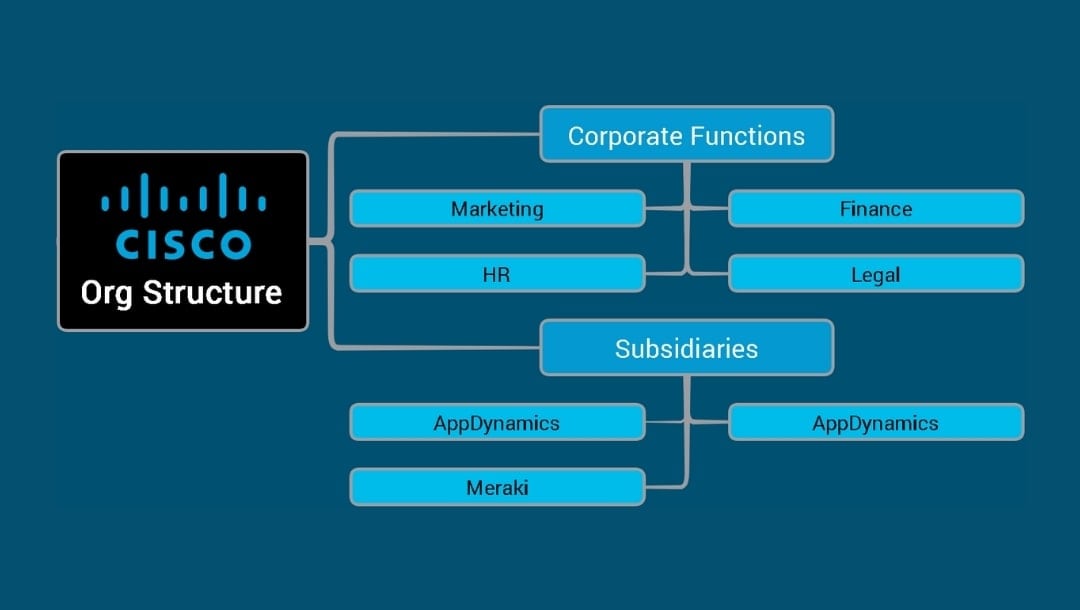
Corporate Teams
- Finance teams manage budgets and track expenses.
- Legal teams write contracts and defend patents.
- HR teams hire new employees and manage pay.
- Marketing teams promote products and plan company events.
Each of these teams supports every division.
Subsidiaries
AppDynamics checks how software performs after release and helps users spot issues that slow it down.
Meraki manufactures Wi-Fi access points and switches that are managed through a simple web dashboard.
ThousandEyes shows how data moves across the internet. It also identifies where delays occur beyond the company's control.
Global Research Centers
Labs in the United States, India, Israel, and other locations work on new research ideas. Scientists publish research papers and register new patents.
Once a project is fully developed, they hand it over to business teams to continue the work.
Why Does Cisco's Structure Work
Cisco's model is effective because it aligns with customer outcomes. One account team sells the full set of offers, and deep experts join when needed. It keeps presentations simple on the front end and delivers them effectively.
- One Face to the Customer: The account lead coordinates across lines, so buyers don't have to chase multiple contacts.
- Right Expert at the Right Time: Hiring and rotations move people to growth areas without breaking teams.
- Global Coverage: Regional field teams handle local rules and support, so customers see faster fixes.
- R&D to Product Path: Research teams hand off to builders through a set stage process, which avoids stalls.
- Install-ready Launches: Operations and services plan handoffs before ship dates, which cuts rework.
- Transparent Metrics: Leaders utilize shared dashboards to track quality, ship dates, and customer health.
This balance lets Cisco build, sell, and support at a global scale without losing control.
How to Make an Organizational Chart
Creating an org chart doesn't require design skills or complex software. You can use a professional tool with drag-and-drop features that are easy to use for anyone. Here are the basic steps:
 Try the app & get 500 free AI tokens


Step1 Start with a Template
- Open the tool and search for organizational chart templates in the library.
- Templates with three levels work for small teams. Larger companies often need five or more levels.
Step2 Add Your Company Information
- Replace the sample CEO name with your actual top executive.
- Add department heads in the boxes below.
- Create new positions at the same level by adding boxes horizontally.
- Build downward reporting lines by adding boxes vertically.
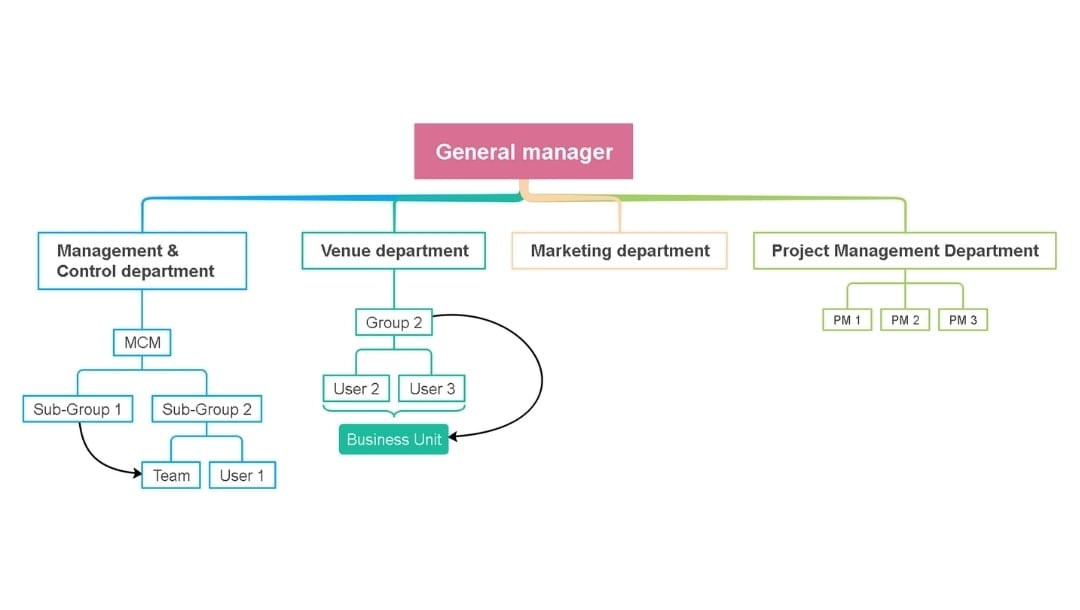
Step3 Customize the Design
- Change the colors to match your company's branding.
- Add employee photos to help people recognize faces more easily.
- Adjust fonts so titles remain readable when printed.
- Drag boxes around to organize the layout clearly.
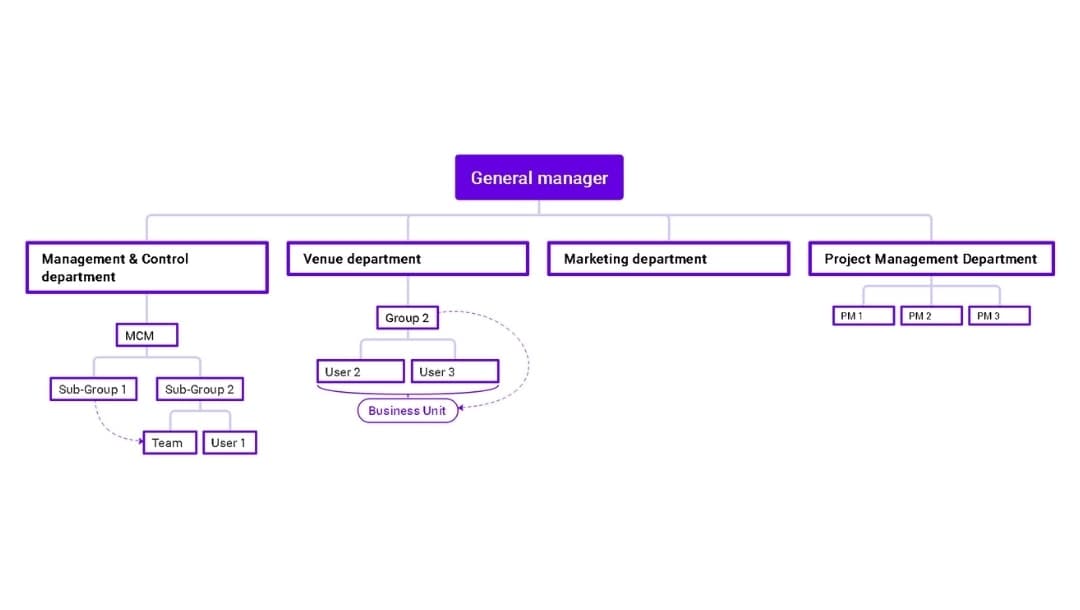
Step4 Share and Save Your Chart
- Export the finished org chart as a PDF for printing or as an image for presentations.
- Save the original file so you can update names and positions when your team changes.
Final Words
Cisco's organizational structure connects product ownership with shared standards and local expertise.
It supports teamwork, quick innovation, and consistent performance across regions. Teams understand where decisions originate, and customers receive faster results.
You can build a similar structure within your company using EdrawMind. It helps you visualize reporting lines, dotted links, and team scopes all in one place. Share it to keep communication open and progress steady.
FAQs
-
How do I show two managers for one person?
Use one solid line for the primary manager and one dotted line for the secondary. Add a brief note to indicate who signs the reviews. -
What is a safe scope for a chart you share outside the company?
Remove personal emails, phone numbers, and headcount. Replace contacts with a team inbox. Share only the layers required for the work, add a "reference only" note, and use links that expire. -
How do I use the chart to confirm access requests?
Ask requesters to name the manager shown on the chart. Review the manager-of-record against the card. This streamlines the process, cutting back and forth to speed up approvals. -
How can a chart help new hires on day one?
Include a "who to ask" line for each team, link to the support queue, or onboarding guide. New hires can find their manager, peers, and escalation path in minutes. -
How do I show a contractor on an org chart?
Label the box “Contractor” and use a lighter color or dashed border. Do not count that box in employee headcount totals.
 EdrawMind
AppsEdrawMind Online
EdrawMind
AppsEdrawMind Online