About the Six Thinking Hats Template
What are the Six Thinking Hats?
Source note: Edward de Bono’s official materials describe the hats as changeable modes of thinking and emphasize parallel thinking rather than assigning people fixed hat identities de Bono.
A crucial distinction is that the hats are not personality types and not permanent roles assigned to different people. In authentic parallel thinking, participants switch modes; in a group, everyone can use the same hat at the same time so the discussion explores one kind of thinking together instead of turning into opposing camps.
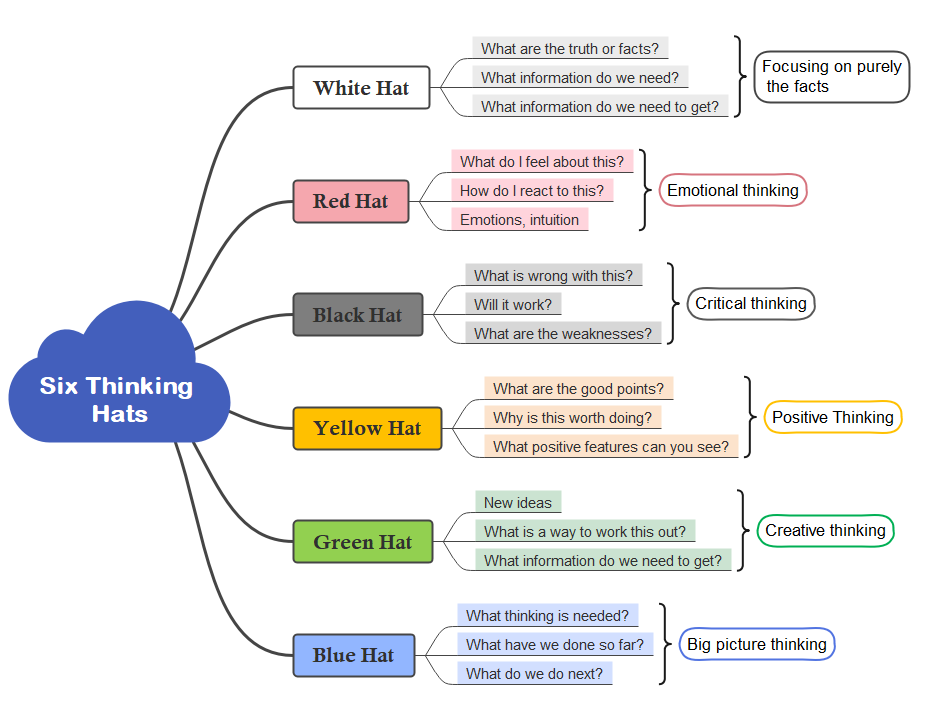
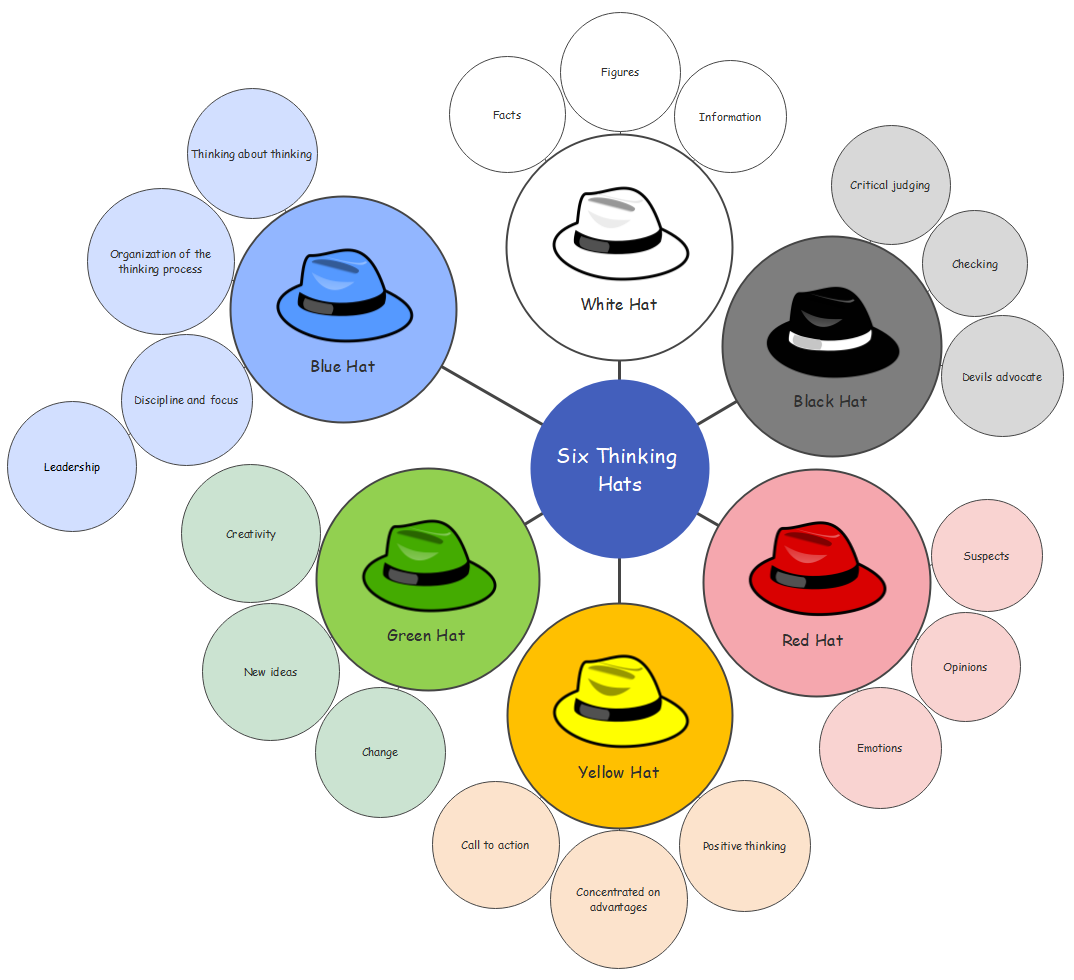
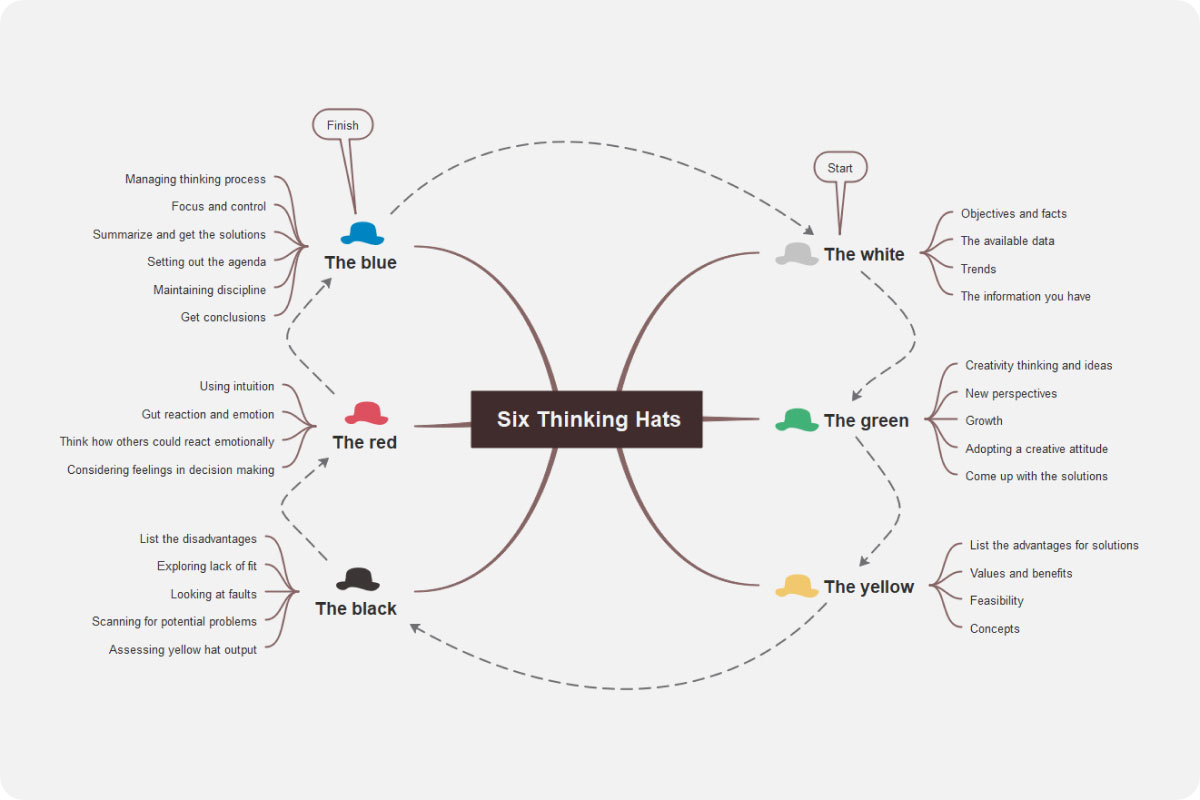
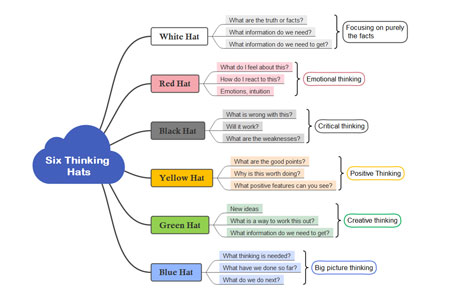
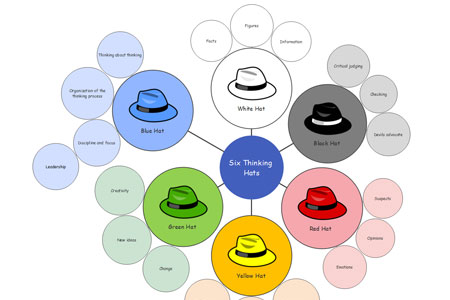
Six Thinking Hats is Edward de Bono’s parallel-thinking framework for examining the same issue through six modes: information (White), feelings and intuition (Red), caution and risk (Black), value and benefits (Yellow), creativity and alternatives (Green), and process control (Blue).
The Blue Hat (Planning)
The Blue Hat manages the thinking process: it defines the focus, sets or changes the sequence, summarizes what has been learned, and identifies next steps. A facilitator may lead the Blue Hat work, but Blue is a thinking mode rather than a permanent “chairperson” personality.
- “What is the problem?”
- “What are the benefits of solving this?”
The White Hat (Facts)
The White Hat focuses on information: what is known, what is missing, what evidence is needed, and how reliable the available data is. The goal is to separate factual inputs from interpretation or preference.
- “What do we need to find out?”
- “What do we know about the issue?”
The Green Hat (Ideas)
The Green Hat opens space for creativity, alternatives, possibilities, and new approaches. During Green Hat thinking, prioritize generating options before judging whether each option will work.
- “What are the possibilities?”
- “Are there alternatives?”
The Yellow Hat (Benefit)
The Yellow Hat looks deliberately for value, feasibility, benefits, and reasons an idea could work. It is constructive optimism supported by reasons—not blind positivity.
- “What are the positives of that?”
The Red Hat (Emotion)
The Red Hat makes room for feelings, intuition, hunches, and immediate reactions. Participants can state these reactions without having to convert them into logical arguments.
- “How does this make you feel?”
The Black Hat (Judgement)
The Black Hat examines caution, risk, constraints, weaknesses, and reasons an option may fail. Its purpose is to identify problems that can be avoided or addressed, not to reject ideas automatically.
- “What can go wrong?”
Why should you use our Six Thinking Hats template?
A visual Six Thinking Hats template gives a meeting one shared workspace for recording facts, reactions, risks, benefits, alternatives, and process decisions without mixing them together. This is especially useful for decisions where discussion keeps circling or where a few viewpoints dominate.
Best fit: team decisions, idea evaluation, retrospectives, planning discussions, and problem-solving sessions that benefit from structured participation. Limitation: the method should not be used to label people (“she is a Black Hat thinker”) or assign each person a different fixed hat throughout the discussion; that undermines the parallel-thinking design.
How to use our Six Thinking Hats template?
1. Define the decision, problem, or opportunity in the center of the template. 2. Choose a hat sequence that fits the purpose; Blue can frame the session and close it. 3. Ask the whole group to focus on the same hat mode at a given point, recording each contribution in the corresponding area. 4. Switch hats deliberately rather than debating across modes. 5. Finish by summarizing the evidence, unresolved risks, promising options, and agreed actions.
There is no single universal sequence for every situation. The useful sequence depends on whether the session is exploring an idea, evaluating options, solving a problem, or making a final decision.
Six Thinking Hats Examples
Use the template when the same question needs several deliberately different lenses. For a software purchase, White captures cost and performance data, Red captures user reactions, Black identifies migration or security risks, Yellow tests the upside, Green generates alternatives, and Blue keeps the discussion focused and turns the result into a decision process.
The information gain comes from keeping these modes distinct while linking them to the same decision entity. That makes the final map useful as a record of why a team chose an option—not just a collection of unrelated brainstorm notes.
For the authoritative framework, see de Bono and the Six Thinking Hats learning site.