About this Monthly Implementation Plan for Localization Marketing Template
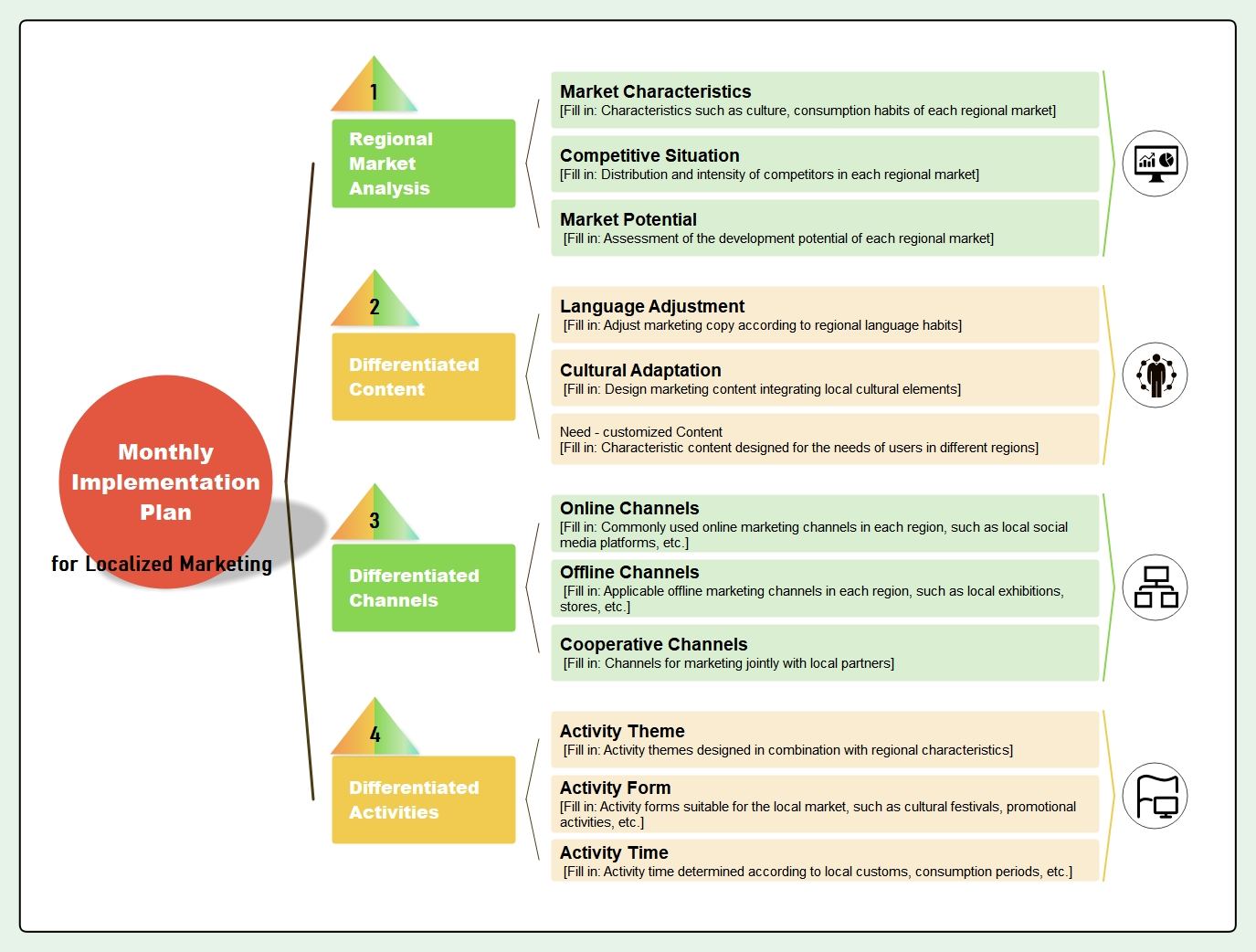
This “Monthly Implementation Plan for Localization Marketing” template organizes market analysis and adaptation tasks into a structured rollout plan, making localization work easier to sequence.
Market Characteristics
This branch defines the local market conditions that shape the rest of the localization strategy, from demand patterns to buyer expectations.
- Use this node to summarize the local market environment.
- Keep later adaptation work tied to real market conditions.
Competitive Situation
This branch maps the local competitive landscape so positioning decisions are made against actual market pressure instead of assumptions.
- Use this node to compare local competitors.
- Keep strategy choices tied to competitive context.
Market Potential
This branch highlights the commercial value of the target market, helping teams judge whether the localization effort is worth scaling.
- Use this node to estimate opportunity and business value.
- Keep resource decisions linked to realistic market potential.
Language Adjustment
This branch focuses on the translation and wording changes needed to make the offer feel natural in the target market.
- Use this node to plan wording and translation work.
- Keep language adaptation tied to audience understanding.
Cultural Adaptation
This branch captures the cultural changes needed beyond direct translation, making the localized message more relevant and acceptable.
- Use this node to align content with local culture.
- Keep message tone and references market-appropriate.
Need - customized Content
This branch shows where standard content is no longer enough and where new market-specific materials must be created.
- Use this node to identify where custom assets are required.
- Keep content production tied to localization gaps.
FAQs about this Template
-
What is localization marketing?
Localization marketing is the process of adapting messaging, content, and campaign execution so they fit the language, culture, and market expectations of a specific audience. It is more than translation because effective localization also reflects local context, behavior, and relevance.
-
How do teams plan localization marketing effectively?
Teams usually plan localization marketing by aligning market priorities, campaign goals, content needs, review workflows, and local adaptation timing before execution starts. A strong plan makes it easier to coordinate global strategy with local relevance instead of treating every market exactly the same.
-
Why is localization important in marketing?
Localization is important because the same campaign can perform very differently across markets if language, cultural signals, or user expectations are handled poorly. Better localization improves clarity, trust, and the chance that the campaign actually resonates with the intended audience.
-
What's the difference between localization and translation?
Translation focuses on converting language, while localization goes further by adapting the message, context, and presentation for a specific market. Good localization usually includes translation, but translation alone is not always enough.