About this Profit tree example template
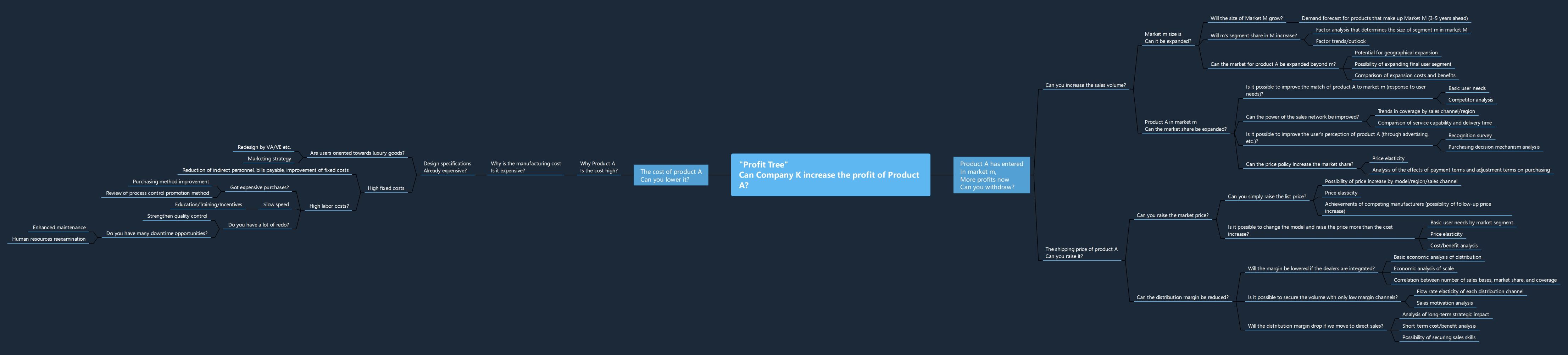
This profit tree template helps businesses analyze how to increase product earnings. It breaks down complex financial goals into actionable steps. You can use it to identify cost reduction opportunities and explore new revenue growth strategies effectively.
Reducing Product Costs
Lowering production costs is a primary way to boost profit margins. This section examines manufacturing expenses, design choices, and fixed costs. It helps managers find inefficiencies in labor, quality control, and general overhead operations.
- Redesign by VA/VE methods
- Marketing strategy adjustments
- Reduction of indirect personnel costs
- Purchasing method improvements
- Education and training for efficiency
- Strengthened quality control
- Enhanced equipment maintenance
- Human resources reexamination
Increasing Sales Volume
Growing your sales volume requires a deep understanding of market dynamics. This branch explores expanding into new territories and improving market share. It focuses on matching products to user needs and enhancing your overall sales network performance.
- Forecast market growth trends
- Expand geographical reach
- Analyze competitor strategies
- Improve sales channel coverage
- Increase brand recognition through ads
- Analyze user purchasing mechanisms
- Compare expansion costs and benefits
Optimizing Price and Distribution
Raising prices or lowering distribution costs can significantly impact the final profit. This section looks at price elasticity and dealer margins. It helps you decide if direct sales or integrated dealer networks will improve your overall profitability.
- Adjust list prices based on elasticity
- Analyze competitor price increases
- Develop high-value model changes
- Integrate dealer networks for better margins
- Secure high-volume, low-margin channels
- Evaluate the move to direct sales
- Perform cost and benefit analysis
FAQs about this Template
-
How does a profit tree help in strategic planning?
A profit tree acts as a visual map for financial growth. It breaks down the broad goal of profit into smaller, manageable parts like volume, price, and cost. By seeing these links, teams can identify which specific areas offer the best return on investment. This clarity helps businesses prioritize resources and create clear action plans for long-term success.
-
When should a company consider withdrawing a product?
Withdrawal is necessary when a product consistently fails to meet profit targets despite optimization efforts. If the market is shrinking or the cost to compete is too high, resources are better spent elsewhere. A profit tree helps identify these dead ends by showing if sales volume or price increases are realistically possible within the current market environment.
-
What role does price elasticity play in a profit tree?
Price elasticity measures how much customer demand changes when you change prices. In a profit tree, this data is crucial for deciding if raising prices will actually increase total revenue. If elasticity is high, a small price hike could cause a large drop in sales. Understanding this helps businesses find the optimal price point for maximum profitability.