About this Biweekly Iteration Plan Template
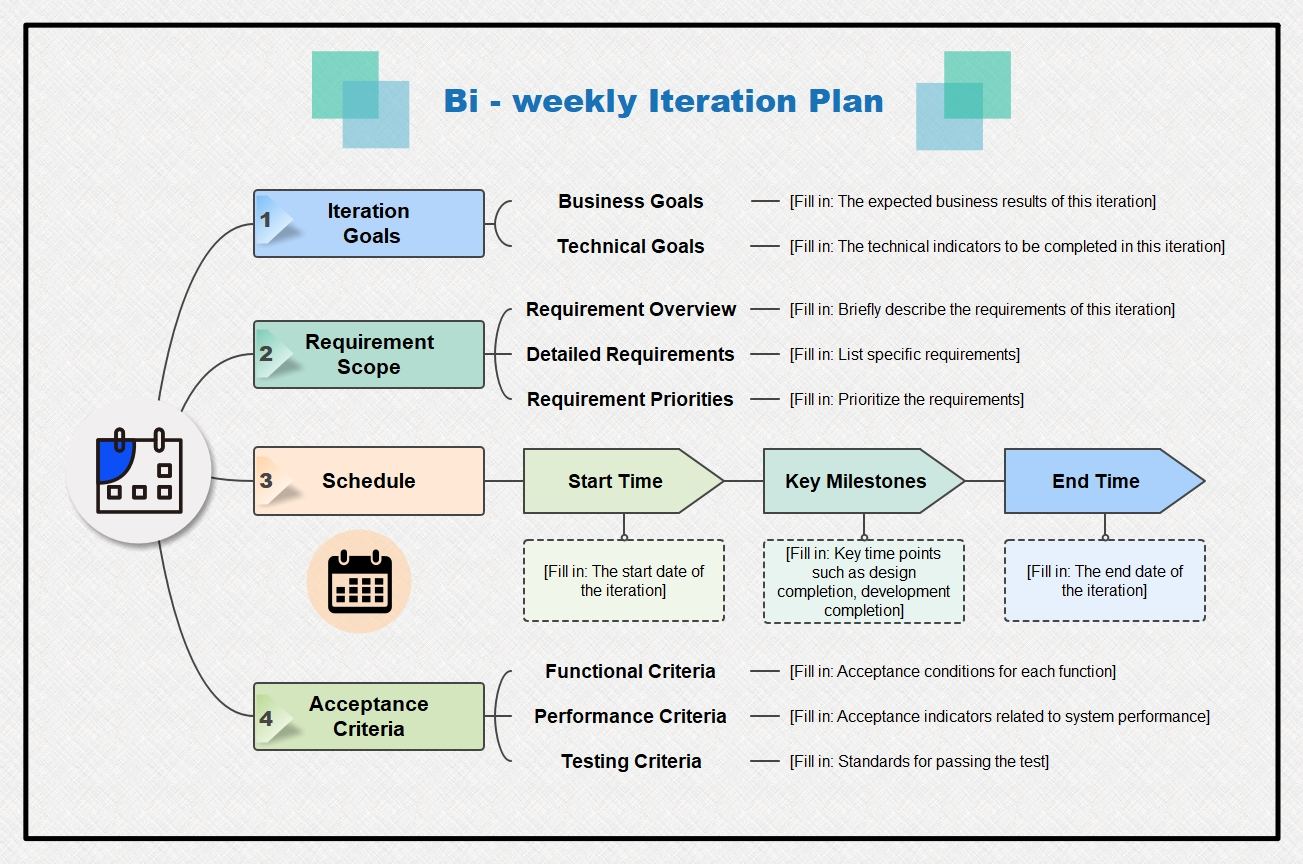
This template organizes an iteration plan around the core planning blocks that teams need before execution starts. It covers goals, requirement definition, timing, and acceptance standards, so the map works as both a planning outline and a delivery-alignment document for a short sprint cycle.
Business Goals
This branch records the expected business results of the iteration. It helps teams anchor the sprint to measurable outcomes rather than only feature activity, which is useful when product, operations, and engineering need a shared understanding of why the cycle matters.
Technical Goals
This section focuses on the technical indicators or engineering targets to be completed during the iteration. It is useful for clarifying non-business success measures such as architecture work, quality improvements, performance goals, or delivery constraints that still define iteration success.
Requirement Scope
This branch groups the planning work that defines what will be built. It includes requirement overview, detailed requirements, and requirement priorities, which makes the map useful for showing not just the task list but also the relative importance and boundaries of the sprint content.
Start Time
This section marks when the iteration begins and helps anchor the delivery window. It is especially useful when teams need to map the start date against preparation work, planning meetings, or upstream dependency handoffs before development is fully underway.
Key Milestones
This branch highlights major checkpoints such as design completion, development completion, and other key delivery moments. It helps teams understand how the iteration progresses internally instead of treating the sprint as a single block with no intermediate coordination points.
End Time
This section defines the close of the iteration window. It helps teams align review, handoff, and completion expectations, especially when release timing, testing closure, or business reporting needs to happen within the same short cycle.
Acceptance Criteria
This branch captures how success will be judged at the end of the iteration. It includes functional criteria, performance criteria, and testing criteria, which makes the template useful for aligning requirement quality with release readiness before the sprint starts.
FAQs about this Template
-
What is a biweekly iteration plan?
A biweekly iteration plan is a short-cycle work plan used to organize what a team intends to complete, review, and adjust over a two-week period. It is especially useful when delivery needs regular checkpoints but still requires enough time for meaningful progress between reviews.
-
How do teams plan a two-week iteration effectively?
Teams usually plan a two-week iteration by selecting the highest-priority work, checking capacity, clarifying dependencies, and agreeing on what counts as done before the cycle begins. The best plans are realistic enough to guide execution without pretending that no change will happen during the sprint.
-
Why is iteration planning important?
Iteration planning is important because it gives teams a short enough cycle to learn and adapt quickly while still creating real delivery discipline. Without a clear iteration plan, work can become reactive, overloaded, or too scattered to evaluate honestly at the end of the cycle.
-
What's the difference between an iteration plan and a roadmap?
An iteration plan focuses on near-term delivery choices within a short cycle, while a roadmap shows broader direction and sequencing over a longer horizon. They support each other, but they answer different planning questions.