


How To Motivate Yourself To Study?
When you're staring at piles of homework and looming deadlines, it can feel like an impossible mountain to climb.
But here's a trick: break down your study tasks, assignments, and responsibilities into smaller, manageable goals. Instead of feeling overwhelmed, you'll be able to take things one step at a time — and that makes all the difference.
Before diving in, get into the right study mindset. Create a study plan that actually works for you, not just a one-size-fits-all method that you hate. Find the materials or subjects that spark your interest, and start with those to build momentum.
And yes, starting early helps — but don’t beat yourself up if you procrastinate now and then. The goal isn’t perfection; it’s progress.
In this article, you’ll find six practical tips to help you stay motivated and focused, even when your workload feels like too much to handle.
In this article
Sometimes, the most challenging part of any study-related task is essentially getting started. Be that as it may, the dread of accomplishing something is often more regrettable than the actual act of starting the work.
When you begin, you'll see it wasn't as terrible as you suspected, and you can easily accomplish it. If you don't have time or are busy, set a 10-minute timer to focus.
You can remind yourself that once those 10 minutes are up, you can stop work, take a little rest, and start again. Be that as it may, no doubt, you would have some force going, so you'll proceed.
You can get motivated to study in many ways if you don't have the time or are unmotivated to research, and often end up procrastinating.
That is not good for your school life and plans. The following tips can help you quickly get motivated to study and ace your exams.
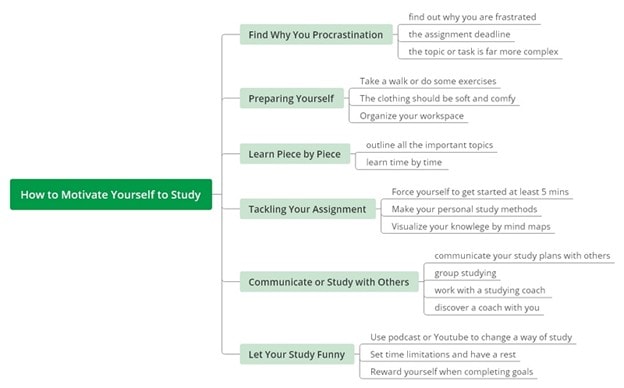
Find Why You Procrastinate
There are many reasons why you intend to procrastinate. Firstly, hesitating on your schoolwork is a mind-boggling issue that can have a wide range of causes. You always waste much more time until you realize that the deadline is coming.
Additionally, external distractions continued to draw your attention, such as your mobile phone, your pet, and other things. Finally, you are inclined to think that tomorrow will get started, and the assignment will be finished soon.
Here are probably the most widely recognized:
- You've persuaded yourself that your homework is beyond your capacities.
- Putting off your assignment is a method of opposing your parents or educators.
- You've chosen the point that makes you exhausted.

Preparing Yourself
Get prepared in advance. It would help if you created an ambiance that is perfect for studying. There are many tips to help you prepare for research, and you will enjoy the learning process.
Take a walk or practice yoga to get into a festive mood. From that, these easy exercises would give you the energy and refresh your mind. Establishing a good state of mind can lead to increased productivity.
The clothing is far more critical in preparation; soft and comfortable fabrics can provide an excellent experience for your body, which can lead to positive feelings and reduce frustration while studying.
Organizing your workspace is another way to motivate your attitude towards learning. At least clear up your workspace and prepare all the study tools that you may use ahead of time.

Learn Piece-by-Piece
Breaking down your assignments or goals into small pieces can relieve your pressure, and you may have a subconscious belief that you can quickly achieve your goals within a minimal amount of time.
A practical study method can significantly reduce the time and energy you invest in your studies.
A significant reason for stalling is that the upcoming assignment appears overwhelming. That is the point at which you have to "lump down."
A piece may be perusing three pages of your course reading, finishing five different decision questions, or discovering three reference articles on your paper.
When you've built up a study plan, talk it over with a companion, colleague, or relative. Inform them that you need to quickly review your plan and address any issues or obstacles early.

Tackling Your Assignment
Force yourself to get started for a few minutes to release your pressure. Once you realize that your task is not a big deal, you may gradually come to love your assignment and be willing to study.
The tips below offer suggestions to help you handle your tasks as soon as possible.
Through research, it has been found that the brain can accept one thing in about five minutes; therefore, force yourself to study for five minutes to see if you are in the mood or not.
Make your study method for each subject. Through your strategy, you can determine which approach is more suitable for each topic, as every issue has its own unique characteristics.
Let your knowledge be visualized, make some visual diagrams, like a mind map or a flowchart, to make your acknowledgment intuitive and easy to understand.

Communicate or Study With Others
When you feel that you are not in the mood to study, try finding a companion or group to learn with.
According to the professional report, teaching others or listening to others can accelerate your understanding of the assignment or topic; therefore, consider finding a friend to study with.
Even though studying is an individual endeavor, being responsible for another person can be an extraordinary source of inspiration.
Pair up with a cohort or flatmate so you can both consider each other responsible for your studies. Unless working with others makes the interruption even more significant, consider finding a study partner.
Make a point to examine your learning style and study inclinations with one another before you start, to ensure that you're compatible study buddies. At that point, set a progression of objectives together and decide how and when you'll achieve them;
If gathering and studying don't work for you, discover a guide who can help you work through your tasks. Make arrangements ahead of time and use these as progress checkpoints to work by.

Let Your Study Be Fun
Take a rest or give yourself individual rewards when you've achieved your goals, as this can increase your study motivation. Furthermore, changing the way you study may help you escape the existing study environment.
Use podcasts or YouTube to learn or research more about your subject. Sometimes, watching an informative video can be more useful than reading or writing textbooks, especially when tackling complex topics.
Set time limitations to help you take a rest and refresh your brain for receiving more knowledge.
Reward yourself when finishing specific study goals. For example, the food could be an excellent reward for maintaining energy and replenishing sweet treats to boost your studies.

Roadmap of Improving Your Study Habits and Motivation
Improving your study habits is not a one‑time fix. It is a process that moves in stages. Each stage builds on the last, and together they form a clear path you can follow.
Taking from our discussion in the previous section, here’s how you can improve your study motivation piece by piece.
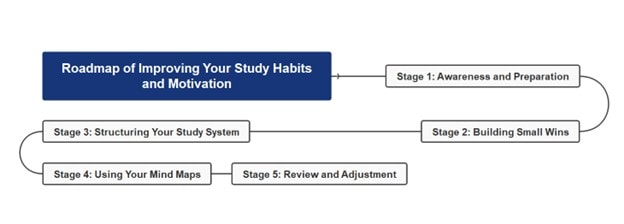


Stage 1: Awareness and Preparation
The first step is awareness. You need to recognize what is holding you back. That can refer to procrastination, distractions, or a lack of structure.
Once the problem is clear, it becomes easier to approach it with a plan. Preparation is also part of this stage. A clean study area, organized materials, and a ready mindset provide a strong foundation.
Stage 2: Building Small Wins
From there, progress begins with small wins. Instead of pushing through large, overwhelming tasks, break them into smaller parts.
Work in focused sessions of twenty to thirty minutes, then take short breaks. Each completed task creates momentum. Even small rewards help you stay motivated and remind you that progress is happening.
Stage 3: Structuring Your Study System
Making a schedule is actually one of the best ways to improve your study motivation. You don’t have to force yourself to study. The ultimate goal here is to treat your study habits like a routine and actually enjoy them.
Thus, you must make a structure that works for you. Do you like studying in the morning? Do you enjoy taking 25-minute breaks occasionally? It all depends on you, as long as your brain remains fresh throughout the process.
Stage 4: Using Your Mind Maps
Now, it’s time to get some study techniques. While making your structure, you can opt to create a mind map for every topic you complete. Creating a mind map actually forces your brain to retain information more effectively.
The maps you create can also be used for the next stage, that is, reviewing.
Stage 5: Review and Adjustment
Once you’ve actually done the studying part, you’ll need to review them from time to time. This is especially the case if you have exams or recitations coming up. Reviewing your material will be helpful.
Try to keep a copy of your mind maps, so these are the only things that you’ll bring to class. With a single look, you can recall everything you’ve learned in the past time you’ve been studying.
Tips To Follow As You Improve Your Study Motivation
Improving your study motivation is not about waiting for inspiration to strike. It is about building habits and using small strategies that keep you moving forward.
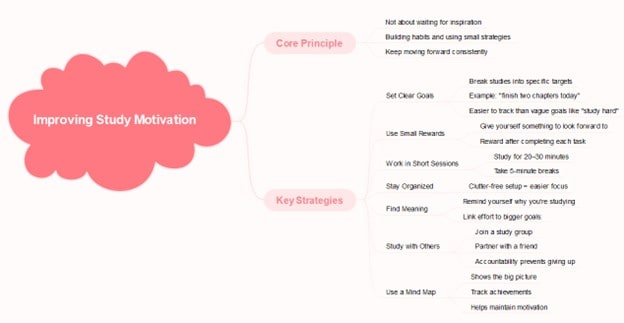
Aside from the tricks above, here are some extra tips you can follow:
- Set clear goals. Break your studies into specific targets. For example, “finish two chapters today” is easier to track than “study hard.”
- Use small rewards. Give yourself something to look forward to after completing a task, such as a snack, a short break, or time on your phone.
- Work in short sessions. Study for 20–30 minutes, then take a 5-minute break. This keeps your energy up and prevents burnout.
- Stay organized. Keep your notes, books, and schedule in order. A clutter-free setup makes it easier to focus.
- Find meaning. Remind yourself why you are studying. Link your effort to bigger goals, such as career growth or personal success.
- Study with others. Join a group or partner with a friend. Accountability makes it harder to give up.
- Use a mind map. Visualize your subjects, deadlines, and progress in one place. A mind map provides a clear overview and helps you stay motivated as you track your achievements.
- Be kind to yourself. Best of all, learn to be kind to yourself. If you’re already demotivated to study, treat yourself with kindness. You’re not a robot that’s required to work 24/7.
How To Boost Your Efficiency When Studying Using a Mind Map
Studying is not only about the hours you put in. It is about how well you organize your thoughts and connect ideas, especially within your mind. A mind map is one of the most effective tools to achieve this.
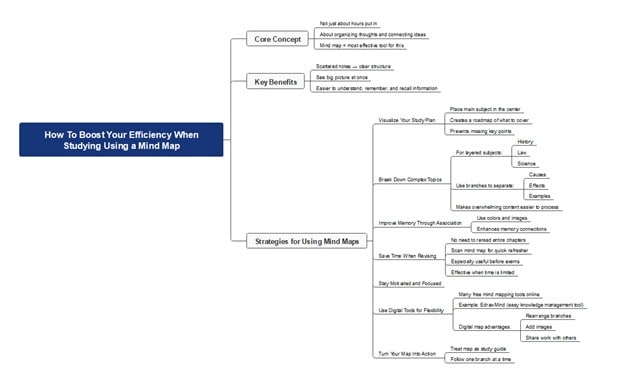
When you use a mind map, scattered notes become a clear structure. Instead of reading long blocks of text, you see the big picture at once. This makes it easier to understand, remember, and recall information when needed.
- Visualize your study plan. Place the main subject in the center. Branch out into topics, subtopics, and details. This creates a roadmap of what to cover, ensuring you don't miss key points.
- Break down complex topics. For layered subjects like history, law, or science, use branches to separate causes, effects, and examples. This makes overwhelming content easier to process.
- Improve memory through association. Colors and images can help improve your memory and its connections. When reviewing, you recall not just the text but also the structure and visuals.
- Save time when revising. Instead of rereading chapters, scan your mind map for a quick refresher. This is especially useful before exams when time is limited.
- Stay motivated and focused. A mind map doubles as a progress tracker. Seeing branches fill out keeps you engaged, while completing sections gives a sense of achievement.
- Use digital tools for flexibility. There are many free mind mapping tools online. One example is EdrawMind, an easy tool for knowledge management. With digital maps, you can rearrange branches, add images, and share your work with others.
- Turn your map into action. Treat the map as your study guide. Follow one branch at a time, check off tasks, and move forward with confidence.
Key Takeaways
With a motivation mind map, it can help you when starting a new course or when going through a period of significant change in a subject. Having a reason and a sheet can improve your maintenance.
In this layout of the inspiration mind map plan, the flawlessly isolated objectives are accompanied by clearly defined purposes and aims, organized in steps and events to help you visualize the process.
With the subtle nuances of botanical craftsmanship and a hint of color, it can create an inspiring image of your life ahead.
You can quickly start it by downloading EdrawMind or logging into their website to create mind maps online. Please select your preferred template for a mind map and then customize it to your liking.
With a ready-made template, you do not have to make it from scratch. Just add the information that might help you motivate you to study, and it's done.
FAQs
-
Here are some related FAQs to improve your study motivation:
-
1. How do I stop procrastinating when I know I should be studying?
The primary cause of procrastination is often being overwhelmed by the amount of work that needs to be done. So, it’s best to start small. Once you get going, the task usually feels less overwhelming, and momentum carries you forward. -
2. What is the best way to review material before an exam?
Aside from rereading your notes, there’s this technique called active recall. Active recall may be done by doing tests or simply trying to discuss what you’ve studied before. -
3. How can a mind map actually help me study better?
Using mind maps can be of great help, especially when you’re digesting a pretty complex topic. By forcing yourself to transform long texts into keywords and connect them, your brain is better able to retain and recall them. -
4. What should I do if I get tired while studying?
Take short breaks. A five‑minute walk, stretching, or even a glass of water can reset your focus. If fatigue persists, review your sleep schedule and ensure you’re not overexerting yourself. -
5. How do I stay motivated over a long semester?
Connect your daily study sessions to long‑term goals. Remind yourself why the subject matters for your future. Break the semester into smaller milestones, reward yourself when you reach them, and update your mind map to track progress visually.
 EdrawMind
AppsEdrawMind Online
EdrawMind
AppsEdrawMind Online