

Do you ever find that your study habits have been all over the place? Are you thinking about what you should do to do well in class and on exams?
Many students realize that their high school habits are not very successful at college. It is understandable because college is very different from high school.
Teachers are less personally involved, lessons are more comprehensive, tests carry more weight, reading is more intensive, and lectures are much more extensive.
This article will explore many active, effective study strategies and learn how to study smarter, not harder.

In this article
How To Study Smarter, Not Harder
There are seven tips to help you study smarter, which could guide you to correct or improve your study habits from the perspective of study methods.
You may find that you work hard every time, but the results do not match your persistence. At that time, a proper study method seems far more essential to improve your performance in grades.
Follow this guide and find specific tips for you.
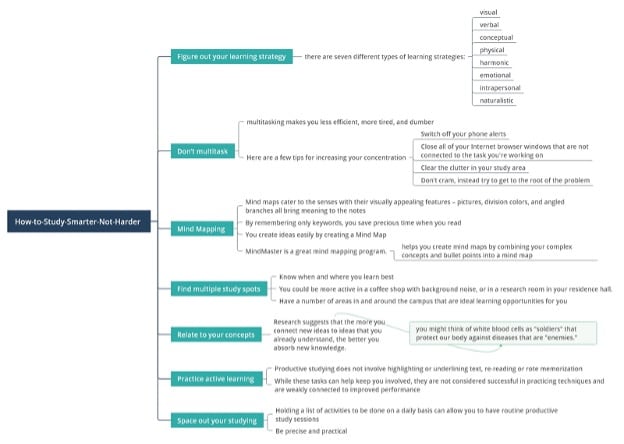
Figure Out Your Learning Strategy
The first step is always to work out how you can study effectively. No two students are the same, and it is essential to know your learning style.
There are seven different types of learning strategies: visual, verbal, conceptual, physical, harmonic, emotional, intrapersonal, and naturalistic.
These learning strategies are all present in us in various proportions, and they work together to influence how you process material.
Think of a kid who knows the math class (high logical intelligence) but doesn't utter a word in English (low verbal intelligence).
Understanding your learning strategy is critical to learning how the brain functions. As it will help make studying techniques work better for you.

Do Not Multitask
Multitasking makes you less efficient, more tired, and dumber. Studies also reveal that people who pretend to be excellent at multitasking are no better off than the average person.
Practical students focus on just one thing at a time. It is impossible to learn while still listening to text messages, watching TV, and updating your Twitter account.
Here are a few tips for increasing your concentration:
- Switch off your phone alerts.
- Close all of your Internet browser windows that are not connected to the task you're working on.
- Clear the clutter in your study area.
- Don’t cram; instead, try to get to the root of the problem.
Eliminating distractions would encourage you to participate in your study sessions completely.
Using applications that help you place restrictions on how much time you will spend on those sites during the day. It is a great way to learn how to study smarter and not harder.

Use Mind Maps
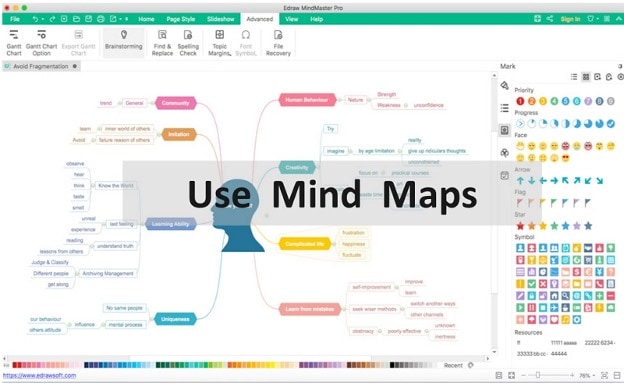
Mind mapping is an excellent tool for studying. Mind maps help in visualizing any problem and theory. It allows free flow of thinking and creativity, which is essential when learning how to study smarter and not harder.
- Mind maps cater to the senses with their visually appealing features – pictures, division colors, and angled branches all bring meaning to the notes;
- By remembering only keywords, you save precious time when you read. Whether you're going to write essays or prepare for tests, you'll know the most valuable stuff.
- You create ideas easily by creating a Mind Map. Your brain continually connects ideas, creates relations, places thoughts in order, and produces ideas.
Wondershare EdrawMind is a great mind-mapping program. It helps you create mind maps by combining your complex concepts and bullet points into them. EdrawMind lets you organize the ideas and create a map to study.
Find Study Spots
Find a few places to study in and around the campus, and change your room if you feel that it's no longer a working space for you.
Know when and where you learn best. Perhaps your attention will be sharp at 10:00 PM instead of 10:00 AM. You could be more active in a coffee shop with background noise, or a study room in your residence hall.
Several areas in and around the campus are ideal learning environments for you.

Relate to Your Concepts
Research suggests that the more you connect new ideas to ideas that you already understand, the better you absorb new knowledge.
For instance, if you think about electricity, you might compare it to the flow of water. Voltage is equivalent to the water strength; current is comparable to the water flow rate, the battery is like the pump, and so on.
Another example: you might think of white blood cells as "soldiers" that protect our body against diseases that are "enemies."
It takes time and commitment to learn how to relate new knowledge to what you already know, but the effort is worth it.

Practice Active Learning
Think about reading as an essential part of pre-study, but studying knowledge requires active engagement with the curriculum. Active participation is a method of creating understanding from the text, including drawing references to lessons, providing examples, and managing your learning.
Productive studying does not involve highlighting or underlining text, rereading, or memorization. While these tasks can help keep you involved, they are not considered successful in practicing techniques and are less likely to improve your performance.

Space Out Your Studying
To extend your study over a short period over various days and weeks, you need flexibility in your timetable. Having a list of daily activities can allow you to have regular, productive study sessions for each lesson.
Approach the plan by being precise and practical on how long you expect to work on a task. It would be best if you didn't have more things on your list than you can realistically complete during the day.

Tips To Follow When Studying
The information provided above refers to general ways to study smarter and not harder. You can refer to them as study habits that will help you in the long run.
However, on the practical side of things, here are some tips that you can employ when studying. These can also refer to hacks or other methods to make your life a lot easier.


Try To Talk With AI
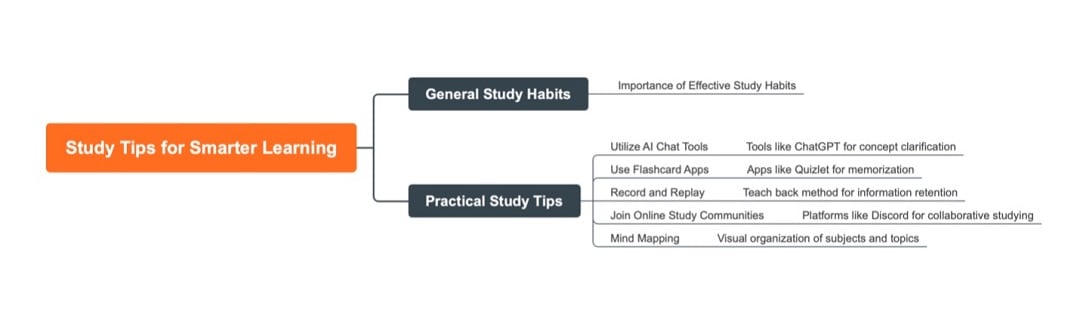
AI chat tools like ChatGPT can help in explaining difficult concepts in simple terms. Sometimes, it’s inevitable that some topics can be hard to understand. In these cases, load up your trusted chatbot.
Remember to verify the information it provides, however. It’s better to feed the AI with your actual material for it to give you the answers you need.
Use Quizlet or Other Apps
Flashcard apps like Quizlet are excellent for memorization. You can search for ready-made sets or create your own. The games and tests built into these apps keep revision quick and engaging.
With this method, you can enjoy different games as well, like snake, crosswords, and more. It’s definitely a way to make your study sessions more fun.
Record and Replay
For the next tip, you can try acting as a teacher. Place your phone in front of you and blurt out or discuss everything you know. This is a smart way of helping you recall and process information you’ve read.
Then, replay the video you’ve just made. You can send it to your friends as well for the purpose of spotting out lapses or errors in your explanations.
Join Online Study Communities
Did you know that there are Discord servers dedicated to studying? Yes, it’s where you open your camera and study with random people. It’s sort of like finding a random study buddy for a specific day.
Being part of a community also helps you stay motivated and exposes you to strategies you might not think of on your own.
Use Mind Mapping
Make sure to use a mind map to organize your subjects, topics, and subtopics visually. This helps you connect ideas, remember details, and quickly review before exams.
Tools like EdrawMind make this process easy, allowing you to build, edit, and refine maps online. You’ll explore this tip in the next section in more detail. Make sure to read through!
How To Boost Efficiency With Mind Maps When Studying
A mind map helps turn scattered notes into a clear, structured picture. Instead of reading endless pages, you can see the big picture at once.
This makes it easier to connect concepts, remember key details, and recall information quickly during exams.
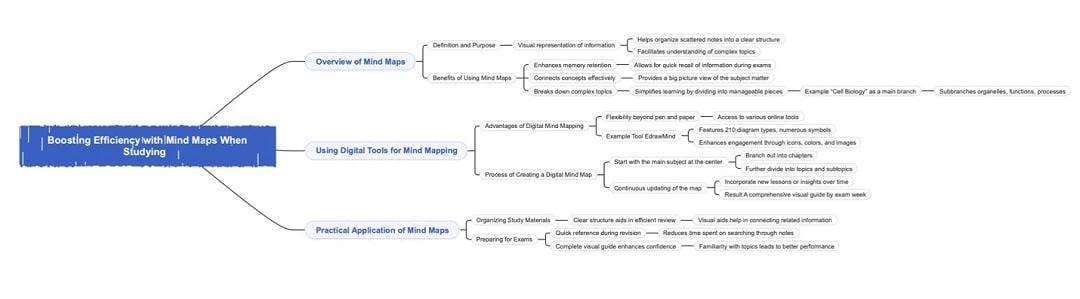
How a Mind Map Helps
Using a mind map also breaks down complex topics into smaller, manageable pieces.
For example, in science, you can map out “Cell Biology” as the main branch, then divide it into organelles, functions, and processes. Each sub-branch keeps the lesson organized and easier to digest.
Using Digital Tools
You don’t need to stick to pen and paper either. There are many free tools online that let you build digital maps. One of them is EdrawMind.
It’s an easy platform for knowledge management with 210 diagram types and lots of symbols.
You can also add icons, colors, and images that strengthen memory and make the review more engaging.
In practice, the process is simple: start with your subject at the center, branch out into chapters, then break those into topics and subtopics.
Over time, you can keep updating the map with new lessons or insights. By exam week, you’ll have a complete visual guide ready for quick and efficient review.
Key Takeaways
A mind map is a graphic representation of your thoughts, structured in a radial structure around a central image.
Use mind mapping to study by starting with the core subject and then arranging your notes around it. Mind maps are flexible and creative, essential when learning how to study smarter and not harder.
With EdrawMind, you can quickly create easy mind maps to study effectively. The software offers 12 different map types, 33 themes, and over 700 clip art materials, providing almost unlimited possibilities for designing your study maps.
FAQs
Ready to start your study session? Read through these frequently asked questions and their answers first.
-
1. Is it better to study longer or study smarter?
Studying longer does not always mean better results. You can spend hours reading the same page and still forget it.
Studying smarter means using strategies like active recall, spaced repetition, or apps that test you with flashcards. These methods help information stick faster than simple rereading.
-
2. Can AI tools really help me study?
Yes. AI tools can explain hard concepts in simple terms, quiz you on topics, or even generate practice questions.
For example, if you are confused about a math problem, you can ask an AI to break it down step by step. It works like having a tutor available anytime.
-
3. What should I do if I lose focus quickly?
Short study sessions help. Work in blocks of 25–30 minutes, then take a 5-minute break. This is known as the Pomodoro technique.
During breaks, step away from your desk and reset. Many students find this easier than sitting for three straight hours without rest.
-
4. Do mind maps really make a difference?
Yes, especially for subjects with many details. Instead of memorizing a long list, you can see how topics connect visually.
For example, in history, a mind map can link events, causes, and effects. This makes recall faster during exams.
-
5. How often should I review my notes?
Reviewing once is not enough. The best way is spaced repetition. Review after one day, then after a week, then again after two weeks.
Each review strengthens memory. Digital apps like Quizlet or Anki make this process easier by scheduling the reviews for you.
 EdrawMind
AppsEdrawMind Online
EdrawMind
AppsEdrawMind Online